
Chellah timeline
- 3rd c. BCE
Phoenician and Carthaginian port of Sala
Seafaring traders settled the estuary of the Bou Regreg, founding the harbour town of Sala on the terraces that Chellah's ruins now occupy.
- 1st c. CE
Roman Sala Colonia
Rome absorbed the town into the province of Mauretania Tingitana and rebuilt it in stone, laying out a forum, a colonnaded decumanus, a capitol, baths, and a triumphal arch.
- 12th century
Almohads abandon the site
The population shifted to the fortified town of Salé across the river and the old Roman city was left to fall into ruin among its gardens.
-
Marinid monumental gate and necropolis
Sultan Abu al-Hassan enclosed the ruins with ochre walls and a carved gateway, adding a mosque, madrasa, and zawiya to turn Chellah into a royal necropolis.
-
Tomb of the "Black Sultan"
Abu al-Hassan was buried here beside his wife Shams ad-Doha, whose finely carved tomb still anchors the walled cemetery.
- 1930s
French archaeological excavations
Digs under the French Protectorate cleared the Roman forum, streets, and temple foundations that lie beneath the overgrowth today.
-
UNESCO World Heritage listing
Chellah was inscribed as part of "Rabat, Modern Capital and Historic City," recognising its rare Roman and Islamic layering.
Excavation History
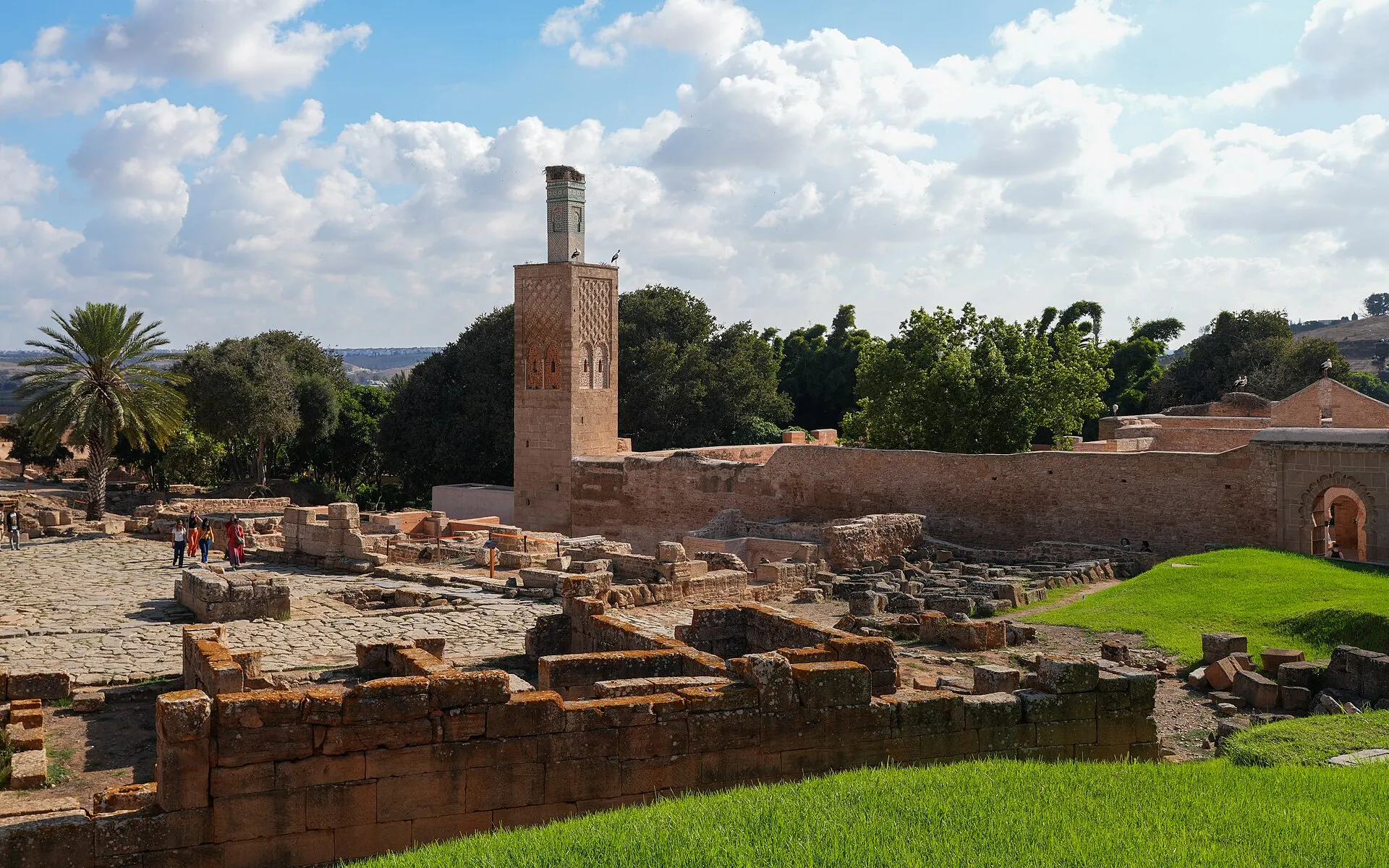
The Roman forum ruins preserve the stone foundations and column bases of the 1st-century CE public square that served as the civic heart of Sala Colonia; French excavations in the 1930s cleared the decumanus maximus and the temple platforms that had vanished under the gardens. The Marinid minaret, topped with massive stick nests inhabited by white storks from March through August, is Chellah's most iconic image — binoculars reveal chicks and parents through the spring. The sacred eel pool is a spring-fed basin near the mosque ruins where eels have lived for generations, linked to fertility beliefs that predate Islam. The elaborately carved tomb of Shams ad-Doha ("Morning Sun"), wife of Abu al-Hassan, demonstrates Marinid funerary art at its finest, while the imposing entrance gateway of 1339, framed by carved Kufic inscriptions and twin bastions, marks the transition from the modern city into this layered landscape of ruins and nature.
Key Artifacts
A guide distinguishes Roman Sala Colonia from the Marinid necropolis — without labels, the 2,300 years of layered history blur together into picturesque ruins.
- Roman civic core: The decumanus (main street), forum foundations, capitol, and temple bases are identifiable beneath the overgrowth with expert guidance
- Marinid royal tombs: The elaborately carved tomb of Abu al-Hassan's wife, Shams ad-Doha ("Morning Sun"), whose decorative program a guide can interpret
- The sacred eel pool: A spring-fed pool near the mosque ruins is home to eels that local legend says grant fertility wishes — a syncretic tradition blending Islamic and pre-Islamic beliefs
- The stork minaret: The ruined Marinid minaret carries some of Morocco's most famous stork nests, a living landmark that has crowned the ruins for centuries
- The semi-wild garden: Fig trees, banana plants, and wildflowers grow through ancient stonework, making this one of the most atmospheric archaeological sites in Morocco
When to Visit
Hours: Daily 8:30 AM - 6:00 PM (closes 5:00 PM in winter). Allow 1-1.5 hours to explore the gardens, Roman ruins, and Marinid necropolis.
- Best light: Morning (9-11 AM) for soft light on the ruins and active stork nesting behaviour, or late afternoon as the ochre walls warm to gold
- Stork season: March-May brings chicks visible in the massive nests atop the minaret, wildflowers across the gardens, and temperatures in the comfortable low twenties
- Avoid: Midday in June-August, when the exposed site becomes uncomfortably hot with little shade, and the wettest stretches of December-February
Admission and Costs
Admission: 70 MAD (€6.50) per person, paid at the ticket booth beside the monumental gate; the site is not covered by a Rabat city pass.
- Private guide: 200-400 MAD (€18-37) for a dedicated 1-hour Chellah tour
- Combined Rabat tour: 500-900 MAD (€46-83) for a half-day covering Chellah, Hassan Tower, and the Kasbah of the Udayas
- Archaeological specialist: 600-1,000 MAD (€55-92) for a detailed Roman and Islamic archaeology tour
The Case for a Guide
Chellah rewards context more than almost any site in Rabat: the ruins carry no on-site labels, so the Roman city and the Islamic necropolis simply merge into scenic rubble unless someone can read them for you.
- Two eras, one field of stone: A guide separates the Roman decumanus, forum, and capitol from the Marinid mosque, madrasa, and royal tombs standing only metres apart
- The stories behind the stones: The saga of the "Black Sultan" Abu al-Hassan, the tomb of Shams ad-Doha, and the fertility legend of the eel pool turn a quiet walk into a narrative
- Timing and photography: Guides know which hour lights the ochre gateway best and where to stand for the stork nests without disturbing them
- Stitching the capital together: The best tours use Chellah as one hinge in a day that also takes in Hassan Tower and the Kasbah of the Udayas
Tips for Visitors
- Bring binoculars: Essential for close-up views of the stork nests atop the minaret
- Wear sturdy shoes: Uneven ancient stone paths and sloping garden terrain make sandals a poor choice
- Pack sun protection: The site is largely exposed with limited shade — bring a hat and water, especially in summer
- Come for the photography: The combination of ruins, dense vegetation, and storks is unique in Morocco
- Getting there: 2 kilometres south-east of the medina; a petit taxi costs 20-30 MAD, or it is a 25-minute walk from Hassan Tower
- Enjoy the calm: Chellah receives fewer visitors than other Rabat sites, so linger and take in the contemplative mood
Frequently Asked Questions
When should visitors time their trip to Chellah?
March through May is the most rewarding season: the white storks that nest atop the ruined minaret are actively raising chicks, wildflowers carpet the semi-wild gardens, and temperatures hover in the comfortable low twenties. October is equally pleasant for exploring the layered Roman and Marinid ruins. The exposed site gets uncomfortably hot in summer and receives occasional chilly rain from December through February that dampens the atmosphere of this otherwise enchanting necropolis.
What time of day is best for touring Chellah?
Hours: Daily 8:30 AM - 6:00 PM (closes 5:00 PM in winter). Best time: Morning (9-11 AM) for soft light on the ruins and active stork nesting behavior. Spring (March-May): Stork nesting season with chicks visible in massive nests atop the minaret.
What is the entrance fee for Chellah?
Admission: 70 MAD (€6.50) per person. Private guide: 200-400 MAD (€18-37) for a dedicated 1-hour Chellah tour. Combined Rabat tour: 500-900 MAD (€46-83) for half-day covering Chellah, Hassan Tower, and Kasbah of the Udayas.
Is a guide recommended for visiting Chellah?
Guides distinguish Roman Sala Colonia from the Marinid necropolis, which blur together without labels. They identify the forum and temple foundations beneath the overgrowth, and explain the sacred eel pool's syncretic fertility traditions.
How do you get to Chellah from central Rabat?
Chellah sits about 2 kilometres south-east of the medina, on a bluff above the Bou Regreg river. A petit taxi from the city centre costs roughly 20-30 MAD and takes 10 minutes; on foot it is a 25-30 minute walk from Hassan Tower. There is no on-site parking beyond a small roadside area, so a taxi drop-off at the monumental gate is the easiest arrival.