
Spiritual Significance
For almost a thousand years Saint-Sernin has been a place of pilgrimage, not just a monument. It stands on the Via Tolosana, one of the four great medieval roads across France that funnelled walkers toward Santiago de Compostela, and its scale and relics made it one of the most important stops on the entire network — a status formally recognised by its UNESCO listing. Modern pilgrims still arrive on foot and bicycle, and the tradition of stamping the pilgrim's credencial continues at the nearby pilgrim office. The basilica's spiritual pull has always rested on its relics, above all those of Saint Saturnin himself, whose feast is kept on 29 November.
The treasures gathered beneath the apse reward slow attention:
- The crypt reliquaries — medieval gold and silver shrines holding relics the abbey amassed over centuries; by long tradition the church was said to hold relics of several apostles, a claim that drew pilgrims from across Christendom.
- The Gilduin altar — the marble altar table consecrated by Pope Urban II in 1096, one of the earliest dated pieces of Romanesque liturgical sculpture in France.
- The ambulatory marble reliefs — late-11th-century carved panels, including the celebrated Christ in Majesty, set into the walls of the choir.
- The Porte Miègeville — the early-12th-century south portal whose tympanum shows the Ascension, a high point of pilgrimage-road sculpture.
Saint-Sernin remains an active parish church, so visitors may well find a Mass, a baptism, or an organ recital under way — part of the living worship that has never stopped here.
Visitor Etiquette
Saint-Sernin is first and foremost a working place of worship on the Camino de Santiago, so visit it as pilgrims do — quietly and respectfully.
- Dress modestly — shoulders and knees covered, as at any active church.
- Keep voices low, and pause or step aside if a Mass or service is in progress.
- Photography is permitted without flash in the main church; it may be restricted in the crypt, so check the posted notices and never photograph people at prayer.
- Switch phones to silent, especially during the Gregorian chant and organ services.
- Pilgrim traditions are alive here — the nearby pilgrim office stamps the credencial for those walking the route, and a small offering for a votive candle is customary rather than required.
Basilique Saint-Sernin timeline
-
Martyrdom of Saint Saturnin
Saturnin (Sernin), the first bishop of Toulouse, is put to death by being tied to a bull and dragged down the hill now remembered as the Rue du Taur, the "street of the bull". His tomb becomes the seed of the future basilica.
- c. 402-403
First church over the tomb
Bishops Silvius and Exupère raise an early basilica to shelter the martyr's relics, establishing the site as the religious heart of early Christian Toulouse.
-
The Romanesque basilica begun
Work starts on the vast pink-brick and stone church that survives today, sized to receive the swelling tide of pilgrims on the road to Santiago de Compostela.
-
Urban II consecrates the altar
Pope Urban II consecrates the high altar; the marble altar table carved by Bernard Gilduin and signed in that year still stands beneath the apse.
-
The Porte Miègeville carved
The south transept gains its celebrated sculpted portal, a landmark of Romanesque carving whose Ascension tympanum influenced the pilgrimage-road workshops across the southwest.
- 13th-14th c.
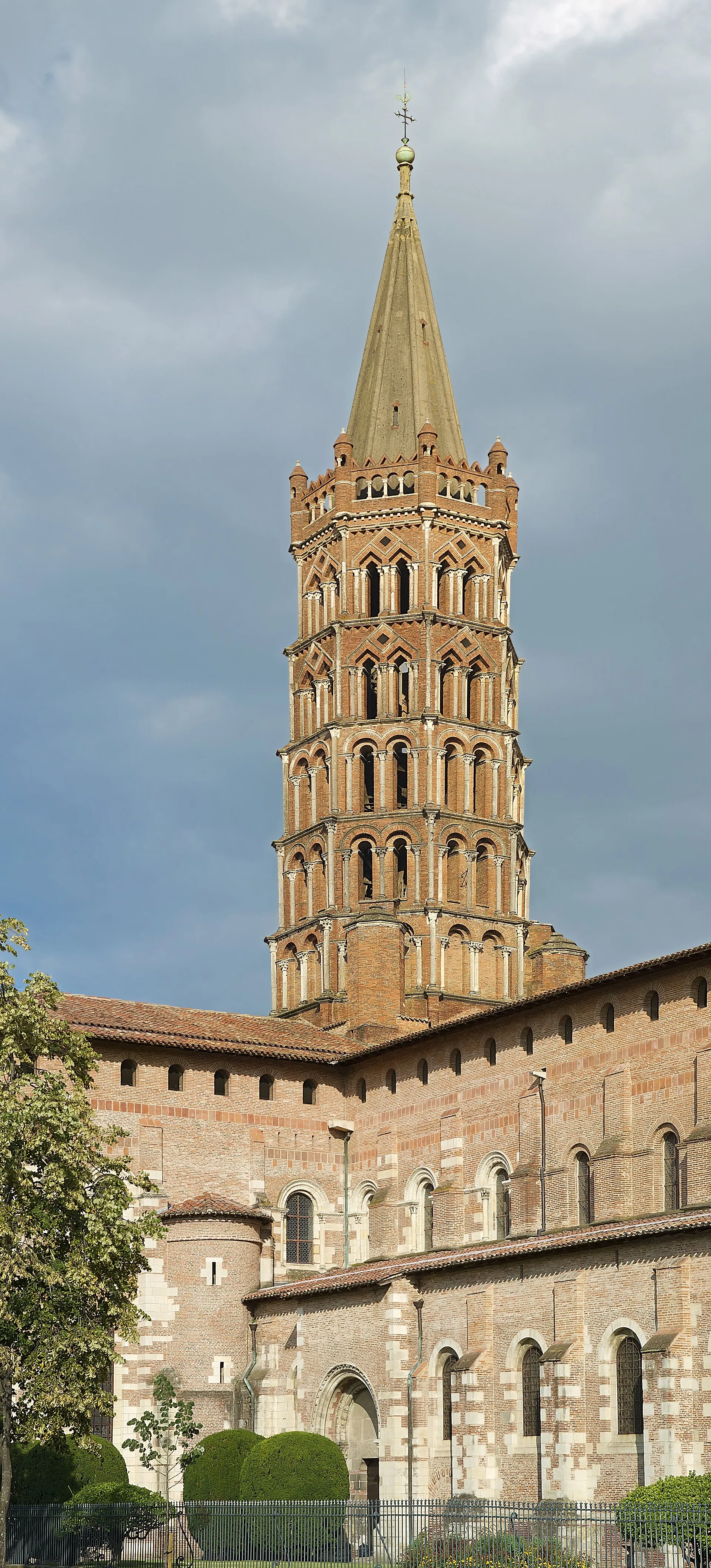
The octagonal tower completed
The upper brick tiers and spire of the five-storey bell tower are raised to roughly 65 metres, giving Toulouse the silhouette that still defines its skyline.
- 1860-1879
Viollet-le-Duc restoration
The architect Eugène Viollet-le-Duc leads a sweeping restoration; parts of his work were later reversed in the 20th century to recover the building's medieval character.
-
UNESCO World Heritage listing
The basilica is inscribed as part of the Routes of Santiago de Compostela in France, recognising its role on the historic pilgrimage network.
When to Visit
The main church is generally open daily outside Mass — roughly 8:30 AM to 6 PM Monday to Saturday and until about 7 PM on Sunday, usually with a quieter lull over the midday lunch hour. The crypt and ambulatory, where the reliquary treasury is displayed, keep shorter afternoon hours (about 10 AM to 6 PM) and charge a small fee. Because the schedule bends around the liturgical calendar, confirm the day's hours on the parish's official website before setting out, particularly around feast days.
For atmosphere, come early in the morning when the nave is calm and the brick catches the low light, or time your visit to an organ recital on the historic Cavaillé-Coll instrument. The adjacent Place Saint-Sernin hosts a lively flea and antiques market on Sunday mornings, which pairs well with a visit. Late spring through early autumn is the most rewarding stretch; winter visits are serene but the unheated stone interior stays cold.
Admission and Costs
Entry to the main church is free, as it is an active parish. To see the medieval reliquaries, access to the crypt and ambulatory costs about €3 ($3.30) per person, usually payable in coins at the entrance. A small-group guided walking tour of the old town that takes in Saint-Sernin typically runs €10-18 ($11-20) per person, while a private guide for a focused 1-1.5 hour visit of the basilica is around €100-150 ($110-165), shared across your group.
A few budgeting notes: carry coins for the crypt turnstile and for votive candles, as card payment is not reliable inside; the church itself has no timed-ticket system, so you can drop in freely between services; and if you plan to tour several Toulouse sights, booking a guide who combines Saint-Sernin with the Place du Capitole usually costs less per site than separate visits. Organ recitals and concerts are ticketed separately and vary by programme.
The Case for a Guide
You can admire Saint-Sernin on your own in twenty minutes, but much of what makes it extraordinary is invisible without context — a good guide turns the biggest Romanesque church in Europe into a story you can read in the stone and brick.
- Reading the architecture — a guide explains why the double side-aisles, broad transept, and ringed ambulatory were a deliberate answer to pilgrim crowds, and how the builders solved the engineering of a barrel-vaulted nave this size.
- Decoding the Porte Miègeville — the carved south portal is a dense program of symbolism; a guide identifies the Ascension tympanum and the figures most visitors glance past.
- The reliquary stories — the gold and silver shrines in the crypt each carry a history of saints, donors, and medieval devotion that transforms a dim vault into a treasury.
- Placing it on the Camino — understanding the Via Tolosana and the pilgrimage economy of medieval Toulouse explains why the church was built so large in the first place.
- A thread through the city — many guides weave Saint-Sernin together with the Place du Capitole and the quays of the Canal du Midi, framing a thousand years of Toulousain history in a single walk.
Tips for Visitors
- Arrive early to have the nave to yourself and to catch the pink brick in soft morning light before tour groups appear.
- Pay the small crypt fee — the reliquary treasury and the ambulatory marble reliefs are the part most day-trippers skip, and they are the highlight.
- Look up and around the exterior before going in: the Porte Miègeville on the south side and the five-tiered octagonal tower are best appreciated from the open square.
- Combine it with the Sunday market on Place Saint-Sernin, then walk ten minutes south to the Place du Capitole for lunch under the arcades.
- Check for a recital — hearing the Cavaillé-Coll organ or Gregorian chant fill the vaults is the memory most visitors carry home.
- Hidden details reward a guide: the carved ambulatory capitals, the mason's marks in the brick, and the stories behind each reliquary are easy to walk past unaided.
Frequently Asked Questions
When is the best season for a visit to the Basilique Saint-Sernin?
April through October brings the most comfortable conditions for appreciating the exterior pink brickwork and lingering inside, before the chill settles into the long stone nave in winter. The Camino de Santiago season peaks from May to September, when modern pilgrims still stop to have their credencial stamped, lending the basilica a layer of living tradition. The acoustics are extraordinary all year, so time a visit to coincide with an organ recital on the historic Cavaillé-Coll instrument or an occasional service sung in Gregorian chant for an unforgettable hour under the vaults.
What are the opening hours of Basilique Saint-Sernin?
The church is generally open daily for visits outside Mass, roughly 8:30 AM to 6 PM Monday to Saturday and until about 7 PM on Sunday, with a quieter window over the midday lunch hour. The crypt and ambulatory, where the medieval reliquaries are displayed, keep shorter afternoon hours and charge a small fee. Because times shift with the liturgical calendar, confirm the day's schedule on the parish's official website before you go, especially around feast days and Sunday Mass.
How much does it cost to visit Basilique Saint-Sernin?
Stepping into the main church is free. Access to the crypt and ambulatory to see the reliquary treasury costs about €3 ($3.30). A small-group guided walking tour that includes Saint-Sernin runs roughly €10-18 ($11-20) per person, while a private guide for a focused 1-1.5 hour visit is around €100-150 ($110-165). Bring coins for the crypt turnstile and for the candle offerings, as card payment is not always available inside.
Why is Saint-Sernin important on the Camino de Santiago?
Saint-Sernin sits on the Via Tolosana (the Arles route), one of the four historic French roads to Santiago de Compostela, and was built on a monumental scale in the 11th century precisely to receive the crowds of pilgrims who flowed through Toulouse. Its ring-shaped ambulatory and radiating chapels let a continuous procession file past the relics of Saint Saturnin without disturbing the monks at the altar. In 1998 the basilica was inscribed by UNESCO as part of the Routes of Santiago de Compostela in France.
What does a specialist guide add to a visit?
A guide turns a beautiful but silent building into a readable one. They decode the symbolism of the Porte Miègeville's carved portal, explain why the double side-aisles and ambulatory were an architectural answer to pilgrim traffic, and tell the stories behind the gold and silver reliquaries in the crypt. Expect context on the martyrdom of Saint Saturnin, the 1096 consecration by Pope Urban II, and how the five-tiered octagonal tower became the emblem of Toulouse.