
Place du Capitole timeline
- 12th century
Birth of the capitouls
The elected magistrates known as capitouls begin governing Toulouse as a semi-independent commune from this site, giving both the building and the square their enduring name.
- 1750-1760
Cammas raises the neoclassical facade
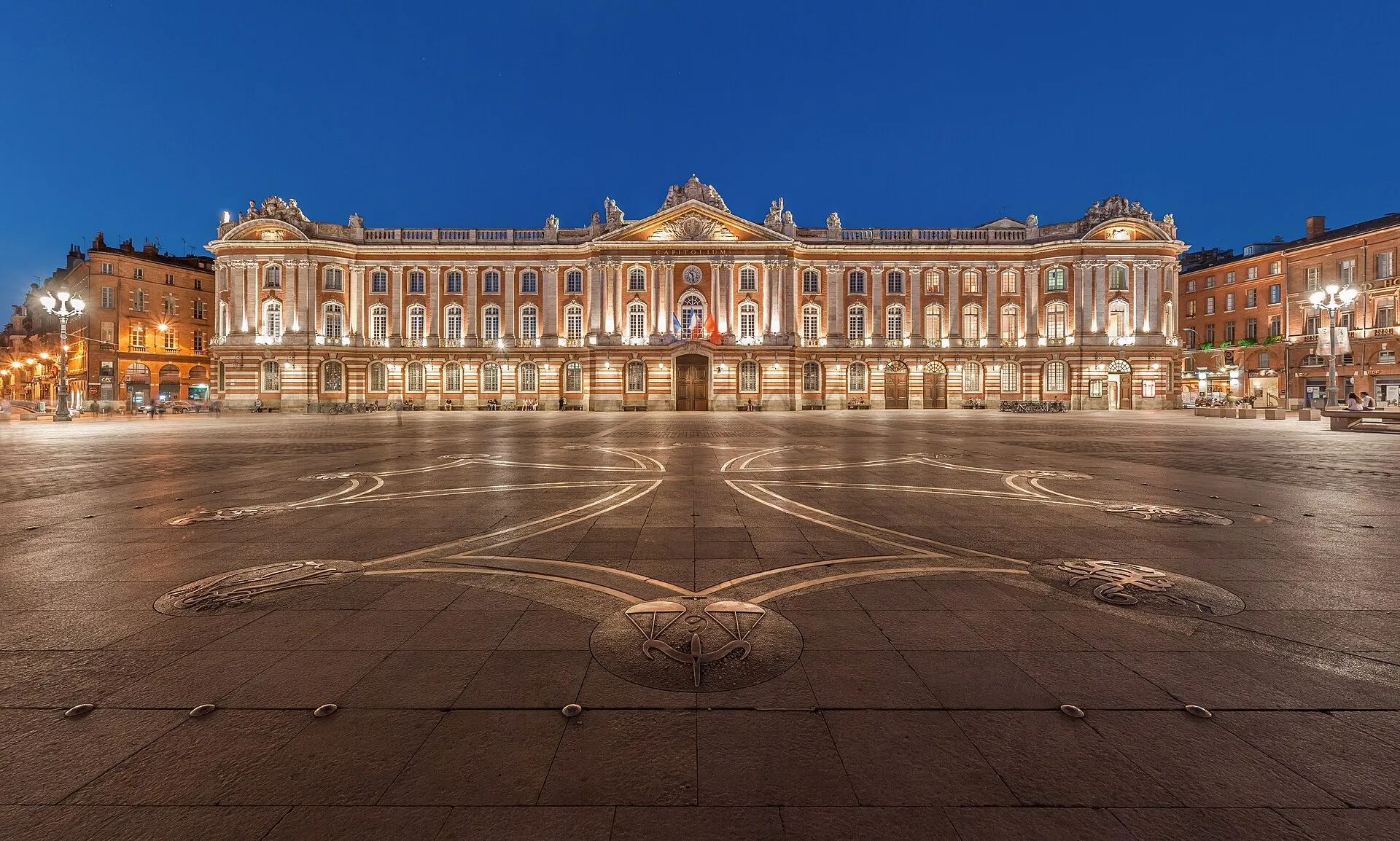
Architect Guillaume Cammas designs the 128-metre pink-brick-and-stone frontage, its eight marble columns standing one for each of the eight capitouls.
-
The capitoulat abolished
The French Revolution ends centuries of capitoul rule; the Capitole becomes the municipal hôtel de ville, the role it still holds today.
- 1892-1898
The Salle des Illustres decorated
The Capitole's grand gallery is painted, gilded, and hung with murals and busts of Toulouse's illustrious figures, earning comparison with the painted halls of Rome.
-
The metro reaches the square
Line A of the Toulouse metro opens with a Capitole station directly beneath the plaza, making it one of the city's most accessible landmarks.
- 1990s
Moretti's Occitan cross laid in the pavement
Artist Raymond Moretti insets the bronze croix occitane and its twelve zodiac signs into the paving and paints the vaulted arcade ceilings with scenes from the city's past.
Architecture
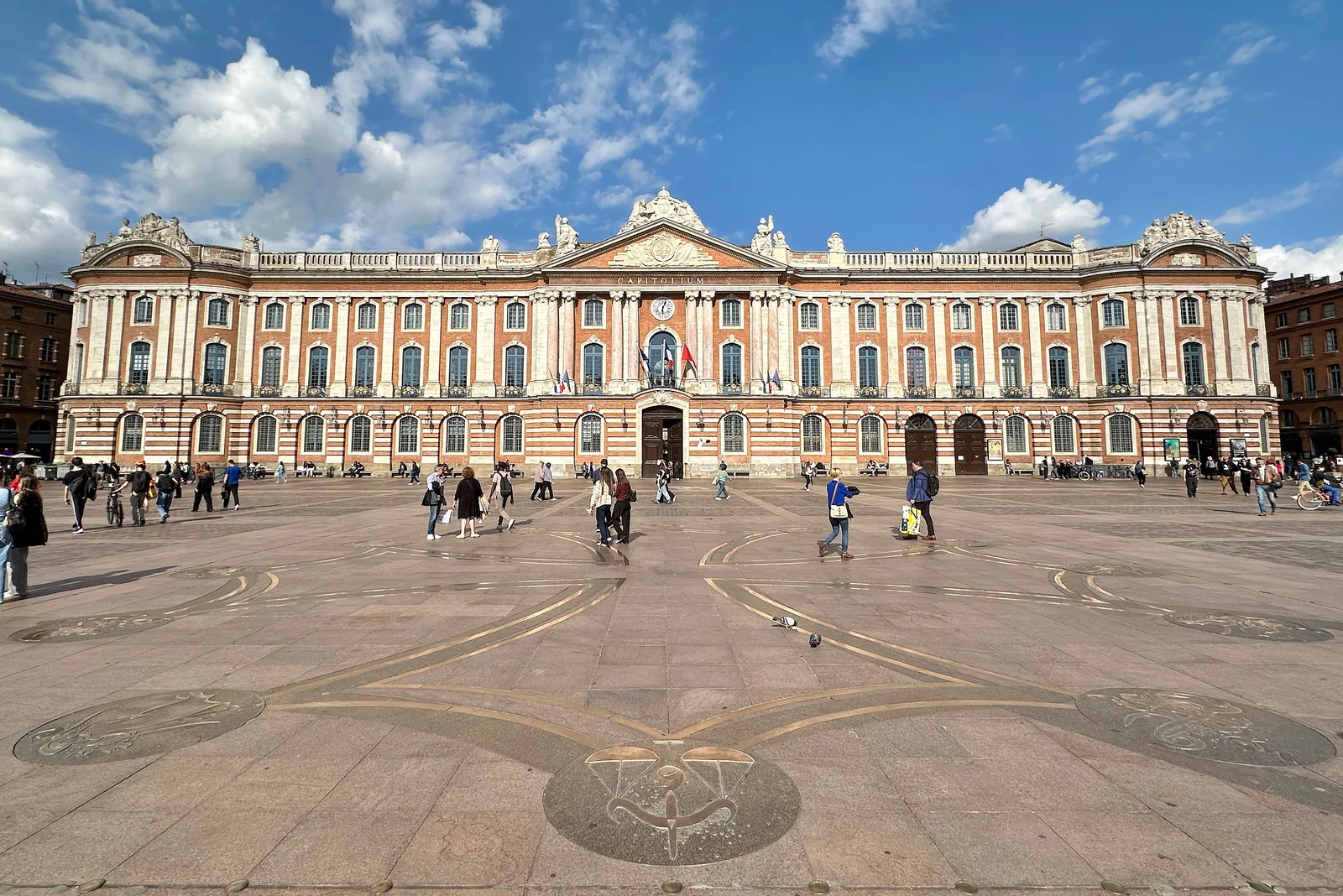
The Capitole facade is one of the great set-pieces of French neoclassicism, stretching 128 metres along the eastern side of the square. Completed around 1760 to designs by Guillaume Cammas, it marries the local pink brick with pale stone and a central range of eight marble columns, each standing for one of the eight capitouls. Behind the frontage the building wraps several courtyards and two very different public treasures.
The first is the Salle des Illustres, a long barrel-vaulted gallery decorated between 1892 and 1898 with murals, gilding, and busts celebrating figures from Toulouse's history - a finish lavish enough to invite comparison with the painted halls of Rome. The second is the Théâtre du Capitole, the opera house occupying the building's southern wing and home to the acclaimed Orchestre National du Capitole. Out on the square, the artist Raymond Moretti laid the bronze Occitan cross and its twelve zodiac signs into the paving in the 1990s and painted the vaulted ceiling of the arcades with scenes from the city's past. Behind the Capitole, in its garden, the 16th-century brick Donjon - once the keep of the capitouls' archives - now houses the city's tourist office.
Historical Significance
For centuries this square was the seat of the capitouls, the body of elected magistrates who ran Toulouse as a proud, semi-independent commune from the Middle Ages onward. Their name gave the building its title of Capitole and, through it, the square. The council's authority ended abruptly with the French Revolution in 1790, after which the building became the municipal hôtel de ville, but the memory of that self-rule remains stamped into the eight columns of the facade.
The plaza has also been Toulouse's civic theatre, hosting markets, proclamations, celebrations, and protests, and today filling for concerts, festivals, and the rituals of daily ville rose life. A guide can trace how the pastel (woad) fortunes of the Renaissance, the arrival of the Canal du Midi in the 17th century, and the modern aerospace boom all left their mark on the city that radiates outward from this single square - making Place du Capitole the natural first chapter of any visit to Toulouse.
Place du Capitole in Pictures
When to Visit
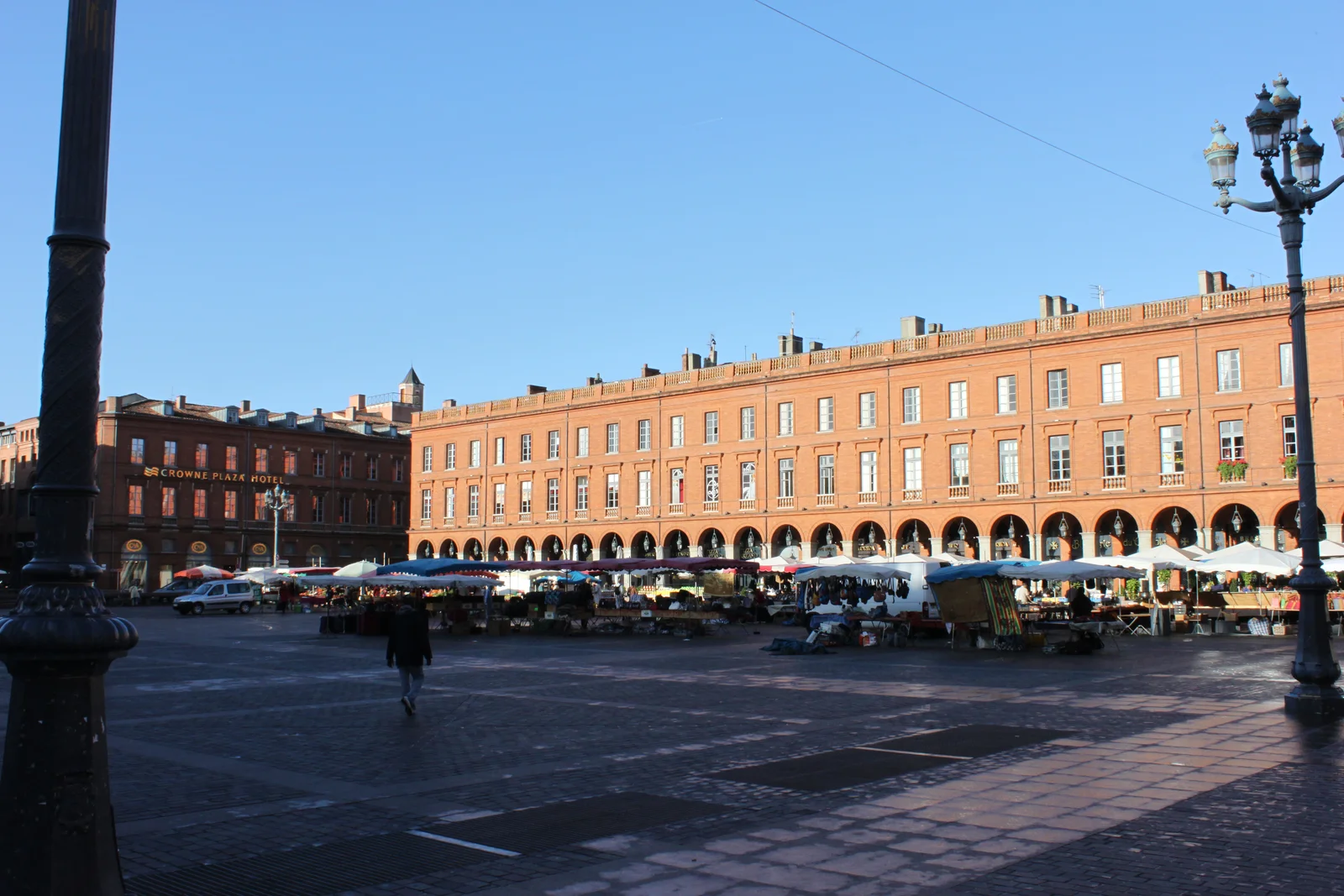
The square itself is open around the clock, free and ungated, but its character shifts through the day. Late afternoon into sunset is the magic hour, when the low southern light turns the pink brick a deep rose-gold and photographers gather along the arcades. Market mornings bring the plaza alive: stalls of local produce, flowers, and bric-à-brac spread across the square on Wednesdays and Saturdays. Evenings belong to the café terraces, busiest after 6 PM as the apéritif hour begins.
Seasonally, May through September is the most rewarding stretch, with warm evenings, open-air concerts, and summer festivals filling the square; the terraces are at their liveliest and the light at its longest. Winter is quieter and can be grey, though the square hosts a Christmas market and festive lights in December. For an unhurried history walk, aim for a weekday morning before the terraces fill.
Admission and Costs
Standing in the square costs nothing, and neither does stepping inside: the Salle des Illustres, the Capitole's sumptuous painted gallery, is free to visit on weekdays when no official event is under way. A guided walking tour that starts here and threads through the old town typically runs €12-20 ($13-22) per person, while a private guide for a focused 1.5-2 hour tour of the square and Capitole interior is around €100-150 ($110-165). Tickets for a performance at the Théâtre du Capitole opera house vary widely by production and seat, from budget upper-gallery places to premium stalls. Check the noticeboard at the Capitole entrance for the day's access to the Salle des Illustres, since ceremonies and weddings occasionally close it.
The Case for a Guide
Place du Capitole rewards context. To an unbriefed visitor it is a handsome square with a big pink building; a good guide turns it into the key that unlocks Toulouse's whole story - how a merchant city on the Garonne governed itself through its capitouls, prospered on the medieval pastel (woad) dye trade, and grew into the aerospace capital of Europe.
- The capitouls decoded: A guide explains who the eight magistrates were, why the facade carries eight columns in their honour, and how their council made Toulouse a self-governing commune long before the French Revolution swept it away in 1790.
- Reading the facade: The neoclassical frontage layers pink brick, stone, and marble in a deliberate hierarchy; guides point out Cammas's design logic and the coats of arms that most visitors walk straight past.
- Inside the Salle des Illustres: The painted gallery upstairs is easy to miss and far richer with a guide, who can identify the Toulousain worthies on the walls and the late-19th-century artists who glorified them.
- The pavement as a map: The bronze Occitan cross and its zodiac, and Moretti's arcade ceilings, encode the identity of Occitanie - a guide reads symbolism invisible to a passer-by.
- A launchpad for the old town: Starting here sets the historical frame for everything that follows, from Saint-Sernin to the Renaissance mansions of the pastel merchants.
Tips for Visitors
The metro makes arrival effortless - Capitole station on Line A opens directly beneath the square, so most visitors skip the traffic entirely. Terrace seating costs a few euros more than standing at the bar, but the people-watching over an afternoon coffee is worth it. If you want the markets, come on a Wednesday (smaller) or Saturday (the full spread). For photography, the late-afternoon-to-sunset window catches the facade at its rosiest; step under the arcades to see Raymond Moretti's painted ceilings overhead. Because nearly every Toulouse walking tour launches from here, it makes a natural first stop before heading north to the Basilique Saint-Sernin or east toward the Canal du Midi.
Frequently Asked Questions
When is the best time to visit Place du Capitole?
Late afternoon into sunset is the highlight, when the low southern light turns the pink brick a deep rose-gold and photographers gather along the arcades. Market mornings on Wednesday and Saturday bring produce, flowers, and bric-à-brac stalls across the square, and the café terraces come alive after 6 PM for the apéritif hour. May through September is the liveliest stretch, with warm evenings, open-air concerts, and summer festivals.
How much does it cost to visit Place du Capitole?
Standing in the square is free, and so is stepping inside: the Salle des Illustres painted gallery is free to visit on weekdays when no event is under way. A guided walking tour that starts here runs about €12-20 ($13-22) per person, while a private guide for a 1.5-2 hour tour of the square and Capitole interior is around €100-150 ($110-165). Théâtre du Capitole opera tickets vary widely by production and seat.
What should visitors know before visiting Place du Capitole?
The metro's Capitole station on Line A opens directly beneath the square, so most visitors arrive without ever meeting traffic. Terrace seats cost a few euros more than the bar but the people-watching is worth it. Markets run Wednesday (smaller) and Saturday (the full spread), the best light falls in the late afternoon, and most Toulouse walking tours begin at these arcades, making it a natural first stop.
How do you get to Place du Capitole?
By metro, Capitole station on Line A of the Toulouse network opens straight onto the square, and the surrounding old town is compact enough that most sights are a flat 5-15 minute walk away. The square is fully pedestrianised, so there is no through traffic; drivers should use one of the underground car parks nearby rather than looking for a space on the plaza itself.
What can you see inside the Capitole building?
The Capitole houses both Toulouse's town hall and the Théâtre du Capitole opera house, home of the Orchestre National du Capitole. Its showpiece for visitors is the Salle des Illustres, a long barrel-vaulted gallery painted and gilded in the 1890s with murals and busts of figures from the city's history - often likened to the grand painted halls of Rome and free to enter on weekdays when no ceremony is being held.