
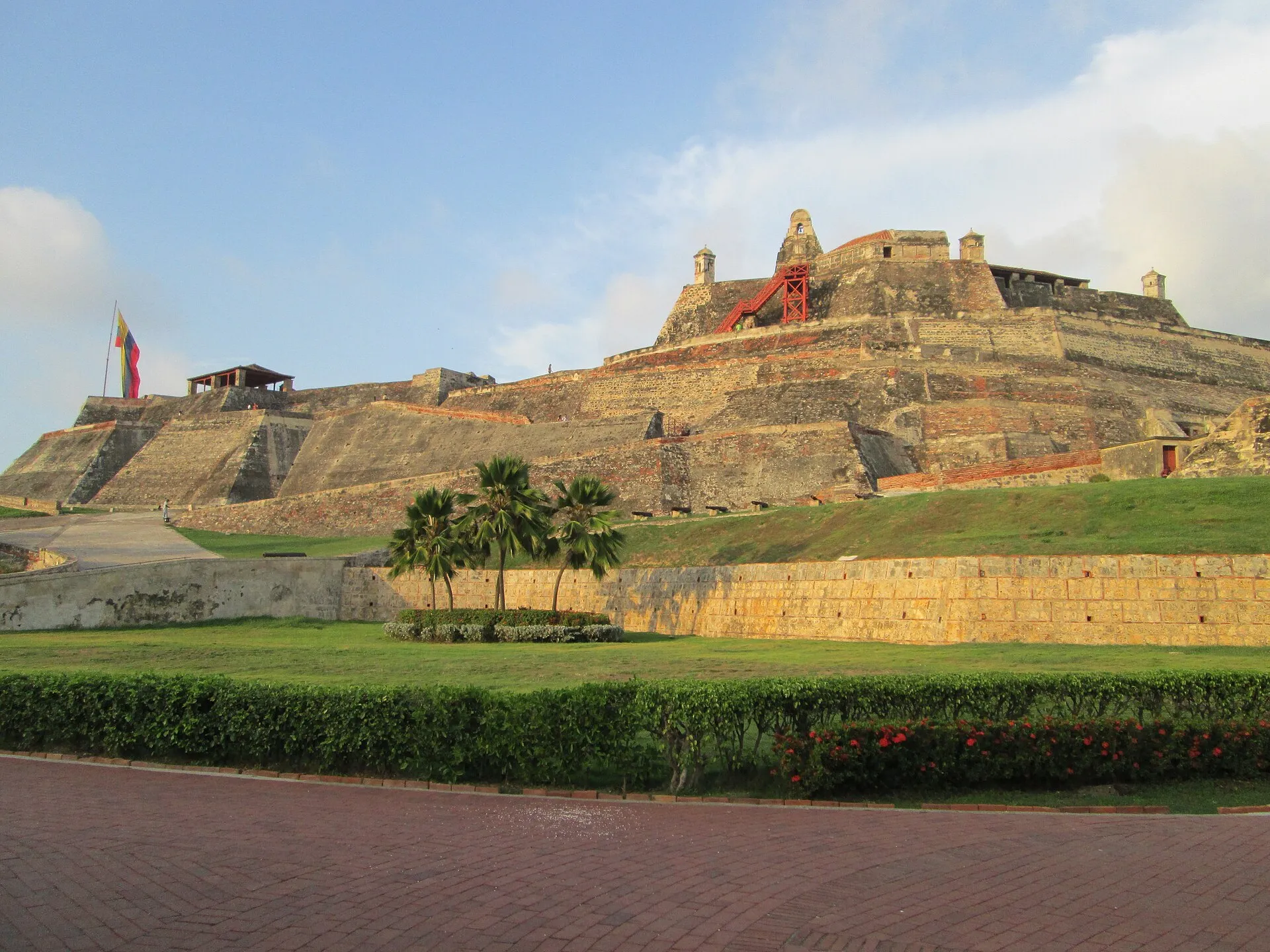
Castillo San Felipe de Barajas timeline
-
Fort of San Lázaro begun
A compact fort rises on the Hill of San Lázaro to cover the land approach to Cartagena, which earlier sea walls left exposed.
-
Pointis sacks the city
A French expedition under Baron de Pointis storms Cartagena from the land side, proving the hill had to become a full-scale fortress.
-
Vernon's siege broken
Blas de Lezo's garrison repels Admiral Edward Vernon's 186-ship armada in one of the largest amphibious assaults before the 20th century.
- 1762–1769
Arévalo's great expansion
Military engineer Antonio de Arévalo wraps the old fort in the stepped batteries, galleries and tunnels that give the castle its present mass.
-
Siege of Cartagena
Pablo Morillo's royalist army besieges the city for 105 days during the wars of independence, and the fortress changes hands again.
-
Spanish rule ends
Cartagena is secured for the new republic and the fortress passes out of Spanish hands for good.
-
UNESCO World Heritage
The castle is inscribed with Cartagena's port and fortifications on the World Heritage List.
Fortification History
Castillo San Felipe de Barajas is less a single building than a machine for defence, and its layered design is what let a small garrison hold off an empire. The genius lay in depth: batteries stacked up the hillside so that every tier covered the one below, and if a section fell, its defenders could retreat upward and detonate the captured ground behind them.
- The battery system — Independent gun platforms climb the hill in overlapping tiers, each able to fire on an enemy who had just taken the level beneath it; there was no single wall to breach, only an ascending gauntlet
- The tunnel galleries — Narrow interior passages were cut so that footsteps carried and echoed, giving defenders early warning of anyone creeping through in the dark; others let troops and powder move between batteries unseen
- The 1741 siege — Blas de Lezo's outnumbered force broke Admiral Vernon's assault on this hill, a defeat so total it is still studied as a case in how terrain and engineering can beat overwhelming numbers
- The Blas de Lezo statue — A bronze monument to the medio hombre admiral stands at the foot of the entrance ramp, the single most photographed figure of Spanish Cartagena
Notable Rooms
The pleasure of Castillo San Felipe de Barajas is working your way up through its distinct levels, each with its own vantage and story, rather than passing through grand chambers. A guide sequences them so the military logic reveals itself step by step.
- The entrance ramp and Blas de Lezo plaza — The approach climbs past the admiral's statue to the main gate, framing the first view back over Cartagena
- The lower batteries — The broad gun terraces where cannon once covered every road into the city; the embrasures still frame the modern skyline of Bocagrande across the bay
- The tunnel network — A warren of vaulted galleries, some open to walk, where the acoustic design meant to betray intruders is easy to test with your own footsteps
- The powder magazines and cisterns — The vaulted stores and water tanks that let the garrison hold out through a long siege without resupply
- The summit battery — The highest platform, crowned by the Colombian flag, with the panorama that takes in the walled city, the harbour and the open Caribbean
When to Visit
Open daily, 8 AM – 6 PM. There is almost no shade on the upper batteries, so the time of day you arrive changes the whole experience.
- Best arrival — Enter at opening (8–9 AM) while the stone is still cool and the Caribbean light rakes low across the ramparts for the clearest photographs of the city below
- Tunnel time — Save the underground galleries for late morning, when the exposed terraces turn brutal; the passages stay cool all day
- Avoid — Midday (roughly 12–3 PM), when the shadeless upper gun platforms bake under a vertical sun
- Season — January to March is the driest, breeziest stretch; the September–October rains cool the heat but can cut short rooftop exploring with sudden afternoon downpours
Admission and Costs
Foreigner entry is about COP 33,000 (≈ US$8); Colombian nationals and residents pay a reduced rate, and tickets are bought at the gate. Confirm the current fare before you go, as it is adjusted most years.
- Audio guide — About COP 15,000 (≈ US$3.70), available in English and worth it for the battle narrative
- Guided group tour — Roughly COP 80,000–150,000 (≈ US$20–37) per person
- Private guide — About COP 200,000–350,000 (≈ US$50–85) for a 1.5–2 hour tour
- Getting there — A 15-minute walk from the walled city or a short, inexpensive taxi; many visitors fold the castle into a half-day with the historic centre
The Case for a Guide
An attacker was meant to see Castillo San Felipe de Barajas as a featureless heap of stone, and without interpretation many visitors still do — which is exactly why a guide, or at least the English audio guide, transforms the climb. Someone who can read the fortress turns a hot scramble up the ramps into the step-by-step story of how 3,000 men broke an armada.
- The retreat-and-destroy logic — A guide shows how the stacked batteries let defenders surrender a level only to rain fire on it from above, so the hill had no single point that, once taken, ended the fight
- The echo tunnels — Standing inside the galleries, a guide demonstrates how the passages were tuned to carry footsteps, an 18th-century intruder alarm you can hear working
- The 1741 battle, on the ground where it happened — A guide places Vernon's landing, the British columns and Blas de Lezo's counter-moves onto the terraces in front of you, so the siege stops being a plaque and becomes a tactical drama
- Reading the sightlines — From the gun embrasures a guide traces which approaches each battery covered, making the fortress's geometry suddenly legible
- The city it guarded — A good guide connects the hill to the walled city below, explaining how fort and ramparts were built to defend each other as one system
Tips for Visitors
Treat Castillo San Felipe de Barajas as a climb, not a stroll — steep ramps, uneven stone and an unrelenting sun reward a little preparation.
- Sun protection is not optional — There is almost no shade on the upper batteries; bring a hat, sunscreen and more water than you think you need, especially in the dry season
- Wear grippy shoes — The ramps and tunnel floors are smooth, worn stone that turns slick after a shower
- Go early, then cool off below — Pair an 8 AM castle visit with a late-morning retreat into the shaded lanes of the walled city or a boat day out to the Rosario Islands
- Take the audio guide or a human one — Without context the fort reads as a pile of rocks; with it, every angle reveals military strategy
- Make a Cartagena day of it — The castle, the historic centre and the bars of Getsemaní are a natural one-two-three for a first visit to Colombia's Caribbean coast
Frequently Asked Questions
Why did the Spanish build such a huge fortress at Cartagena?
Cartagena was the Spanish Caribbean's main treasure port — silver and gold from across the Americas were gathered here before the fleets sailed for Seville — which made it a magnet for enemy navies and privateers. Sea walls guarded the harbour, but raids such as Francis Drake's in 1586 and Baron de Pointis's land assault in 1697 showed the city could be taken from behind. Castillo San Felipe de Barajas was raised on the inland Hill of San Lázaro precisely to close that landward gap, and the walled city and the hilltop fort were designed to defend each other.
Who was Blas de Lezo and why is he honoured here?
Blas de Lezo was the Spanish admiral who commanded Cartagena's defence during the catastrophic British siege of 1741. A career naval officer, he had lost a leg, an eye and the use of an arm in earlier battles — Spaniards nicknamed him medio hombre ("half a man") — yet with roughly 3,000 soldiers and six ships he turned back Edward Vernon's force of some 27,000 men and 186 vessels. He is a hero of Spanish and Cartagena naval history, not of Colombian independence, which came some eighty years later; his bronze statue stands at the foot of the fortress ramp.
How much time should I budget, and can I do the tunnels?
Allow 1.5 to 2 hours to climb the batteries, walk the ramparts and explore the tunnel galleries. The underground passages are open throughout the day and are markedly cooler than the exposed upper terraces, so they make a good midday refuge; a few are low and narrow, so they suit confident walkers more than anyone with claustrophobia or mobility limits. The ramps are steep and the stone is uneven, so flat, grippy shoes matter more than at the flat walled city.
Is Castillo San Felipe de Barajas worth visiting without a guide?
You can walk it alone, but the fort was engineered to look like a plain pile of stone to an attacker, so its genius — the overlapping fields of fire, the retreat-and-destroy battery system, the echo-tuned tunnels — is largely invisible without someone to explain it. A guide or the English audio guide turns the climb from a hot scramble into the story of how an outnumbered garrison beat an empire, which is why most visitors pair the castle with a guided walk of the historic centre.