
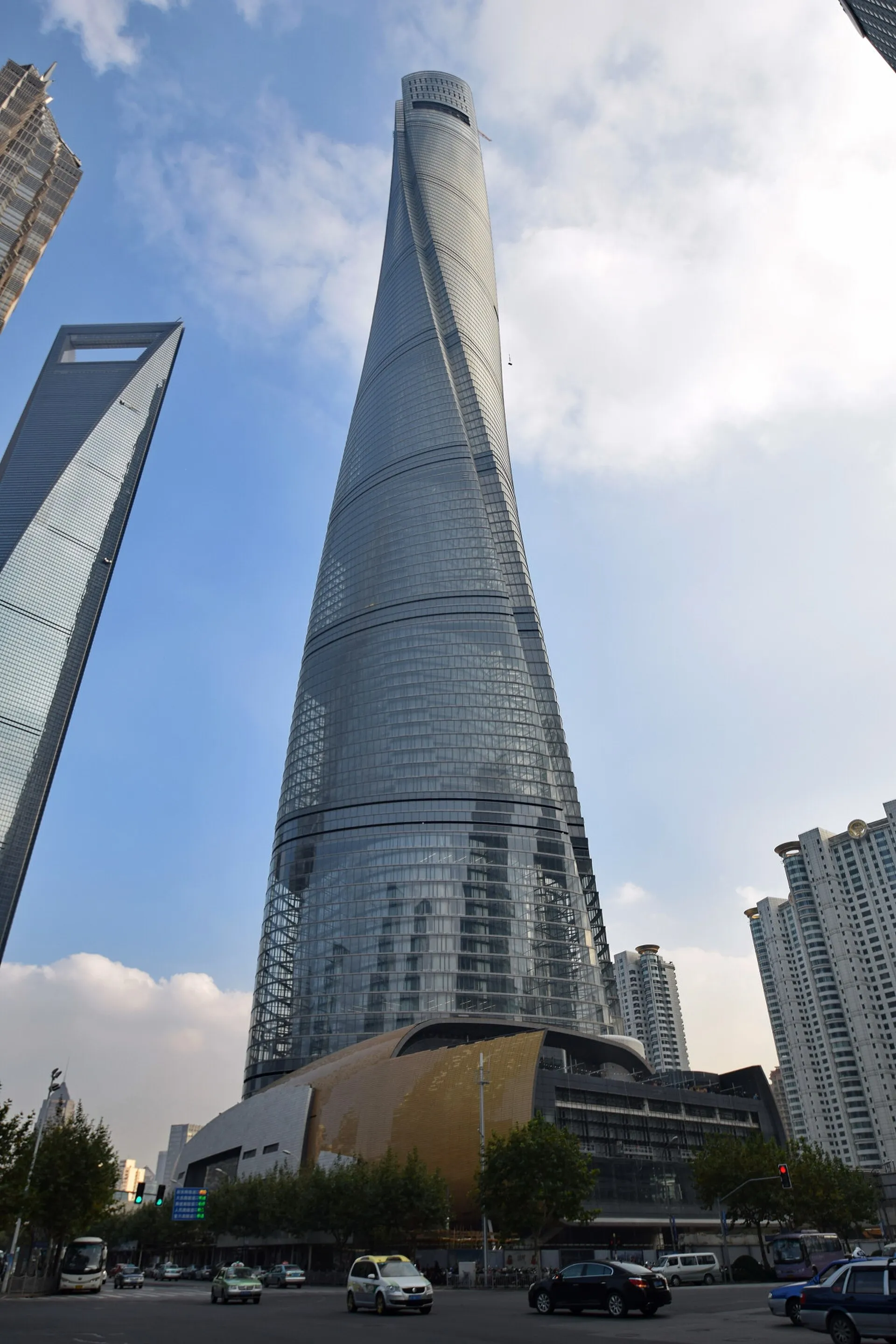
Engineering Facts
Shanghai Tower is as much a feat of structural engineering as a viewpoint, and knowing what you are looking at transforms the visit.
- The twisting silhouette: the tower rotates roughly 1 degree per floor for a full 120-degree turn, a shape wind-tunnel-tested to shed typhoon gusts and cut the wind load that drives cost on any supertall
- World's fastest lift: three Mitsubishi elevators rise from the basement to the 118th floor in under 55 seconds, pressurised so your ears barely register the climb
- Double-skin façade: the transparent outer shell sits about 1–10 metres beyond the inner wall, creating nine atrium sky gardens that buffer temperature and let daylight flood the interior
- A vertical city: 128 storeys hold offices, the sky-high J Hotel, and observation levels, served by 149 elevators and stabilised near the summit by an 1,000-tonne tuned mass damper that counters sway
- The supertall trio: standing beside the pagoda-crowned Jin Mao Tower and the aperture-topped Shanghai World Financial Center, the three towers trace three generations of Chinese engineering ambition in a single glance
When to Visit
The observation deck runs daily 8:30 AM – 9:30 PM (last entry 9:00 PM). The best window is late afternoon, 4:00–6:00 PM, to watch the sunset paint the city gold, then dissolve into neon. Skies are clearest on autumn and winter mornings after rain, when pollution washes out and visibility stretches to the horizon. Avoid hazy summer days, when smog can cut the view to a few kilometres and the ticket is largely wasted.
Admission and Costs
Observation deck ticket: ¥180 (about $25). Online advance booking: often ¥160 (discounted). Children under 1 metre: free. A combined ticket with the other Pudong towers appears seasonally for ¥250–300. The 119th-floor enclosed observatory and the J Hotel sky-lounge carry separate, higher fees. Card and mobile payment (Alipay, WeChat Pay) are accepted at the counters, but a linked international payment method helps if you have not set up a local wallet.
The Case for a Guide
The observation deck is self-guided, but the tower sits inside the dense Shanghai story of Lujiazui — a rice-paddy floodplain in 1990 that became the tallest skyline in Asia in a single generation — and a guide is what connects the view to that history.
- Reading the skyline: from 561 metres a guide can name the landmarks below — The Bund's 1920s trading houses, the Huangpu ferries, the aperture of the World Financial Center — so the panorama becomes a map instead of a blur
- Lujiazui's transformation: the story of how farmland became a supertall financial district in thirty years is the context that makes the height meaningful, not just impressive
- Skip-the-queue logistics: a guide books timed entry, watches the air-quality forecast, and re-times the visit to sunset so you are not stuck in a 30-minute ground-floor line on a grey day
- Pairing the day: a guide sequences the tower with ground-level Lujiazui, a Huangpu crossing to The Bund, and the classical Yu Garden so you see Shanghai from above and at street level in one coherent route
Tips for Visitors
Check air quality first: use an AQI app before buying — anything above 150 means limited views and wasted money. Book online to skip lines: the ground-floor ticket queue can stretch to 30 minutes on busy days. Combine with a Pudong walk: after descending, stroll between the three supertall towers and across the Lujiazui pedestrian ring bridge for ground-level perspective. Bring a zoom camera: the height reveals fascinating detail — ships on the Huangpu, The Bund's rooftop sculptures, even planes lining up for Hongqiao. Evening alternative: if you miss sunset, the nighttime city-lights view is equally spectacular and the lines are shorter after 8 PM.
Frequently Asked Questions
How tall is Shanghai Tower and where does it rank?
Shanghai Tower measures 632 metres to its architectural tip and 128 storeys, making it the tallest building in China and — since its 2015 completion — the third-tallest in the world after the Burj Khalifa in Dubai and the Merdeka 118 in Kuala Lumpur. The public observation deck on the 118th floor sits at 561 metres, and the enclosed observatory on the 119th floor at 562 metres is one of the highest of its kind on the planet.
What months offer the clearest views from Shanghai Tower?
October and April deliver the best visibility, with crisp autumn air and spring breezes clearing the humidity haze that often blankets Shanghai in summer. Winter visits after rainfall can also yield surprisingly sharp panoramas, though January and February bring cold winds at observation-deck altitude. Check an air-quality index before you buy — anything above AQI 150 flattens the horizon into grey.
What are the public access hours for Shanghai Tower?
The observation deck is open daily 8:30 AM – 9:30 PM, with last entry at 9:00 PM. The most rewarding window is late afternoon, 4:00–6:00 PM, when you can watch the city turn gold, then dissolve into neon as the Lujiazui towers light up around you. Arrive 60–90 minutes before sunset to secure a west-facing spot at the glass.
What does a visit to Shanghai Tower cost?
A standard observation-deck ticket is ¥180 (about $25). Booking online in advance often drops it to ¥160, and children under 1 metre enter free. A combined ticket bundling the neighbouring Pudong towers appears seasonally for ¥250–300. The 119th-floor enclosed observatory and the J Hotel sky-lounge experiences carry separate, higher fees.
What practical steps should visitors take before buying Shanghai Tower tickets?
Check the air quality first — use an AQI app before you commit, because anything above 150 means limited views and wasted money. Book online to skip the line, since the ground-floor ticket queue can stretch to 30 minutes on busy days. Time your entry for golden hour if you want both daylight and the illuminated skyline in a single visit.
Is Shanghai Tower worth visiting, and how does it compare to the other Pudong towers?
For most first-time visitors, yes — the 118th-floor deck gives the highest public view in the city and the fastest lift ride to reach it. Lujiazui holds a "supertall trio": the pagoda-topped Jin Mao Tower (1999, 421 m), the bottle-opener Shanghai World Financial Center (2008, 492 m), and Shanghai Tower (2015, 632 m). The World Financial Center's 100th-floor glass "sky walk" sits lower but pushes you further out over the void; Shanghai Tower wins on sheer altitude and the fastest elevators. On a clear day, pick Shanghai Tower; on a hazy day, its extra height gains you little.