
Walking Route
Landmarks Along the Route
The Bund is best read as a sequence of individual buildings, each with a precise date and a story. Working from north to south, these are the facades worth slowing down for:
- Garden Bridge (Waibaidu Bridge), 1907 — The first all-steel bridge in China, spanning Suzhou Creek at the northern gateway to the waterfront and a beloved backdrop for wedding photographs.
- HSBC Building (No. 12), 1923 — A neoclassical masterpiece by Palmer & Turner, once called "the most luxurious building between the Suez Canal and the Bering Strait." Its octagonal entrance hall hides a restored mosaic ceiling, and a pair of bronze lions (replicas of the wartime originals now in a museum) still flank the door.
- Custom House (No. 13), 1927 — Home to "Big Ching," the clock tower whose bells were cast to chime the Westminster melody of London's Big Ben, long the aural timekeeper of the waterfront.
- Peace Hotel (Sassoon House / Cathay Hotel, No. 20), 1929 — Shanghai's most storied hotel, crowned by a green copper pyramid, where Noël Coward is said to have written Private Lives and a jazz band has played nightly since the 1930s.
- Rockbund Art Museum — A restored Art Deco building a block inland at the north end, housing excellent contemporary exhibitions in the revitalised Rockbund quarter.
- Meteorological Signal Tower, 1907 — A slim round brick tower at the southern end that once dropped a time ball and hoisted storm signals for ships on the Huangpu, now a small museum and café.
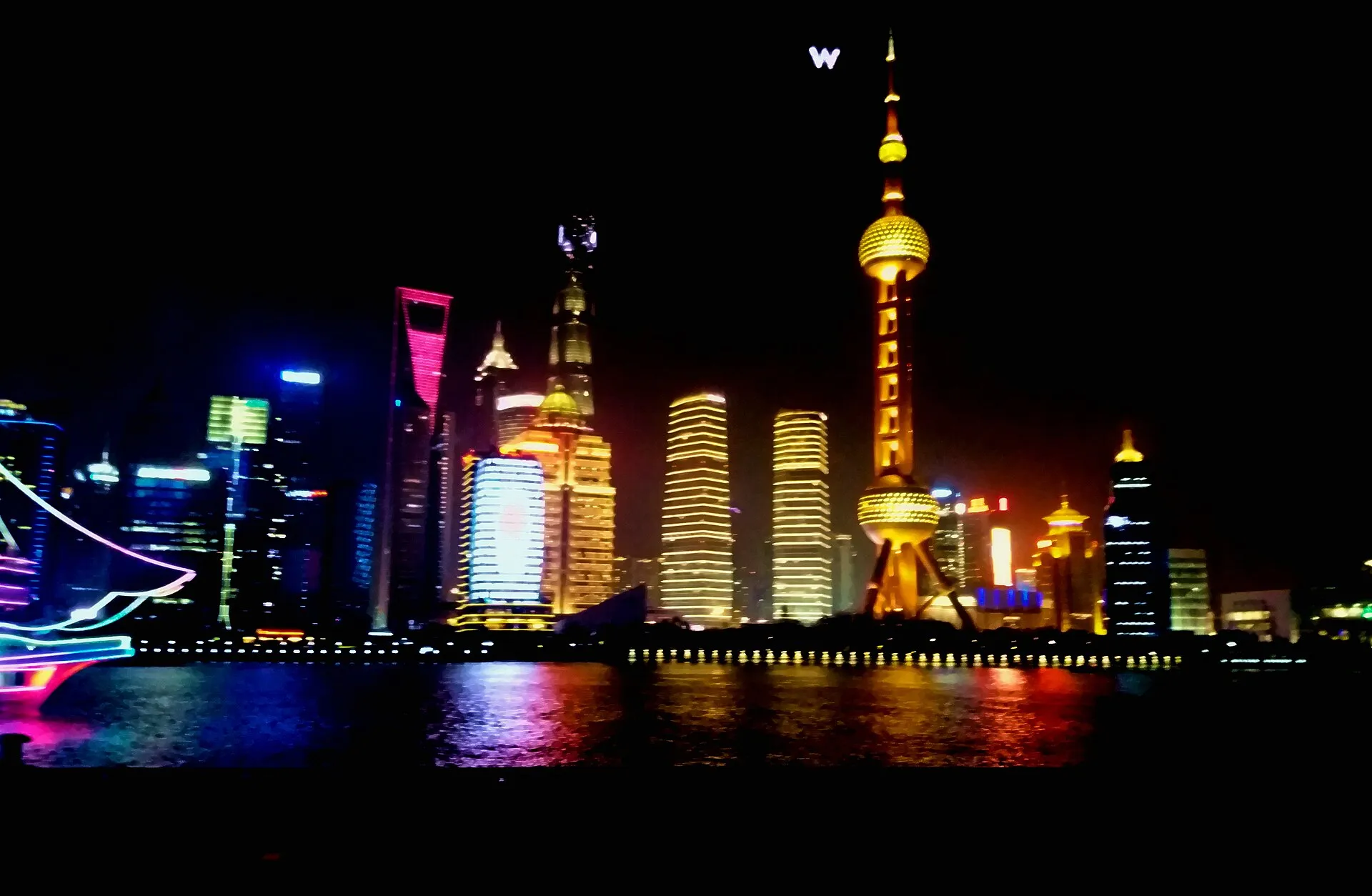
- Huangpu River cruise & sunset panorama — A nighttime boat ride is the best vantage point to see both illuminated riverbanks at once, while golden hour paints the colonial facades amber as Pudong's towers begin to glow.
Photo Spots
Several points along The Bund line up light, framing, and atmosphere at specific times of day, and knowing which to use when is the difference between a snapshot and a memorable image.
- The central promenade parapet at sunset — The classic shot: the Pudong skyline across the water catching the last gold light before the towers switch to neon. Arrive 30 minutes early to claim a spot at the rail.
- Beneath the Garden Bridge at the north end — Frames the steel trusses of the 1907 span against the glowing towers of Lujiazui, a composition that marries the Bund's two eras in one frame.
- Looking back from a Pudong ferry or the Lujiazui waterfront — The reverse angle: the entire colonial facade lit up as a single illuminated wall, impossible to capture from the Bund itself.
- Street level among the facades at blue hour — Tilt up at the HSBC dome and the Custom House clock tower while the sky still holds colour and the building floodlights are already on.
- The empty promenade at dawn — Soft, haze-free morning light, tai chi groups for foreground interest, and a mist that often softens the Pudong backdrop into something painterly.
The Bund timeline
-
Shanghai opens as a treaty port
After the First Opium War and the Treaty of Nanjing, Shanghai opened to foreign trade in 1843 and the British secured a settlement on the marshy towpath beside the Huangpu that became the Bund.
-
Public Garden laid out
Huangpu Park, the oldest public garden in the city, opened at the northern end of the waterfront where the Suzhou Creek meets the Huangpu River.
-
British Consulate completed
The former British Consulate at No. 33, set in its own lawns at the north end, is the oldest surviving structure on the Bund.
-
Garden Bridge opens
The Waibaidu (Garden) Bridge over Suzhou Creek, the first all-steel bridge in China, framed the northern gateway to the waterfront.
-
HSBC Building completed
Palmer & Turner's domed headquarters for the Hongkong & Shanghai Bank crowned the 'Wall Street of Asia' at the height of the Bund's banking era.
-
Customs House clock tower rises
The new Custom House at No. 13 added the Bund's landmark clock tower, 'Big Ching', whose chimes were modeled on the Westminster melody of Big Ben.
-
Promenade rebuilt for Expo
A 2007-2010 reconstruction buried the elevated through-traffic in the Bund Tunnel and roughly doubled the pedestrian promenade ahead of World Expo 2010.
When to Visit
Promenade: Open 24 hours, 7 days a week — the raised riverside walkway sits atop a flood wall and never closes. Light show: The Pudong skyline and the illuminated Bund facades light up nightly, typically until 10:00 PM (11:00 PM on weekends and holidays); the schedule shifts with the season and is trimmed on hazy or windy nights, so confirm timing locally.
Best: Arrive 30 minutes before sunset to witness the daylight-to-neon transition, when the colonial stone glows amber and the towers across the water begin to flicker on. Quietest: Early mornings, when locals practise tai chi on a near-empty promenade with a misty Pudong backdrop. Avoid: Weekend evenings in summer and Chinese national holidays, when the central promenade becomes extremely crowded and access can be managed by one-way barriers.
Admission and Costs
Walking The Bund: completely free. Metro to the waterfront: ¥3-5 ($0.40-0.70) one way. Huangpu River cruise: ¥80-150 ($11-21) depending on route and duration. Bund Sightseeing Tunnel to Pudong: ¥55 ($8) one way (kitschy but fun). Cross-river ferry from the south end to Pudong: about ¥2 ($0.30), the cheapest and most local way over the water. Rooftop bar drinks: ¥80-200 ($11-28) per cocktail at venues such as Bar Rouge or The Nest. Card and mobile payment (Alipay, WeChat Pay) are expected almost everywhere, so set up a wallet before you arrive.
The Case for a Guide
The Bund's 52 buildings are a compressed history of international commerce, colonial ambition, and Shanghai's unique role as the crossroads between Asian trade and Western capital — a guide turns a waterfront walk into a story with characters, scandals, and consequences.
- Each building's empire backstory: The HSBC Building financed opium, cotton, and rubber across Asia; the Chartered Bank handled the silver trade that drained Chinese imperial reserves — a guide assigns specific histories to specific facades rather than letting them merge into "old colonial buildings"
- The Sassoon House and opium wealth: Victor Sassoon's Cathay Hotel (now the Peace Hotel) was built on a fortune rooted in Baghdadi Jewish family opium trading with China — a guide explains this uncomfortable provenance and why the Sassoon family's story is central to understanding Shanghai's rise
- Art Deco vs. neoclassical identification: The Bund contains both styles in adjacent buildings — a guide teaches you to spot the difference and explains why certain nationalities favored particular architectural vocabularies as national branding
- Pudong before-and-after: In 1990, the Pudong bank across the river was farmland and warehouses — a guide frames the current skyline, crowned by the Shanghai Tower, as a deliberate government project built in thirty years, making the contrast with the century-old Bund a story about competing visions of modernity
- Best photography angles for both skylines: The optimal spots for photographing the colonial facade change by time of day, and the best reverse shots of the Bund from Pudong require knowing which ferry pier to use — a guide positions you correctly at the right moment
Tips for Visitors
Walk the full stretch: Most visitors cluster in the middle; the northern end around the Garden Bridge and the southern end by the Signal Tower offer quieter views and overlooked buildings. Cross the river: Take the cheap ferry (¥2) from the south end to Pudong for reverse views of The Bund's facade, or the kitschy Bund Sightseeing Tunnel if travelling with children.
Explore behind the facades: The streets one block west — around the restored Rockbund quarter and the lanes toward Yu Garden — are packed with hidden restaurants, speakeasies, and boutiques. Check the light schedule: The Pudong light show runs on a set schedule that varies by season — confirm timing locally. Bring a jacket in winter: The river wind cuts through the promenade and can feel significantly colder than inland streets. Go early for photos: Before 8:00 AM the promenade belongs to tai chi practitioners and the light is soft and haze-free.
Frequently Asked Questions
When is the Bund promenade open and when does the Pudong light show run?
Promenade: Open 24 hours, 7 days a week. Light show: Pudong skyline lights up nightly, typically until 10:00 PM (11:00 PM on weekends). Best: Arrive 30 minutes before sunset to witness the daylight-to-neon transition.
Is The Bund free to visit?
Walking The Bund: Completely free. Huangpu River cruise: ¥80-150 ($11-21) depending on route and duration. Sightseeing tunnel to Pudong: ¥55 ($8) one way (kitschy but fun). Rooftop bar drinks: ¥80-200 ($11-28) per cocktail at venues like Bar Rouge or The Nest.
How do you get to The Bund by metro?
East Nanjing Road station (Lines 2 and 10) sits one block inland from the central and northern Bund and is the most useful stop — follow the crowds east down the pedestrianised Nanjing Road to reach the waterfront in about ten minutes. For the southern end and the Meteorological Signal Tower, Yuyuan Garden station (Line 10) is closer. A single metro ride costs ¥3-5 ($0.40-0.70).
How much time should you set aside for The Bund?
Allow 60-90 minutes to walk the full 1.5-kilometre promenade one way at an unhurried pace, pausing at the major buildings and photographing both riverbanks. Add another hour if you cross to Pudong by ferry or sightseeing tunnel for reverse views, and budget a half-day if you also tour the restored banking halls or take a Huangpu River cruise at dusk.
Which buildings should you not miss on The Bund?
The three signatures are the domed HSBC Building (No. 12, 1923), the clock-towered Custom House (No. 13, 1927), and the green-roofed Peace Hotel (the former Sassoon House, No. 20, 1929). Add the 1907 Garden Bridge and the round Meteorological Signal Tower at the southern end, and you have walked the Bund's headline century of architecture.
What practical tip helps visitors see the best of The Bund beyond the crowds?
Walk the full stretch: Most visitors cluster in the middle - the northern and southern ends offer quieter views and interesting buildings. Early mornings bring locals practising tai chi on an almost empty promenade, the single best window for crowd-free photographs.