
Walking Route
Landmarks Along
Working downhill from the top, the avenue strings together its signature addresses. Near George V stands Le Fouquet's, the 1899 brasserie that is a listed monument and the historic haunt of the French film industry, alongside the flagship stores of Louis Vuitton and Dior and the Ladurée tearoom, famous for its macarons since 1862. The Rond-Point des Champs-Élysées, laid out by Le Nôtre and later set with Lalique glass fountains, marks the switch from shops to gardens. Below it, the Grand Palais — a vast glass-and-steel nave built for the 1900 Exposition Universelle and reopened after a major restoration — faces the Petit Palais, whose free fine-arts museum wraps a peaceful garden café. The lower Jardins des Champs-Élysées screen the Théâtre Marigny and a scattering of pavilion restaurants among the chestnut trees, before the avenue opens onto Place de la Concorde and its 3,300-year-old Luxor Obelisk, with the Louvre and Tuileries beyond.
Photo Spots
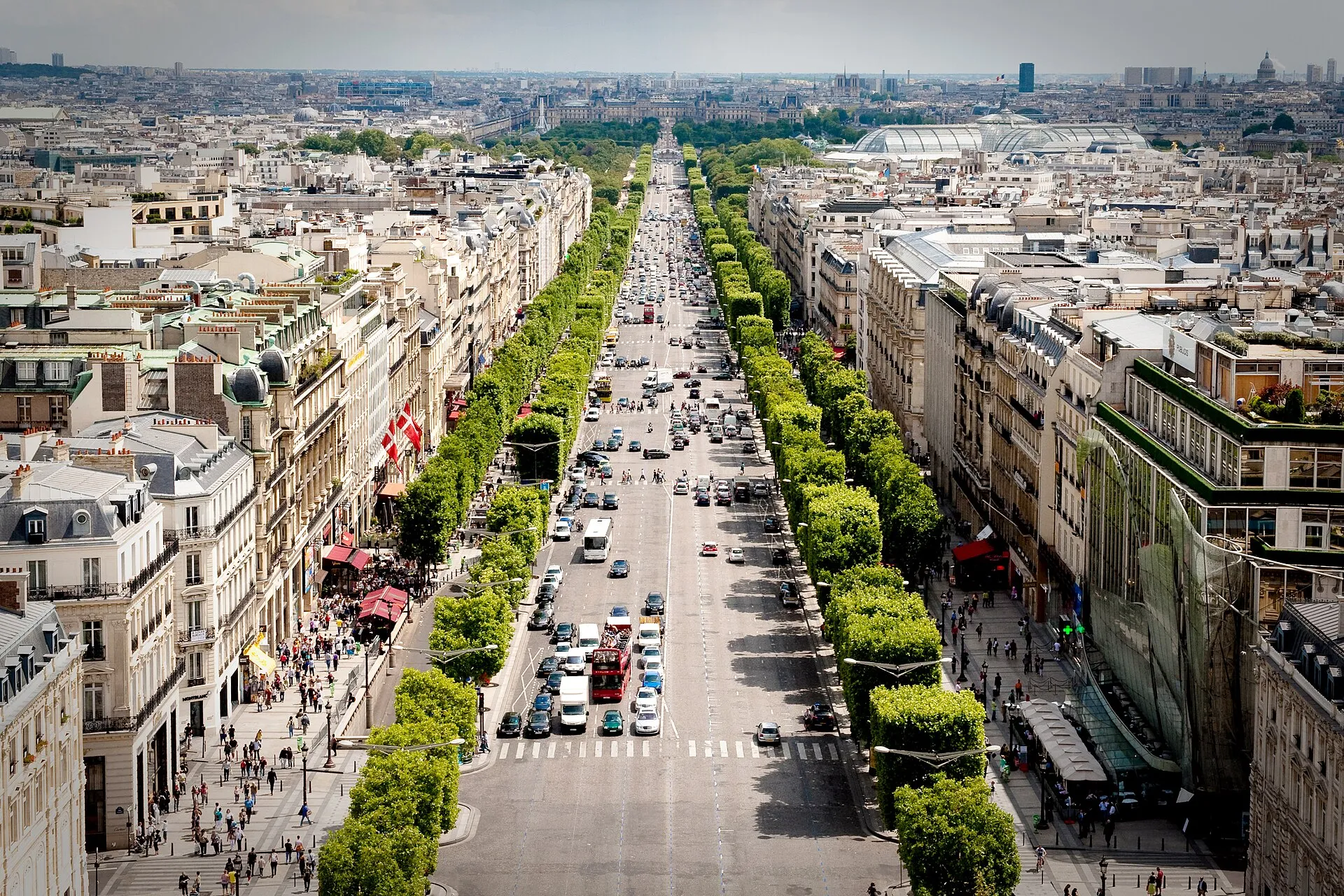
The defining shot is the avenue itself framing the Arc de Triomphe: stand on the central reservation low on the slope and shoot uphill, ideally at golden hour when the sun sets directly behind the arch. From the top, the roof terrace of the Arc gives the reverse view — the twelve radiating avenues and the dead-straight line of the Champs-Élysées running to the obelisk at Concorde and on to the Louvre, the historic Axe historique of Paris. Lower down, the glass nave of the Grand Palais photographs best from Avenue Winston Churchill, and the Luxor Obelisk at Concorde makes a clean foreground for the Eiffel Tower on the skyline to the west. In December, the illuminated plane trees turn the whole avenue into a tunnel of light after dark — a long exposure from the central island captures the headlights streaming beneath them.
Champs-Élysées timeline
-
Cours-la-Reine planted
Marie de' Medici lays out a tree-lined riverside promenade west of the Tuileries, the first greenery on what will become the avenue.
-
Le Nôtre extends the royal axis
André Le Nôtre, gardener to Louis XIV, prolongs the Tuileries vista with a broad avenue of elms climbing toward the hill at Étoile.
-
Named "Champs-Élysées"
The promenade takes its name from the Elysian Fields of Greek myth, the paradise reserved for heroes.
-
Handed to the City of Paris
The city paves the avenue, adds footpaths, gas lamps and fountains, turning a muddy ride into a fashionable promenade.
-
Arc de Triomphe inaugurated
Napoleon's triumphal arch is completed at the summit, giving the avenue the monumental crown that defines its skyline today.
-
Grand & Petit Palais rise
Both glass-and-steel palaces are built for the Exposition Universelle, framing the lower avenue's garden section.
-
Liberation of Paris march
On 26 August, Charles de Gaulle leads a vast crowd down the avenue to celebrate the city's liberation.
-
Bernard Huet redesign
Architect Bernard Huet widens the pavements, removes side parking and replants the double rows of plane trees that shape the avenue now.
When to Visit
The Champs-Élysées is a public street, open 24 hours a day, year-round, with no admission. For photographs without crowds, come before 10 AM, when delivery vans have left and the pavements are nearly empty. For atmosphere, aim for golden hour: stand low on the avenue and look west as the sun sets behind the Arc de Triomphe, a sightline that only lines up around the equinoxes and the week either side. From mid-November to early January the plane trees carry their famous illuminations, and the avenue is at its most festive after dark. Avoid Saturday afternoons, when shopping crowds peak, and note two recurring closures: the roadway goes car-free on the first Sunday of each month, which is the calmest time to walk the tarmac itself, and it fills from dawn for the 14 July parade. Allow 30–45 minutes to walk the length one way, or a couple of hours with stops for the gardens and the Grand Palais.
Admission and Costs
Walking the full avenue is free, and so is sitting in the lower Jardins des Champs-Élysées or visiting the Petit Palais, whose permanent collection costs nothing. Paid extras add up quickly on the avenue: a small-group guided walking tour runs about €25–45 (US$27–49) per person, while a private guide is roughly €150–250 (US$165–275) for two to three hours. Temporary exhibitions at the Grand Palais are ticketed, typically €15–22 (US$17–24). Food and drink are where the avenue is most expensive: a coffee on a terrace can top €6 (US$7) and a box of Ladurée macarons starts around €20 (US$22). The simplest saving is to step one block onto a side street such as Rue de Ponthieu or Rue Marbeuf, where the same coffee costs roughly half. Luxury flagship prices on the upper half, of course, are in a league of their own.
The Case for a Guide
The avenue rewards context. Walked cold it can feel like an expensive shopping street; walked with a guide it becomes a 400-year lesson in how Paris stages power, from Le Nôtre's royal garden axis to the military parades that still march down it every July. A good guide reads the two halves of the avenue, steers you away from the tourist-priced terraces, and links the Champs-Élysées into the wider sweep of monuments around it. Walking it with a guide adds:
- The hidden history behind the facades: why the avenue has a shopping half and a garden half, what the Rond-Point's fountains commemorate, and how the 1900 Exposition shaped the lower end.
- The Axe historique explained: how the Champs-Élysées fits the dead-straight line running from the Louvre through the obelisk and arch to La Défense, and where to stand to see it.
- Where locals actually go: the side-street cafés a block off the avenue, and which flagship interiors are worth entering purely for their architecture.
- A joined-up route: linking the arch, the gardens and Concorde into a single downhill walk that ends within reach of the Eiffel Tower and the Seine.
Tips for Visitors
Walk downhill for the best of it: start at the Arc de Triomphe — climb it first for the view straight down the avenue — then descend toward Concorde with the gradient and the panorama both in your favour. Five Métro stops shadow the route — Charles de Gaulle-Étoile, George V, Franklin D. Roosevelt, Champs-Élysées-Clemenceau and Concorde — all on line 1, so you can ride between any two if the full walk is too far. Keep valuables zipped in the crowded upper half, where pickpockets work the café terraces and store queues. Eat and drink on the side streets rather than the avenue itself to spend far less. If you can, plan for the first Sunday of the month, when the car-free roadway makes the whole avenue a pedestrian space, and cross the river afterwards toward the Eiffel Tower for a full day on foot.
Frequently Asked Questions
When is the best time to walk the Champs-Élysées?
The avenue is a public street, open around the clock all year. For photographs without crowds, arrive before 10 AM; for atmosphere, come at golden hour and look west, when the setting sun lines up behind the Arc de Triomphe. December is magical — the plane trees are strung with illuminations from mid-November to early January — while Saturday afternoons bring the heaviest shopping crowds. The first Sunday of each month the roadway closes to cars and belongs to pedestrians.
Is the Champs-Élysées free to visit, and what do extras cost?
Walking the full 1.9 km costs nothing. A small-group guided walking tour runs about €25–45 (US$27–49) per person, and a private guide is roughly €150–250 (US$165–275) for two to three hours. The neighbouring Petit Palais museum is free; the Grand Palais charges for its exhibitions. Café prices on the avenue itself are steep — a coffee can top €6 (US$7) — but drop sharply a block onto the side streets.
How long is the Champs-Élysées and how long does it take to walk?
The avenue runs 1.9 km (about 1.2 miles) in a straight line from Place de la Concorde up to the Arc de Triomphe at Place Charles de Gaulle. A relaxed one-way walk takes 30–45 minutes without stops; allow two hours or more if you pause for the Grand Palais, the lower gardens, and photographs. Most visitors walk downhill from the Arc toward Concorde so the gradient and the view are both in their favour.
How do I reach the Champs-Élysées by Métro?
Five stations line the avenue: Charles de Gaulle-Étoile (lines 1, 2, 6 and RER A) at the Arc, George V and Franklin D. Roosevelt (both line 1) along the shopping stretch, Champs-Élysées-Clemenceau (lines 1 and 13) by the Grand Palais, and Concorde (lines 1, 8 and 12) at the lower end. Line 1 shadows the whole avenue, so you can ride between any two points if the full walk is too much.
What should visitors know before walking the Champs-Élysées?
Keep valuables zipped and close in the crowded upper half, as at any famous tourist street. Save money by eating and drinking on the side streets rather than the avenue terraces. Wear comfortable shoes for the cobbled crossings, and plan around closures: the roadway goes car-free on the first Sunday of each month and for the Bastille Day military parade on 14 July, when the lower avenue is packed from dawn.