
Collection Highlights
Olympia — Édouard Manet (1863)
A reclining nude who stares straight back at the viewer, Olympia scandalised the 1865 Salon by casting a modern Parisian courtesan in the pose of a Renaissance Venus. Its flat lighting, hard outlines, and confrontational gaze broke with academic convention and helped push the door open for modern painting.
Le Déjeuner sur l'herbe — Édouard Manet (1863)
A naked woman picnics with two clothed, respectable men in a leafy glade, a juxtaposition that outraged critics when the official Salon jury rejected it. Manet's loose brushwork and refusal of any mythological excuse made the canvas an early manifesto for the avant-garde.
Poppies — Claude Monet (1873)
A woman and child drift through a blaze of red poppies under a soft summer sky, rendered in quick, broken touches of pure colour. The picture distils the Impressionist programme — ordinary open-air life seized in changing light rather than posed and finished in a studio.
Bal du moulin de la Galette — Pierre-Auguste Renoir (1876)
Dappled Sunday sunlight falls over a crowd dancing at an open-air Montmartre café, caught in flickering strokes that dissolve faces into light. It is Renoir's most joyous large canvas and one of Impressionism's defining images of modern Parisian leisure.
Ballet Dancers — Edgar Degas
Degas returned obsessively to the dancers of the Paris Opéra, catching them mid-stretch, adjusting a slipper, or waiting in the wings. Behind the apparent grace lies the hard, physically punishing work of girls from poor families, recorded with a draughtsman's cool precision across dozens of pastels and oils.
Bedroom in Arles — Vincent van Gogh (1889)
Van Gogh painted his simple yellow-house bedroom in flat, saturated colour to convey what he called absolute rest; Orsay holds one of the three versions. The tilted floor and vibrating complementary colours turn a humble room into an unmistakable emotional self-portrait.
Starry Night Over the Rhône — Vincent van Gogh (1888)
Gas lamps and their wavering reflections meet the stars of the Great Bear over the river at Arles. Distinct from the more famous New York canvas, this earlier night scene shows Van Gogh already translating the sky into swirling, expressive light.
The Gleaners — Jean-François Millet (1857)
Three peasant women stoop to gather leftover grain in a vast golden field, monumental and dignified despite their poverty. Millet's unglamorous image of rural labour was read as politically charged and prefigured the Realist current that runs through Orsay's ground floor.
Whistler's Mother — James McNeill Whistler (1871)
Formally titled Arrangement in Grey and Black No. 1, this severe profile portrait of the painter's mother is an exercise in tonal harmony as much as family likeness. One of the most recognised American paintings, it anchors Orsay's holdings of the wider international art of the period.
Collections Highlights
The Orsay reads best as three horizontal layers of art history, and knowing the layout saves an hour of backtracking:
- Ground floor (the nave) - Sculpture lines the great glass-roofed hall, flanked by the mid-19th-century painting that set the stage for the revolution to come: Courbet's vast A Burial at Ornans, Millet's The Gleaners and The Angelus, Ingres, and Manet's scandalous Olympia.
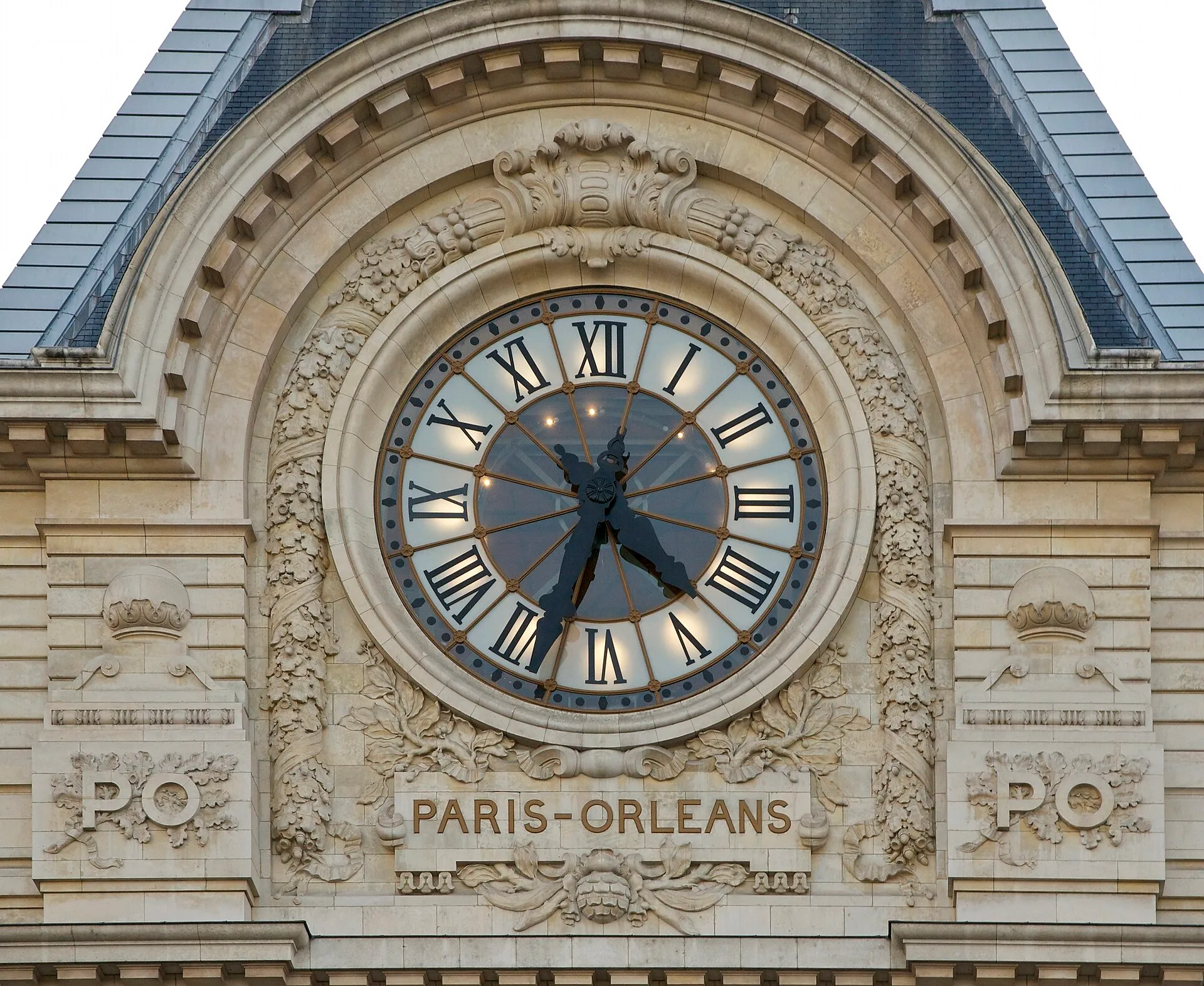
- Upper level (Impressionist galleries) - The top floor holds the collection most visitors come for: Monet's Poppies, La Gare Saint-Lazare, and Rouen Cathedral series, Renoir's Bal du moulin de la Galette, Degas' ballet pastels, and Pissarro and Sisley landscapes, all behind the famous transparent clock of the Café Campana.
- Median level (Post-Impressionism and Art Nouveau) - On the way down, Van Gogh's Bedroom in Arles and self-portrait, Cézanne's still lifes and The Card Players, Gauguin's Tahitian canvases, Seurat's pointillism, and Toulouse-Lautrec's Montmartre share the floor with sinuous Art Nouveau furniture and sculpture terraces overlooking the nave.
One common surprise: the vast water-lily cycle many visitors expect hangs at the Musée de l'Orangerie across the river, not here - Orsay holds Monet's earlier work, including a single luminous Water Lily Pond.
Guided Tours
Art historical context: understand why the Salon rejected these painters before the public embraced them. Efficient navigation: the collection runs to several thousand works across three levels, so prioritisation is essential. Hidden connections: a guide traces how Realism, Impressionism, and Post-Impressionism hand off to one another floor by floor. Building history: the story of the station's rescue and conversion. Timing the clock room: guides know when the fifth-floor Salle du Cadran is clear enough for the classic photograph through the glass.
Musée d'Orsay timeline
-
The Gare d'Orsay opens
Built by architect Victor Laloux for the 1900 Exposition Universelle, the electrified terminus was hailed as a palace of the railway age on the banks of the Seine.
-
Mainline trains depart
The platforms proved too short for the longer carriages of the modern network, and long-distance service moved to the Gare d'Austerlitz, leaving the grand hall to slow decline.
-
Saved and reimagined
After years under threat of demolition, the French government designated the station a future museum of 19th-century art; it was listed as a monument historique the following year.
-
The museum opens
Reworked inside by architect Gae Aulenti, the Musée d'Orsay opened on 1 December 1986 to bridge the classical collections of the Louvre and the modern art beyond.
-
Impressionist galleries reborn
A major renovation redesigned the top-floor Impressionist rooms with darker walls and refined lighting, sharpening the display of Monet, Renoir, and Degas.
When to Visit
Hours: Tuesday-Sunday, 9:30 AM - 6:00 PM, with a late Thursday until 9:45 PM. Closed: Mondays, 1 May, and 25 December. Last admission is 5:00 PM (9:00 PM on Thursdays), and rooms begin clearing about 30 minutes before closing. Best time: Thursday evening, when the crowds thin and low light rakes across the nave; early Tuesday and Wednesday mornings are the next-quietest windows. Avoid: Sunday afternoons, the free first Sunday of the month, and rainy days, when indoor attractions across Paris fill up.
Admission and Costs
Full ticket: €16 - buy a timed slot online to skip the courtyard queue. Reduced: €11 at the museum for eligible visitors, or €12 online / €10 at the museum after 6:00 PM on Thursdays. Free: under-18s, and EU or EEA residents aged 18-25; entry is also free for everyone on the first Sunday of each month, which is correspondingly crowded. A combined Orsay + Rodin ticket is valid for one entry at each museum, and the Paris Museum Pass includes the Orsay with no separate booking. Guided small-group tour: €50-80 per person; a private art-historian guide runs €300-450 for a focused 2-3 hour visit for a handful of people. Under-26s should carry ID for the free and reduced rates - see the museum's rates page for current prices.
The Case for a Guide
The Musée d'Orsay contains the world's greatest Impressionist collection, but without context these paintings look like pleasant scenes of gardens and cafés — a guide reveals them as radical acts of institutional defiance and the compressed work of artists who knew their time was limited.
- The train station conversion story: The building was a functioning railway terminus until 1939 and slated for demolition in the 1960s to build a hotel; a guide traces the preservation campaign led by museum advocates and explains how the great clock faces, now looking into the galleries, were originally designed to be read from the platforms below.
- Impressionism's Salon rejection: Manet's Olympia and Déjeuner sur l'herbe were rejected by the official Salon and ridiculed in the press; a guide explains the specific academic rules these paintings violated and why the jury's rejection inadvertently created the artistic movement that would redefine modern painting.
- Degas' ballet paintings as labor documentation: The ballerina canvases appear elegant but depict girls from poor families doing physically damaging work under conditions that would be considered exploitative today; a guide explains the Opéra's abonnés system, the wealthy male patrons who had backstage access, and what Degas was actually recording.
- Van Gogh's tortured brushwork: Standing in front of The Church at Auvers or the self-portraits with a guide who explains that Van Gogh's distinctive stroke direction was partly deliberate and partly driven by the urgency of a man who produced 900 works in 10 years transforms what looks like style into a visible psychological state.
- Monet's relationship with photography: Early Impressionism developed exactly as photography made realistic representation obsolete; a guide traces the specific photographers — Nadar, Gustave Le Gray — whose work was exhibited alongside paintings, explaining why the Impressionists abandoned precision at precisely the moment a machine made it unnecessary.
Tips for Visitors
- Book a timed entry at musee-orsay.fr; walk-up queues in the forecourt can swallow an hour in summer.
- Start at the top. Ride to the fifth-floor Impressionist galleries first, while your eyes are fresh and before tour groups arrive around 11, then work down through Post-Impressionism to the nave.
- Allow three hours for the highlights alone; a thorough visit easily fills half a day.
- Café des Hauteurs, behind the great glass clock on the fifth floor, is the one refreshment stop worth the queue - coffee with a view out over the Seine.
- Getting there: RER C stops at Musée d'Orsay directly beneath the building, and Métro line 12 (Solférino) is a two-minute walk. It is a 15-minute riverside stroll from the Louvre across the Passerelle Léopold-Sédar-Senghor, making the two great museums an ambitious but doable single day.
- Pair it well. For an itinerary that threads the Orsay into a wider Left Bank day, see our three-day Paris guide.
Frequently Asked Questions
When is the best time to visit Musée d'Orsay?
Hours: Tuesday-Sunday 9:30 AM - 6:00 PM (Thursday until 9:45 PM). Closed: Mondays, May 1, December 25. Best time: Thursday evening (fewer crowds, atmospheric lighting) or early Tuesday and Wednesday mornings. Avoid: Sunday afternoons, the free first Sunday of the month, and rainy days when indoor attractions fill up.
What does admission to Musée d'Orsay cost?
Full ticket: €16 (book a timed slot online). Under 18: Free. EU or EEA residents 18-25: Free. Thursday after 6 PM: €12 online / €10 at the museum. First Sunday of the month: Free for all (very busy). Guided small-group tour: €50-80 per person. Private guide: €300-450 for 2-3 hours.
What should visitors know before visiting Musée d'Orsay?
Buy timed tickets: Online booking essential for busy periods. Start at top: Impressionists on level 5, work down. Allow 3 hours: Minimum to see highlights properly. Café des Hauteurs: Coffee with a view through the station clock on the fifth floor.
How do you get to the Musée d'Orsay?
The fastest route is RER C to the Musée d'Orsay station directly beneath the building. Métro line 12 stops at Solférino, a two-minute walk, and several bus lines pass nearby. On foot it is about 15 minutes along the Seine from the Louvre, crossing the Léopold-Sédar-Senghor footbridge.
What are the must-see works at the Musée d'Orsay?
On the fifth floor: Renoir's Bal du moulin de la Galette, Monet's Poppies, and Degas' ballet dancers. On the ground floor: Manet's Olympia and Le Déjeuner sur l'herbe, and Millet's The Gleaners. Also unmissable: Van Gogh's Bedroom in Arles and Starry Night Over the Rhône, and Whistler's Mother.