
Collection Highlights
The inside-out building
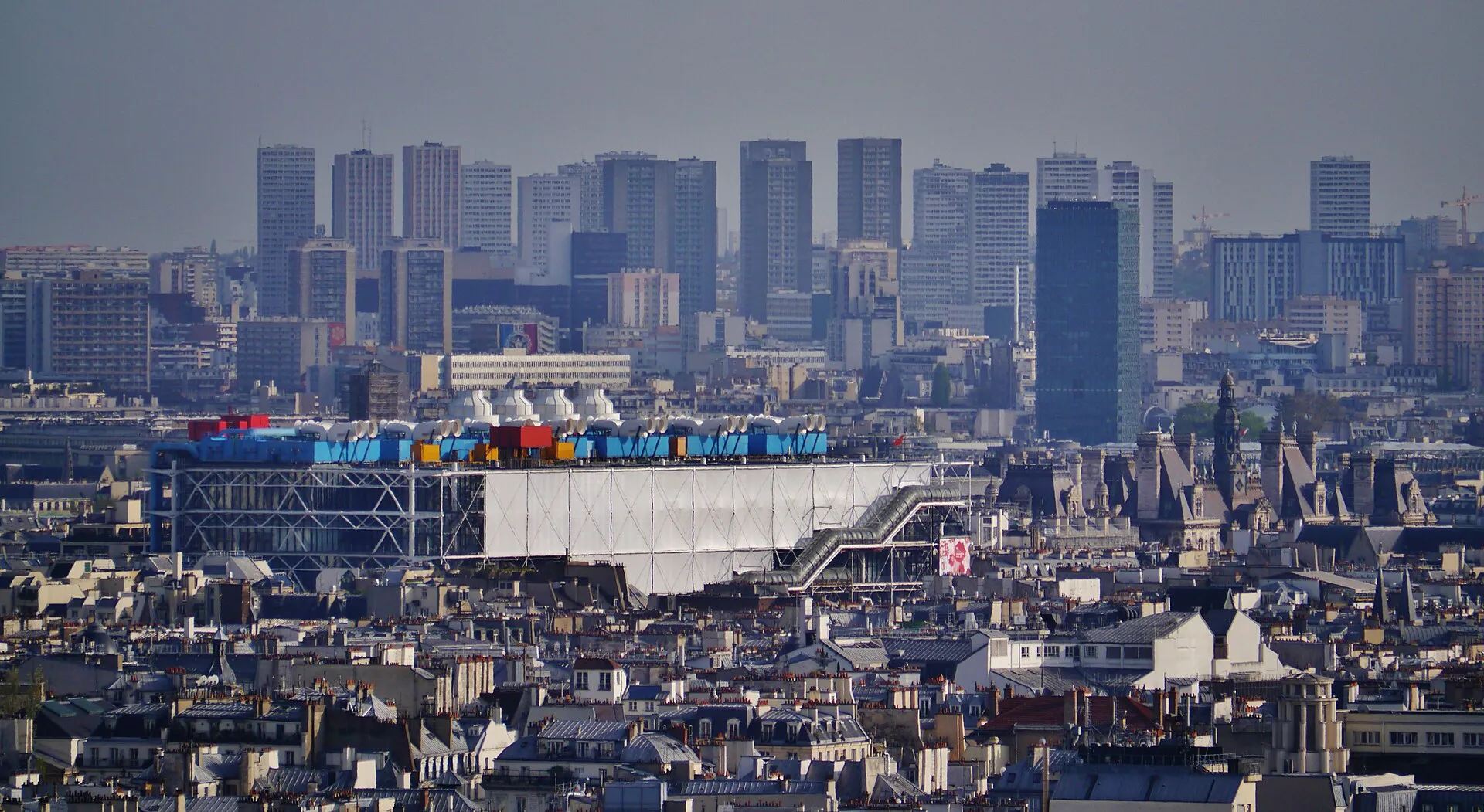
The Centre Pompidou is its own greatest exhibit. Pipes, ducts, and the glass escalator tube climb the exterior, colour-coded blue, green, yellow, and red, so the whole structure reads like an engineering diagram turned inside out. A guide explains how this freed the floors into open galleries and why the 1977 design still influences architects today.
The Kandinsky collection
The museum holds the world's largest body of work by Wassily Kandinsky, much of it bequeathed by his widow Nina. The galleries trace his path from figurative beginnings through his Munich Blaue Reiter years to the pure geometric abstraction of his Paris period, a near-complete map of how one artist invented a visual language with no subject at all.
Matisse - The Sadness of the King
Henri Matisse's monumental 1952 cut-out, one of his last great works, uses scissored sheets of painted paper to conjure a musician, a dancer, and a seated king in glowing blue, green, and gold. It is a cornerstone of the collection's mid-century holdings and a lesson in how Matisse "drew with scissors" when illness kept him from the easel.
Picasso, Braque, and Cubism
The galleries chart the Cubist revolution Pablo Picasso and Georges Braque launched before the First World War, fracturing objects into shifting planes and gluing newspaper and rope into the first collages. Seeing their works side by side shows how closely the two painters worked, often making it hard to tell one hand from the other.
Robert and Sonia Delaunay
The Delaunays' spinning discs and prismatic cityscapes gave abstraction a jolt of pure colour in the years around 1912, a movement the poet Apollinaire christened Orphism. Sonia's textiles and book-bindings sit beside Robert's canvases, a reminder that the couple carried their colour theory into everyday design as well as painting.
Marcel Duchamp's readymades
Duchamp's mass-produced objects, declared art simply because the artist chose them, detonated the idea that art had to be hand-made or beautiful. The collection's readymades and related works let a guide trace a direct line from his early-20th-century provocations to the conceptual and installation art that fills the upper, contemporary floor.
Atelier Brancusi
On the piazza stands a faithful reconstruction, designed by Renzo Piano, of the Montparnasse studio Constantin Brancusi left to the French state. His polished bronzes and carved-stone bases are arranged exactly as the sculptor positioned them, so the room itself becomes a single composition rather than a display of separate objects.
The level 6 panorama
Reached by the external escalator, the top-floor terrace and Restaurant Georges open onto one of the best free-range rooftop views in central Paris, sweeping across the zinc rooftops of the Marais to Montmartre and the dome of Sacré-Cœur. When the centre reopens, the ride up the glass caterpillar is worth it for the view alone.
The Stravinsky Fountain
Just south of the building, the pool on Place Igor-Stravinsky bubbles with sixteen moving sculptures by Jean Tinguely and Niki de Saint Phalle, from a spraying red lips to a spinning treble clef. Free, open-air, and endlessly photographed, it stays accessible even while the museum behind it is closed.
Collections Highlights
The Musée national d'art moderne is organised chronologically, and knowing the split turns a huge collection into a readable route. The historic galleries (roughly 1905-1960) cover the movements that remade Western art - Fauvism and Cubism, the Kandinsky rooms that form the world's largest holding of the artist, the colour experiments of Robert and Sonia Delaunay, Matisse's late cut-outs, and the shock tactics of Marcel Duchamp. The contemporary floor (1960 to today) carries the story through Pop, conceptual, and installation art up to living artists, so a visit traces an unbroken line from the first abstract paintings to work made in the present decade.
On the piazza, the reconstructed Atelier Brancusi preserves the sculptor's studio as a single installation, and the adjacent Stravinsky Fountain adds a free, open-air dose of Niki de Saint Phalle and Jean Tinguely. During the 2025-2030 closure these highlights are dispersed on tour or, in the fountain's case, still visible outside - a guide can tell you which of the signature works are currently on show in Paris and which have travelled.
Guided Tours
- Decode the building before the art: a guide explains the inside-out structure and colour code so the architecture stops being a curiosity and starts making sense.
- Context for difficult art: modern and contemporary work is hard to read cold; a guide supplies the movements, rivalries, and ideas that make a Kandinsky or a Duchamp click.
- Strategic navigation: with around 120,000 works in the collection, a guide curates a focused route through the pieces that matter rather than leaving you to drift.
- The Beaubourg story: the controversy of 1977, the centre's role in reviving a run-down quarter, and the 2025-2030 renovation all come alive with someone to narrate them on the piazza.
Centre Pompidou timeline
-
Pompidou launches the project
Newly elected president Georges Pompidou calls for a bold new cultural centre on the Beaubourg plateau, a long-cleared site in the heart of old Paris, to house modern art, a public library, and music research under one roof.
-
Piano and Rogers win the competition
An international jury picks the unknown young architects Renzo Piano and Richard Rogers, with engineer Peter Rice, whose inside-out, flexible "cultural machine" beats nearly 700 rival entries.
-
The centre opens
Inaugurated on 31 January 1977, the colour-coded building is attacked by critics as an oil refinery dropped into Paris, yet it draws enormous crowds from day one and quickly becomes one of the city's most-visited sites.
-
The Stravinsky Fountain arrives
Niki de Saint Phalle and Jean Tinguely install sixteen playful mechanical sculptures in the pool on the adjoining Place Igor-Stravinsky, a riot of colour and spraying water that became a Beaubourg landmark in its own right.
-
First major refit reopens
After a 27-month renovation the centre reopens on 1 January 2000 with reorganised galleries, the top-floor Restaurant Georges, and expanded space for its ever-growing collection.
-
The five-year closure begins
The centre shuts completely in 2025 for its most extensive renovation yet, tackling asbestos, fire safety, accessibility, and energy performance while the collection travels on tour.
-
Planned reopening
The transformed building is scheduled to return around 2030, with an overhaul led by the Moreau Kusunoki and Frida Escobedo studios reopening the facade and gardens more fully to the surrounding city.
When to Visit
Status: The centre is closed for renovation until roughly 2030 - galleries, the Bpi library, and the rooftop are all shut. The Place Georges-Pompidou piazza and the Stravinsky Fountain on neighbouring Place Igor-Stravinsky remain open-air and accessible at any time. Standard hours (when open, and expected on reopening): Wednesday to Monday, 11 AM - 9 PM, with the top-floor exhibition spaces running later on Thursday evenings. Closed Tuesdays and on 1 May. Best time: weekday evenings after 6 PM, once the day-tour groups have thinned, were historically the quietest window. Always confirm the live calendar on the museum's official site, as the reopening date and hours may shift as the works progress.
Admission and Costs
During the closure no tickets are sold on-site; follow the collection's touring exhibitions instead, many of which set their own admission. Historic pricing (for reference, and likely to be reset on reopening): full ticket €15 (about $16); free for under-18s, for EU residents aged 18-25, and for everyone on the first Sunday of the month (expect crowds). The Bpi public library was always free to enter, and the external escalators and level 6 terrace could be ridden for free views without a museum ticket. Guided tours ran €30-50 (about $32-54) per person, and a private guide €200-350 (about $215-375) for two hours. Budget fresh prices when the renovated centre reopens around 2030.
The Case for a Guide
The Pompidou rewards context more than almost any museum in Paris: modern and contemporary art can feel baffling without someone to explain why a blank canvas or an upturned urinal belongs on the wall, and the building itself needs decoding before the collection even begins.
- Reading the architecture: a guide walks you around the colour-coded exterior and explains the inside-out logic - why the pipes and escalators are on the outside, and how that let Piano and Rogers open up the galleries within.
- Making modern art make sense: from Kandinsky's leap into abstraction to Duchamp's readymades, a guide supplies the ideas behind the images so the 20th-century rooms read as a story rather than a puzzle.
- Connecting the Paris museums: the Pompidou picks up exactly where the Musée d'Orsay leaves off, and a guide threads the two into a single arc from Impressionism to the present.
- Beaubourg beyond the building: while the museum is closed, a guide turns the piazza, the Atelier Brancusi, the Stravinsky Fountain, and the surrounding Marais into a satisfying walking route in their own right.
Tips for Visitors
- Check the status first. With the building closed to about 2030, confirm on the official site whether any part of the site or a touring show is open before you build a visit around it.
- The piazza is still worth the detour. The sloping Place Georges-Pompidou, the colour-coded facade, and the Stravinsky Fountain make a rewarding free stop even with the galleries shut - a guide can read the architecture for you from the square.
- Pair it with nearby sights. The Marais, Notre-Dame, and the Louvre are all within a short walk, so Beaubourg slots neatly into a Right Bank day.
- Follow the collection on tour. Works from the Musée national d'art moderne travel to partner museums during the closure; the official programme lists where the Kandinskys and Matisses have gone.
- Save the rooftop for reopening. When the centre returns, ride the external escalator up to level 6 for the free panorama and a drink or meal at Restaurant Georges with the Marais rooftops below.
Frequently Asked Questions
Is the Centre Pompidou open to visitors right now?
No. The Centre Pompidou closed to the public in 2025 for a deep renovation - asbestos removal, fire-safety and accessibility upgrades, and a major energy overhaul - and is not expected to reopen until around 2030. The galleries, the Bibliothèque publique d'information, and the rooftop are all shut for the duration. The sloping Place Georges-Pompidou outside and the nearby Stravinsky Fountain stay open, and much of the collection travels to partner museums in France and abroad while the building is dark. Always confirm the current status on the official site before planning a visit.
Why is the Centre Pompidou's architecture so unusual?
Renzo Piano and Richard Rogers designed it "inside-out": the structural steel, ventilation ducts, water pipes, electrical conduits, and escalators are all pushed onto the exterior, freeing the interior for vast, column-free gallery floors. Every external service is colour-coded by function - blue for air handling, green for water, yellow for electricity, and red for the escalators and lifts that move people. When it opened in 1977 the design shocked Paris, but it became a defining monument of high-tech architecture.
What are the must-see works in the collection?
The Musée national d'art moderne holds the world's largest Kandinsky collection, Matisse's late cut-out The Sadness of the King, landmark Cubist canvases by Picasso and Braque, the kaleidoscopic abstractions of Robert and Sonia Delaunay, and Marcel Duchamp's provocative readymades. Alongside the galleries sit the reconstructed Atelier Brancusi on the piazza and, around the corner, the playful Stravinsky Fountain by Niki de Saint Phalle and Jean Tinguely.
How do you get to the Centre Pompidou?
It sits in the Beaubourg quarter of the 4th arrondissement. The closest Métro is Rambuteau (line 11), with Hôtel de Ville (lines 1 and 11) and Châtelet (lines 1, 4, 7, 11, 14) a short walk away, and the Châtelet-Les Halles RER hub just to the west. On foot it is about ten minutes from Notre-Dame across the Île de la Cité and fifteen minutes through the Marais from the Louvre.
What can a guide add at the Centre Pompidou?
A guide decodes the colour-coded facade and the building's radical engineering, then gives modern and contemporary art the context it needs - why a Kandinsky abstraction or a Duchamp readymade mattered, and how the 20th-century story runs on from the Impressionists at the Musée d'Orsay. While the museum is closed, guides fold Beaubourg and the surrounding Marais into a wider Right Bank walk.