
Collection Highlights
Mona Lisa - Leonardo da Vinci (c. 1503-1519)
The most famous painting on earth hangs behind bulletproof glass in the Salle des États, and at 77 by 53 centimetres it surprises everyone with how small it is. Leonardo's genius is in the sfumato - the smoky, edgeless transitions that make the sitter's expression shift as you move. Arrive at opening or in the last hour to face fewer than a hundred phones; midday brings a scrum ten deep.
Venus de Milo (c. 130-100 BC)
Discovered on the Greek island of Milos in 1820 and rushed to the Louvre as a diplomatic prize, this marble Aphrodite is the museum's most celebrated antiquity. The lost arms have fuelled two centuries of speculation, but the real achievement is the spiral twist of the body and the way the drapery seems to slide from the hips - late Hellenistic sculpture at its most sensuous.
Winged Victory of Samothrace (c. 190 BC)
Poised at the top of the Daru staircase as though she has just alighted on the prow of a ship, the goddess Nike is the Louvre's most dramatic sculpture. Carved to celebrate a naval victory, the wet drapery pressed against her body by an imagined sea wind makes weightless marble look like billowing cloth. The staircase setting is no accident - the statue was placed to be seen in mid-flight.
Liberty Leading the People - Eugène Delacroix (1830)
Delacroix's bare-breasted allegory of Liberty striding over the barricades with the tricolour aloft commemorates the July Revolution of 1830, not the more famous 1789 one. Part reportage, part myth, it fuses a real Parisian uprising with classical personification, and its composition has echoed through political imagery ever since.
The Raft of the Medusa - Théodore Géricault (1818-1819)
Nearly five by seven metres, this Romantic thunderclap depicts survivors of the wrecked frigate Méduse waving at a distant ship after days adrift and descending into cannibalism. Géricault interviewed survivors and studied corpses to get the horror right, turning a naval scandal into a monument of human desperation and hope.
The Coronation of Napoleon - Jacques-Louis David (1807)
Six metres tall and ten wide, David's official record of the 1804 ceremony at Notre-Dame shows Napoleon crowning Joséphine rather than kneeling for the Pope - a deliberate piece of political theatre. The canvas is a who's who of the empire, and David quietly edited reality, painting in the emperor's mother, who had in fact boycotted the event.
The Wedding Feast at Cana - Paolo Veronese (1563)
The largest painting in the Louvre at almost 70 square metres, this Venetian banquet crams 130 figures into a biblical scene of Christ's first miracle. It hangs directly opposite the Mona Lisa, so the crowd that turns to photograph Leonardo has its back to a canvas many times the size and every bit as rich.
Code of Hammurabi (c. 1750 BC)
A black basalt stele nearly two and a half metres tall, carved with one of the oldest deciphered law codes in human history. Beneath a relief of King Hammurabi receiving authority from the sun-god Shamash, columns of cuneiform set out the famous principle of proportional justice - a foundation stone of the Near Eastern Antiquities department.
The Seated Scribe (c. 2600-2350 BC)
This painted limestone figure from Saqqara sits cross-legged with papyrus on his lap, and his rock-crystal eyes are so lifelike they seem to follow visitors around the room. One of the treasures of the Egyptian Antiquities wing - founded on the collections Jean-François Champollion helped assemble - he receives a fraction of the Mona Lisa's crowds despite being nearly 4,500 years old.
Winged Bulls of Khorsabad (c. 710 BC)
Guarding a reconstructed Assyrian palace court, these colossal lamassu - human-headed winged bulls with five legs so they appear to stride from any angle - once flanked the gates of Sargon II's capital. Standing among them in the Richelieu wing is the closest the Louvre comes to walking into a vanished Mesopotamian throne room.
Guided Tours
- Navigate the overwhelming scale: a guide sees the highlights efficiently in 2-3 hours instead of leaving you to wander lost through eight departments.
- Art-history expertise: understand the symbolism, technique, and historical context behind works from ancient Mesopotamia to nineteenth-century French Romanticism.
- Skip the security lines: licensed guides enter through the Group entrance, saving the long wait at the pyramid.
- Hidden gems beyond the crowds: discover the medieval moat, the Islamic Art courtyard, and the Egyptian galleries that most Mona Lisa-bound visitors never reach.
Collections Highlights
The Louvre's holdings are organized into eight curatorial departments across three wings, and knowing where they sit turns a maze into a route:
- Denon wing (the crowd magnet) - Italian and large-format French painting, including the Mona Lisa, Veronese's Wedding Feast at Cana, Delacroix's Liberty Leading the People, and Géricault's Raft of the Medusa, plus the Winged Victory of Samothrace on the Daru staircase and Michelangelo's Slaves.
- Sully wing (the oldest core) - built around the Renaissance palace, it holds the medieval Louvre moat in its basement, the Egyptian Antiquities galleries with the Seated Scribe and the Great Sphinx of Tanis, and the Venus de Milo among the Greek antiquities.
- Richelieu wing (the quiet one) - French sculpture in its glass-roofed courts, the sumptuous Napoleon III Apartments, Northern European painting, and the Near Eastern Antiquities galleries with the Code of Hammurabi and the Assyrian winged bulls of Khorsabad.
One common surprise: the department of Islamic Art sits below ground in the Cour Visconti beneath a shimmering golden canopy, one of the museum's most beautiful modern spaces and one of its least crowded.
Louvre Museum timeline
-
Fortress origins
Philip II Augustus built the medieval fortress guarding the Seine; its circular keep and moat survive beneath the museum's Sully wing.
-
A Renaissance palace
François I ordered the old keep demolished and commissioned Pierre Lescot to raise a Renaissance palace; the king's collection, including the newly acquired Mona Lisa, formed the museum's earliest core.
-
The court leaves for Versailles
Louis XIV moved the royal court to the [Palace of Versailles](/france/paris/palace-of-versailles/), and the half-finished Louvre was left to artists, academies, and salon exhibitions.
-
Museum opens
The revolutionary government opened the former royal palace as the Muséum central des arts, making the crown's collection public property.
-
The Musée Napoléon
Renamed for the emperor, the galleries swelled with art seized across Europe and Egypt; much was repatriated after 1815, but the campaigns shaped the collection's global reach.
-
Glass Pyramid completed
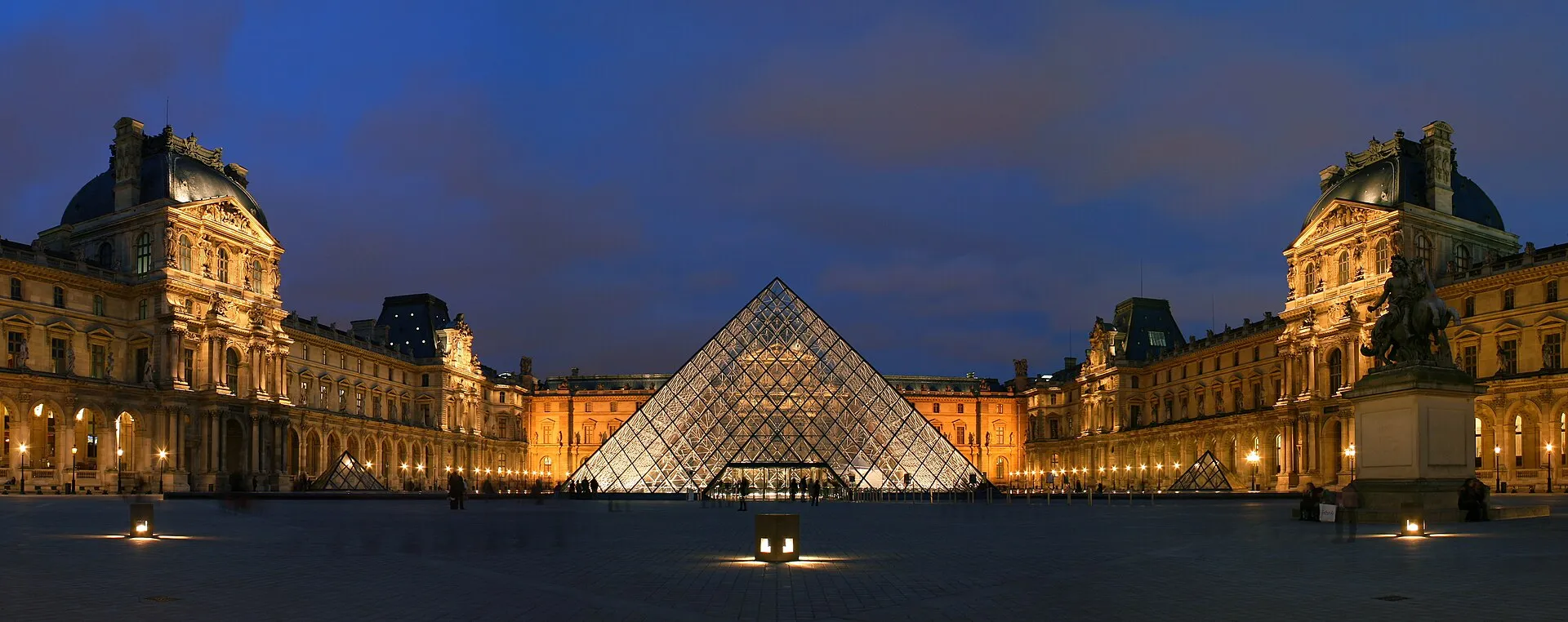
I. M. Pei's 21-metre glass pyramid crowned President Mitterrand's Grand Louvre project, unifying the wings around a single subterranean entrance and becoming a modern Paris landmark.
-
Islamic Art galleries open
A new department for Islamic art opened beneath an undulating golden canopy in the Cour Visconti, adding a wing that had no home when the museum first opened.
When to Visit
Hours: 9 AM - 6 PM, with late evenings on Wednesday and Friday until 9:45 PM. Closed every Tuesday, and on 1 January, 1 May, and 25 December. Last admission is 60 minutes before closing, and staff begin clearing the rooms about 30 minutes before. Best time: a Wednesday or Friday evening, once the day-tour groups have left and the Mona Lisa room finally breathes; the first hour (9-10 AM) and the stretch after 5 PM are the next-quietest windows. Avoid: the middle of the day, weekends, school holidays, and the free first-Friday evenings, when the galleries are at their most crowded. Confirm the current calendar on the museum's official hours page before you travel, as evening openings occasionally change for events.
Admission and Costs
Entry ticket: €22 (about $24) - always book a timed slot online to skip the ticket queue; walk-up tickets sell out on busy days. Free for under-18s, for EU/EEA residents aged 18-25, and for everyone on the first Friday evening of each month from 6 PM (except July and August) and on Bastille Day, 14 July. The Paris Museum Pass includes the Louvre with no separate booking, though you still reserve a time slot. Guided small-group tours: €60-90 (about $65-98) per person for a 2-3 hour skip-the-line visit. Private art historian: €300-500 (about $325-540) for up to six people over three hours. Audio guide: €5 on the museum's handheld player - serviceable for orientation, but no substitute for a guide's context.
The Case for a Guide
With 35,000 works spread across 72,735 square metres, the Louvre without a guide is less a museum visit than a very expensive walk through a crowd — a guide transforms it into a curated journey through nine millennia of human civilization.
- Navigating to the marquee works: Guides chart a purposeful 2-3 hour route through the Denon, Sully, and Richelieu wings that hits the Winged Victory, Venus de Milo, and the Mona Lisa while avoiding the corridors where most visitors lose an hour between signage and cafés.
- Why the Mona Lisa disappoints — and why it shouldn't: Guides explain why Leonardo's portrait is smaller than expected, why the crowds gather, and what Da Vinci's sfumato technique achieves that makes it unlike anything painted before or since — then turn you around to face Veronese's vast Wedding Feast at Cana on the opposite wall.
- Hidden rooms most visitors never enter: The medieval Louvre moat in the Sully basement, the Islamic Art wing's golden-canopied courtyard, and the Egyptian antiquities galleries are all off the beaten tourist path.
- Da Vinci's optical tricks decoded: A guide demonstrates in front of Virgin of the Rocks how Leonardo used atmospheric perspective and anatomical foreshortening to create the illusion of a third dimension on a flat panel.
- Ancient world gems in context: The Seated Scribe, the Code of Hammurabi, and the Assyrian winged bulls of Khorsabad receive a fraction of the Mona Lisa's visitors despite being thousands of years older — a guide ensures you see them with the history that makes them extraordinary.
Tips for Visitors
- Skip the pyramid queue. The glass pyramid is the slowest entrance; enter instead through the Carrousel du Louvre (99 rue de Rivoli, or straight from the Palais Royal - Musée du Louvre Métro), the Porte des Lions, or the Passage Richelieu for pass and advance-ticket holders.
- Book a timed slot online at louvre.fr even if entry is free for you; slots cap the crowd and are required at peak times.
- See the Mona Lisa first or last. Head straight for the Salle des États at opening, or leave it for the final evening hour - the queue is shortest at the ends of the day.
- Plan 3-4 hours minimum. You could spend days here; a well-guided half-day covers the essentials without collapse. Wear comfortable shoes for the marble floors.
- Photography is allowed without flash in most galleries, but not in Napoleon III's Apartments and certain temporary shows.
- Eat before you arrive or bring a snack - the interior cafés are pricey - and use the free cloakroom for coats and bags to move faster through the galleries.
- Pair it with the Left Bank. It is a 15-minute riverside walk to the Musée d'Orsay, making a two-museum day ambitious but doable.
Frequently Asked Questions
What are the opening hours of the Louvre Museum?
Hours: 9 AM - 6 PM, with late evenings on Wednesday and Friday until 9:45 PM. Closed every Tuesday, and on 1 January, 1 May, and 25 December. Best time: Wednesday or Friday evening, when the day-tour groups have gone and the galleries quieten. Least crowded: the first hour (9-10 AM) or after 5 PM. Last admission is 60 minutes before closing, and rooms start emptying about 30 minutes before.
What does admission to Louvre Museum cost?
Entry ticket: €22 (book a timed slot online to skip the ticket line). Free: under-18s, EU/EEA residents aged 18-25, and everyone on the first Friday evening of each month from 6 PM (except July and August) and on Bastille Day, 14 July. The Paris Museum Pass covers entry with no separate booking. Guided small-group tours run €60-90 per person (2-3 hours, skip-the-line); a private art historian is €300-500 for up to six people.
What can visitors see at Louvre Museum with a guide?
A guide charts a purposeful route to the marquee works - the Mona Lisa, Venus de Milo, and Winged Victory of Samothrace - then decodes the symbolism and technique most visitors miss, and enters through the Group entrance to skip the security queue. Expect to cover the essentials in 2-3 focused hours instead of wandering the 72,735 square metres of galleries.
How do you get to the Louvre Museum?
The Métro station Palais Royal - Musée du Louvre (lines 1 and 7) opens directly into the Carrousel du Louvre shopping concourse beneath the museum, the quietest way in. Bus lines 21, 27, 39, 68, 69, 72, and 95 stop nearby, and the Batobus river shuttle calls at the Louvre quay on the Seine. On foot it is about 15 minutes across the river to the Musée d'Orsay and a short walk through the Tuileries toward the Champs-Élysées.
What are the must-see works at the Louvre?
The essential five: Leonardo's Mona Lisa in the Salle des États, the armless Venus de Milo, the Winged Victory of Samothrace poised at the top of the Daru staircase, Delacroix's Liberty Leading the People, and Géricault's Raft of the Medusa. Beyond the paintings, seek out the Code of Hammurabi, the Egyptian Seated Scribe, the Assyrian winged bulls from Khorsabad, and the medieval moat of Philip II's fortress in the Sully basement.