
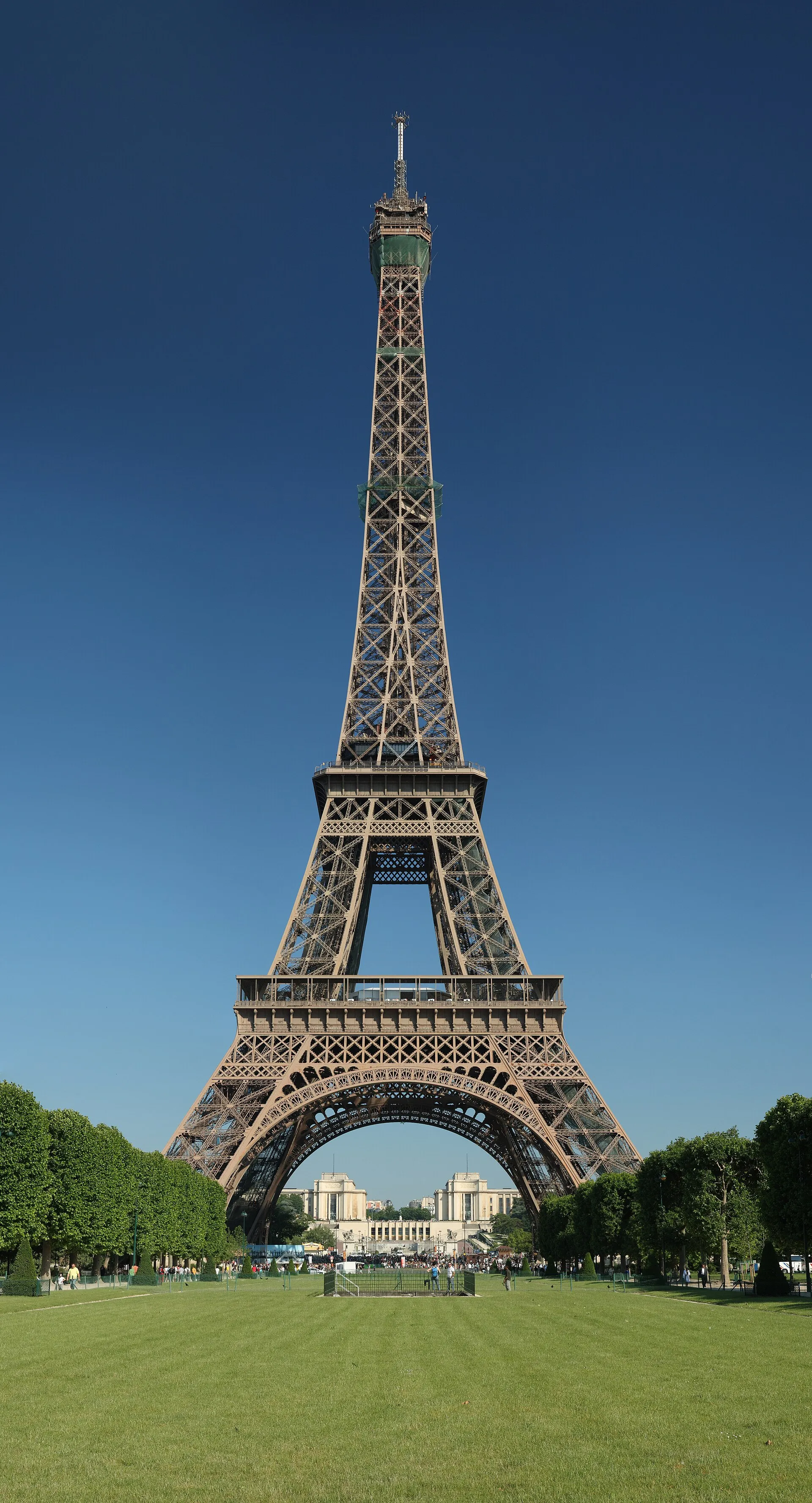
Observation Points
First floor (57 m): a glass floor added in 2014 lets you stand over the void above the entrance esplanade — the least vertiginous level and the roomiest for families. Second floor (115 m): the sweet spot for photography, high enough to read the street plan of Paris yet low enough to pick out individual monuments; the Michelin-starred Le Jules Verne is tucked into its south pillar (book months ahead). Summit (276 m): a double-deck platform whose open-air upper level holds a Champagne bar — a toast at the highest public point in the city — beside a reconstruction of Gustave Eiffel's private apartment. At ground level the classic frame is from the Trocadéro esplanade across the river, while locals favour the diagonal from the Champ de Mars lawns or the ironwork of the Pont de Bir-Hakeim for the hourly sparkle. For a complementary rooftop panorama, climb the Arc de Triomphe.
Engineering Facts
The tower is a study in wind, not weight. Gustave Eiffel's four curved legs were shaped by calculation so that wind load is carried outward and down rather than fought head-on, letting 7,300 tonnes of puddled wrought iron stand 330 metres tall. Crews joined 18,038 individually drawn iron pieces with roughly 2.5 million rivets, and because every part was pre-fabricated in the Levallois-Perret workshops, on-site assembly took just over two years, finishing in early 1889. Heat still moves it: on a hot day the sunward iron expands so the summit leans up to 18 cm away from the sun while the whole structure gains about 15 cm in height. A repaint every seven years takes 60 tonnes of paint applied by hand in three graduated tones of bronze, lightest at the top to sharpen the silhouette against the sky. Slated for demolition when its 20-year permit lapsed, it was saved by the antennas bolted to its crown — first for wireless telegraphy, then for intercepting enemy signals in WWI. Trace the same engineering optimism down the river past the Louvre Museum or along the Champs-Élysées.
Eiffel Tower timeline
-
Ironwork begins
Construction started for the tower that would serve as the entrance arch to the 1889 world fair.
-
World fair opening
The tower opened to visitors and quickly became the most visible symbol of modern Paris.
-
Radio use saves tower
Wireless experiments helped justify keeping the structure after its original concession period.
-
Loses tallest title
After 41 years as the world's tallest structure, the tower was overtaken by New York's Chrysler Building.
-
Broadcast mast added
A television transmitter bolted to the crown raised the tower's overall height and cemented its second life as a broadcasting antenna.
-
Sparkle switched on
20,000 flashbulbs installed for the millennium made the tower shimmer on the hour; the display was kept on permanently from 2003.
When to Visit
Hours run 9:30 AM - 11:45 PM daily from mid-June to early September; outside summer the lifts close earlier, around 6:30 PM, with the last summit ascent roughly 45 minutes before. Crowds are lightest right at opening (9:30-11 AM) and after 8 PM, once the day-trippers thin and the city starts to light up. Aim to be on an upper level at dusk — you catch the skyline in daylight, the slide into night, and then the sparkle: 20,000 bulbs that shimmer for five minutes on the hour, every hour, from nightfall until 1 AM in summer.
Admission and Costs
Tickets are tiered by how high you go and how you get there. Lift to the second floor is about €19.40 ($21); lift all the way to the summit is €29.40 ($32). The thriftiest — and often quickest — option is the staircase to the second floor at €11.30 ($12), 674 steps that rarely sell out even when the lift queue is two hours deep. Under-4s go free and 4-11s pay a reduced rate. A guided small-group tour, typically €50-80 ($54-86) per person, bundles skip-the-line summit access with expert narration; a private guide for up to 6 people runs €250-400 ($270-430). Because timed-entry slots and the stairs-versus-lift choice each save time, the guiding fee is often earned back in queue time on a first visit.
The Case for a Guide
A knowledgeable guide turns a queue-and-selfie experience into a genuine encounter with one of history's most audacious engineering gambles — revealing the stories that plaques and audio guides never reach.
- Eiffel's secret apartment: Gustave Eiffel built a private apartment at the very top of the tower, turning down lucrative offers to rent it — guides explain why, and what he used it for with famous guests like Thomas Edison.
- Radio mast salvation: The tower was scheduled for demolition after 20 years; guides explain exactly how its use as a long-range radio antenna, and then for intercepting German military communications in WWI, saved it from being torn down.
- Construction secrets: Guides decode the precision behind the 2.5 million rivets and why no two of the tower's 18,000 iron pieces are identical — a story invisible to anyone simply riding the lift.
- Best local photo positions: Beyond the Trocadéro cliché, guides know the lesser-used Pont de Bir-Hakeim angle and the Champ de Mars diagonal that locals use for crowd-free shots with dramatic perspective.
- VIP queue strategy: Experienced guides navigate timed-entry windows, the stairs-vs-lift trade-off, and the precise booking tactics that bypass two-hour waits — often saving the full cost of the tour on the first visit alone.
Tips for Visitors
Reserve a dated, timed ticket at toureiffel.paris well ahead — walk-up counters routinely sell out by midday in high season. Arrive via Bir-Hakeim (Métro line 6), Trocadéro (line 9), École Militaire (line 8), or RER C to Champ de Mars-Tour Eiffel, and allow extra time for the airport-style screening at the glass-walled perimeter; large bags and glass bottles are not allowed. Check the forecast before booking the summit, which closes in high winds even when the lower floors stay open. Bring a light layer — it is noticeably cooler and windier at 276 m — and eat before you climb, since the kiosks on the first and second floors cost far more than the cafés around the Champ de Mars.
Frequently Asked Questions
What months are best for going up the Eiffel Tower?
May, June and September pair warm weather with extended evening hours for watching sunset from the summit, and somewhat lighter crowds than the July-August peak when queues can stretch beyond two hours. Late spring and early autumn also bring the clearest air, when visibility can reach 70 kilometres across the Île-de-France. In December and January the hourly sparkle against dark skies is magical from below, though the summit sometimes closes in high winds.
What time does the Eiffel Tower open, and when is it least busy?
Doors open at 9:30 AM daily. From mid-June to early September the lifts run until 11:45 PM (stair entrances close a little earlier); the rest of the year the lifts shut around 6:30 PM, with the last summit ascent roughly 45 minutes before. The thinnest crowds are in the first 90 minutes after opening and again after 8 PM, so an early ascent or a late-evening summit slot both sidestep the midday peak.
Is it cheaper to take the stairs up the Eiffel Tower?
Yes. The staircase to the second floor costs €11.30 ($12) versus €19.40 ($21) by lift, and its 674 steps often move faster than the lift queue at peak times. Only the summit at €29.40 ($32) requires a lift, which you board from the second floor, so many visitors climb the stairs and buy the lift-to-summit upgrade once inside.
How far in advance should I book Eiffel Tower tickets?
Book a dated, timed ticket at toureiffel.paris as early as you can — summit slots can vanish weeks ahead in summer and the walk-up counters often sell out by midday. If the summit shows as sold out online, a second-floor ticket plus an on-site lift upgrade sometimes reopens access to the top once you have passed security.
Is the Eiffel Tower wheelchair accessible?
The esplanade, first floor (57 m) and second floor (115 m) are all reachable by lift, and visitors using a wheelchair pay the reduced elevator fare with a companion admitted free. The summit is the exception: the lift linking the second floor to the top is too narrow for wheelchairs, so the second floor is the highest level a wheelchair user can reach. Accessible toilets sit on the esplanade and first floor, and the glass-floor viewpoints added in 2014 are step-free.
Can you eat at the Eiffel Tower?
Yes, on every level. The first floor holds Madame Brasserie, chef Thierry Marx's all-day restaurant with views up into the tower's legs, alongside a casual buffet; the second floor hides Le Jules Verne, the Michelin-starred dining room reached by a private lift in the south pillar (reserve months ahead). At the summit a Champagne bar pours a glass 276 metres up. Fixed-menu restaurant bookings include your lift access, so you bypass the main ticket queue.
Is it worth going all the way to the summit?
It depends what you are after. The second floor at 115 metres sits close enough to pick out individual landmarks — Les Invalides, the Trocadéro, the bend of the Seine — and is where photographers do their best work. The summit at 276 metres trades that detail for a sweeping, horizon-to-horizon panorama, the open-air Champagne bar, and the reconstruction of Gustave Eiffel's private apartment. First-timers chasing the view usually spring for the top; repeat visitors often stop at the second floor.