
Guided Tours
Musical context: a guide explains the significance of each instrument and manuscript on display, connecting the childhood violin and clavichord to specific compositions rather than leaving them as glass-case curiosities. Leopold Mozart's role: understanding the ambitious father who shaped — and sometimes constrained — his son's career gives emotional depth to the family letters in the rooms. 18th-century Salzburg: the prince-archbishop's court, where music was both art and political tool, formed Mozart's sensibility, and a guide sets the household in that world.
Beyond the museum: guides connect the birthplace to the other Mozart sites a short walk away — the Residenz where he performed, the Cathedral where he was baptised, and the university hall where early works premiered. Debunking myths: separating documented fact from two centuries of romantic Mozart legend is often the most useful thing a knowledgeable guide does here.
Collections Highlights
Child's violin: the small Kindergeige Mozart played as a boy, displayed in the apartment among the museum's most treasured objects. Concert violin: the full-size instrument he used as a working musician. Clavichord: a keyboard of the type young Wolfgang first composed on, the museum's example tied by tradition to The Magic Flute and the Requiem. Family portraits: including the unfinished oil by his brother-in-law Joseph Lange, considered the most faithful likeness of the adult Mozart.
Family letters: correspondence between Wolfgang and Leopold that reveals their complex, sometimes fraught relationship. Period rooms: recreated 18th-century domestic interiors showing the everyday life behind the musical genius. Opera stage models: miniature sets from the operas performed in Mozart's lifetime, in the exhibition on his work for the theatre. Getreidegasse itself: the medieval shopping lane with ornate wrought-iron signs that frames the house — Salzburg's most photographed street.
Mozart's Birthplace timeline
-
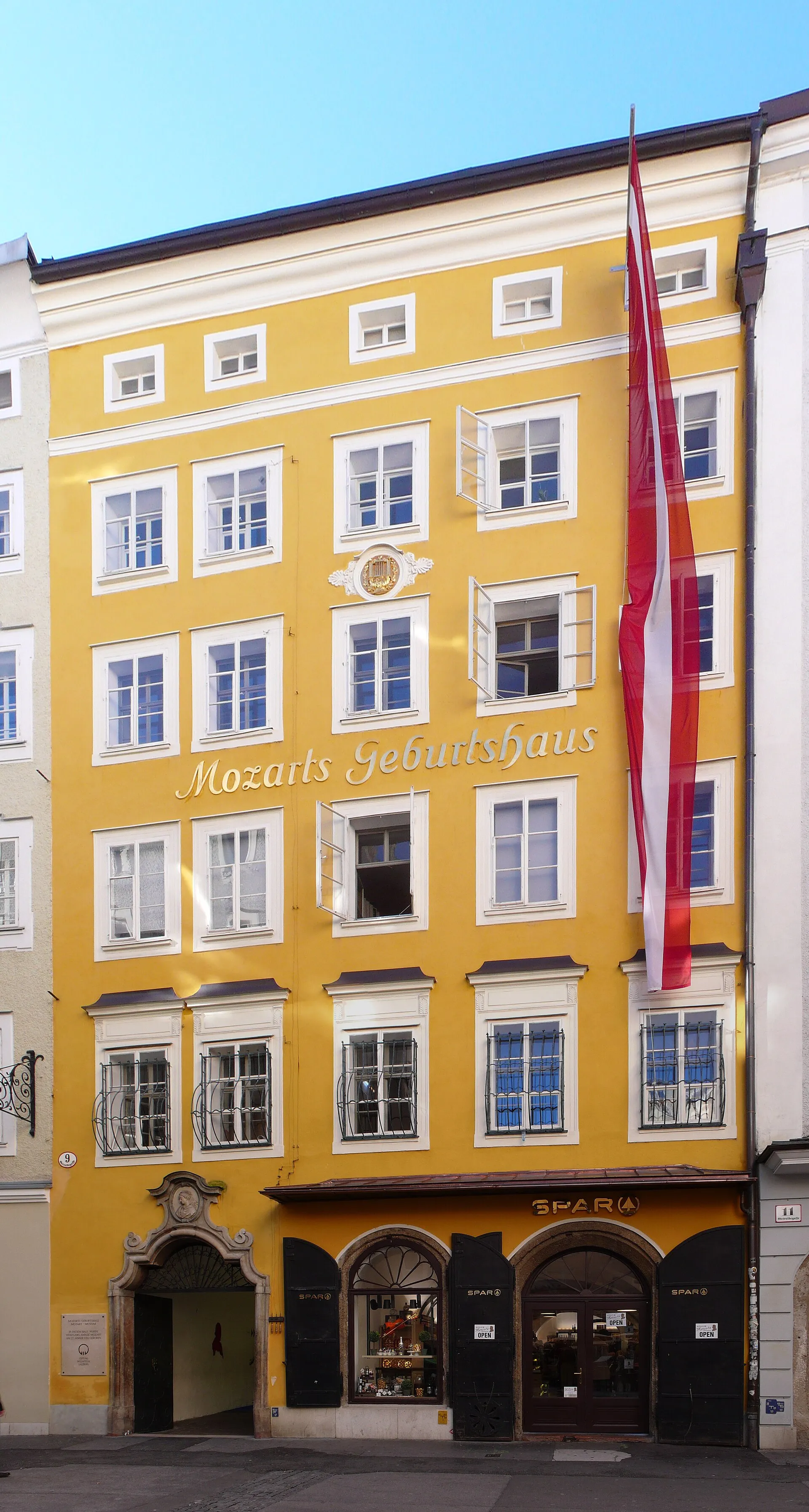
The Mozarts move into Getreidegasse 9
Leopold Mozart, a violinist and composer in the prince-archbishop's court orchestra, rented the third-floor apartment from the merchant Johann Lorenz Hagenauer, a family friend who later received Leopold's famous travel letters.
-
Wolfgang Amadeus Mozart is born
Born on 27 January 1756 and baptised the next day at Salzburg Cathedral as Joannes Chrysostomus Wolfgangus Theophilus Mozart, he was the seventh and last Mozart child, one of only two to survive infancy alongside his sister Nannerl.
-
The family crosses the river
After the European concert tours that made the child prodigy famous, the Mozarts left Getreidegasse for the roomier Tanzmeisterhaus (now the Mozart Residence) on Makartplatz, ending twenty-six years at the birthplace.
-
The apartment opens as a museum
The newly founded International Mozarteum Foundation opened the birthplace to the public, beginning the collection of instruments, portraits and documents that fills the rooms today.
- Today
One of Austria's most-visited museums
The house on its medieval shopping street now draws hundreds of thousands of visitors a year and anchors the UNESCO-listed old town, still cared for by the Mozarteum Foundation.
When to Visit
Open: Daily 9 AM-5:30 PM (last admission 5 PM), with extended summer hours until 6 PM in July and August. Duration: three floors of exhibits reward 45-60 minutes for a thorough visit. Best time: arrive at the 9 AM opening or after 3 PM, when the morning tour groups and Salzach cruise day-trippers have thinned.
Audio guide: included in admission and available in multiple languages, so you can set your own pace through the narrow rooms. The house is busiest around Mozart Week in late January, when the city marks the composer's birthday with concerts.
Admission and Costs
Admission is €14 ($15) for adults, €5 ($5.50) for children aged 6-14, and free for under-6s. A combined ticket with the Mozart Residence across the river costs €20 ($22) for adults and is the natural choice if you want both Mozart museums in one day.
The Salzburg Card (€30-42 / $33-46 for 24-72 hours) includes free entry to both Mozart museums plus the Hohensalzburg funicular and every other major attraction, so it pays for itself quickly on a full sightseeing day. A private music-history guide who covers several Mozart sites across the city runs €160-260 ($175-285) for a half-day.
Tips for Visitors
- Rooms are small and can crowd fast — the original apartment corridors are narrow, so an early or late slot beats the mid-morning coach arrivals.
- No photography inside — the instruments, portraits and documents are protected, so plan to look rather than shoot.
- Walk the street itself — Getreidegasse and its wrought-iron guild signs are half the experience; browse before or after rather than rushing straight in.
- Pair the two Mozart museums — the Mozart Residence at Makartplatz 8 covers the family's later Salzburg years and holds more instruments; the combined ticket links them.
- Try the original Mozartkugel — Café Fürst at Alter Markt, a 3-minute walk away, hand-makes the original 1890 chocolate; the supermarket foil versions are a different recipe entirely.
- One card for everything — the Salzburg Card folds in both Mozart museums and the fortress, the most efficient way to see the old town in a day.
Frequently Asked Questions
When is the best time to visit Mozart's Birthplace?
Open daily 9 AM to 5:30 PM, with last admission at 5 PM, and extended summer hours until 6 PM in July and August. Allow 45-60 minutes for all three floors. The narrow apartment rooms feel calmest at the 9 AM opening or after 3 PM, once the morning tour groups and Salzach cruise day-trippers have moved on. An audio guide is included in admission and offered in multiple languages.
What does admission to Mozart's Birthplace cost?
Adults €14 (about $15), children 6-14 €5 (about $5.50), and under-6s free. A combined ticket with the Mozart Residence across the river is €20 (about $22) for adults. The Salzburg Card covers free entry to both Mozart museums along with the Hohensalzburg funicular and the city's other major sights.
What practical tips help when visiting Mozart's Birthplace?
The original apartment rooms are narrow, so visit early or late to avoid jostling with tour groups, and note that photography is not allowed inside. The Mozart Residence at Makartplatz 8 pairs naturally with a visit, the original Fürst Mozartkugel shop at Alter Markt is a three-minute walk away, and the Salzburg Card covers both Mozart museums plus Hohensalzburg Fortress and the rest of the old town.