
Walking Routes
Federation Square to Hosier Lane (5 minutes): Cross Swanston Street and walk east along Flinders Lane to Hosier Lane — Melbourne's most photographed laneway and the most intensively decorated street art site in the city. The lane runs 120 metres between Flinders Lane and Flinders Street; every surface is repainted regularly, making each visit genuinely different.
Yarra River walk (40 minutes, easy): From the square's southern edge, descend the ramp to Birrarung Marr park and follow the Yarra southbank path east toward the MCG, passing the Aboriginal Scarred Tree, the Federation Bells installation, and the indigenous plantings of Birrarung Marr before crossing the river at the Princes Bridge into Southbank.
Collins Street architecture loop (30 minutes): Walk north from Federation Square on Swanston Street, turn east on Collins Street and walk three blocks to explore the Gothic Revival Town Hall, the Block Arcade (1891, the finest Victorian-era shopping arcade in Australia), the Royal Arcade (1869, the oldest surviving arcade), and the National Trust-listed Block Place laneway — a circuit that compresses 150 years of Melbourne commercial architecture into a single manageable walk.
Local Life
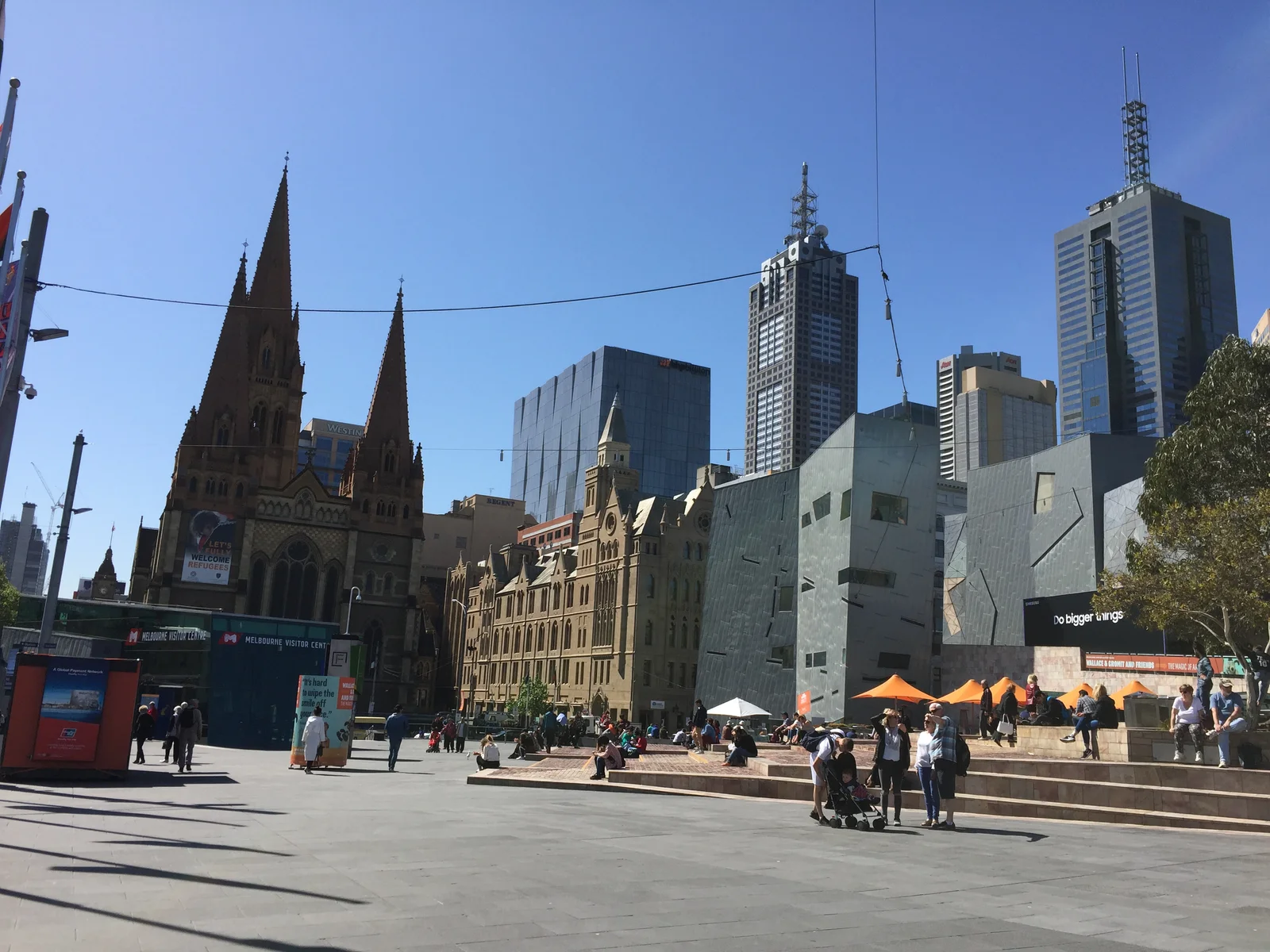
Federation Square functions as Melbourne's informal town square in a way that few planned civic spaces achieve: Melburnians gather here spontaneously for major sporting events broadcast on the big screen (particularly AFL finals and Australian cricket victories), for New Year's Eve countdowns, and for major civic moments. The square's emotional significance was demonstrated most clearly when the 2019 Apple Store proposal was abandoned after public protest — the community reaction revealed that a building people had initially ridiculed had been quietly adopted as genuinely theirs.
The Flinders Street Station forecourt across the intersection is where Melburnians traditionally arrange to meet — "under the clocks" at Flinders Street is as embedded in local conversation as "at the corner of" is in other cities. The combination of station entrance, Federation Square, and the Swanston Street tram corridor makes this intersection the functional centre of gravity for the entire city, the place where any walking tour of Melbourne should begin.
Federation Square in Pictures
When to Visit
Central plaza: Open 24 hours, no entry charge. Ian Potter Centre (NGV Australia): Tuesday to Sunday 10 AM–5 PM, closed Monday. Permanent collection free; ticketed temporary exhibitions A$22–30. ACMI: Open daily 10 AM–5 PM. Permanent gallery free; ticketed exhibitions A$22–27. Koorie Heritage Trust: Monday to Friday 10 AM–5 PM, Saturday 10 AM–4 PM; suggested donation. Major public events — New Year's Eve, AFL Grand Final, Australia Day, and annual cultural festivals — operate extended hours with free entry to the plaza but may restrict access to surrounding areas for management of large crowds.
Admission and Costs
Plaza and public areas: Free. NGV Australia (Ian Potter Centre): Permanent collection free; temporary exhibitions A$22–30. ACMI: Permanent gallery free; temporary exhibitions A$22–27. Koorie Heritage Trust: Suggested donation A$5–10. ACMI guided school programmes: A$8–12 per student (schools only). Architecture tours of the building and plaza with an architectural guide: A$65–120 per person, typically 1.5 hours.
Tips for Visitors
ACMI permanent gallery: The free permanent gallery on screen culture takes 2–3 hours if engaged with seriously — the interactive installation covering video game history alone justifies the visit. Check ACMI's calendar before visiting; temporary shows require separate tickets.
Ian Potter Centre: The NGV Australia collection is consistently undervisited compared to the NGV International on St Kilda Road. The Aboriginal and Torres Strait Islander collection on the ground floor is among the most significant in the country and entirely free.
Events calendar: Federation Square's outdoor screen shows AFL matches and major sporting finals live — the atmosphere during an AFL Grand Final broadcast is genuinely extraordinary. Check the Federation Square events calendar before visiting if spontaneous large crowds are not part of your plan.
Frequently Asked Questions
What is at Federation Square Melbourne?
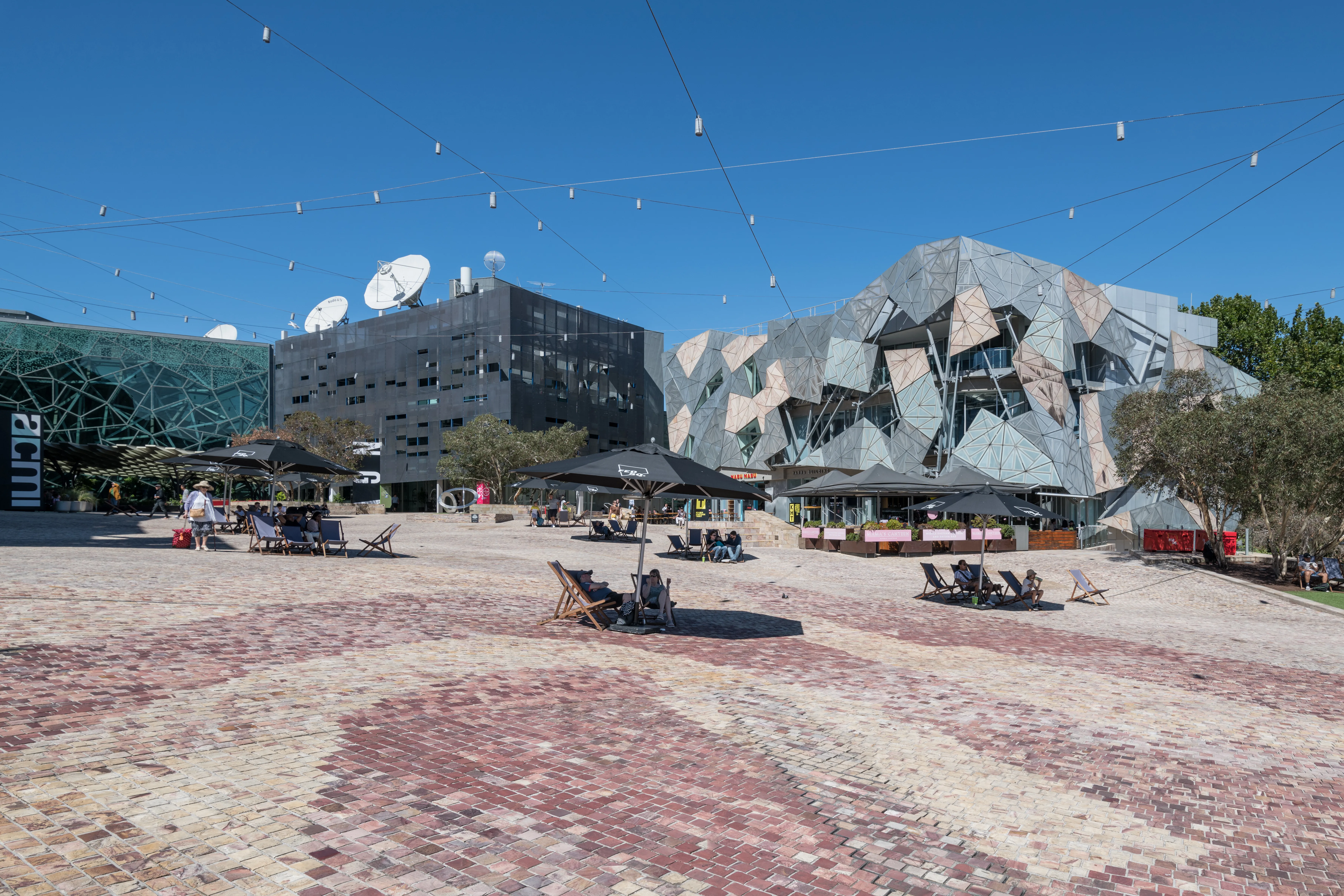
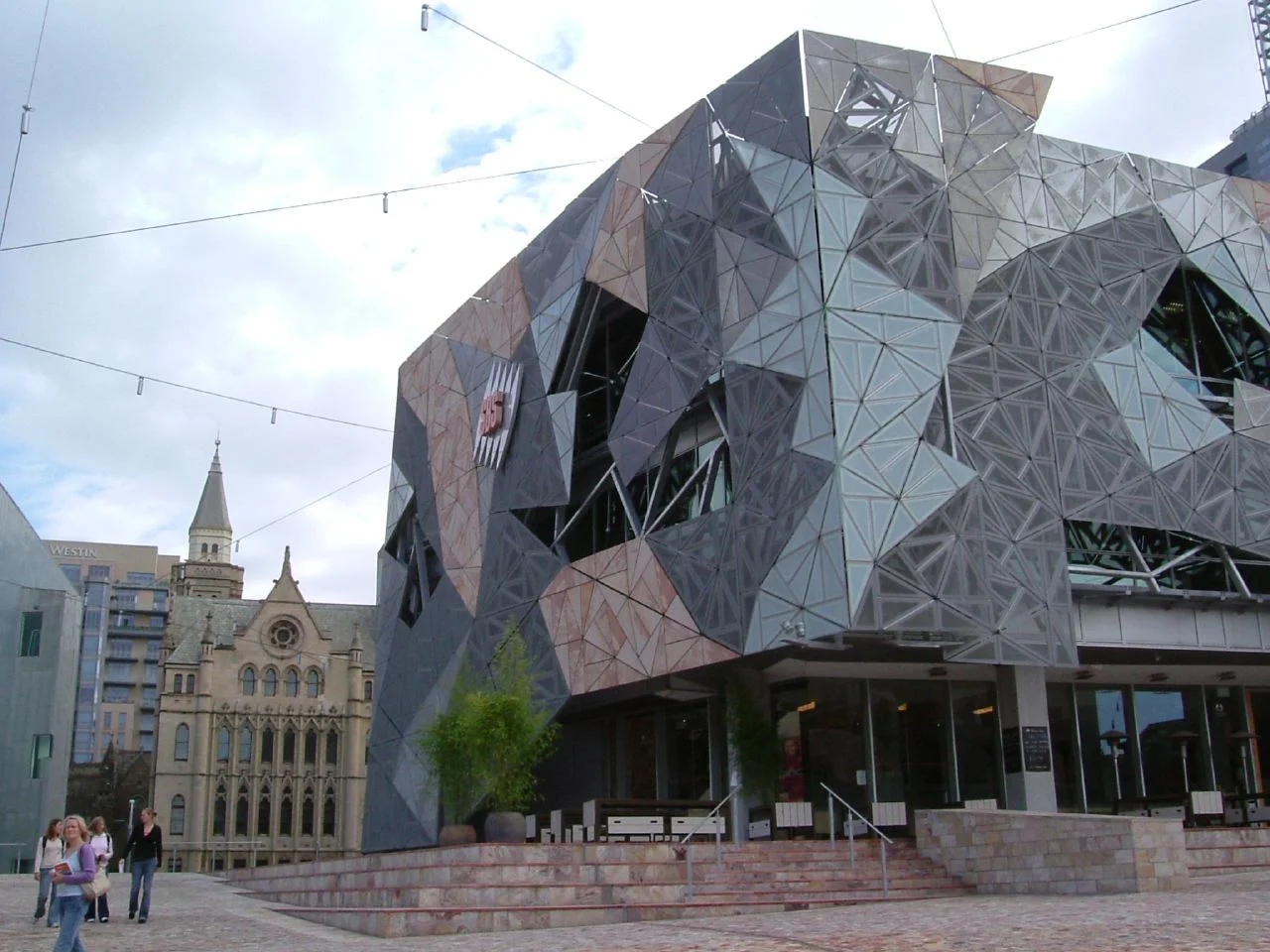
Federation Square contains the Ian Potter Centre (the National Gallery of Victoria's Australian art collection, free entry), the Australian Centre for the Moving Image (ACMI, a museum of film and digital culture), SBS television studios, the Koorie Heritage Trust Cultural Centre, and a large central plaza that hosts over 2,000 events per year. The architecture — designed by Lab Architecture Studio and Bates Smart and completed in 2002 — uses a deconstructivist geometry of fractal panels in ochre sandstone, glass, and zinc, which creates a distinctive façade visible from Flinders Street Station across the intersection.
Is Federation Square free to visit?
The central plaza is a public space open 24 hours with no entry charge. The Ian Potter Centre (NGV Australia) charges no entry to its permanent collection — one of the most significant free cultural experiences in Australia. ACMI has a free permanent gallery covering the history of screen culture, with ticketed exhibitions for major temporary shows (A$22–27 per adult). The Koorie Heritage Trust Cultural Centre has a suggested donation for entry. Most events in the main plaza are free, including New Year's Eve celebrations, AFL Grand Final broadcasts, and cultural festivals, though some concerts and ticketed screenings use the plaza as a venue.
Why was Federation Square controversial when it opened?
Federation Square opened in 2002 after a 10-year planning and construction process that ran significantly over budget (final cost approximately A$467 million against an initial estimate of A$128 million) and was substantially delayed. The architectural design was divisive from the start: the fractured geometric façade was condemned by critics as unsuited to Melbourne's Victorian streetscape while being praised by others as a genuinely bold contemporary statement. The decision in 2019 to allow construction of an Apple Store on the square's southern edge — which would have blocked sightlines and disrupted the plaza's spatial logic — provoked significant public opposition and was ultimately abandoned following protests, cementing Federation Square's status as a genuinely loved public space in the post-controversy period.