
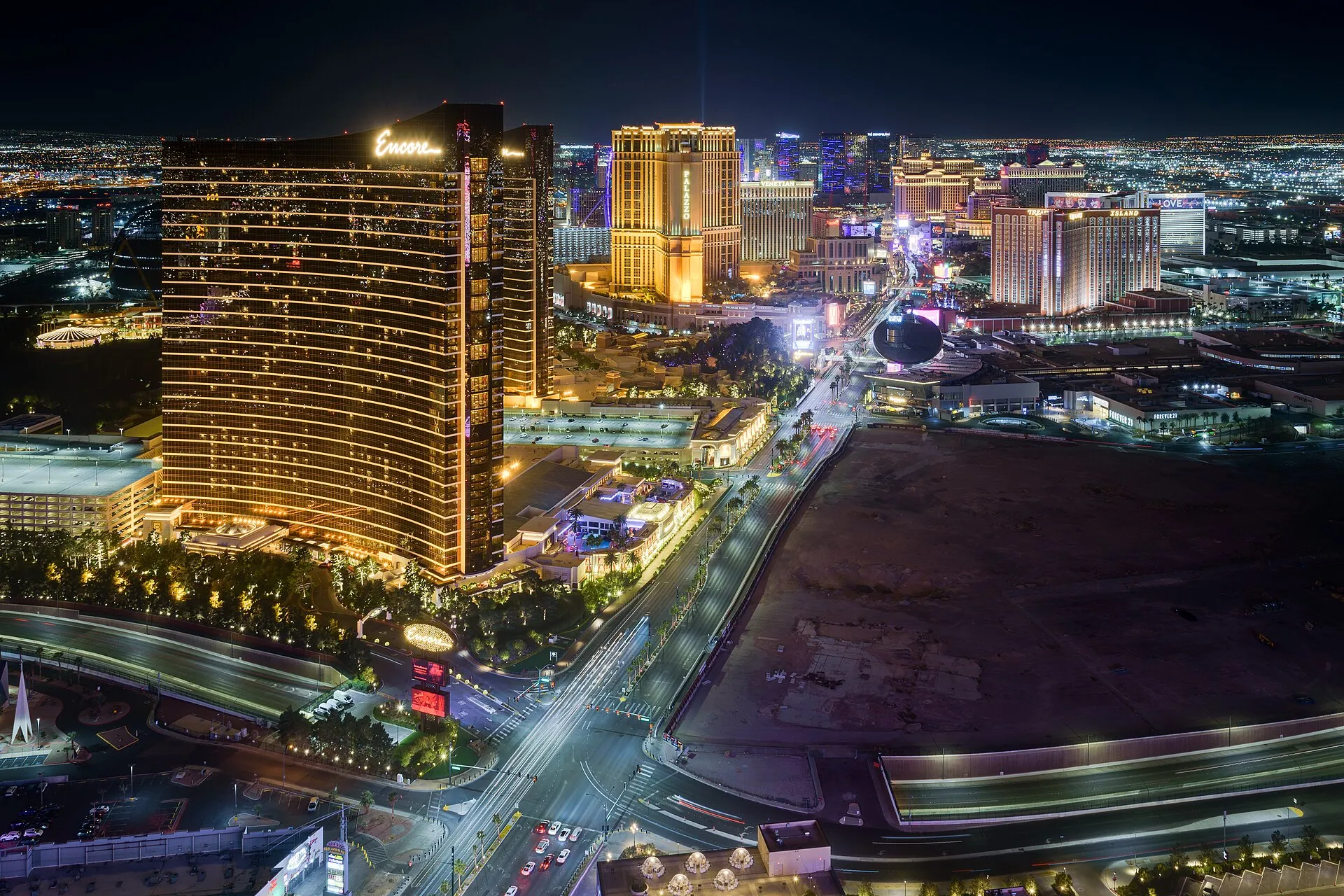
Photo Spots
Dusk is the golden hour for Strip photography, when neon signs and LED facades ignite against the deepening blue sky. The Bellagio Fountains lakefront provides the most iconic shot, with water jets framing the resort towers behind. The elevated pedestrian bridges at major intersections -- particularly the one connecting Aria and Cosmopolitan -- offer unobstructed corridor views of the boulevard stretching to the mountains.
The Paris Las Vegas Eiffel Tower observation deck (460 feet up) delivers an aerial perspective that captures the Strip's scale from above. At street level, the Venetian's replica Piazza San Marco and the colonnaded entrance to Caesars Palace offer European-flavoured backdrops unique to this city. After dark, long-exposure shots from the High Roller capture the Strip as a river of light winding through the desert.
Landmarks Along
Bellagio Fountains: Choreographed water show with 1,200 nozzles shooting 460 feet high, free to watch from the lakefront promenade. Eiffel Tower Experience: Half-scale replica at Paris Las Vegas with an observation deck 460 feet up offering panoramic Strip views.
Venetian gondola rides: Indoor Grand Canal with singing gondoliers beneath a painted sky ceiling. High Roller observation wheel: 550-foot views over a 30-minute rotation. Shark Reef Aquarium: Mandalay Bay's 1.6-million-gallon facility housing sharks, rays, and sea turtles. Caesars Palace Forum Shops: Indoor sky that cycles through day and night, with trompe-l'oeil ceiling paintings and animatronic fountain shows.
When to Visit
Hours: Public street open 24/7, casinos never close. Best for walking: Early morning (6-9 AM) before heat and crowds. Best for photos: Dusk (6-8 PM) when lights illuminate against evening sky. Fountain shows: Bellagio every 30 minutes afternoon, every 15 minutes after 7 PM.
Most crowded: Friday-Saturday evenings, holidays, and convention weeks. Quietest stretches: Tuesday and Wednesday mornings, when the boulevard is almost peaceful enough to hear the fountains from a distance. Summer heat: From May through September, daytime temperatures regularly exceed 110 degrees F -- plan outdoor walking for early morning or after sunset.
Admission and Costs
Walking The Strip: Free. Las Vegas Monorail: $5 single ride, $13 day pass (east side only). Casino attractions: $20-35 each (Secret Garden, Shark Reef, etc.). Guided walking tours: $30-50 per person (3-4 hours, hotel interiors).
Private guide with vehicle: $250-400 for up to 6 people (covers more ground). Photo tours: $60-90 per person (best angles, nighttime shots). High Roller observation wheel: $25-37 for a 30-minute rotation with panoramic views of the entire Strip.
The Case for a Guide
Walking the Strip without context is like reading a novel with half the pages missing. Every mega-resort along this famous stretch was built by visionaries, gamblers, and occasionally mobsters who left behind stories that no plaque or pamphlet can adequately tell. A knowledgeable guide brings Caesars Palace to life with tales of its original owner's ambitions, points out the blown-glass flower canopy suspended over the Bellagio lobby, and explains the engineering behind the Venetian's indoor canals. Just as valuable is navigation: the casinos are deliberately laid out like mazes to keep guests circling the slot machines, and an experienced guide knows every air-conditioned shortcut, tram connection, and pedestrian bridge on the boulevard.
A good Strip guide typically adds value by:
- Decoding the history -- the mob-era backstories, original owners, and long-demolished landmarks behind today's themed resorts.
- Solving the maze -- the fastest indoor routes between casinos so you spend the walk in air conditioning rather than in the sun.
- Timing the free shows -- lining up the Bellagio fountains, the Forum Shops animatronics, and hotel lobby displays so nothing is missed.
- Connecting the region -- pairing the boulevard with a High Roller ride, a Hoover Dam day trip, or a Grand Canyon tour from the same base.
Tips for Visitors
Walking distances: South Strip to North Strip is 4+ miles -- allow 90+ minutes. To cover the full boulevard without walking, the RTC's double-decker Deuce bus runs Las Vegas Boulevard around the clock and continues downtown to Fremont Street, while the Las Vegas Monorail is faster but serves only the east side behind the resorts. Hotel shortcuts: Cut through casinos to avoid outdoor heat -- guides know all connections. Pedestrian bridges: Essential for crossing the Strip safely -- Clark County routes foot traffic over the overpasses, so there are no street-level crossings at major intersections.
Free attractions: Fountain shows, hotel lobbies and conservatory displays, people-watching. Hydration essential: Desert air and walking require constant water intake. Casino navigation: Deliberately confusing layouts -- guides save time getting through. For a change of pace, that same vintage neon downtown on Fremont Street shows what Las Vegas looked like before the mega-resorts arrived.
Frequently Asked Questions
What are the best times of day to walk The Strip?
Hours: Public street open 24/7, casinos never close. Best for walking: Early morning (6-9 AM) before heat and crowds. Best for photos: Dusk (6-8 PM) when lights illuminate against evening sky.
Is The Strip free to visit?
Walking The Strip: Free. Las Vegas Monorail: $5 single ride, $13 day pass (east side only). Casino attractions: $20-35 each (Secret Garden, Shark Reef, etc.). Guided walking tours: $30-50 per person (3-4 hours, hotel interiors).
How far is it to walk The Strip and what shortcuts exist?
Walking distances: South Strip to North Strip is 4+ miles -- allow 90+ minutes, or use the Deuce bus, monorail, or Uber. Hotel shortcuts: Cut through casinos to avoid outdoor heat -- guides know all connections.
What is the best way to get around The Strip without walking?
For the full length of the boulevard, the RTC double-decker Deuce bus runs Las Vegas Boulevard 24 hours a day and continues downtown to Fremont Street, making it the cheapest way to cover ground. The Las Vegas Monorail is faster but only serves the east side behind the resorts ($5 single ride, $13 day pass). Free hotel trams also link a few neighbours -- Bellagio to Park MGM and Mandalay Bay to Excalibur.