
Formation
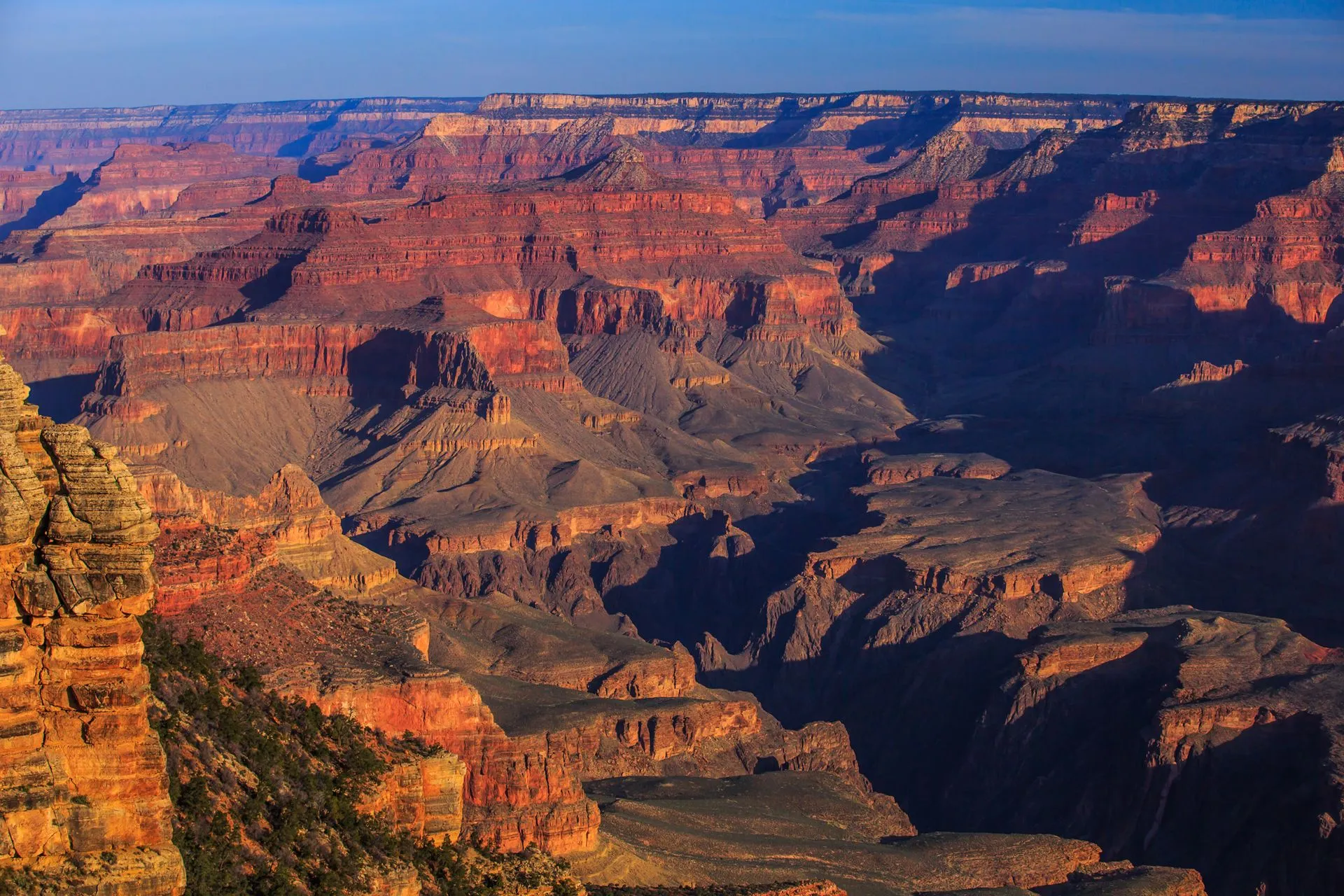
The canyon exists because two forces worked against each other over deep time: the Colorado Plateau slowly lifted the land nearly a mile above sea level, while the Colorado River kept cutting straight down through it. Geologists date the carving of the modern gorge to roughly the last 5-6 million years -- a blink beside the far older rock it exposes. Most of the deepening happened as the uplift steepened the river's gradient and gave it the energy to saw through one rock layer after another.
Read from rim to river, the walls stack like a library shelved in reverse: pale Kaibab Limestone, laid down in a warm sea about 270 million years ago, caps both rims; below it the cliff-forming Redwall Limestone and older sandstones record vanished oceans and coastlines. Near the bottom the neat layers stop abruptly at the Great Unconformity, a single contact where flat sedimentary beds rest directly on ancient crystalline basement -- more than a billion years of missing history worn away before the sea returned. A guide who can point out that line turns a wall of colour into a readable calendar of the planet.
Wildlife
California condors: The Grand Canyon is one of the best places in the world to spot these critically endangered birds, reintroduced to the area in 1996 -- their 9.5-foot wingspan makes them unmistakable soaring above the rim. Mule deer: Common along the South Rim trails, especially at dawn and dusk near Bright Angel Lodge and the Greenway Trail.
Bighorn sheep: Desert bighorn sheep navigate the canyon's steep terrain with remarkable agility, most often spotted on the Bright Angel and South Kaibab trails. Elk: Large herds roam the South Rim forests and are frequently seen near the visitor centre and El Tovar Hotel, particularly in autumn. Rock squirrels: Ubiquitous at every viewpoint -- do not feed them, as they bite and carry diseases. Ravens: Intelligent and bold, canyon ravens are expert food thieves at picnic areas. The inner canyon supports an entirely different ecosystem from the rim, with ringtail cats, collared lizards, and pink rattlesnakes adapted to the desert heat below.
Trails
Skywalk glass bridge: West Rim only, walk 70 feet out over the canyon edge on a horseshoe-shaped glass platform -- not for those with vertigo, but the views straight down 4,000 feet are extraordinary. Helicopter landing: Descend 4,000 feet to the canyon floor for a champagne toast beside the Colorado River, available on West Rim helicopter tours.
Mather Point: South Rim's most accessible and dramatic viewpoint, a 5-minute walk from the main visitor centre with panoramic views spanning 180 degrees across the canyon. Yavapai Point: South Rim geology museum with panoramic windows and interpretive exhibits that explain the visible rock layers. Desert View Watchtower: A 70-foot stone tower designed by architect Mary Colter in 1932, modelled after ancestral Puebloan towers, with interior murals by Hopi artist Fred Kabotie. Eagle Point: West Rim's signature viewpoint, named for a naturally formed rock resembling an eagle with outstretched wings. Guano Point: West Rim 360-degree views with the remains of an aerial tram once used to transport bat guano from a cave across the canyon.
When to Visit
Tour duration: Full day (10-14 hours) including travel time. Departure times: Early morning (6-7 AM) for the best light and cooler temperatures at the rim. Best seasons: March-May and September-November when rim temperatures range 60-80 degrees F.
Summer caution: Rim temperatures can exceed 100 degrees F, and inner canyon temperatures soar even higher -- bring sun protection and extra water. Winter access: South Rim open year-round (occasional snow enhances the views dramatically); West Rim is weather-dependent. Return timing: Most tours return to Las Vegas by 7-9 PM, in time for evening activities on The Strip or Fremont Street.
Admission and Costs
West Rim bus tour: $100-150 per person (includes Hualapai tribal admission). South Rim bus tour: $180-250 per person (longer drive, National Park entrance included). Helicopter tours: $300-500 per person (West Rim landing with canyon-floor champagne toast, 4 hours total). Airplane and helicopter combo: $400-700 per person (includes Skywalk).
Private guide and driver: $800-1,200 for up to 6 people, with customised itineraries and flexible pacing. Skywalk glass bridge: $25 add-on at the West Rim (not included in most basic tours). South Rim individual entry: $35 per vehicle if driving independently (National Park annual pass accepted). Budget tip: West Rim bus tours offer the lowest cost for a Grand Canyon experience from Las Vegas, but the South Rim delivers the more iconic and dramatic views.
The Case for a Guide
The Grand Canyon is overwhelming in its sheer scale, and without context most visitors spend their time at overlooks taking photos without understanding what they're actually seeing — a guide reframes those identical orange-and-red walls into a comprehensible geological and human story.
- South Rim vs. North Rim distinction: A guide explains that the South Rim is open year-round and receives 90% of visitors, while the North Rim closes in winter due to snow access, sits 300 meters higher, and offers a dramatically different perspective — critical information for planning any multi-day trip.
- Havasupai tribal history and permit system: The Havasupai have lived inside the canyon for over 800 years; a guide explains that the spectacular Havasu Falls area requires permits that are released in a single online lottery each February, and provides the strategy for securing one before they vanish within minutes.
- Geological time made tangible: The bottom of the canyon exposes 1.8-billion-year-old Vishnu Schist, the oldest exposed rock in North America; a guide translates the geological column into human terms — each meter of vertical rock represents roughly two million years of Earth history, making the rim-to-river descent a journey through almost half of Earth's existence.
- Skywalk vs. helicopter descent comparison: Both experiences at the West Rim cost premium prices; a guide who knows both explains that the Skywalk offers dramatic glass-floor vertigo but a static view, while the helicopter descent puts you at river level where the scale is genuinely incomprehensible.
- Colorado River rapid rating system: The river's rapids use a unique 1-10 scale rather than the standard 1-6 used on other rivers; a guide explains why the Colorado's system was invented separately and which rapids — Lava Falls at 10, Crystal at 8-9 — define the rafting experience for those considering a multi-day trip.
Tips for Visitors
Book at least 2-3 days in advance during peak season (March-May, September-November) -- popular helicopter tours and South Rim small-group excursions sell out. Bring at least 2 litres of water per person, sunscreen, a hat, and comfortable walking shoes. Temperatures at the rim can be 20-30 degrees cooler than Las Vegas, so pack layers for early morning departures.
West Rim vs South Rim: The West Rim is closer (2 hours) and offers helicopter landing options and the Skywalk, but the South Rim (4.5 hours) is the true National Park with the most iconic viewpoints including Mather Point, Yavapai Point, and Desert View Watchtower. Photography timing: Morning light at the South Rim paints the canyon walls in warm gold and red; afternoon light at the West Rim creates maximum depth and shadow at Guano Point. Combine with other day trips: Some multi-day itineraries pair the Grand Canyon with Hoover Dam stops along the route, or add a nearer half-day at Red Rock Canyon right on the edge of the city.
Frequently Asked Questions
How long does a Grand Canyon day trip from Las Vegas take, and when do tours depart?
Full-day trips run 10-14 hours door to door. West Rim coaches usually leave around 7 AM, while the more distant South Rim departs as early as 6 AM to reach the classic viewpoints before the midday crowds build. March-May and September-November bring the mildest rim temperatures, roughly 60-80 degrees F.
Which is better from Las Vegas, the West Rim or the South Rim?
The West Rim sits about 2 hours away on Hualapai tribal land and is the only rim with the Skywalk and canyon-floor helicopter landings. The South Rim is 4.5 hours away but is the true National Park, home to the iconic Mather Point, Yavapai Point, and Desert View Watchtower. Day trips reach the West Rim comfortably; the South Rim makes for a long but far more scenic 12-14 hour outing.
What should I pack for a Grand Canyon day trip, and how cold does the rim get?
The rims sit near 6,600-7,000 feet and run 20-30 degrees cooler than the Las Vegas valley, so bring layers and a windproof jacket for the early start, sturdy walking shoes, sun protection, and at least 2 litres of water per person. Winter can dust the South Rim with snow, while summer rim temperatures still climb past 100 degrees F.