
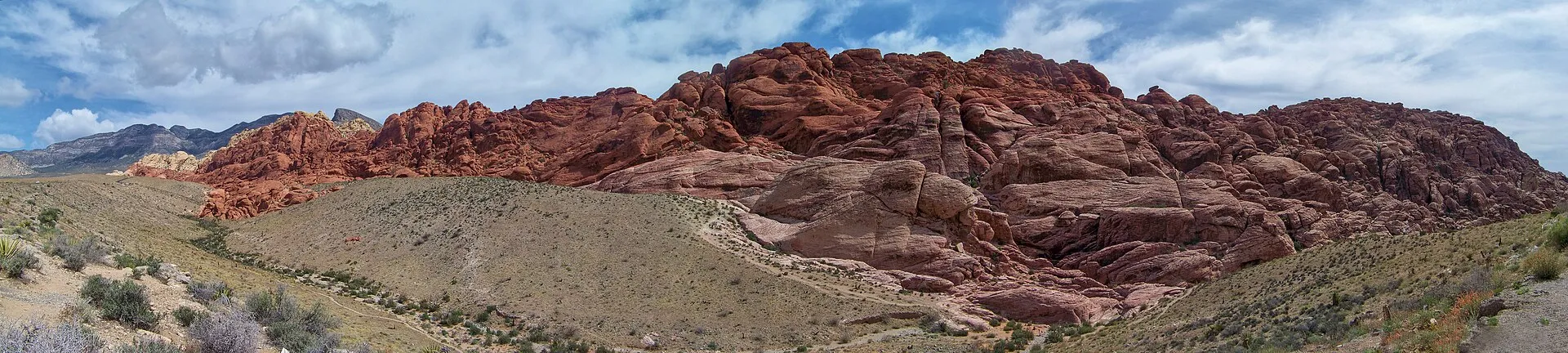
Observation Spots
Formation
Red Rock Canyon is where the geology of the Mojave is written plainly across the cliffs, and the single most important feature is the Keystone Thrust Fault. Around 65 million years ago, the tectonic forces that built the Rocky Mountains shoved a slab of older grey Cambrian limestone -- roughly 600 million years old -- up and over the much younger red Aztec Sandstone. The result is one of the clearest thrust faults on Earth: from the scenic loop you can see grey rock sitting directly on top of red, the older layer resting improbably above the younger one.
Two other processes give the canyon its colour and shape:
- Petrified dunes. The crimson and cream Aztec Sandstone began as a vast Sahara-scale desert of wind-blown dunes in the Jurassic. Cross-bedded ripples frozen into the cliff faces still record the direction those ancient winds once blew.
- Iron staining. The vivid red bands come from hematite -- iron oxide -- that leached through the porous sandstone and rusted; the cream and white zones are simply where the iron was bleached out. A guide who reads these colour boundaries can trace where ancient groundwater once flowed through solid rock.
Wildlife
Red Rock's desert supports far more life than a first glance suggests, and knowing where to look transforms the drive. Desert bighorn sheep -- Nevada's state animal -- are the canyon's most prized sighting, often picked out on the rocky slopes above the loop near the Calico Hills and along the escarpment in early morning and late afternoon. Wild burros, descendants of mining-era animals, graze near road pullouts and trailheads, especially at dawn.
The desert tortoise, a federally threatened species, emerges from its burrow during spring and fall; never touch or pick one up, as the stress can make it void the water reserves it depends on to survive. Overhead, red-tailed hawks and golden eagles soar along the cliffs, most visible during spring migration, while the Gila monster -- Nevada's only venomous lizard -- keeps to the rocks and is rarely seen thanks to its largely nocturnal habits. Listen, too, for the cascading song of the canyon wren echoing off the walls. Guides trained in desert ecology read tracks, scat, and behaviour that most visitors walk straight past.
Trails
The canyon's trailheads branch off the scenic loop, ranging from flat family strolls to strenuous scrambles:
- Calico Tanks: a 2.5-mile round-trip moderate scramble over sandstone to natural water tanks (tinajas), with a surprise view of the Las Vegas skyline from the top -- the most popular hike in the conservation area.
- Keystone Thrust Trail: a 2.2-mile round-trip easy hike straight to the contact zone where grey limestone sits atop red sandstone, one of the most legible thrust faults on Earth.
- Ice Box Canyon: a 2.6-mile round-trip moderate hike into a narrow, shaded slot canyon that stays cool even in warm weather, ending at a seasonal waterfall during spring snowmelt.
- Pine Creek Canyon: a 3-mile round-trip easy-to-moderate trail through riparian habitat with ponderosa pines and the ruins of the historic Wilson homestead.
- Turtlehead Peak: a 5-mile round-trip strenuous climb to 6,323 feet with panoramic views over the whole conservation area and the Las Vegas Valley.
- White Rock-Willow Springs loop: a 4.5-mile moderate loop passing petroglyph panels left by ancestral Puebloan and Southern Paiute peoples, connecting to Lost Creek for a seasonal waterfall.
When to Visit
- Scenic loop hours: 6 AM to 7 PM (spring/summer) and 6 AM to 5 PM (fall/winter); the visitor centre opens at 8 AM daily.
- How long to allow: the one-way loop takes 30-45 minutes by car without stops, or 2-4 hours with hiking and photography stops.
- Best seasons: October through April, when daytime temperatures sit at a comfortable 50-75 degrees F for hiking.
- Summer caution: temperatures regularly exceed 110 degrees F from June through August -- if visiting then, start at dawn and finish hiking by 10 AM.
- Timed-entry reservations: required for the scenic loop during peak season (roughly October to May, 8 AM-5 PM); book online in advance through recreation.gov.
- Getting there: 30-40 minutes from The Strip via Charleston Boulevard (State Route 159); there is no public transport to the loop, so drive, take a rideshare, or join a guided tour.
Admission and Costs
- Vehicle entry fee: $15 per car; a Red Rock annual pass is $30 for unlimited visits.
- National parks passes: the America the Beautiful pass is accepted for entry.
- Timed-entry reservation: an extra $2 booking fee per vehicle during the peak-season reservation window.
- Visitor centre: free, with outdoor exhibits on geology, wildlife, and cultural history.
- Guided hiking tour from Las Vegas: $80-150 per person for a half-day excursion including hotel pickup and transport.
- Guided scenic drive with naturalist commentary: $60-100 per person.
- Private guide: $200-350 for up to 6 people, with routes tailored to fitness level and interests.
- Rock-climbing guide: $150-300 per person for a half-day introductory session with equipment provided.
The Case for a Guide
Most visitors drive the 13-mile loop, snap a few photos of the red cliffs, and leave with little idea of what they just saw. A guide versed in desert geology and Mojave ecology turns the same route into a coherent story -- the kind of context you cannot read off a roadside pullout.
- The rock, decoded: guides point out the Keystone Thrust where grey limestone rides over red sandstone, and explain why the cliffs are red at all -- iron oxide rusting inside ancient petrified dunes.
- Wildlife you would otherwise miss: trained eyes spot bighorn sheep on the escarpment and burros at the pullouts, and know the etiquette that keeps a threatened desert tortoise alive.
- The right trail for you: rather than default to crowded Calico Tanks, a guide matches the hike to your fitness and the season, steering you to quieter western trailheads like Ice Box Canyon or Pine Creek.
- Logistics handled: securing a scarce timed-entry reservation, timing the visit around the heat and the weekend crush, and arranging transport from the Strip -- all the friction that trips up unprepared visitors.
Tips for Visitors
- Carry water: at least 1 litre per person per hour of hiking; the dry desert air dehydrates far faster than most visitors expect.
- Dress for rock: sturdy shoes with ankle support for uneven trails, plus a hat, sunscreen, and UV-blocking sunglasses -- the desert offers almost no natural shade.
- Expect no signal: cell service is limited throughout the canyon, so download maps and directions before you leave the visitor centre.
- Start early: the loop fills with cars by mid-morning on weekends; arriving at 6 AM means emptier trails and cooler air.
- Calico Hills first: the first major pullout accesses the most photogenic formations and the best short hikes; for solitude, push on to the western trailheads.
- Combine strategically: a morning at Red Rock pairs perfectly with an afternoon on The Strip or an evening under the lights of Fremont Street, the natural counterpoint to Las Vegas's built environment.
Frequently Asked Questions
What are the scenic loop hours and best hiking seasons at Red Rock Canyon?
Scenic loop hours: 6 AM to 7 PM (spring/summer), 6 AM to 5 PM (fall/winter). Best seasons: October through April when temperatures are comfortable for hiking. Summer temperatures can exceed 110 degrees F.
How much does it cost to access Red Rock Canyon?
Vehicle entry fee: $15 per car. Annual pass: $30. Guided hiking tours from Las Vegas: $80-150 per person (half-day, including transport). Guided scenic driving tour: $60-100 per person with naturalist commentary.
What should visitors bring when visiting Red Rock Canyon?
Bring at least 1 litre of water per person per hour of hiking. Wear sturdy shoes with ankle support for rocky trails. Sun protection is essential -- the desert offers almost no natural shade. Cell service is limited throughout the canyon.