
Excavation History
The lost temple was famously rediscovered in 1869 by the English engineer John Turtle Wood, working for the British Museum, who dug for years through the marsh until he struck the foundations several metres below the modern ground level. Later excavation by David George Hogarth in 1904–1905 recovered a rich deposit of votive offerings from beneath the altar, evidence of centuries of worship on the spot.
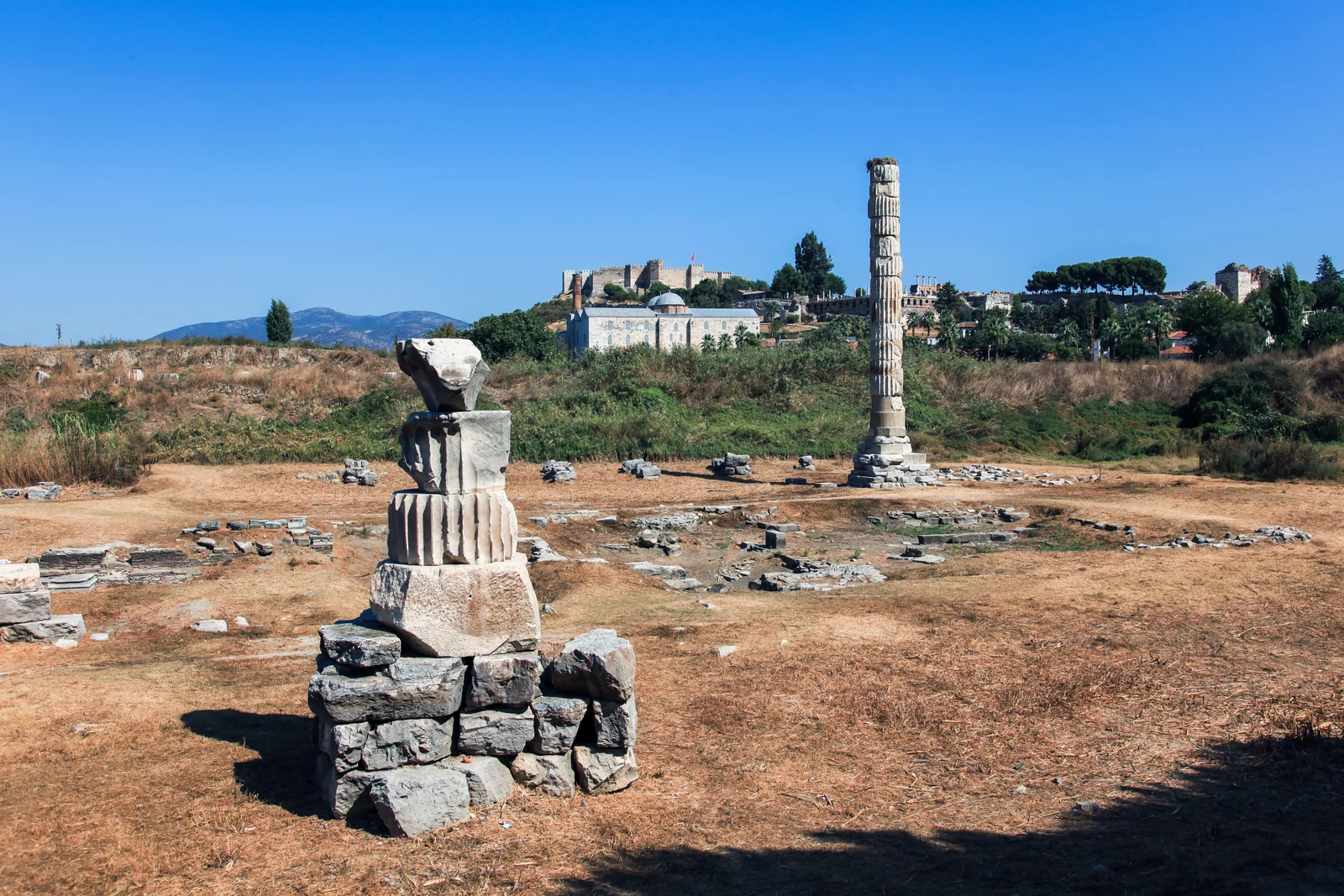
Because the site is waterlogged and the stone was so thoroughly robbed, reconstruction on the ground has been limited to the reassembly of the single column from surviving drums. The layered foundations, however, preserve the sequence of successive temples built on the same sacred site, and study of them has helped establish the chronology of the Croesus temple, its burning, and its Hellenistic replacement.
Key Artifacts
Sculptural fragments and architectural pieces from the temple, including carved column bases and elements of the friezes, are held in museum collections — many recovered by Wood and Hogarth went to the British Museum in London, while other finds and the celebrated statues of Artemis of Ephesus are the highlight of the Ephesus Archaeological Museum in Selçuk. Those cult statues, showing the goddess hung with rows of gourd-like protuberances, are the most vivid surviving evidence of what the temple enshrined.
Hogarth's excavation of the votive deposit produced coins, jewellery and ivory offerings that are among the earliest datable finds from the site, throwing light on the wealth and reach of the sanctuary. To see the temple's real treasures, in other words, you go to the museums; the site itself keeps only its foundations and its fame.
When to Visit
The site is open, flat and quick to see, so it slots easily into a wider day at Ephesus. Because there is little shade, the cooler hours of morning and late afternoon are most pleasant, and the low light does more for the lone column and the ridge of Selçuk castle behind it than the flat glare of midday.
In spring the hollow is often flooded and green, with storks nesting on the column — the most atmospheric time to come — while high summer can leave it dry and dusty. A visit takes only fifteen to twenty minutes, so most people fold it into the walk between the main Ephesus site and the town, or pair it with the Basilica of St John on the hill above.
Admission and Costs
The Temple of Artemis is free to visit — there is no gate and no ticket, and you can walk up to the fenced edge of the foundations at any reasonable hour. This makes it one of the easiest add-ons to a day at Ephesus, with nothing to lose by stopping even briefly.
If you want the wider story, a licensed guide covering Ephesus and its satellites (the temple, the Basilica of St John, and the museum) typically charges in the region of €120–180 ($130–195) for a half-day for a small group. The nearby Ephesus Archaeological Museum in Selçuk, where the finest finds are displayed, has a modest separate admission. Figures are estimates that shift with the exchange rate.
The Case for a Guide
Nowhere at Ephesus is a guide more useful than at a ruin that shows so little. A guide reconstructs the vanished building in words — its size, its 127 columns, its fusion of Greek and Anatolian religion — and threads together the melodrama of its history: Croesus's gold, the arson of Herostratus, the Gothic sack, the centuries of quarrying. They connect the empty platform to the cult statues in the Selçuk museum and to the later Christian Basilica of St John on the hill, showing how one sacred landscape was reused across a thousand years. Without that narration the site is a puzzling field; with it, the lone column becomes a genuinely moving marker of a lost Wonder of the World, and a fitting close to a day that began at the Library of Celsus.
Tips for Visitors
Come with the history in your head, because the site itself supplies almost none — a guidebook description or a guide's commentary is what turns a muddy field into a Wonder of the World. Read up on the scale of the vanished temple before you arrive, then stand at the platform and picture 127 columns where one now stands.
Combine the visit with the Basilica of St John and the Isa Bey Mosque on the slope above, and with the Ephesus Museum in Selçuk, all within a short walk or drive. Spring visitors should look for the storks that nest on the single column; photographers get the best result with the column set against the castle-topped ridge in soft morning or evening light.
Frequently Asked Questions
Why is there almost nothing left of the Temple of Artemis?
The temple was destroyed and rebuilt several times, and the final structure was sacked by the Goths in 268 AD and never restored. Over the following centuries its marble was quarried away for other buildings — including, by tradition, the Hagia Sophia in Constantinople — and the site sank into marsh. What survives today is essentially the foundation platform and a single column reassembled from scattered drums, standing in a watery field.
Who was Herostratus and why did he burn the temple?
Herostratus was a man who, in 356 BC, set fire to the great temple purely to make his name immortal. The Ephesians executed him and forbade anyone to speak his name — a punishment known as damnatio memoriae — yet the story survived anyway, which is why "Herostratic fame" still means notoriety sought through destruction. Legend held that the fire happened the same night Alexander the Great was born.
Is it worth visiting if only one column remains?
That depends on your imagination. There is little to photograph beyond the lone column and the marshy foundations, and many visitors are underwhelmed. But standing on the site of a building that ancient writers ranked among the Seven Wonders of the World — larger than the Parthenon and famous across the Mediterranean — has a quiet power, especially with the Basilica of St John and Selçuk's castle on the ridge behind it. It is free, and only minutes from the main Ephesus site.