
Excavation History
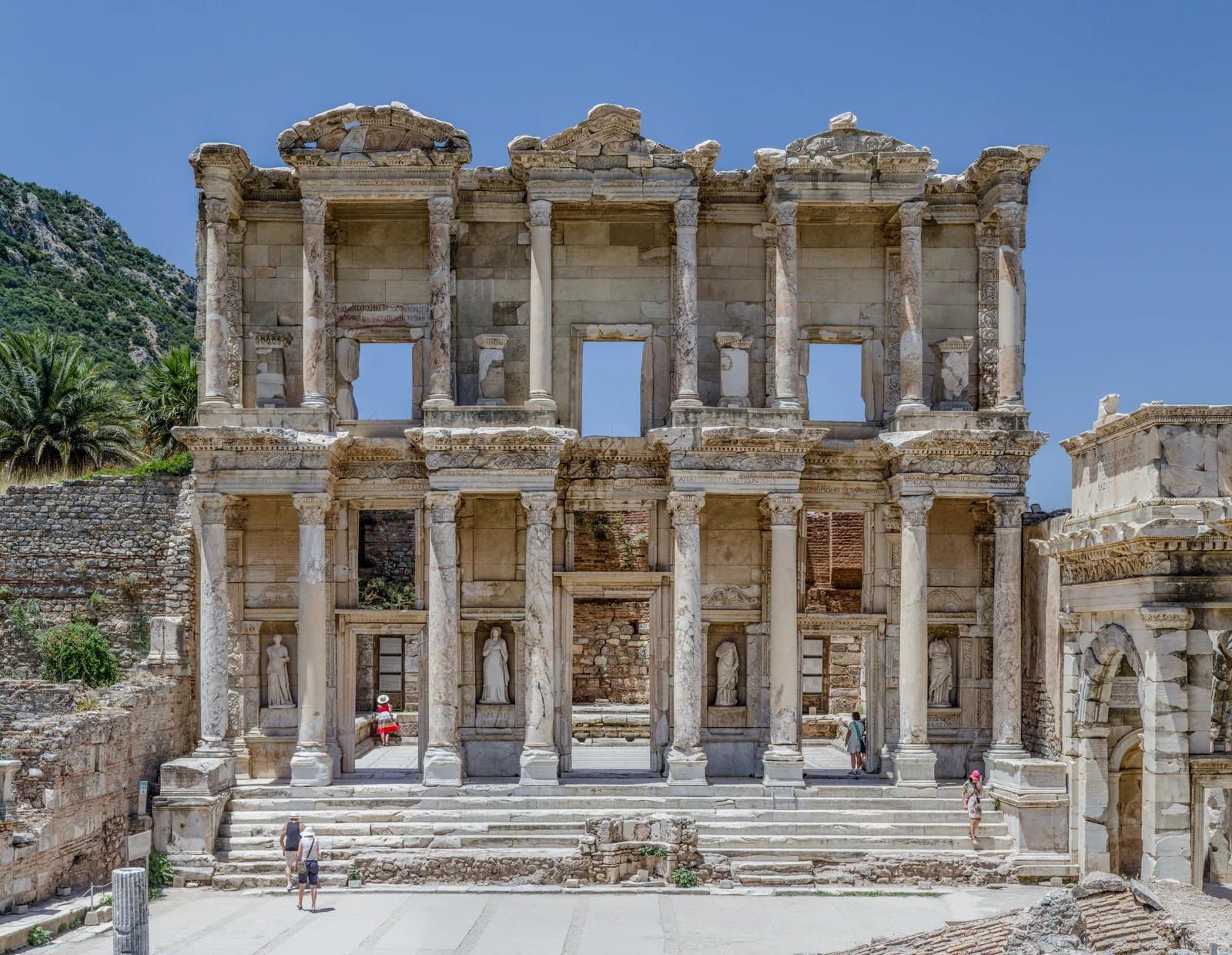
Systematic excavation of Ephesus has been led by the Austrian Archaeological Institute since 1895, and the library was first uncovered in the opening years of that campaign. For decades the facade remained a jumble of fallen blocks lying where the earthquake had dropped them. The great reconstruction — the anastylosis of 1970–1978, directed by the archaeologists Friedrich Hueber and Volker Michael Strocka — involved identifying each surviving stone, determining its original position from its profile and tooling, and re-erecting the front using as much authentic material as possible.
The work was as much detective exercise as engineering: fragments had to be matched across a debris field, and the offset, curved arrangement of the columns had to be reasoned out from the surviving foundations. The result is one of the most celebrated anastylosis projects anywhere, and a large part of why the library, rather than any single temple, has become the emblem of Roman Asia Minor.
Key Artifacts
The building's most important find lies out of sight: the marble sarcophagus of Celsus still rests in the barrel-vaulted burial chamber beneath the reading room, a rare survival that confirms the library doubled as a tomb. The four allegorical statues from the facade — Sophia, Episteme, Ennoia and Arete — are the other headline objects, though the originals are now in Vienna and only casts stand in the niches today.
Inscriptions carved on the podium and the statue bases record the dedication and the endowment Aquila left to buy new books and maintain the building, giving historians unusually direct evidence of how a Roman civic library was funded. Movable finds from the wider site, including sculpture and everyday objects, are displayed in the Ephesus Archaeological Museum in nearby Selçuk, a natural companion visit.
When to Visit
Ephesus is a large, mostly shadeless archaeological site, so timing a visit around the sun matters more than around the library itself. Aim for the first hour after opening or the last two hours before closing, when the light rakes low across the facade and the midday coach crowds have thinned. The library faces broadly east, so morning light strikes it directly and is best for photography; by late afternoon the front falls into softer shade.
April, May, September and October are the ideal months, with warm days and manageable crowds. Midsummer brings fierce heat and the heaviest cruise-excursion traffic from nearby Kuşadası, so if you must come in July or August, be at the gate when it opens. Allow at least half a day for the whole site and expect to spend fifteen or twenty unhurried minutes at the library, ideally returning once the initial crowd moves on toward the theatre.
Admission and Costs
The library has no separate charge — it is included in the single Ephesus site admission, which is paid at either the Upper (Magnesia) Gate or the Lower (Harbour) Gate. Entry runs to a few hundred Turkish lira for an adult, and the Turkey Müzekart covers it for residents; prices are revised regularly with inflation, so confirm the current figure before you travel and carry a card, as gate payment is cashless.
The nearby Terrace Houses require a separate supplementary ticket and are well worth it, but the library, Curetes Street and theatre are all inside the base ticket. A licensed guide for a small group typically costs in the region of €100–160 ($110–175) for a half-day, and audio guides are available at the gates for a modest fee. All amounts are estimates that drift with the exchange rate.
The Case for a Guide
The library rewards a guide more than almost anything at Ephesus, because so much of what makes it remarkable is invisible to the eye. A good guide explains the perspective tricks built into the facade, points out where ancient marble ends and reconstruction begins, and takes you round to the crypt to reveal that this celebrated library is also a father's tomb. They place it in the sequence of the site — the descent from the civic centre, the meaning of the personified virtues, the connection to the Great Theatre and the vanished harbour — so that the ruin reads as a chapter in a city's life rather than a handsome backdrop. For a monument this layered, the difference between looking and understanding is almost entirely the guide.
Tips for Visitors
Walk down through the site from the Upper Gate rather than up from the Lower Gate — the route is gently downhill and delivers you to the library with the facade revealing itself dramatically at the end of Curetes Street. Bring more water than you think you need, a hat, and real sun protection: there is almost no shade on the marble avenues.
For the classic clean photograph, stand back up the street and shoot the facade framed by the columns of the avenue; for the quietest moment, linger until a tour group departs, as they cycle through every few minutes. Look for the Gate of Mazeus and Mithridates, the triple archway to the right of the library that led into the commercial agora, and don't miss the reconstructed crypt doorway at the base of the facade.
Frequently Asked Questions
Is the Library of Celsus a real reconstruction or a modern replica?
It is a genuine reconstruction, not a replica. The technique is called anastylosis — the facade collapsed in an earthquake and lay in a heap of shattered marble for centuries, and between 1970 and 1978 an Austrian Archaeological Institute team catalogued the fallen blocks and re-erected the original stones in their correct positions, filling only the unavoidable gaps with new material. The great majority of what you see is the ancient marble put back where it stood.
Are the four statues on the facade the originals?
No. The four female figures in the niches personify Sophia (wisdom), Episteme (knowledge), Ennoia (intelligence) and Arete (virtue) — the qualities attributed to Celsus — but the ones on site are casts. The originals were taken to Vienna in the early twentieth century and are displayed in the Ephesos Museum there, a point of lasting friction with Turkey.
Who was Celsus and is he buried here?
Tiberius Julius Celsus Polemaeanus was a Roman senator who served as governor (proconsul) of the province of Asia around 105–107 AD. His son, Tiberius Julius Aquila, built the library in his honour and, unusually, had his father entombed in a marble sarcophagus in a vaulted crypt directly beneath the reading hall — making the building simultaneously a public library and a heroon, or monumental tomb.