
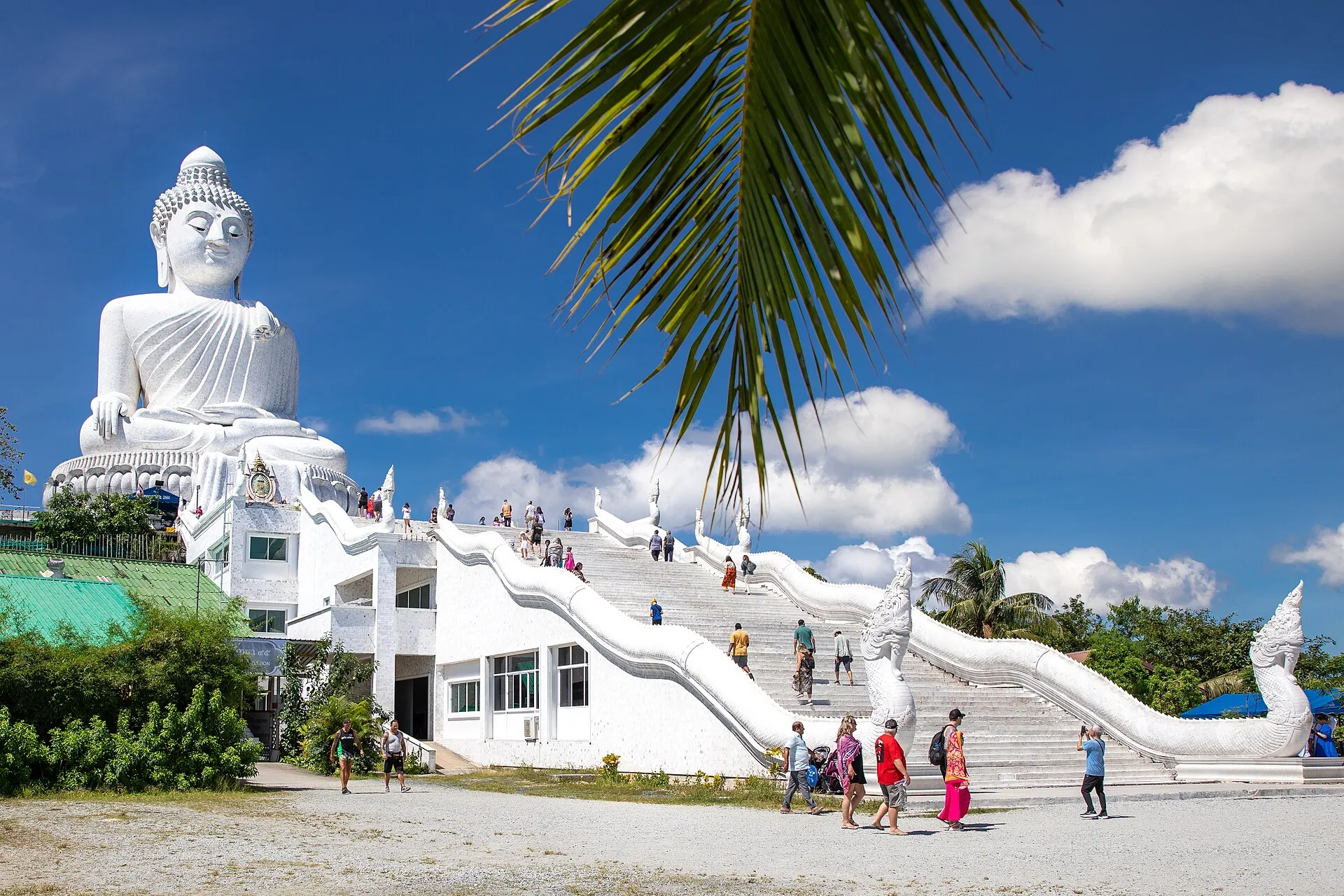
Spiritual Significance
Though barely two decades old, the Big Buddha is a genuine Buddhist devotional site, not merely a viewpoint. The great white figure depicts Maitreya, the Buddha of the future who is believed to appear in a coming age, and its hilltop setting - deliberately raised above Phuket's busy coast - gives worshippers and visitors alike a place of quiet merit-making far from the beach bars below. Every marble tile in the structure is a donated act of merit, so the statue is, quite literally, built from the gifts of the faithful.
- Circling the base: Walk a slow loop around the seated Buddha to take it in from every angle and to find the meditation halls tucked around the platform.
- The bell and gong pavilion: Visitors ring the row of bells for good fortune, a traditional merit-making gesture that fills the hilltop with soft sound.
- The gilded companion Buddha: A smaller golden figure beside the marble colossus offers a second, quieter focus for offerings and incense.
- Donation tiles: The engraved marble plaques carry the names of sponsors worldwide - a tangible record of how the whole monument came to be.
- The panoramic terrace: The 360-degree outlook over Chalong Bay, Kata, Karon and Phuket Town turns the climb into its own form of contemplation.
Visitor Etiquette
The Big Buddha is an active place of worship, so modest dress is not optional: cover your shoulders and knees, and expect to be lent one of the free sarongs at the entrance if you arrive in beach clothes. Remove your shoes before stepping onto the raised Buddha platform and inside the meditation halls, and keep your voice low in these spaces. Photography is welcome, but never climb on the statue, its base or the railings, and avoid posing in a way that treats the Buddha as a prop - guides and staff will gently correct visitors who do.
A little practical courtesy goes a long way on the exposed summit. It is often windy, so secure hats and loose belongings before they blow across the terrace, and there is very little shade, so the midday sun is punishing. If you make a donation - the gift that keeps the site free and funds its continued construction - the engraved-tile stalls and donation boxes are clearly marked. Keep to the paths around the shrines, let those who have come to pray do so undisturbed, and treat the hilltop as the serene counterpoint to Phuket's beaches that it is meant to be.
Big Buddha Phuket timeline
-
Construction begins on Nakkerd Hill
Work on the colossus started atop the previously undeveloped hill between Chalong, Kata and Karon, financed entirely by public donations rather than state or temple funds.
- Late 2000s
The 45-metre statue takes its final form
The reinforced-concrete core rose to its full height and was progressively clad in white Burmese marble, giving the Buddha the pale shell that makes it visible from much of southern Phuket.
- Today
A donation-funded work still in progress
The site remains officially unfinished - fresh marble tiles, shrines and pavilions are still added as donations accumulate, which is why entry stays free and giving is encouraged.
When to Visit
- Hours: Open daily, roughly 6:00 AM - 7:00 PM. Hours can shorten in heavy monsoon weather when the access road is unsafe.
- Best for light: Late afternoon (4-6 PM) for golden-hour warmth on the white marble and sunset over the Andaman.
- Best for calm: Early morning (6-8 AM), before the tour coaches arrive and while the hilltop is still cool.
- Avoid: The middle of the day - the terrace is shadeless and scorching, and the marble throws back a blinding glare.
- How long: Budget 1-2 hours to circle the base, visit the shrines and meditation halls, and take in the views.
Admission and Costs
- Entry: Free - the site is donation-funded. A gift of around ฿100-500 ($3-14) toward maintenance and ongoing construction is appreciated.
- Sponsor a tile: Engraved marble donation tiles start at about ฿1,000 and run to ฿10,000+, carrying the sponsor's name into the fabric of the statue.
- Guided group tour: Roughly ฿800-1,200 ($23-35) per person, typically with hotel pickup and an air-conditioned van.
- Private guide with transport: About ฿2,500-4,000 ($72-115) for up to six people.
- Taxi from Patong: Around ฿600-800 ($17-23) each way, or about ฿1,200 return including waiting time.
The Case for a Guide
The view alone rewards the drive up Nakkerd Hill, but almost everything that gives the Big Buddha meaning
why it is here at all, how a 45-metre statue gets built entirely on spare change, what the Maitreya figure and its hand gesture signify - is invisible without someone to explain it. A good local guide also solves the single biggest practical problem: there is no public bus to the top.
The donation story: A guide explains how the colossus has been raised since 2004 purely on public gifts, why it is still officially unfinished, and what the engraved marble tiles underfoot actually represent - context that turns a photo stop into a living site.
Reading the Buddha: The seated Maitreya, the "Buddha of the future," and the meaning of its mudra (hand position) are easy to walk past; a guide draws out the Buddhist symbolism the marble quietly carries.
Beating the road and the crowds: The steep, winding six-kilometre climb has no bus service and is best driven by someone who knows its sharp turns; guides bring an air-conditioned van and time the visit around the tour-coach rush and the harsh midday light.
Pairing it sensibly: The Buddha sits only about 15 minutes from Wat Chalong, Phuket's most revered temple, and 20 minutes from Kata and Karon beaches, so a guide can thread all three into one unhurried half-day.
Etiquette without the guesswork: At an active worship site a guide quietly steers you on dress, removing shoes, and respectful photography, so you never put a foot wrong.
Tips for Visitors
- Dress modestly. Shoulders and knees must be covered; free sarongs are lent at the entrance if you turn up in beachwear, and shoes come off on the raised Buddha platform and in the meditation halls.
- Bring sun protection. The exposed hilltop has almost no shade and the marble reflects fierce light - a hat, sunglasses and sunscreen are essential, especially at midday.
- Secure loose items. The summit is genuinely windy; hold onto hats, scarves and anything that can blow off the terrace.
- Mind the drive up. The access road is steep with sharp switchbacks - take it slowly on a scooter, or let an experienced guide or taxi driver handle it.
- Combine your visit. Pair the Buddha with nearby Wat Chalong (about 15 minutes away) and the Kata and Karon beaches 20 minutes downhill for a full southern-Phuket outing.
- Photograph respectfully. No climbing on the statue or striking irreverent poses - this is a place of worship as much as a viewpoint.
Frequently Asked Questions
When is the best season to visit Big Buddha Phuket?
January and February are the peak months, with dry skies, gentle sea breezes at the hilltop, and crystal-clear visibility stretching across Chalong Bay and the Andaman Sea from the 360-degree viewpoint. The southwest monsoon from May through October brings heavy rain that can make the winding mountain road treacherous, and cloud frequently obscures the panorama that justifies the climb to the 45-metre statue.
What are the opening hours of Big Buddha Phuket, and when should I go?
The site is open daily from roughly 6:00 AM to 7:00 PM. Come early (6-8 AM) to beat the tour-bus crowds and photograph the white marble before the midday glare, or arrive in the late afternoon (4-6 PM) for golden-hour light and sunset over the Andaman. Avoid the middle of the day, when the exposed, shadeless hilltop is scorching and the marble throws back a blinding reflection.
Is there an entry fee for Big Buddha Phuket?
No. Entry is free and the whole site is funded by donations, so a gift of about 100-500 baht (roughly $3-14) is appreciated and goes toward the statue's ongoing construction and upkeep. You can also sponsor an engraved marble tile from around 1,000 baht. Only the optional guided transport costs money: shared group tours run about 800-1,200 baht ($23-35) per person with hotel pickup, and a private guide with an air-conditioned van is roughly 2,500-4,000 baht ($72-115) for up to six people.
How do you get to Big Buddha Phuket?
The statue sits atop Nakkerd Hill between Chalong, Kata and Karon, reached by a steep, winding six-kilometre road that climbs from the Chalong circle. There is no public bus to the top, so most visitors come by taxi, rented car or scooter, or on a guided tour; a taxi from Patong runs about 600-800 baht ($17-23) each way. It is roughly 15 minutes from Wat Chalong and 20 minutes from Kata and Karon beaches.
What else is there to see at the Big Buddha besides the main statue?
A smaller gilded Buddha stands beside the white marble colossus, and the grounds include a bell and gong pavilion, shrines, meditation halls, stalls selling the engraved donation tiles, and a terrace whose 360-degree outlook takes in Phuket Town, Kata, Karon and Chalong Bay, with the Phi Phi islands visible on clear days. Allow one to two hours to circle the base, take in the views and explore.
What should I wear and know before visiting the Big Buddha?
This is an active place of worship, so cover your shoulders and knees; free sarongs are lent at the entrance if you arrive in beachwear, and shoes come off on the raised Buddha platform and in the meditation halls. The hilltop is windy and offers almost no shade, so bring sun protection and secure loose hats and bags. Keep photos respectful - no climbing on or posing inappropriately with the Buddha.