
Collection Highlights
Moving Image Archive viewing pods
The National Library of Scotland's free access point lets anyone search the catalogue and watch digitised Scottish film — industrial documentaries, amateur reels, newsreels, and home movies spanning more than a century — from a viewing pod, no booking required.
Hunterian Collections Study Centre
A pre-booked tour or research appointment opens the University of Glasgow's main off-display store, a rare chance to see how a national-standard museum keeps, catalogues, and studies objects that never reach a public gallery case.
Antonine Wall Roman stones
Among the Hunterian material held here are Roman altars and carved distance slabs recovered from the Antonine Wall, the frontier's most important surviving assemblage and a tangible link to Roman Scotland.
Instruments of Kelvin and Watt
The store's scientific holdings include instruments connected to Lord Kelvin and James Watt, whose work at and around the University of Glasgow helped shape modern physics and the age of steam.
The 1927 exhibition hall and facade
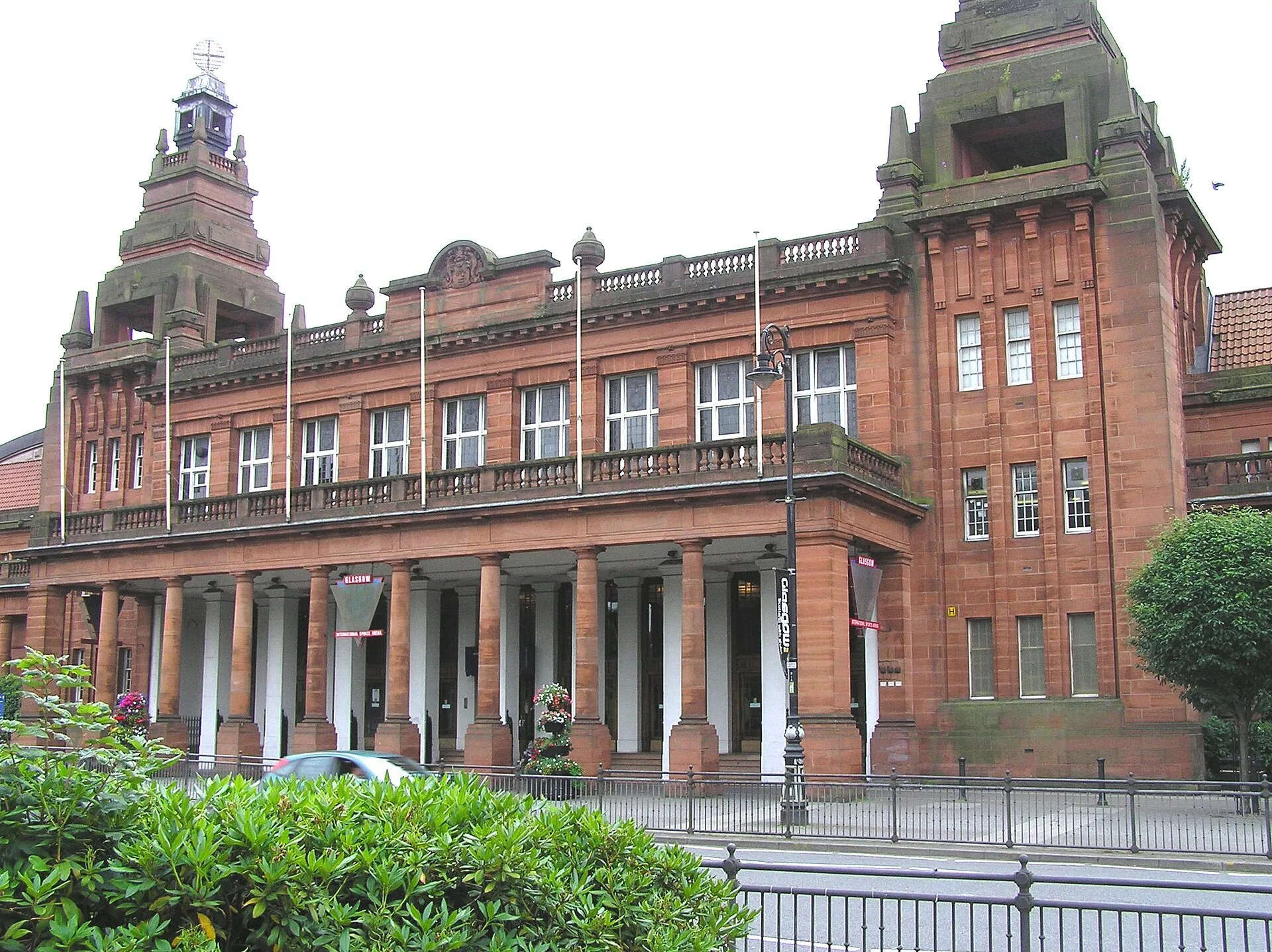
The retained brick shell and long classical Argyle Street frontage are a rare survival of interwar civic architecture, and the sheer internal volume still betrays the building's origins as a great exhibition shed.
Glasgow Club Kelvin Hall
A full Glasgow Life sports centre occupies much of the building, with an indoor athletics track, gym, and fitness suites open to day-pass visitors and members alike.
The Kelvingrove pairing
Directly across Argyle Street stands the free Kelvingrove Art Gallery and Museum, making the two an obvious half-day double-header at the heart of Glasgow's West End.
Collections Highlights
Unlike a conventional gallery, much of what makes Kelvin Hall interesting is the material held behind the scenes — and increasingly opened up to visitors:
- The Hunterian collections store — The University of Glasgow's Hunterian, Scotland's oldest public museum (founded in 1807 on the bequest of the anatomist William Hunter), keeps its main off-display store and a Collections Study Centre here. Its holdings span Roman altars and finds recovered from the Antonine Wall — the Hunterian cares for the world's most important assemblage of that frontier's carved distance slabs — alongside scientific instruments linked to Lord Kelvin and James Watt, zoological and anatomical specimens, coins, and fine art. Booked tours and research appointments let visitors see objects normally locked away in store, a genuinely unusual kind of museum visit.
- The Moving Image Archive — The National Library of Scotland's Moving Image Archive — tens of thousands of items spanning more than a century of Scottish film, from industrial documentaries and amateur reels to newsreels and home movies — has a free public access point at Kelvin Hall, with viewing pods where anyone can search the catalogue and watch digitised material.
- The building itself — The vast 1927 hall, with its long classical Argyle Street frontage and sheer internal volume, is a monument to the confidence of a city that had hosted the international exhibitions of 1888 and 1901 in the park next door. Even reused as a sports and archive venue, the scale of the original exhibition shed is unmistakable, and the retained brick shell is a rare survival of interwar civic architecture.
For most leisure visitors the neighbouring Kelvingrove Art Gallery remains the headline attraction; Kelvin Hall is the rewarding companion for anyone curious about how collections are actually stored, catalogued, and studied.
Guided Tours
Kelvin Hall rewards the kind of context a guide provides, because so much of its significance is invisible from the street. The building's story mirrors Glasgow's twentieth-century arc — from the exhibition-hall confidence of the shipbuilding city that hosted the international exhibitions of 1888 and 1901, through the beloved Christmas circus, to its reinvention as a store and study centre for the national and civic collections. A guide can connect the Hunterian material held here — the Roman stones off the Antonine Wall, the instruments of Lord Kelvin and James Watt — to the wider story of Scotland's museums, and set Kelvin Hall within a West End walking circuit that takes in the Kelvingrove Art Gallery, the University of Glasgow cloisters, and Kelvingrove Park. Behind-the-scenes Collections Study Centre tours — run by the University — are the single most distinctive guided experience the building offers, giving access to objects that are otherwise in secure store.
Kelvin Hall timeline
-
First International Exhibition
Kelvingrove Park hosts Glasgow's first great international exhibition, the confident backdrop against which the West End's civic-culture quarter took shape.
-
Kelvin Hall opens
Thomas Somers's restrained classical exhibition hall replaces a fire-destroyed predecessor to become Glasgow's principal events and trade-show venue.
- 1930s
Carnival and Circus begins
The Christmas carnival and circus takes up residence, becoming a fixture of Glasgow childhood for roughly fifty years.
-
Museum of Transport arrives
Glasgow's transport collection moves into the hall, drawing generations of visitors to trams, locomotives, and a recreated cobbled street.
-
Transport collection departs
The museum decants to the new Zaha Hadid-designed Riverside Museum on the Clyde, leaving the great shed empty and awaiting reinvention.
-
Reopens for culture and sport
The Hunterian's store, the National Library of Scotland's Moving Image Archive, and a Glasgow Life sports centre share the rebuilt interior.
When to Visit
Sports facilities (Glasgow Club Kelvin Hall): broadly Monday–Friday 7 AM–10 PM and Saturday–Sunday 8 AM–8 PM; confirm current hours on the Glasgow Life website. Moving Image Archive access point: free, open on published days during the week — check the National Library of Scotland listing before travelling, as the pods run to set hours. Hunterian Collections Study Centre: by pre-booked tour or research appointment through the University of Glasgow; tours run to a published schedule rather than daily, so plan ahead. The building's exterior — the classical brick facade and the Argyle Street entrance — can be appreciated at any time, and the adjacent Kelvingrove Art Gallery is open daily as the natural companion visit.
Rough time budgets:
- 30–45 minutes — a drop-in browse of the Moving Image Archive pods
- 1–2 hours — a combined study-centre tour and archive browse
- Half a day — a full West End circuit pairing Kelvin Hall with Kelvingrove and the University cloisters
Admission and Costs
Sports facilities: day passes and membership rates vary — check the Glasgow Life website. Moving Image Archive access point: free to walk in and use the viewing pods. Hunterian Collections Study Centre: typically free but requires a pre-booked tour or appointment. Kelvin Hall exterior: free to view at any time. Most Glasgow walking tours anchor on the neighbouring Kelvingrove Art Gallery, but private architectural and social-history tours of the West End that take in Kelvin Hall run £80–150 ($100–190) for up to 6 people (about 2 hours). Group city walking tours that pass through the West End typically cost £15–25 ($19–32) per person. Because so much of what is worth seeing here is free, a guide's fee — rather than any admission charge — is usually the main expense, exactly as it is at the free Kelvingrove Art Gallery and the Necropolis on the other side of the city.
The Case for a Guide
Kelvin Hall's guide value lies less in a fixed display than in interpretation and access:
- Behind-the-scenes collections — A study-centre tour explains how a national-standard museum store actually works, and why an object off display can be as revealing as one in a gallery case
- Popular-culture history — The Kelvin Hall Carnival and Circus that filled this building each Christmas for fifty years is a rich chapter of working-class Glasgow; a guide who can connect it to the city's wider social history adds real depth
- Architectural contrast — Read against the Spanish Baroque of Kelvingrove across the road, Kelvin Hall's stripped 1927 classicism tells the story of changing civic taste between 1901 and 1927
- West End circuit — As one anchor of a wider West End walk — with Kelvingrove, the University, and Kelvingrove Park — Kelvin Hall gives a half-day architectural and cultural route real shape, and slots naturally into a fuller Glasgow itinerary alongside the Cathedral and Necropolis in the east
Tips for Visitors
Treat Kelvin Hall as part of a West End circuit rather than a standalone stop: pair it with the Kelvingrove Art Gallery directly across Argyle Street and the University of Glasgow campus, a ten-minute walk up the hill. If you want the behind-the-scenes Hunterian experience, book a Collections Study Centre tour in advance — it is not a drop-in. The Moving Image Archive access point, by contrast, is free to wander into, and its viewing pods are a quietly absorbing way to spend a rainy Glasgow afternoon. Byres Road, five minutes' walk away, is the spine of the West End's independent café, restaurant, and bookshop culture and rewards a wander before or after.
A few practical notes:
- Photography — the long classical Argyle Street frontage reads best in afternoon light, when the sun swings round to the south-facing brick
- Transport — the nearest Subway stop is Kelvinhall, with Partick station (Subway and rail) about ten minutes further; the building is step-free with on-site pay-and-display parking
- Rainy-day pairing — combine the free archive pods with the free galleries at Kelvingrove for a dry half-day when Glasgow's weather closes in
Frequently Asked Questions
What is Kelvin Hall today?
Kelvin Hall is a shared cultural and sports venue reopened in 2016 after a major redevelopment led by Glasgow Life, the University of Glasgow, and the National Library of Scotland. The University's museum — the Hunterian, Scotland's oldest public museum — keeps its main collections store and a Collections Study Centre here, and the National Library of Scotland's Moving Image Archive has a public access point with viewing pods and a café. A Glasgow Life sports centre (Glasgow Club Kelvin Hall) with an indoor athletics track, gym, and fitness suites occupies the rest of the building.
What was Kelvin Hall historically used for?
Kelvin Hall opened in 1927 as Glasgow's principal exhibition and events venue, replacing an earlier hall on the site that had been destroyed by fire two years earlier. For roughly fifty years, from the 1930s to the 1980s, it hosted the annual Kelvin Hall Carnival and Circus each Christmas — fairground rides, dodgems, and menagerie shows that were a fixed point of Glasgow childhood. It also staged trade fairs, boxing bouts, and motor shows, and from 1988 until 2010 it was the home of Glasgow's Museum of Transport before that collection moved to the new Riverside Museum on the Clyde.
Can you visit the Hunterian collections stored at Kelvin Hall?
Yes, in part. The Hunterian's Collections Study Centre at Kelvin Hall opens for public tours and pre-booked research appointments, giving a rare behind-the-scenes look at objects held in store rather than on display — from Roman finds off the Antonine Wall to scientific instruments, natural-history specimens, coins, and fine art. Access is arranged through the University of Glasgow rather than as a drop-in, so check the Hunterian's website and book ahead. The Moving Image Archive access point, by contrast, is free to walk into during opening hours.
How do you get to Kelvin Hall?
Kelvin Hall sits on Argyle Street in Glasgow's West End. The nearest Subway station is Kelvinhall (a short walk south on Byres Road), and Partick station — served by both the Subway and national rail — is about ten minutes away on foot. Several city bus routes run along Argyle Street and Dumbarton Road. From the city centre it is roughly a 30-minute walk west through Kelvingrove Park, or a few minutes on the Subway's circular line to Kelvinhall or Kelvinbridge.
Is Kelvin Hall worth visiting compared to Kelvingrove next door?
Kelvin Hall and the Kelvingrove Art Gallery sit directly across Argyle Street from one another and make natural companions. Kelvingrove is the primary destination for most leisure visitors — free, vast, and unmissable. Kelvin Hall adds a different, more institutional heritage — the behind-the-scenes world of a working collections store and a century of Scottish film in the Moving Image Archive, plus sports facilities. Pairing the two makes an easy half-day in the West End.
Is Kelvin Hall accessible, and is there parking?
Yes. The rebuilt interior is step-free, with lifts to all public floors, accessible toilets, and level access from the Argyle Street entrance, so the Moving Image Archive access point, café, and sports facilities are all reachable without stairs. There is on-site pay-and-display parking, including Blue Badge bays, and the building sits on flat ground a few minutes from Kelvinhall Subway and Partick's Subway-and-rail interchange. Because the Hunterian material is held in a secure store, the collections themselves are seen only on a booked Collections Study Centre tour rather than by walking a gallery floor.