
Walking Routes
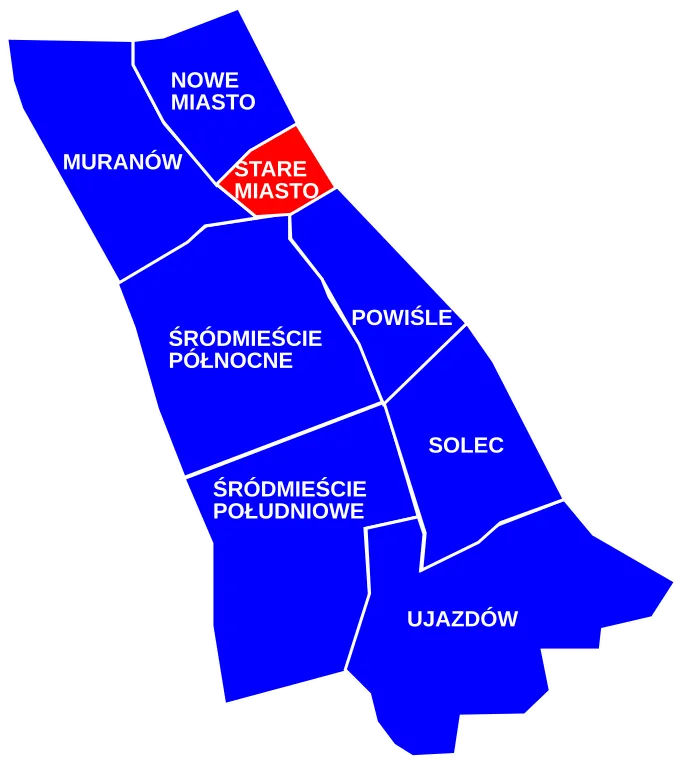
Old Town circuit (2 hours, easy): Begin at Castle Square — Plac Zamkowy — beneath the Sigismund's Column. Enter the Royal Castle for the state rooms and the Bellotto paintings (allow 1 hour). Exit onto Świętojańska Street and walk north through the Cathedral of St John the Baptist (the royal coronation church, rebuilt 1948–56). Continue north to the Old Town Market Square — the central rectangle of coloured townhouses surrounding the Mermaid of Warsaw fountain. Walk west to the Barbican defensive gate (1548, rebuilt) and continue into the New Town for the Church of the Holy Sacrament and the New Town Market Square.
Royal Route walk (2 hours, easy): From Castle Square, follow Krakowskie Przedmieście south — the grand ceremonial boulevard that connects the Old Town to Łazienki Park. Pass the Presidential Palace, the Holy Cross Church (with Chopin's heart in a pillar on the left aisle), and the Warsaw University main gate before reaching Nowy Świat and the junction with Aleje Jerozolimskie. Continue south on Ujazdowskie Avenue to reach Łazienki Park at the park's northern entrance.
Local Life
The Old Town functions as both a tourist precinct and a working residential neighbourhood — Warsaw people live in the reconstructed tenements, use the market square for weekend markets and outdoor concerts, and treat Castle Square as the city's gathering point for major collective events (New Year's Eve, Independence Day parades, and unofficial celebrations of major football results). The Saturday antique market on the New Town Market Square is where Warsaw dealers and private sellers trade Soviet-era memorabilia, pre-war Polish coins, and 20th-century ceramics — a less touristic version of the Old Town's souvenir circuit.
The most atmospheric time in the Old Town is early morning (before 9 AM) when the market square is still and the side streets are almost empty, and late evening when outdoor restaurant seating fills the square and the Barbican is illuminated against the summer sky.
When to Visit
The Old Town is a living neighbourhood open 24 hours; the main tourist circuit operates throughout the day with the market square and castle exterior accessible at any time. The Royal Castle opens Tuesday–Sunday 10 AM–4 PM (last entry 3 PM); closed Mondays. Admission: 30–50 PLN per adult depending on whether guided or audio guide is selected. The Cathedral of St John: open for visitors daily 10 AM–5 PM outside mass times. Free guided walking tours of the Old Town (tipping model) depart from Castle Square at 10 AM and 2 PM daily in English. Private guide tours depart from any agreed meeting point.
Admission and Costs
Old Town streets and market square: Free. Royal Castle: 30–50 PLN (€7–12) per adult; audio guide additional 10 PLN. Cathedral of St John: Suggested donation 5 PLN. Free walking tour: Gratuity recommended €5–10 per person. Private guide: €50–100 per group for a 2-hour Old Town and Royal Route tour. Barbican tower access (seasonal): 10–15 PLN per adult.
Tips for Visitors
Skip the souvenir shops on the market square: The Old Town Market Square is ringed with tourist-facing restaurants and souvenir stalls that are uniformly overpriced and of poor quality. Walk one block in any direction to find better restaurants at local prices, and visit the Saturday antique market on the New Town Market Square for meaningful souvenirs.
Royal Castle timing: Entry is timed and the castle closes earlier than most visitors expect (last entry 3 PM). For the Bellotto paintings gallery specifically, join an early guided tour where the guide provides context on which buildings survive and which were reconstructed using the paintings as blueprints. Without this framing, the paintings appear decorative rather than documentary.
Weather and cobblestones: The Old Town's historic streetscape is entirely cobblestone, which becomes slippery in rain. Flat-soled shoes or walking boots with grip are strongly recommended. In summer, the market square fills quickly after 10 AM; mornings before 9 AM offer the best light for photography and the most atmospheric empty-square experience.
Frequently Asked Questions
Was Warsaw's Old Town completely destroyed in WWII?
Yes. Following the failed Warsaw Uprising of August–October 1944, Hitler ordered the systematic destruction of Warsaw as punishment. German demolition squads used flamethrowers, explosives, and incendiary devices to destroy 85 percent of the city building by building, with the historic Old Town receiving particular attention. By January 1945, when Soviet and Polish forces entered the city, the Old Town was almost entirely rubble. The current streetscape is a post-war reconstruction completed primarily between 1949 and 1963, using Bernardo Bellotto's precise 18th-century vedute paintings of Warsaw as primary architectural references.
Which Old Town buildings are original and which are reconstructed?
Almost nothing in the Old Town survived intact — only a very small number of ground-floor vaults and basement structures predate 1945. The reconstructed buildings are often described as more accurate than many "original" historic buildings in other cities, because Polish architects deliberately recreated the 18th-century appearance using Bellotto's paintings rather than attempting to restore the varied accretions of multiple centuries. This makes the Old Town unusual: it is simultaneously genuinely historic (the streetscape accurately represents how Warsaw looked in 1770) and entirely post-war construction.
What should you see in Warsaw's Old Town?
The essential circuit covers Castle Square, the Royal Castle, the Old Town Market Square (Rynek Starego Miasta), the Cathedral of St John the Baptist, the Barbican defensive walls, and the New Town Market Square just north. Castle Square is the best orientation point — the Sigismund's Column (originally 1644, rebuilt 1949) marks the formal centre of historic Warsaw. The Royal Castle houses the original Bellotto paintings used as reconstruction blueprints, displayed alongside the castle's recreated royal interiors. Allow 3–4 hours minimum to see the castle interior and walk the main circuit; a guided tour significantly deepens understanding of what you are actually looking at.