
Observation Spots
Activities
Palace on the Isle circuit (45 minutes, easy): the lake path loops around the island residence, delivering the classic reflected-façade view from the southern bridge. The interior has been restored to its royal apartments, including the king's picture gallery and the Rotunda; allow an extra hour for the museum.
The outlying pavilions (1–2 hours, easy): the park is as much an ensemble of garden buildings as a single palace. The Amphitheatre stages its stone stage on an islet separated from the auditorium by water; the Old Orangery (Stara Pomarańczarnia) shelters one of Europe's few surviving original 18th-century court theatres and a gallery of sculpture; and the Myślewicki Palace nearby was the king's guest residence.
Northern garden (1 hour, moderate): the quieter northern section holds the White Pavilion (Biały Domek), a small Neo-classical garden house, and the Egyptian Temple — an unusual folly with hieroglyph-style reliefs that looks entirely out of place in Warsaw and is all the more memorable for it. This corner stays calm even in peak season.
Southern terraces (30 minutes, easy): the formal gardens south of the palace descend toward the Belvedere Palace and the Temple of Diana. The peacocks concentrate along this axis and around the rose terraces.
Seasonal Highlights
May–September: the Sunday Chopin recitals at noon and 4 PM are the park's signature event. The May Day opening weekend draws the largest crowds; later Sundays are calmer. Peak peacock display season is April–June, when the males fan their plumage along the main promenades.
July–August: the Amphitheatre's summer season brings classical theatre and open-air concerts, and the lakeside fills with evening promenaders while the park stays open to around 9 PM — unusually late for Warsaw, and a real extension of the usable day.
October: autumn colour across the mature lime, chestnut, and oak plantings makes the park exceptionally atmospheric, with fallen leaves on the gravel and mist rising off the lake at dawn.
November–March: the park is largely empty and at its most introspective. The Palace on the Isle can be seen without the summer queues; the peacocks are still present but less conspicuous, and a heavy snowfall turns the lake and pavilions into one of Warsaw's most photogenic winter scenes.
When to Visit
Park grounds: open daily from 6 AM to dusk — roughly 9 PM at midsummer, closing as early as 4:30 PM in December — with free entry. Palace on the Isle (museum): Tuesday–Sunday, broadly 9 AM–4 PM and later in summer, closed Mondays; confirm the current calendar on the Royal Łazienki Museum site, as the outlying pavilions (the Old Orangery theatre, Myślewicki Palace, the White Pavilion) keep shorter and seasonal hours. Sunday Chopin recitals: the first Sunday in May through the last Sunday in September, at noon and 4 PM at the Chopin Monument. Amphitheatre: scheduled theatrical and musical performances across the summer, tickets required. The Belvedere Palace on the southern boundary is an official state residence and is not generally open to visitors.
Admission and Costs
Park entry: free. Palace on the Isle museum: around 30–50 PLN (€7–12) adults / 20 PLN (€5) concession, with one free-entry day most weeks (typically Thursday). Chopin Monument recitals: free. Amphitheatre performances: roughly 30–80 PLN depending on the production. Guided park-and-palace walk: about 50–100 PLN (€12–25) per person for a two-hour private tour — in line with the half-day guide rates on the Warsaw city guide. Café kiosks: standard Warsaw prices, 10–25 PLN per item. Bring a few złoty in coins for the lakeside kiosks, which are quicker than card at busy summer weekends.
The Case for a Guide
Łazienki rewards a guided walk more than most city parks, because so much of its meaning is in the composition rather than on a label:
- Reading the garden as a political statement — a guide explains how Poniatowski's Enlightenment-era layout, with its classical temples and theatre, projected a reformist royal image in the decades just before Poland lost its independence in the Partitions.
- The Palace on the Isle interiors — the Rotunda of Polish kings, the Bacchus Room, and the picture gallery read as a careful programme; guidance turns a set of handsome rooms into the self-portrait of an ambitious, ultimately doomed monarch.
- The pavilions most visitors miss — few day-trippers reach the Old Orangery theatre, Myślewicki Palace, or the Egyptian Temple; a guide routes you to them efficiently and explains what each was for.
- Timing the park's rhythms — knowing when the Chopin recitals start, where the peacocks display, and which gate to enter for the quietest circuit makes the difference between a rushed loop and a half-day that flows. Many Warsaw guides fold the park into a wider Royal Route walk down from the Old Town.
Tips for Visitors
Chopin concerts: the free Sunday recitals run May through September at noon and 4 PM — arrive 20–30 minutes early, as the best positions around the monument fill well before the start. Bring a mat or blanket if you plan to stay for both.
Palace on the Isle entry: the interior is separately ticketed and is usually visited as a timed entry; availability on summer weekends is limited, so book ahead through the Royal Łazienki Museum. The exterior, bridges, and grounds are free and need no booking.
Peacocks: the resident birds roam freely and are boldest in spring, when the males display. They gather near the rose terraces and along the main south axis; do not feed them, and keep your distance if they approach, as the males defend territory during breeding season.
Getting there: it is a 35–40 minute walk south from the Old Town along the Royal Route, or a short hop on buses 116 and 180 down Aleje Ujazdowskie. The nearest metro is Politechnika (M1), about 10 minutes on foot from the western gates.
Frequently Asked Questions
When are the Chopin concerts in Łazienki Park?
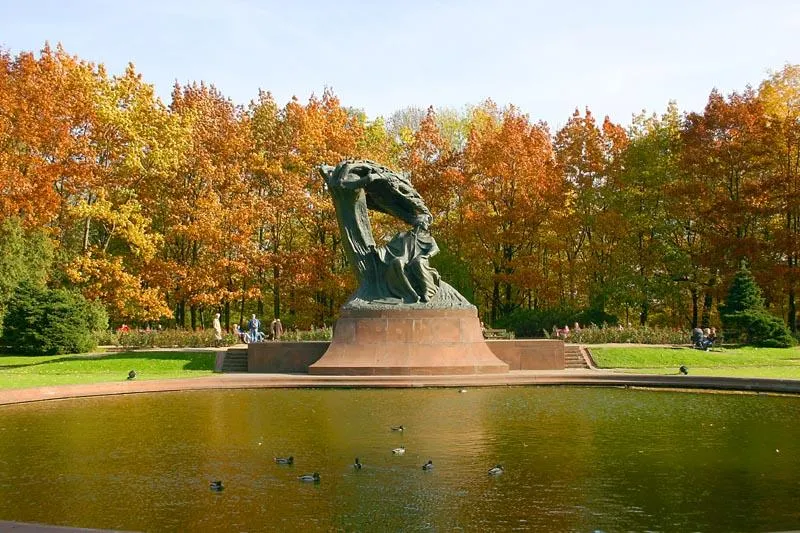
The Sunday Chopin concerts at the foot of the Chopin Monument — a bronze statue of the composer sheltering beneath the wind-swept boughs of a willow tree — take place every Sunday from the first Sunday in May through the last Sunday in September, at noon and at 4 PM. Entry to the open-air concert area is free, and seating is available on benches around the monument. The concerts are performed by Polish pianists, often young laureates of the Chopin Competition, and last approximately 45 minutes each. Arrive 20–30 minutes early on summer Sundays, as the best seated positions fill quickly. Rain cancellations are announced on the day at the park entrance and on the Chopin Institute's website.
How long does it take to walk through Łazienki Park?
A basic circuit of the central park including the Palace on the Water exterior, the Chopin Monument, the amphitheatre, and the main promenades takes approximately 1.5 to 2 hours at a relaxed pace. The full park including the northern section (White Pavilion, White Cottage, Egyptian Temple), the southern New Guardhouse area, and the Botanical Garden adjacent to the park boundary takes 3–4 hours. The park is hilly in places and has well-maintained gravel and paved paths throughout. Café kiosks operate within the park from April to October.
Do peacocks actually live in Łazienki Park?
Yes. A colony of free-roaming peacocks has inhabited Łazienki Park for centuries — they are year-round residents and are one of the park's most unexpected and delightful features. The peacocks wander the main promenades and garden terraces, sometimes blocking paths or perching on benches, and are entirely accustomed to people. They are most spectacular from April through June, when males display full fans for mating season. Do not approach them too closely; they are wild animals and the males in breeding season can be defensive.
How do you get to Łazienki Park?
Łazienki sits at the lower end of Warsaw's Royal Route, about a 35–40 minute walk south from the Old Town along Krakowskie Przedmieście and Aleje Ujazdowskie — a classic itinerary that links the two in one afternoon. City buses running along Aleje Ujazdowskie (including routes 116 and 180) stop at the "Łazienki Królewskie" and "Plac na Rozdrożu" gates on the park's western edge. The nearest metro station is Politechnika on the north–south M1 line, roughly a 10-minute walk west, and trams run along Marszałkowska a few blocks further. The main gates face Aleje Ujazdowskie and Agrykola; the Ujazdowskie entrance puts you closest to the Chopin Monument and the lake, while the eastern Agrykola gate is handiest for the Amphitheatre.
What is there to see besides the Palace on the Water?
The lake and the Palace on the Isle are the centrepiece, but the 76-hectare park is a whole ensemble of 18th-century garden buildings. The open-air Amphitheatre stages a stone stage on an islet separated from the auditorium by water; the Old Orangery houses one of Europe's few surviving original 18th-century court theatres and a gallery of sculpture; and the Myślewicki Palace, the White Pavilion, the Egyptian Temple, the Temple of Diana, and the Water Tower are scattered through the grounds as follies and smaller residences. Allow half a day to take in the pavilions as well as the central lake, and more if you tour the Palace on the Isle interior.