
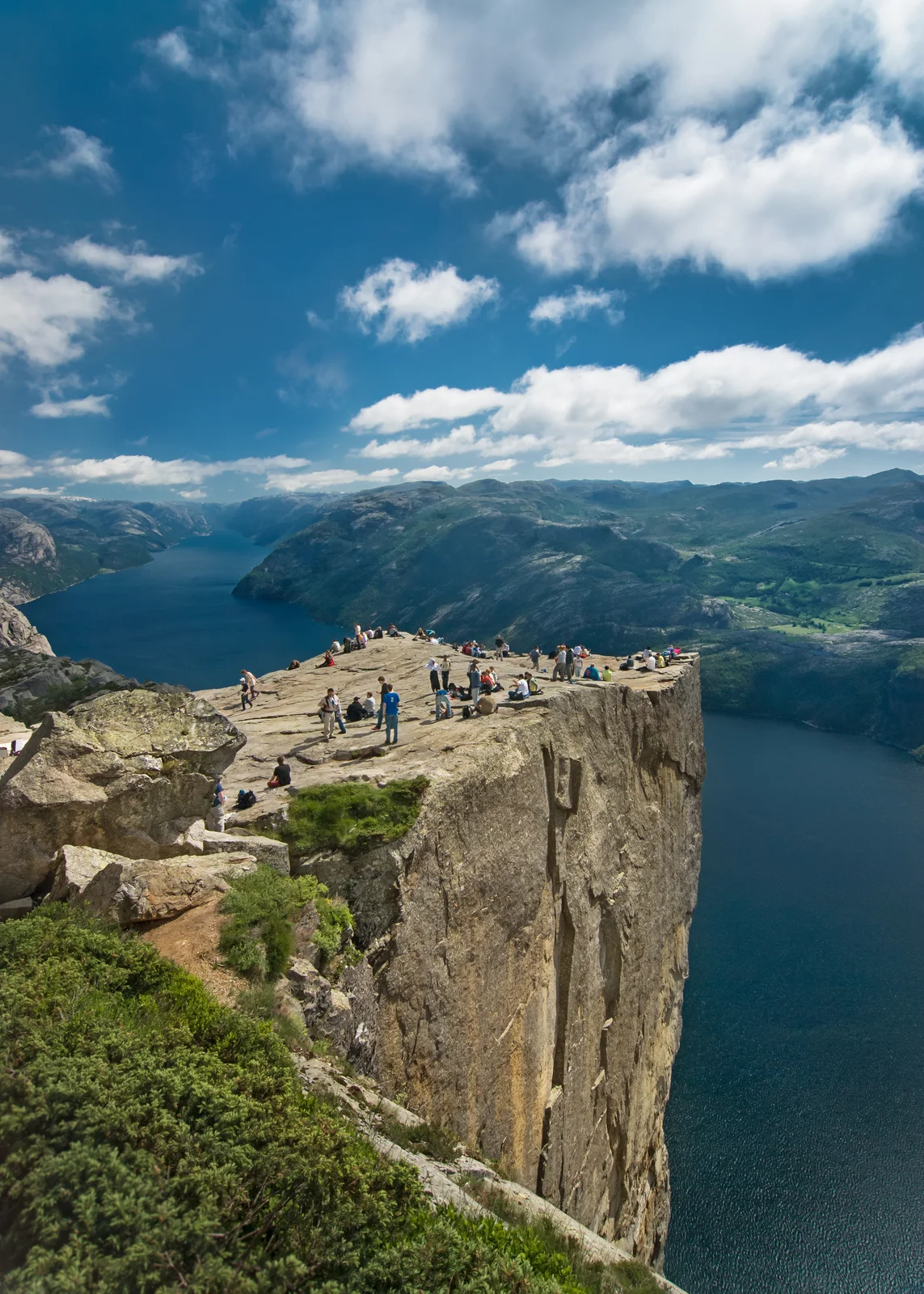
Trails
The single main trail runs about 3.8 kilometres each way from the Preikestolen mountain lodge to the plateau, climbing roughly 500 metres in a series of well-defined stages: an initial steep pull out of the car park, a gentler stretch across boardwalked marsh and small lakes, a rocky staircase section, and a final airy traverse along the mountainside to the rock. It is waymarked with red T paint marks in the classic Norwegian Trekking Association style and is impossible to lose in clear weather.
There is no loop and no easier alternative — everyone returns the way they came — so pace yourself for a full out-and-back. Slower walkers and families with older children manage it comfortably by allowing extra time, while the fittest do it in under three hours. The stone steps built by Himalayan trail-builders have greatly reduced erosion on the steepest pitches, but they are steep, and knees feel the descent.
Formation
Preikestolen was carved by glaciers during the last Ice Age, which gouged out the U-shaped trough now filled by the Lysefjord and left the resistant granite plateau standing proud above it. The flatness of the top and the sheerness of the sides come from the rock's natural jointing — the granite is split by deep vertical cracks, and one such crack, running across the back of the plateau, is slowly widening.
Geologists expect that this fissure will, over a distant timescale, eventually cause the whole slab to break away and crash into the fjord, though there is no sign of imminent danger and the rock is monitored. For now the crack is one of the features guides point out on the plateau, a reminder that the seemingly permanent cliff is a single frost-riven block in the long, slow process of a fjord landscape remaking itself.
When to Visit
Start early or late to escape the midday press: the trail can carry thousands of people on a fine summer day, and the plateau becomes crowded from late morning to mid-afternoon. Setting off soon after dawn, or in the long light of a summer evening, gives you a quieter mountain and softer light on the fjord.
The hikeable season is broadly May to September. July and August are warmest and busiest; June and September trade a little warmth for space and long daylight. In shoulder months and winter, snow and ice turn the route into a serious undertaking best attempted with a guide. Watch the forecast closely — the exposed plateau is no place to be in low cloud, which robs you of the view, or in strong wind near the edge.
Admission and Costs
The hike itself is free — there is no charge to walk the trail or stand on the rock — but you pay to park at the trailhead (around NOK 250 ($23) per car in season) or to take a shuttle bus from Stavanger or the ferry pier, which costs roughly NOK 400–600 ($37–55) return including the boat and bus links. Booking transport ahead in peak season is wise.
A guided hike, valuable for winter conditions or for nervous first-timers, typically runs NOK 700–1,200 ($65–110) per person and includes safety oversight and local knowledge of the trail and fjord. Food and water you carry yourself; the lodge at the base has a café and simple accommodation. All prices are seasonal estimates worth confirming before you set out.
The Case for a Guide
A guide adds most on the shoulders of the season and in uncertain weather, when local judgement about conditions, timing and turn-around points genuinely matters on an exposed 604-metre cliff. Beyond safety, a good guide reads the landscape for you — explaining how the glacier cut the Lysefjord, pointing out the widening joint across the plateau, and naming the peaks and fjord arms spread below — and paces the group so nobody is rushed on the steeper pitches. Guided winter and sunrise trips open up experiences that are risky to attempt alone, and many combine the hike with a Lysefjord cruise that shows the rock from the water far beneath. For visitors short on Norwegian mountain experience, that mix of safety and storytelling is well worth the fee.
Tips for Visitors
Wear proper hiking boots with grip — the stone steps and slabs are punishing in trainers and treacherous when wet — and pack layers, water, food and a waterproof, as mountain weather turns quickly. Start with enough daylight in hand to complete the round trip comfortably.
At the top, stay back from the unfenced edge, especially for photographs and in wind; the classic shot of a figure sitting on the lip is taken with far more margin than it appears. Come early to beat the crowds, and consider hiking on a shoulder-season weekday for the plateau closer to yourself. If the summit is in cloud, wait or turn back — the whole point is the view down the Lysefjord.
Frequently Asked Questions
How long and how hard is the hike to Preikestolen?
The trail is about 8 kilometres round trip with roughly 500 metres of ascent, and most walkers take 2 hours up and 1.5–2 hours down, so budget four to five hours plus time at the top. It is graded moderate: the path is well marked and hugely popular, but it climbs steeply in sections over boulders and stone steps and can be slippery in wet weather. Reasonable fitness and proper footwear are essential; it is not a stroll.
Is there a barrier at the edge of the cliff?
No. The plateau is completely unfenced, dropping a sheer 604 metres to the Lysefjord, which is part of what makes the view so extraordinary and so exposed. Keep well back from the edge, supervise children closely, and be especially careful in wind, rain or icy conditions. Accidents here are rare but almost always involve people getting too close to the drop for a photograph.
When is the best time of year to hike it?
The main season runs May to September, when the trail is largely snow-free and the mountain lodge, car park and shuttle buses are operating. June and September offer long daylight with slightly thinner crowds than midsummer. Outside the season the route is a genuine winter mountain hike requiring experience and equipment, and is best done with a guide.