
Tips for Visitors
Visit early morning (before 9 AM) on weekdays for the quietest experience. The park is equally spectacular in winter snow — the bronze figures acquire extraordinary presence with snow-covered shoulders and heads. Combine with the Vigeland Museum (studio building at the south end of the park) to see the plaster models behind the finished sculptures — the maquettes reveal how Vigeland's ideas evolved. The Sinnataggen (Angry Boy) figure on the bridge's east side has been polished copper-bright by generations of visitors; its leg is the most-touched sculpture in Norway. The park is located in the Frogner neighbourhood, 20 minutes on foot from the city centre or 5 minutes on tram lines 12 and 19 from Nationaltheatret.
When to Visit
The park is open 24 hours a day, every day of the year, free of charge. There is no closing time and no high season surcharge. Early morning (before 9 AM) and evening visits offer the best light and the fewest crowds. In summer, the park's extraordinary 18–20 hours of daylight make 10 PM visits entirely viable. The Vigeland Museum adjacent to the park — housed in Vigeland's actual studio building — is open Tuesday to Sunday from 10 AM to 5 PM (reduced hours in winter) and charges a small entry fee; it shows the plaster models and sketches behind the finished park sculptures.
Admission and Costs
Park entry: Free. Always. The Vigeland Museum (studio building): NOK 100 adults, reduced rates for students and seniors. Guided tours of the park: NOK 250–400 per person for group tours (typically 90 minutes); NOK 1,500–2,000 for private guide for up to 6 people. Audio guides are available from the Vigeland Museum. There are no food or drink vendors inside the park boundaries; the nearest cafés are along Frognerveien at the park gates.
The Case for a Guide
Most visitors spend an hour in Vigeland Park and come away impressed but vaguely baffled. A guide who has studied Vigeland's artistic biography, his philosophical sources, and his technical methods turns the same 90-minute walk into something far more absorbing.
- The thematic programme: Vigeland never published a written explanation of the park's meaning, which he considered self-evident. A guide decodes the iconographic logic — why the bridge figures are arranged in their sequence, what distinguishes the fountain's tree-of-life motif from the Monolith's aspiration narrative, and how the Wheel of Life circle at the far end completes the thematic arc.
- Vigeland's biography: The contrast between Vigeland's turbulent personal life — difficult relationships, difficult personality, 40-year studio isolation — and the universal humanity of the sculptures he produced is one of the great ironies of Norwegian cultural history. A guide brings this tension alive.
- Technical achievement: The three stone-carvers who executed the Monolith from Vigeland's models worked 8 hours a day, 6 days a week for 14 years without power tools for the final detail work. A guide points out the visible tool marks and explains the quarrying and positioning of the 17-tonne block.
- Finding the overlooked works: The Sinnataggen angry toddler gets the most attention, but some of Vigeland's most moving works are on the bridge's outer balustrades — a father holding a newborn, an elderly couple facing each other — that visitors walk past while looking for the famous pieces.
- The park in Oslo's identity: Vigeland Park functions simultaneously as a world-class cultural destination and as a neighbourhood park where Oslo families bring children on Sunday mornings. A guide who lives in the Frogner area explains how locals relate to the sculptures across the seasons.
Frequently Asked Questions
Is Vigeland Sculpture Park really free?
Yes — Vigeland Sculpture Park is entirely free and open 24 hours a day, every day of the year. This was a deliberate condition of the agreement between Gustav Vigeland and the City of Oslo: in exchange for donating his entire artistic output to the city, Vigeland was given a lifetime studio at the park's edge (now a museum) and the guarantee that his sculptures would remain publicly accessible without charge in perpetuity. Over 1 million visitors walk through the park each year, making it one of the most-visited attractions in Norway despite — or because of — the absence of any ticket price.
How long does it take to see the whole park?
A walk along the main axis — from the main gate through the bridge of sculptures, past the fountain, to the Monolith plateau and the wheel of life circle beyond — takes approximately 45 minutes at a brisk pace. Most visitors spend 1.5 to 2.5 hours if they read the sculptures carefully and circle back to particular favourites. With a guide who explains the thematic programme, the biographical context, and the technical achievement of specific works, allow 2–2.5 hours. The park within Frogner Park also includes a rose garden, the Frognerbadet outdoor swimming complex, and the Oslo City Museum — extend the visit with these if time permits.
What is the story behind the Monolith?
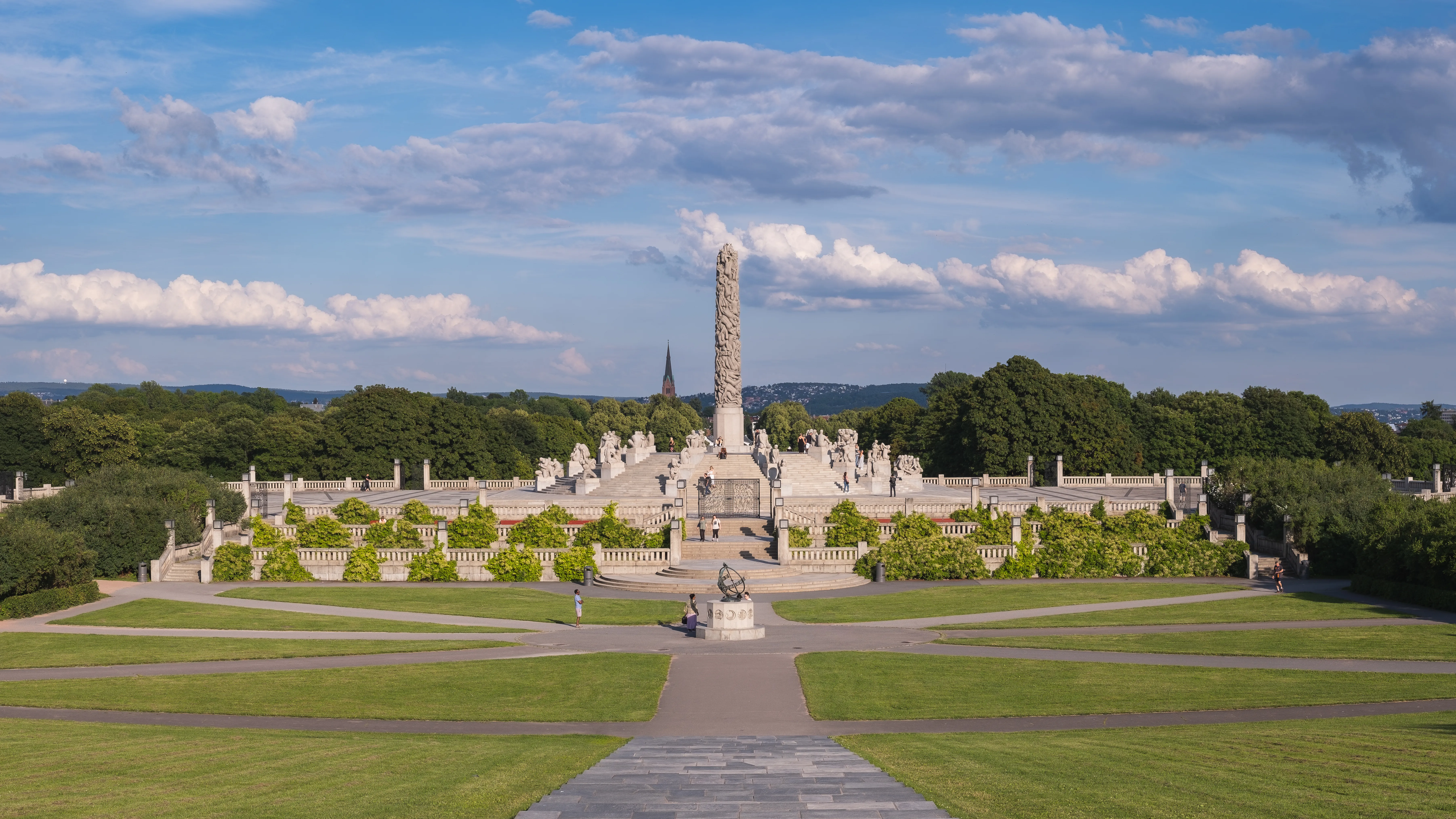
The Monolith (Monolitten) stands at the geometric centre of the park's composition and was Gustav Vigeland's greatest technical challenge: a single 17-tonne block of Iddefjord granite, 14.12 metres tall, carved with 121 intertwined human figures emerging from and dissolving back into the stone. The idea came to Vigeland around 1919, but the block was not quarried until 1924 and three stone-carvers spent 14 years, from 1929 to 1943, executing Vigeland's design by hand in the studio that stood adjacent to the park. The figures at the base are children and the elderly; ascending toward the summit they become more athletic and sensual, then more transcendent, culminating at the very top in a cluster of figures reaching upward — Vigeland's visual poem about the life cycle and humanity's longing for something beyond it.
When is Vigeland Park most atmospheric to visit?
The park changes radically with the season. In winter snow, the bronze sculptures on the bridge acquire caps and mantles of white that transform their already complex human expressions. The midnight sun of June and July keeps the park bathed in golden light until midnight, making evening visits extraordinarily atmospheric. The rose garden peaks in late June and early July. Weekday mornings in May and September are the quietest; Saturday afternoons in July are the busiest. Local Oslo families use the park as a regular green space, and encountering it as the Norwegians do — as part of daily life — is part of its appeal.