
Engineering Facts
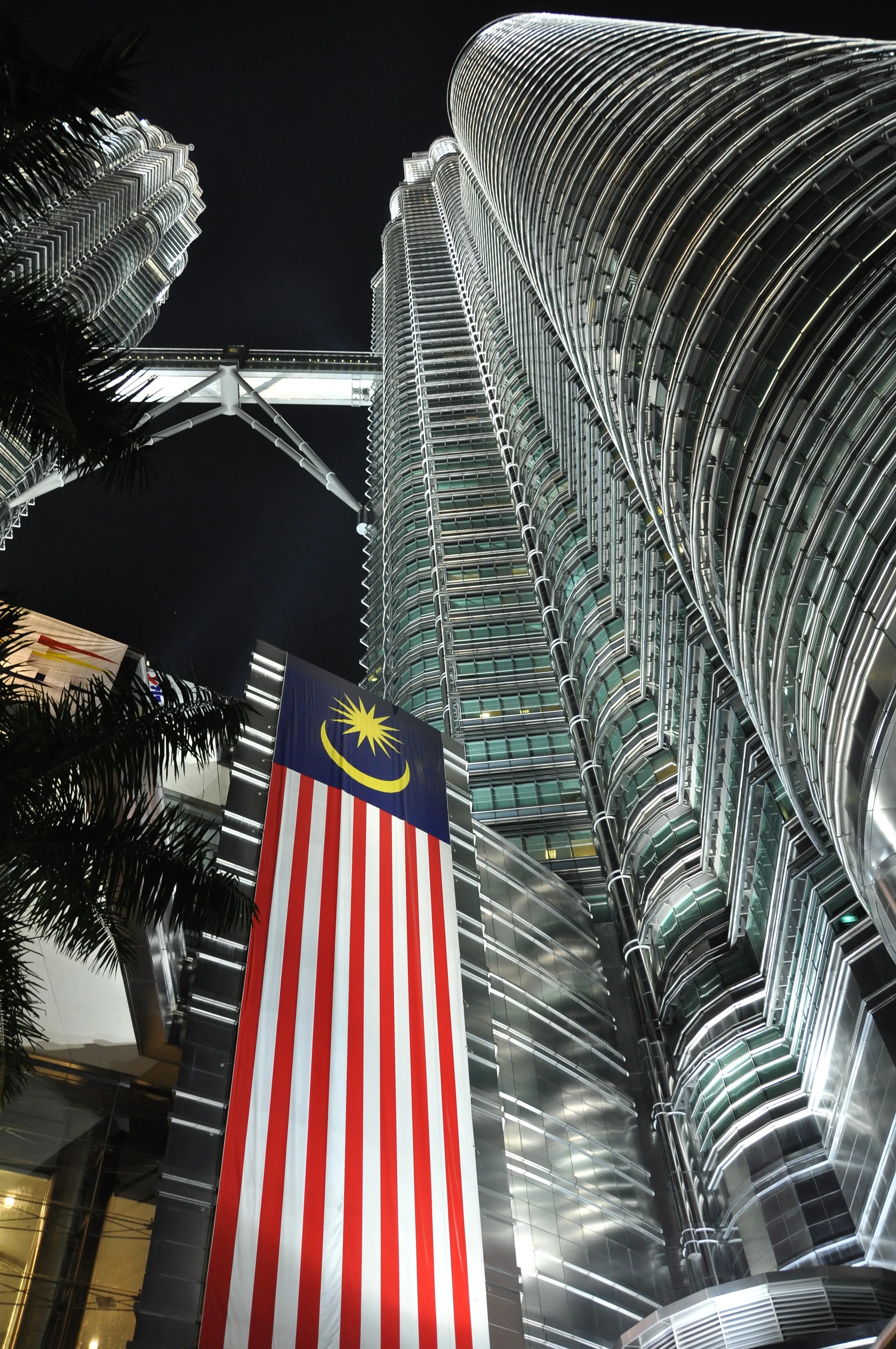
César Pelli's design drew explicitly from Islamic geometric principles, most visibly in the tower cross-section — an eight-pointed star formed by two overlapping squares, softened at the corners with semicircular projections. This shape repeats at every scale: the floor plates, the crown detailing, the decorative panels, and the spire tips all echo the same geometric logic.
The steel and glass facade is clad in aluminium and stainless-steel sun-shading panels arranged in horizontal bands, giving the towers a vertical rhythm that reads as both modern and traditionally patterned from different distances. The pinnacle spires add a further 73.5 metres above the 88th-floor structural top, lending the silhouette the pointed quality of a minaret. From ground level, the towers appear to grow organically from the city, their tapering profiles drawing the eye upward with no abrupt transitions.
The skybridge at floors 41–42 is a separate engineering statement: a twin-span steel structure that connects the towers but does not bear on them rigidly, instead resting on sliding bearings that allow up to 500 mm of lateral movement as the towers flex independently in wind. It was assembled on the ground and jacked up into position — the single most dramatic operation in the construction sequence.
Observation Points
The Skybridge (floors 41–42) floats 170 metres above Jalan Ampang, offering a narrow, enclosed walkway between the two towers. From its windows you look down onto the KLCC district — the Suria KLCC mall roof, the KLCC Park lake, and the surrounding Golden Triangle skyline — while the towers' steel shafts fill the peripheral vision on both sides. The sense of being suspended between two independent structures is unlike any other elevated walkway in Southeast Asia.
The Observatory (floor 86) is the higher experience: at roughly 370 metres, the floor-to-ceiling glass panels frame an unobstructed panorama that stretches to the jungle-covered hills ringing the KL basin on clear mornings. To the north, Batu Caves is visible as a limestone outcrop; to the south, the older shophouse streets of Brickfields and Bangsar spread toward the airport expressway corridor. At night, the illuminated grid of the Golden Triangle — Bukit Bintang, KLCC, and Jalan Tun Razak — creates one of the most legible city panoramas in Asia, each district distinct in density and light colour.
From KLCC Park below, the optimal ground-level view is from the footbridge over the decorative lake, where both towers reflect in the water. The park's elevated walkway near the Mandarin Oriental Hotel frames both towers symmetrically against the sky — the single best photography position accessible without a ticket.
When to Visit
Skybridge and Observatory hours: Daily 9:00 AM – 9:00 PM (last entry 8:30 PM); closed on the first Monday of each month for maintenance.
Recommended visit duration: Allow 2–3 hours for a thorough visit — 45 minutes inside for the skybridge and observatory, plus time for KLCC Park and the fountain plaza.
Best photography windows:
- Sunrise (6:30–8:00 AM): Towers backlit against soft sky; KLCC Park largely empty
- Golden hour (5:30–7:00 PM): Warm light on the steel facade; fountain show begins at dusk
- Night (8:00 PM onwards): Full illumination, fountain light show every hour on the hour
Note: The skybridge and observatory are separate ticketed experiences on different floors — confirm your ticket type before entering.
Admission and Costs
- Skybridge only (floors 41–42): RM 80 ($18 USD) per adult; RM 33 ($7 USD) per child (aged 3–12)
- Observatory only (floor 86): RM 80 ($18 USD) per adult; RM 33 ($7 USD) per child
- Combined Skybridge + Observatory: RM 120 ($27 USD) per adult; RM 50 ($11 USD) per child
- KLCC Park: Free
- Suria KLCC mall: Free entry; shopping and dining at all price points
- Petrosains science museum: RM 30 ($7 USD) adult, RM 17 ($4 USD) child
- Aquaria KLCC: RM 57 ($13 USD) adult, RM 43 ($10 USD) child
Book online: Tickets at www.petronastwintowers.com.my; walk-up availability is very limited.
The Case for a Guide
A guide adds multiple layers to the Petronas Towers experience that a ticket alone cannot provide. The engineering backstory — the foundation crisis, the skybridge jack-up operation, the Islamic geometric grammar embedded in Pelli's design — is invisible without narration. Guides also know the optimal ground-level photography positions (the KLCC Park footbridge, the Mandarin Oriental walkway, the specific park bench that frames both towers symmetrically), the best rooftop bar alternatives for budget-conscious visitors who want height without the observatory queue, and the cultural context of why this building matters to Malaysians in a way that goes beyond mere height records.
For visitors combining the towers with a broader Kuala Lumpur day — perhaps including Batu Caves or Petaling Street — a guide coordinates the logistics of the timed ticket around other sights, ensuring the KLCC experience fits into a coherent itinerary rather than dominating the day by accident.
Tips for Visitors
- Book online in advance — especially for December–February peak season and Malaysian school holidays; slots sell out days ahead
- Arrive 15 minutes early for your time slot; late arrivals may lose their booking without refund
- Visit the park at night even if you skip the interior — the fountain show reflecting in the lake costs nothing and is genuinely spectacular
- Camera gear: The floor 86 observatory is fully enclosed with glass; bring a polarising filter to reduce reflections if you're shooting seriously
- Adjacent rooftop bars: Sky51 at Element Hotel and the Traders Hotel Sky Bar both offer tower views with cocktails — excellent alternatives or additions to the official observatory
- Combine with Petrosains — the interactive oil-and-gas museum on level 4 of Suria KLCC adds context to Malaysia's petroleum wealth and makes a strong family half-day
- Dress code: Smart casual is appropriate for the observatory; no restrictions on the park or mall
Frequently Asked Questions
How do I get Petronas Twin Towers skybridge and observatory tickets?
Tickets must be purchased online in advance at the official KLCC website — walk-up tickets at the basement ticket counter are extremely limited and often sell out by mid-morning. The Skybridge (floors 41–42) costs RM 80 ($18 USD) per adult, while the Observatory (floor 86) costs RM 80 ($18 USD) as well; a combined ticket for both costs RM 120 ($27 USD). Book at minimum two to three days ahead, and during school holidays or peak travel season (December–February), book a week or more in advance. Each time slot is fixed, so plan your day around your booked entry time.
What is the best time of day to visit the Petronas Twin Towers?
Sunrise and late afternoon both produce spectacular light. At sunrise the towers glow against a deep blue sky with minimal haze; the golden hour before sunset saturates the steel and glass in warm tones. For night views, the KLCC Park fountains and light show — which runs hourly after dark until around 10 PM — reflect the illuminated towers in the decorative lake, creating the most iconic photograph of modern Kuala Lumpur. The best photography angle from ground level is from the KLCC Park footbridge or the elevated walkway near the Mandarin Oriental Hotel. Inside the towers, floor 86 views are clearest before 11 AM when haze typically builds through the day.
What else is there to see and do in the KLCC area?
The KLCC precinct packs extraordinary variety into a walkable area. Suria KLCC, the six-storey mall at the towers' base, is one of Southeast Asia's premier shopping destinations. KLCC Park directly behind the towers has landscaped gardens, a jogging track, a children's water park, and the famous fountain plaza. Petrosains on level 4 of Suria KLCC is an interactive science museum dedicated to Malaysia's oil and gas industry — excellent for families. The Aquaria KLCC underwater tunnel and Galeri Petronas art gallery are in the same complex. A ten-minute walk brings you to Jalan Bukit Bintang and its concentration of rooftop bars with towers views, making the KLCC district an easy all-day itinerary with a guide who knows which venues offer the best perspectives.