
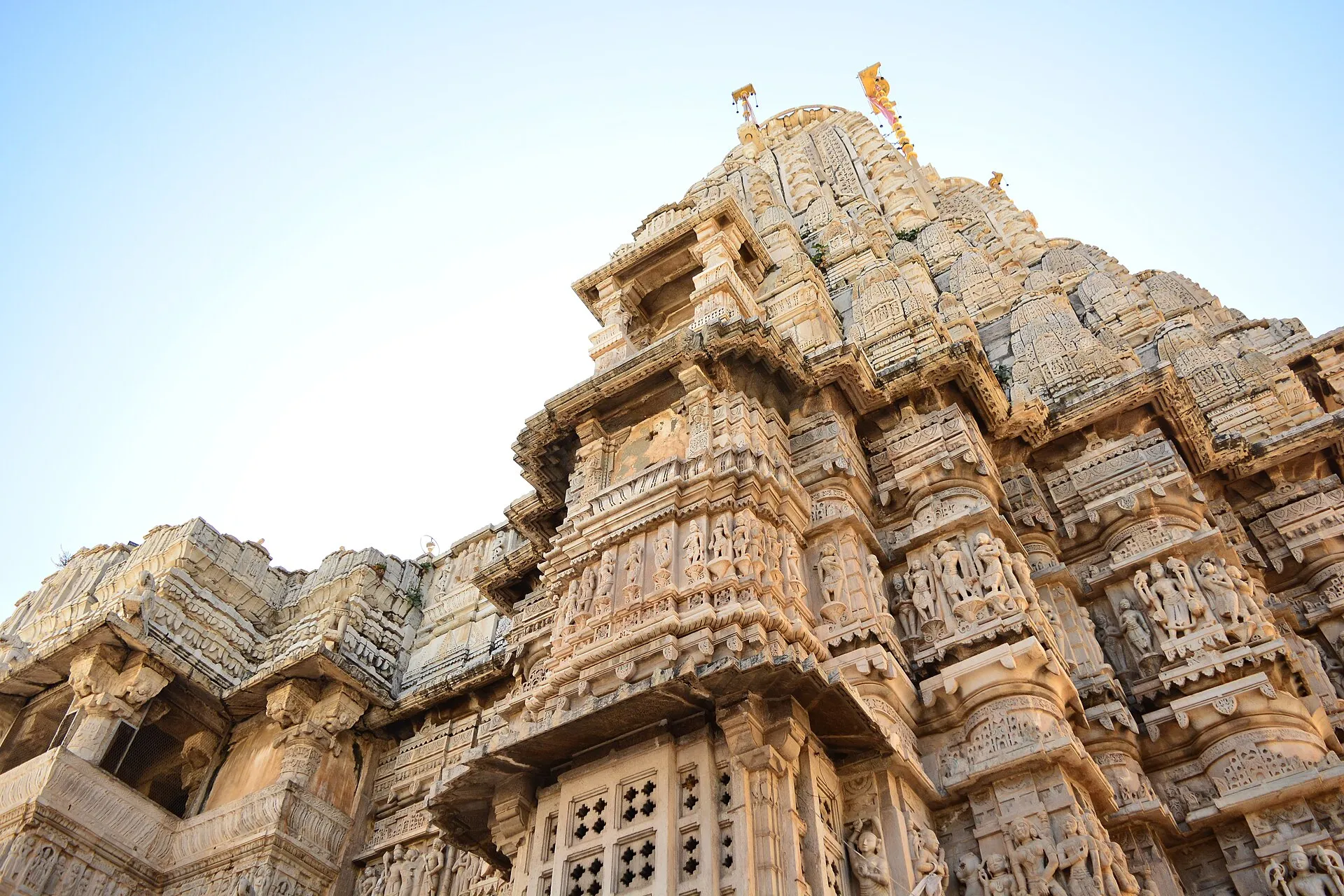
Spiritual Significance
Jagdish Temple stands at the devotional centre of Udaipur's old city, and it is first of all a Vaishnavite temple — a house of Vishnu, the preserver of the universe, worshipped here in his form as Jagannath, "Lord of the Universe."
The presiding image in the garbhagriha (inner sanctum) is a four-armed figure carved from a single block of black stone; it is treated not as a statue but as a living deity — woken, bathed, dressed in fresh silks, and offered flowers on a daily cycle the temple's priests have kept since the sanctum was consecrated in 1651 under Maharana Jagat Singh I (see the temple's recorded history).
The rhythm of that worship — the aartis at dawn, midday, and evening, when bells, drums, and conch shells fill the pillared hall — is the real spectacle, more than any single carving.
The building itself reads like a sermon in stone. Its tall shikhara and the outer walls are banded with registers of sculpture that a guide can trace as a continuous devotional programme: ranks of apsaras (celestial dancers), musicians and gandharvas, mounted warriors, elephants, and scenes from Vaishnavite legend, rising toward the heavens as the tower narrows. Before the main doorway, a small pillared mandapa shelters the brass Garuda, Vishnu's eagle-mount and gatekeeper, where devotees pause before stepping inside.
The four corner shrines — to Ganesh, Shiva, Surya, and Shakti — make the complex a compact panchayatana ensemble, letting a worshipper honour the principal Hindu deities on a single circuit. The great Vaishnavite festivals, above all Janmashtami (Krishna's birth) and the lamp-lit nights of Diwali, draw the surrounding lanes into the ritual, and the temple sits only steps above the City Palace, whose Mewar rulers endowed it.
Visitor Etiquette
Jagdish Temple is an active place of worship, so a few customs matter more here than they would at a museum:
- Remove your shoes at the foot of the 32 marble steps, where a stall minds footwear; the stone can turn scorching in summer, so carry socks.
- Dress modestly — cover shoulders and knees. A light scarf or shawl is easy to carry for the purpose.
- Photograph the exterior carvings and courtyard freely, but be discreet during aarti and avoid pointing a camera at the sanctum image or at worshippers mid-prayer.
- Step to the side during services rather than crossing in front of devotees, and keep voices low inside the hall.
Once inside, the features worth lingering over are the main shikhara, carved with row upon row of deities, apsaras, and battle scenes; the brass Garuda on its pillar facing the entrance; the life-sized stone elephant guardians flanking the staircase; and the inner sanctum's black-stone Jagannath, dressed each day in fresh flowers, silk, and gold. The four corner shrines to Ganesh, Surya, Shiva, and Shakti each carry their own iconographic detail and are easy to miss if you head straight for the main hall.
Jagdish Temple timeline
-
Udaipur founded by Udai Singh II
Maharana Udai Singh II founds Udaipur on the shore of Lake Pichola after the Mughals press on the old Mewar capital at Chittorgarh, laying out the old city whose devotional centre the temple would become.
-
Jagat Singh I accedes to the Mewar throne
Maharana Jagat Singh I takes the throne and proves a prolific temple-builder, commissioning the great Vishnu temple that would come to carry the name Jagdish.
-
Jagdish Temple consecrated
The temple to Vishnu as Jagannath is completed and consecrated on its raised plinth, steps from the City Palace gates, in the Indo-Aryan Maru-Gurjara style.
When to Visit
Morning session: 5:00 AM - 2:00 PM. Evening session: 4:00 PM - 10:00 PM. Aarti times: 5:30 AM, 12:00 PM, 5:30 PM, and 8:00 PM. Best time: evening aarti (5:30 PM) when bells ring and devotees gather on the steps.
Admission and Costs
Entry to Jagdish Temple is free — it is a living place of worship, not a ticketed monument, and there is no separate camera charge, though you should put the phone away inside the inner sanctum out of respect. The few costs are small and optional:
- Local guide: ₹200-500 (about $2.50-6) for a focused 30-45-minute tour — reasonable for so compact a site, and often best arranged as an add-on to a half-day City Palace tour next door, where a licensed Mewar guide already runs ₹500-1,000 ($6-12).
- Flower and offering trays: ₹10-20 (under $0.25) from the vendors on the steps, if you wish to make an offering at the sanctum.
- Shoe-minding: a few rupees, and often free, at the stall where you leave footwear at the foot of the stairs.
Because admission is free, the temple is an easy, no-commitment stop between paid sights — you lose nothing by ducking in for the evening aarti even if you only have twenty minutes to spare.
The Case for a Guide
Jagdish Temple rewards a guide less for logistics — the site is tiny and free — than for translation. Almost nothing here is labelled, and the carvings that cover every surface are a visual language most visitors walk straight past. A knowledgeable local guide turns a ten-minute look into a proper reading of the place:
- Decoding the carvings panel by panel — which deities, apsaras, and mythological episodes are worked into each band of the shikhara.
- Explaining the living ritual — what the aarti means, why the Jagannath image is dressed daily, and how to watch respectfully.
- Placing it in Mewar history — how and why Maharana Jagat Singh I built it, and its link to the ruling house next door at the City Palace.
- Pointing out the Garuda shrine and corner temples that first-timers overlook.
Most visitors book the temple as a short add-on to a City Palace tour, where the same licensed Mewar guide can cover both and then time your exit for a sunset boat ride on Lake Pichola.
Tips for Visitors
A visit takes only 20-30 minutes, which makes Jagdish Temple the easiest sight in the old city to slot into a fuller day. The single best time to come is the 5:30 PM evening aarti, when the hall fills with bells, incense, and chanting and the steps crowd with devotees — far more atmospheric than a quiet midday look.
- Combine it next door: the City Palace is a two-minute walk downhill; do the palace first, then the temple, then drop to the Lake Pichola jetty for a sunset boat ride — a single loop with no backtracking.
- Shop the old-city market: the lanes around the temple sell Pichwai paintings, Mewar miniatures, silver jewellery, and lac bangles, with the Hathi Pol bazaar a short stroll north.
- Best photographs: the carved spire reads beautifully from the temple steps and from the rooftop cafés on the surrounding lanes, especially in the low gold light of late afternoon.
Frequently Asked Questions
Which months offer the most pleasant conditions for visiting Jagdish Temple?
October through March is the most comfortable period, with mild temperatures ideal for lingering on the temple steps and watching the evening aarti ceremony. The winter months of November through February bring crisp air and clear skies that show off the temple's carved spire against deep blue. May and June bring punishing Rajasthani heat, while July through September monsoon rains, though intense, lend a lush green backdrop to the sandstone carvings.
During which hours can visitors explore Jagdish Temple?
Morning session: 5:00 AM – 2:00 PM. Evening session: 4:00 PM – 10:00 PM. Aarti times: 5:30 AM, 12:00 PM, 5:30 PM, and 8:00 PM. Best time: Evening aarti (5:30 PM) when bells ring and devotees gather on the steps
What does it cost to visit Jagdish Temple?
Temple entry is free — it is a living place of worship, not a ticketed monument, and there is no separate camera charge. A local guide runs ₹200–500 (about $2.50–6) for a focused 30–45-minute tour of this compact site, and is often best booked as an add-on to a City Palace guide next door. Flower offerings cost ₹10–20 (under $0.25) from the vendors on the steps.
What do tour guides explain at Jagdish Temple?
A guide decodes the carved mythological scenes panel by panel, explains the temple's ongoing role in daily devotional life, and illuminates the significance of the Garuda pillar and its place in Vaishnavite tradition.