
Key Artifacts
Cave 1, the main temple, is not built but excavated -- a pillared hall carved straight into the mountain, its rows of cushion-capital columns left in place to hold up the rock above. The plan is unusually subtle: a free-standing square shrine housing a linga, each of its four doors flanked by colossal dvarapala guardians, sits off-axis from the grand north-south sculptural sequence, so the temple reads two ways at once.
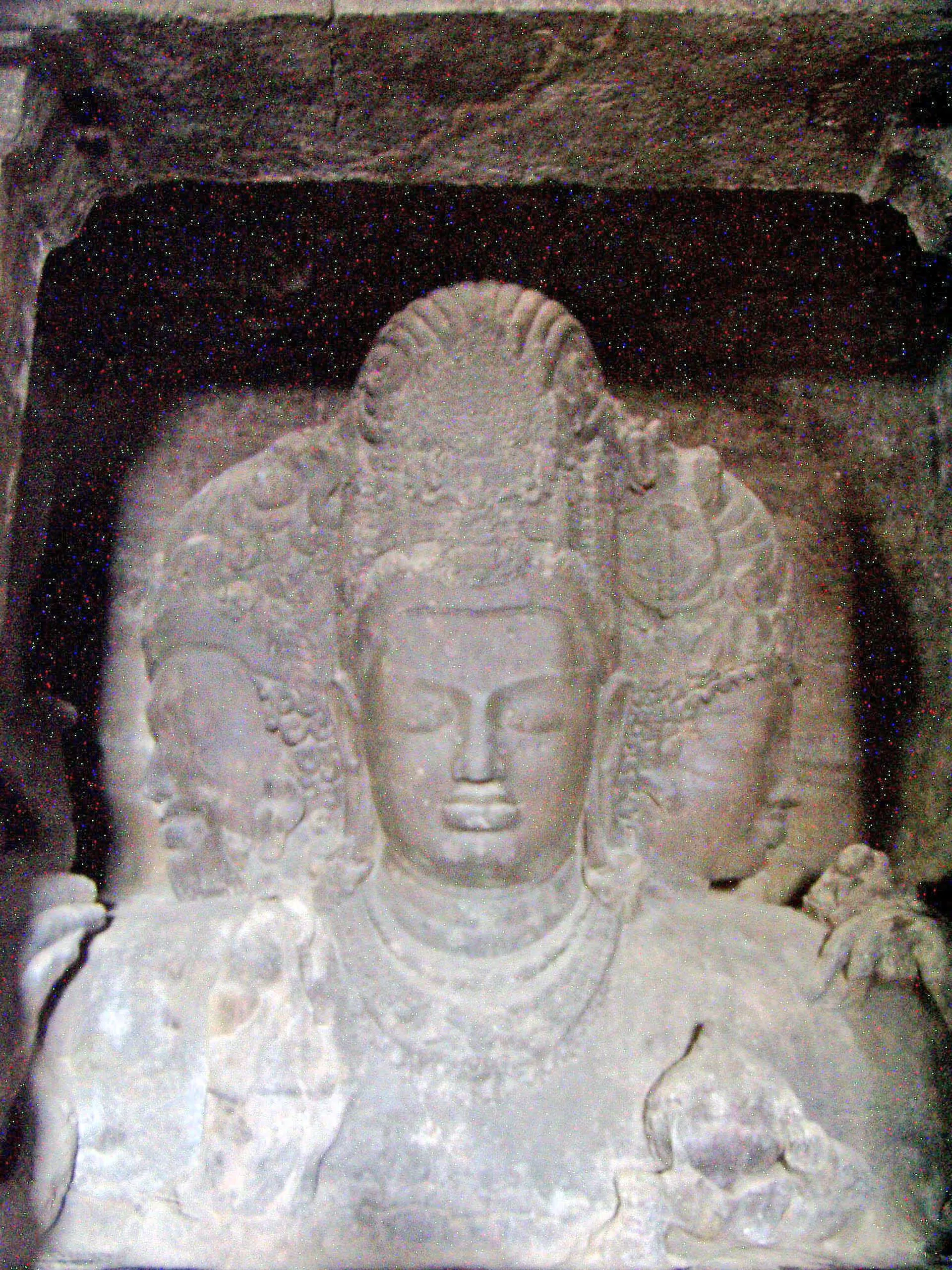
The south wall holds the centrepiece, the 6-metre Trimurti or Sadashiva: three faces of Shiva emerging from the living rock -- the calm, almost feminine creator to one side, the fierce Aghora with curling moustache and serpents to the other, and the meditative central visage gazing inward. It is routinely ranked among the masterpieces of Indian art.
Around the hall run some of the greatest reliefs in Indian sculpture. Ardhanarishvara fuses Shiva and Parvati into one androgynous body; Gangadhara shows Shiva catching the falling river Ganges in his hair; the Kalyanasundara panel stages the wedding of Shiva and Parvati with Brahma as priest. Opposite them a vigorous Nataraja dances creation and destruction, while Ravananugraha captures the demon-king straining to lift Shiva's mountain.
The sculptors used the cave itself as a medium. Shafts and openings throw changing light across the panels through the day, modelling the deep-cut figures so they seem to move, and the eastern and western courts once held subsidiary shrines. Outside, macaques, mango trees, and tropical birds crowd the 120-step climb from the jetty -- part pilgrimage, part nature walk.
Excavation History
No one can say for certain who carved Elephanta, or exactly when. Scholars place the great cave in the mid-6th century CE and most credit the Kalachuri dynasty, whose rulers were devotees of Shiva, yet firm proof is thin and the Chalukyas and others have also been proposed. Estimates for the wider complex still stretch across the 5th to 8th centuries, making the island one of Indian archaeology's great open questions.
That uncertainty has a specific, tantalising cause. Early visitors recorded a carved dedicatory stone that would have named the patron and the date, but it was removed -- reportedly carried off by the Portuguese -- and has never been found. Its loss is why the caves can be admired in extraordinary detail yet not securely dated, an enduring mystery that still divides specialists.
The Portuguese, who took the islands in the 16th century, named the place "Elephanta" after a large stone elephant standing near the landing. That figure was later moved to Mumbai's Jijamata Udyaan garden, where it survives. Colonial-era accounts and local tradition also blame Portuguese soldiers for much of the mutilation visible across the panels, from hacked limbs to defaced faces.
After long neglect, the Archaeological Survey of India began systematic conservation in the colonial period and still maintains the site, bracing the fractured basalt and shielding the carvings from monsoon damp. UNESCO's 1987 World Heritage inscription recognised the caves as a masterpiece of rock-cut art, and that listing now anchors the funding and oversight that keep the sculptures standing.
When to Visit
Caves open Tuesday-Sunday, 9:30 AM - 5:30 PM, and close every Monday along with the ticket office and the small on-site museum. Ferries, not opening hours, set the real timetable: the first boat leaves the Gateway of India around 9 AM, the last outbound boat around 2 PM, and the last return near 5:30 PM, so a late start can strand you.
Take the 9 AM ferry to reach the island ahead of the tour groups and the midday heat, giving you the main cave in relative quiet; allow about an hour each way on the water. The Elephanta Festival of classical music and dance, long associated with the island, is another reason some visitors time their trip for the cooler winter months.
Admission and Costs
Cave entry is ₹600 (about $7.20) for foreign visitors and ₹40 for Indian nationals, collected by the Archaeological Survey of India at the top of the stairs. The return ferry runs ₹200 (economy) to ₹250 (deluxe, upper deck), and a small landing fee of about ₹10 applies on the island.
A toy train carries those who prefer not to walk the first stretch from the jetty to the foot of the staircase for roughly ₹10. Licensed guides wait near the entrance and charge about ₹500-1,000 for a 1-1.5-hour tour; agree the price and the language before you set off. Carry small cash, as card payment is unreliable on the island.
The Case for a Guide
Elephanta rewards context more than almost any monument in Mumbai: the carvings are theology in stone, and without a reading of the iconography most visitors simply photograph the Trimurti and leave. A licensed guide turns half an hour of looking into the layered story of a 6th-century Shaiva temple.
- Decoding the iconography: a guide walks you panel by panel -- why Ardhanarishvara is split male and female, what the river in Gangadhara means, how the fierce and serene faces of the Trimurti express one god -- so the hall reads as a designed programme rather than scattered carvings
- The dating mystery: good guides are candid that the patron and exact date are unknown, and explain how the lost inscription and the Kalachuri attribution fit the wider history of Deccan rock-cut temples
- Reading the damage: they distinguish weathering from deliberate mutilation, and set the Portuguese story in its contested, evidence-light context instead of repeating it as settled fact
- Spotting the plan: the off-axis linga shrine and its guardian dvarapalas are easy to miss; a guide shows how the cave works as two temples in one
- Logistics and timing: a guide hired at the jetty or arranged in advance manages the ferry, the climb, and the monkeys, and knows when the light favours each panel
Tips for Visitors
A visit is a half-day expedition, not a quick stop -- budget 4-5 hours door to door: about an hour of ferry each way, the climb, and 1-1.5 hours in the caves. Build in slack so a missed return boat doesn't become an evening stuck on the island.
- Wear proper shoes: the 120-step stone staircase is steep, uneven, and slippery after rain; it is the main accessibility barrier, as there is no step-free route up to the caves
- Avoid the monsoon: ferry services are suspended or unreliable in heavy rain (roughly July-September) and the paths turn treacherous -- plan for December-February instead
- Guard your snacks: the island's macaques are bold and fast, and will snatch food, water bottles, and anything shiny straight from your hands
- Bring water and cash: facilities on the island are limited, there are few ATMs, and small notes make the ferry, train, and guide far easier
- Combine the day: start at the Gateway of India for the ferry, and on your return explore Colaba or walk north through the Fort to Chhatrapati Shivaji Terminus
Frequently Asked Questions
When is the best season to visit Elephanta Caves?
December through February is the prime window, with calm harbour waters for a smooth ferry crossing and comfortable temperatures for climbing the 120 stone steps to the caves. January and February skies are typically the clearest. The monsoon from July through September suspends or severely disrupts ferry services, and the island's paths become dangerously slippery -- effectively closing the attraction for the season.
What time of day is best for touring Elephanta Caves?
Caves open: Tuesday–Sunday, 9:30 AM – 5:30 PM. Closed: Every Monday. Ferry schedule: First boat 9 AM, last boat to island around 2 PM, last return around 5:30 PM. Best time: Take the 9 AM ferry to arrive before tour groups
What is the entrance fee for Elephanta Caves?
Cave entry (foreigners): ₹600 ($7.20). Cave entry (Indians): ₹40. Ferry (return): ₹200 economy, ₹250 deluxe. Toy train on island: ₹10 (from jetty to cave staircase base). Guide at caves: ₹500–1,000 for a 1–1.5-hour tour
How long should visitors plan for a trip to Elephanta Caves?
Plan a half day: Ferry (1 hour each way), climbing steps (20 minutes), exploring caves (1–1.5 hours) — total 4–5 hours. Wear sturdy shoes: The 120-step stone staircase to the caves is uneven and steep.