
Gateway of India timeline
- Dec 1911
King George V lands at Apollo Bunder
The first British monarch to visit India steps ashore at Apollo Bunder during the Delhi Durbar tour. A temporary structure marks the exact spot where the permanent arch will later rise.
-
Foundation stone laid
The Governor of Bombay, Sir George Sydenham Clarke, lays the foundation stone on 31 March 1913, though a finished design and the reclaimed land to build on are both still years away.
-
George Wittet's design sanctioned
The final Indo-Saracenic design by architect George Wittet -- who also shaped the nearby Prince of Wales Museum -- is approved, fixing the arch's fusion of a Roman triumphal form with Gujarati detailing.
-
Apollo Bunder reclaimed
Land reclamation at Apollo Bunder is completed, providing both the foreshore site for the monument and the sea wall that frames its approach from the harbour.
- Dec 1924
Gateway completed and opened
Viceroy Rufus Isaacs, the Earl of Reading, opens the finished 26-metre arch on 4 December 1924 -- thirteen years after the royal landing it commemorates, at a cost of around 21 lakh rupees.
- Feb 1948
Last British troops depart
On 28 February 1948 the First Battalion of the Somerset Light Infantry, the last British regiment in India, marches through the arch to waiting ships as a newly independent India watches from the quay.
-
Shivaji equestrian statue installed
A bronze equestrian statue of the Maratha king Chhatrapati Shivaji Maharaj is unveiled on the plaza, recasting an imperial monument as a stage for Indian identity; a statue of Swami Vivekananda later joins it.
- Nov 2008
Terror attacks strike the waterfront
Gunmen assault the adjacent Taj Mahal Palace Hotel during the 26 November 2008 attacks. The Gateway plaza has since become a gathering place for vigils and quiet public remembrance.
Architecture
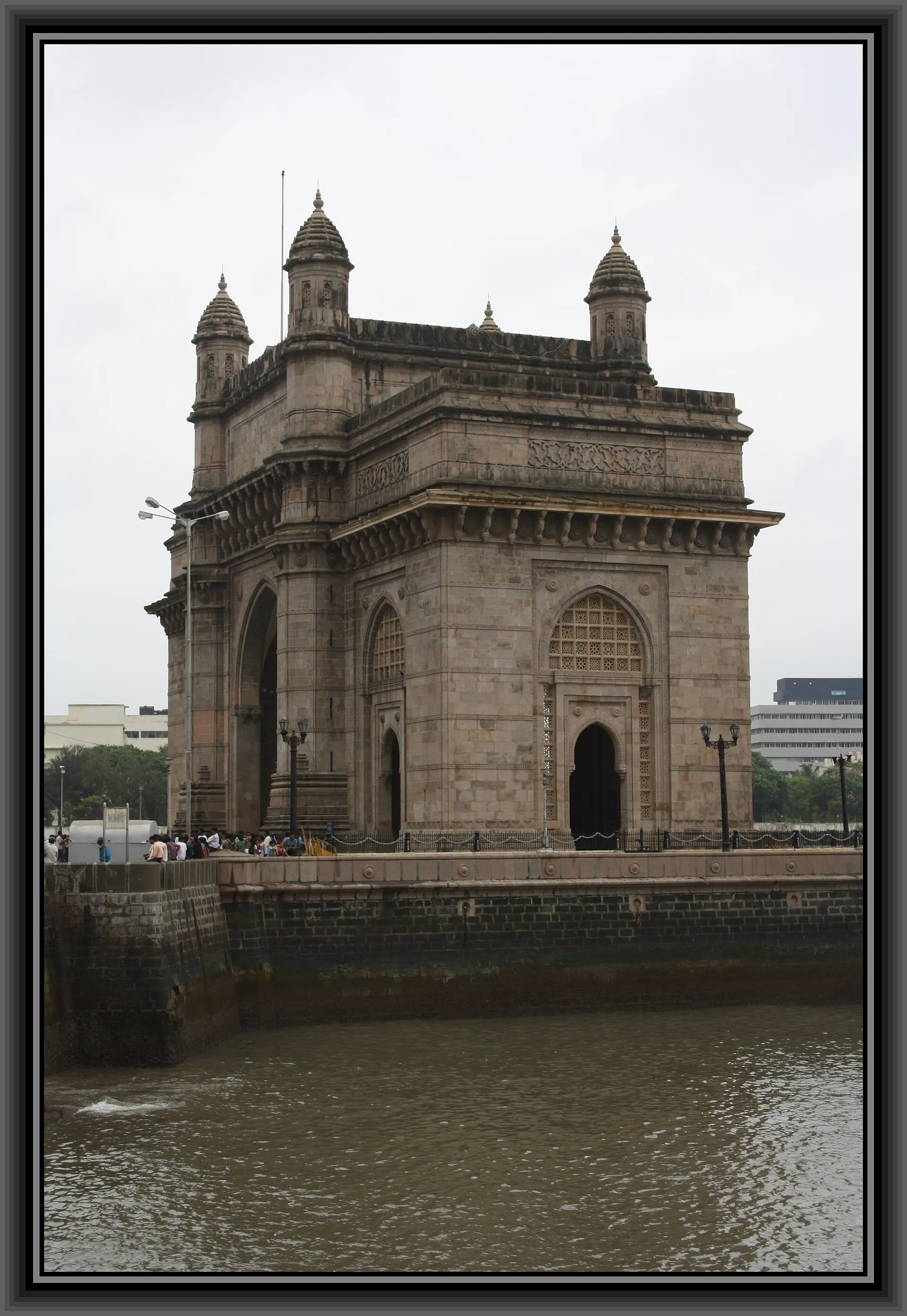
The 26-meter (85-foot) arch is built from yellow Kharodi basalt and reinforced concrete, blending a Roman triumphal arch form with Indo-Saracenic detailing. The central dome is roughly 15 meters (48 feet) across and rises about 25 meters (83 feet) at its peak; four corner turrets anchor the structure, and the interior ceiling carries intricate carved patterns. Muslim architecture informs the dome while the decorative jali lattice screens reflect Gujarati craftsmanship. The arch faces the Arabian Sea, framing the harbour in the way that made it the first sight for every ship arriving in British India. The adjacent Taj Mahal Palace Hotel (1903) complements the Gateway with its own Indo-Saracenic red dome and was famously built by Jamsetji Tata after he was reportedly refused entry to a Europeans-only hotel. Together, the Gateway and the Taj define Mumbai's iconic waterfront silhouette, a composition best appreciated from the sea on the short harbour cruises that leave from the jetty.
Historical Significance
Designed by George Wittet and completed in 1924, the Gateway was built to commemorate the 1911 visit of King George V and Queen Mary -- the first British monarchs to visit India. The foundation stone was laid in 1913, but construction dragged on for over a decade while the Apollo Bunder foreshore was reclaimed from the sea; the finished monument was opened by the Viceroy, the Earl of Reading, on 4 December 1924 at a cost of roughly 21 lakh rupees. The arch quickly became the ceremonial entrance to British India, welcoming dignitaries arriving by ship. The profound historical irony is that on February 28, 1948, the last British troops marched through this same archway to board vessels back to England, watched by the citizens of a newly independent India. The Gateway also stands near the site of the devastating 2008 Mumbai terror attacks, when gunmen struck the adjacent Taj Hotel. A guide connects the architectural details -- how the arch echoes Roman triumphal forms but in Gujarati jali latticework -- to the broader history of the waterfront, from the cotton trade that built Mumbai's wealth to India's struggle for independence.
When to Visit
Open: 24 hours (outdoor monument, viewed from the plaza -- the arch cannot be entered or climbed). Best for photos: early morning (6-8 AM) with soft light and few people, before the balloon sellers and boat touts arrive. Best for atmosphere: evening, when the arch is illuminated and the waterfront fills with families and street vendors. Elephanta ferries: depart from the adjacent jetty roughly 9 AM - 2 PM, with the last return around 5:30 PM; the crossing takes about an hour each way. Allow 30-45 minutes for the Gateway alone, or a half-day if you combine it with a Colaba walk and a harbour ferry.
Admission and Costs
Gateway of India: free to view. Elephanta ferry: ₹200 return (economy), ₹250 (deluxe), plus a small ₹10 (about $0.10) landing fee on the island. Guided heritage walk (Colaba): ₹1,500-3,000 (about $18-36) per person, 2-3 hours, typically covering the Gateway, the Taj Hotel exterior, and the surrounding colonial district. Short harbour boat rides from the jetty run ₹80-120 (about $1-1.50) per person. Photographers should note that tripods and commercial shoots may draw a fee or a request to move on, though casual phone and camera photography is free.
The Case for a Guide
The Gateway of India is simultaneously a monument to imperial arrival and imperial departure — a guide holds both ironies together and connects the arch to the neighborhood, the hotel next door, and the harbor it overlooks.
- The last British troops' departure irony: The arch was built to welcome King George V in 1911 and became a symbol of British power — but on February 28, 1948, the last British regiment marched through it to ships waiting in the harbor as independent India watched from the quayside; a guide makes this reversal visceral rather than a footnote
- Yellow basalt stone sourcing: The arch is built from Kharodi basalt quarried from near Mumbai — a guide explains why George Wittet chose this stone, how it was transported, and why the Indo-Saracenic style was specifically chosen to signal that British India was a hybrid civilization rather than a purely imported one
- Taj Mahal Palace Hotel's 1903 founding legend: The Taj next door was allegedly built after Jamsetji Tata was refused entry to the Europeans-only Watson's Hotel — a guide navigates the actual historical evidence for this story, explains the Tata family's role in India's industrial independence, and connects the hotel's opening to the broader context of Indian responses to colonial exclusion
- Apollo Bunder harbor history: The promontory the Gateway stands on was Mumbai's original landing point for centuries of trade — a guide traces the cotton merchants, the opium shipments, and the colonial administrators who all arrived at this exact spot before the arch was built
- Elephanta Caves ferry context: The ferry to Elephanta departs from immediately beside the Gateway, but most visitors don't know the island's rock-cut 6th-century Shiva temples predate the arch by 1,400 years — a guide frames the two monuments as bookends of the harbor's history
Tips for Visitors
Getting there: the Gateway sits at Apollo Bunder in Colaba; the nearest suburban stations are Churchgate and Chhatrapati Shivaji Terminus, each a 10-15 minute taxi ride or a 25-30 minute walk south through the Fort. Security checkpoints: bag screening is required to enter the plaza, so travel light. Skip weekends: the plaza gets extremely crowded on weekends and holidays; weekday mornings are ideal. Combine with a Colaba walk: stroll north along Shahid Bhagat Singh Road and browse the stalls of Colaba Causeway for the full colonial-architecture-and-bazaar experience. Book Elephanta early: the first ferry at 9 AM is the least crowded -- buy tickets at the booth beside the jetty and keep the return time in mind. Handle touts firmly: fix any price for boat rides, balloons, or photos before you agree. From here, walk north to Chhatrapati Shivaji Terminus through the Fort district, or take the ferry to Elephanta Caves for a half-day island excursion.
Frequently Asked Questions
What months are most enjoyable for visiting the Gateway of India?
November through February brings Mumbai's coolest, driest weather -- perfect for evening waterfront strolls and the first ferry to Elephanta Caves across a calm harbour. The basalt arch looks particularly striking against clear January skies. June through September sees dramatic monsoon waves crashing over the waterfront and reduced ferry service, though some visitors enjoy the raw spectacle of the Arabian Sea during storms.
When can visitors tour Gateway of India?
Open: 24 hours (outdoor monument). Best for photos: Early morning (6–8 AM) with soft light and few people. Best for atmosphere: Evening, when the arch is illuminated and the waterfront fills with families and street vendors.
How much is the entrance fee for Gateway of India?
Gateway of India: Free. Elephanta ferry: ₹200 return (economy), ₹250 (deluxe). Guided heritage walk (Colaba): ₹1,500–3,000 per person, 2–3 hours including Gateway, Taj Hotel exterior, and surrounding colonial district
How do you get to the Gateway of India?
The Gateway sits at Apollo Bunder in Colaba, at the southern tip of the Fort district. From the suburban rail network, Churchgate (Western Line) and Chhatrapati Shivaji Maharaj Terminus (Central/Harbour Lines) are both about 2–3 km away; from either, a metered taxi or auto-rickshaw takes 10–15 minutes, or it is a 25–30 minute walk south through the colonial-era Fort. BEST buses and app-based cabs serve Colaba Causeway a short walk from the plaza. There is no dedicated visitor car park, so public transport or a drop-off is easiest.
How long should you spend at the Gateway of India?
Allow 30–45 minutes to see the arch itself, walk the plaza, and photograph the harbour and the Taj Mahal Palace Hotel next door. Pair it with the surrounding Colaba and Fort heritage streets for a half-day (2–3 hours), or make it a full day by catching a morning ferry to the Elephanta Caves, which take roughly an hour each way plus two to three hours on the island.
What should visitors know before visiting Gateway of India?
Security checkpoints: Bag screening is required to enter the plaza around the Gateway; leave large bags and sharp objects behind. The monument is not enclosed and cannot be climbed or entered, so viewing is from the plaza and waterfront. Weekends and public holidays get very crowded, and touts selling balloons, photos, and boat rides are persistent -- agree any price before accepting a service.