
Red Fort timeline
-
Construction begins
Shah Jahan began building the fort as the palace citadel of his new capital, Shahjahanabad.
-
Fort completed
After nine years, the court moved in and the river-facing marble pavilions became the Mughal imperial residence.
-
Mughal rule ends
After the uprising, the British deposed the last emperor and razed much of the interior to build barracks.
-
Independence address
Jawaharlal Nehru raised the national flag at the fort, beginning the annual Independence Day address.
-
World Heritage listing
UNESCO inscribed the Red Fort Complex, recognising its fusion of Persian, Timurid and Indian design.
Fortification History
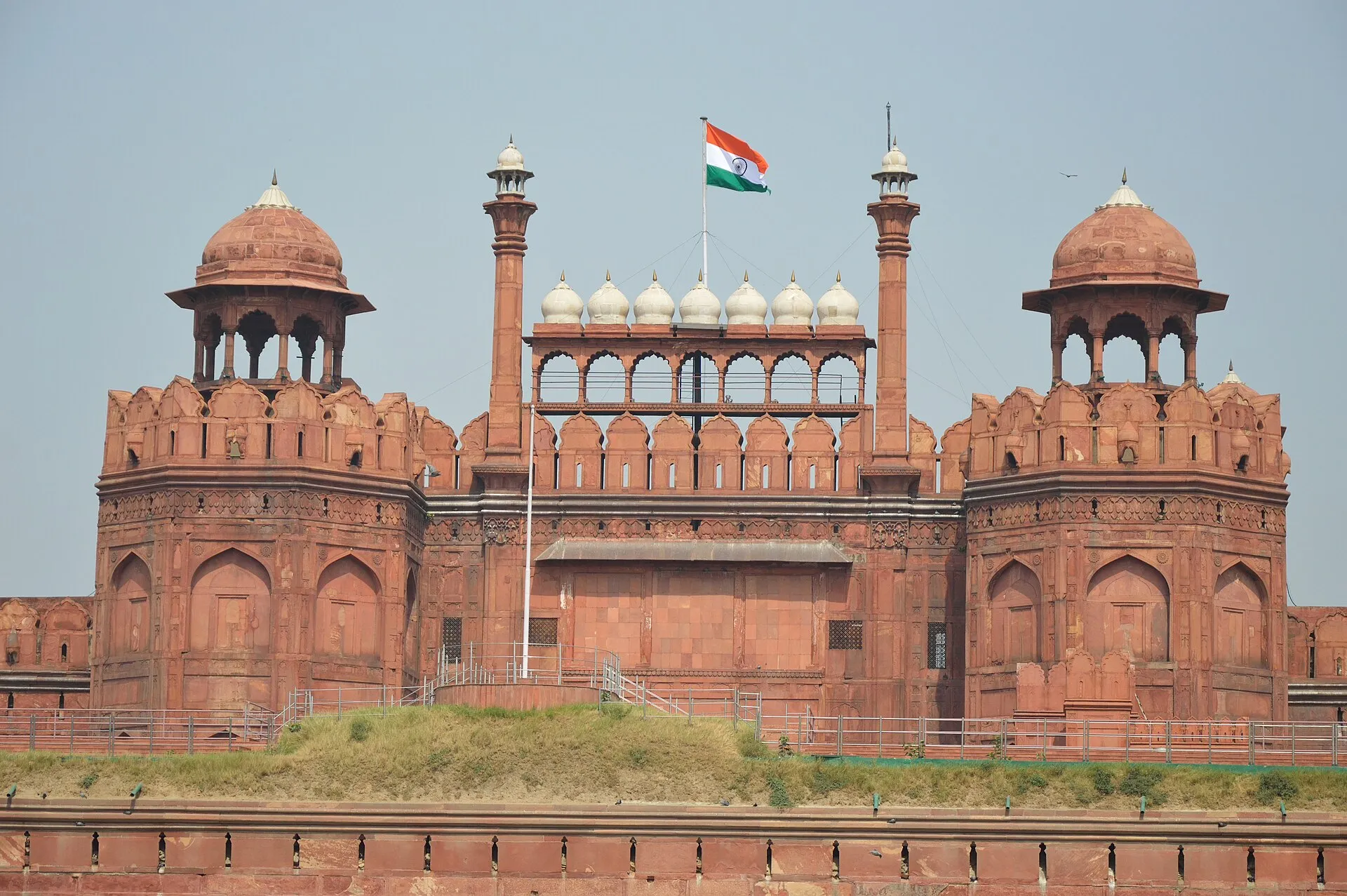
The Red Fort is first and foremost a fortress, and its defenses repay a slow walk. Shah Jahan's engineers anchored the citadel against the Yamuna, whose waters once lapped the eastern ramparts and filled a protective moat on the landward sides; a causeway linked it to the older Salimgarh Fort (built 1546), and the two together make up the UNESCO-listed Red Fort Complex. Of the fort's gates, the western Lahori Gate faces the bazaar street of Chandni Chowk and remains the ceremonial entrance where the tricolor flies on Independence Day, while the southern Delhi Gate is guarded by a pair of stone elephants. Emperor Aurangzeb later added a protruding barbican in front of the Lahori Gate; Shah Jahan, by then his son's prisoner, is said to have lamented that the screen turned the fort into "a bride with a veil over her face." Step through the gate and you enter Chhatta Chowk, a vaulted covered bazaar where court jewellers and silk merchants once traded, leading to the Naubat Khana drum house where musicians announced each arrival. The deepest scars came after the 1857 uprising: with the last emperor Bahadur Shah Zafar deposed, the British demolished roughly two-thirds of the inner palaces and gardens to raise military barracks, several of which still stand, and bullet marks from the independence struggle remain on the walls. Shah Jahan's own Agra Fort offers a vivid comparison of how one emperor fortified two Mughal capitals.
Notable Rooms
Along the riverfront runs the Nahr-i-Behisht — the "Stream of Paradise" — a marble channel that once threaded cool, perfumed water through a row of pavilions, and the surviving rooms are best read in sequence. The Diwan-i-Am, or Hall of Public Audience, shelters a raised marble canopy where the emperor heard petitions; its back wall is inlaid with Florentine pietra dura panels, including a famous image of Orpheus charming the animals, carried off after 1857 and only returned and reset on Lord Curzon's orders. Beyond it, the Diwan-i-Khas (Hall of Private Audience) was the most precious room in the empire: the jewelled Peacock Throne stood here beneath a ceiling of solid silver, and the Persian couplet attributed to Amir Khusrau still circles its arches — "If there is paradise on earth, it is this, it is this, it is this."
The Rang Mahal ("Palace of Colours") housed the imperial women and keeps the exquisite ivory-and-marble lotus fountain set into its floor, while the adjoining Khas Mahal held the emperor's private apartments and the octagonal Musamman Burj tower, from whose balcony he showed himself to the crowds each morning in the ritual of jharokha darshan. Nearby stand the marble Hammam royal baths, whose basins were once fed with rose water, and the pristine white Moti Masjid ("Pearl Mosque") that Aurangzeb added for his personal prayers in 1659. At the northern end the Hayat Bakhsh Bagh ("Life-Bestowing Garden") frames the twin Sawan and Bhadon monsoon pavilions around a central tank holding the red sandstone Zafar Mahal. The Mumtaz Mahal palace, meanwhile, now houses the fort's archaeological museum of Mughal relics.
When to Visit
Open Tuesday-Sunday, 9:30 AM - 4:30 PM; the fort is closed every Monday, and the ticket counters and gates stop admitting visitors about 30 minutes before closing. Arrive at opening (9:30-11 AM) to walk the complex before the midday heat and the tour-group crowds build. The on-site museums — including the Kranti Mandir cluster opened in 2019, which tells the story of the Indian National Army and the freedom struggle — keep the same Tuesday-Sunday hours. After dark, the Son et Lumière (sound-and-light) show narrates Mughal and colonial history across the floodlit walls, usually around 7-8 PM with separate Hindi and English sittings whose exact times shift with the season; winter evenings are the most comfortable for it.
Admission and Costs
Admission is ₹600 ($7.20) for foreign visitors and ₹35 for Indian nationals, with children under 15 admitted free; buy tickets at the gate or online through the ASI portal to skip the queue. A video-camera fee of ₹25 applies, and the separate Son et Lumière show costs around ₹80. Engaging a licensed ASI guide typically runs ₹800-1,500 for a 1.5-2 hour tour — well worth it for a monument whose stripped interiors need narration to come alive. The in-fort museums charge a small additional ticket.
The Case for a Guide
The Red Fort's stripped interiors require storytelling to come alive — a guide restores the silver ceilings, inlaid throne rooms, and rose-water fountains through narration in the very spaces they once occupied.
- Mughal architectural symbolism: The fort's layout mirrors the Quranic description of paradise — four rivers running from a central point, gardens divided into quadrants, water everywhere — a design that guides trace from the Nahr-i-Behisht channel to the Hayat Bakhsh Bagh, explaining each element's cosmological meaning.
- Diwan-i-Khas "heaven on earth" inscription: The Persian couplet "If there is paradise on earth, it is this, it is this, it is this" circled the hall's silver ceiling; guides explain that the ceiling was stripped by the Maratha and Jat invaders before the British arrived, and reconstruct what the space looked like when those words were a statement of fact rather than archaeology.
- The Koh-i-Noor diamond's time here: The Peacock Throne stood in the Diwan-i-Khas and the Koh-i-Noor sat in its peacock's eye; guides trace the diamond's journey from the Mughal treasury through Nadir Shah's 1739 Persian sack and onward to the Sikh Empire before its controversial arrival in the Tower of London.
- British colonial changes after 1857: The barracks built inside the fort after the uprising demolished several palaces and gardens; guides identify where buildings once stood using surviving foundations and old photographs, explaining what was destroyed and why the British chose to garrison the emperor's private quarters specifically.
- Independence speech tradition started by Nehru: Every August 15th since 1947, India's Prime Minister addresses the nation from the Lahori Gate ramparts; guides explain why Nehru chose this location, what the first speech contained, and how the symbolism of reclaiming the Mughal emperor's gate for a free republic was absolutely deliberate.
Tips for Visitors
Allow 2-3 hours: the complex is vast, and rushing past the pavilions misses half the detail. The fort is easiest to reach by Metro — Lal Qila station on the Violet Line sits at the entrance, and Chandni Chowk on the Yellow Line is a short cycle-rickshaw ride away. Security screening at the Lahori Gate is airport-style, so travel light, as large bags are restricted. Shade is limited inside, so carry water, especially from April to September. Because the Lahori Gate opens straight onto Chandni Chowk, the fort pairs naturally with an Old Delhi street-food walk and the nearby Jama Masjid. For a fuller day of imperial Delhi, combine it with Humayun's Tomb and India Gate; history buffs can extend the Mughal trail to Agra Fort and the Taj Mahal on a day trip from the capital.
Frequently Asked Questions
When is the best time of year to explore the Red Fort?
November through February offers the most comfortable conditions for walking the sprawling riverside complex, where limited shade makes Delhi's summer visits grueling. The evening sound-and-light show is particularly atmospheric during the cool winter months. August 15 is Independence Day, when the Prime Minister addresses the nation from the Lahori Gate ramparts -- a historic occasion, though public access to the fort itself is restricted on that day.
When can visitors explore Red Fort?
Open: Tuesday–Sunday, 9:30 AM – 4:30 PM. Closed: every Monday. Last entry is roughly 30 minutes before closing. Sound-and-light show: evenings (timings vary by season, usually 7–8 PM, with separate Hindi and English sittings). Best time: early morning (9:30–11 AM) before the crowds and midday heat.
What is the admission price for Red Fort?
Foreigners: ₹600 ($7.20). Indian nationals: ₹35. Children under 15 enter free. Sound-and-light show: ₹80. ASI guide: ₹800–1,500 for a 1.5–2 hour tour. Video-camera fee: ₹25. Tickets are sold at the gate or online through the ASI portal.
How do I get to the Red Fort?
The easiest route is by Delhi Metro: Lal Qila station on the Violet Line sits right at the fort's entrance, while Chandni Chowk on the Yellow Line is a short cycle-rickshaw ride through Old Delhi's bazaars. Expect airport-style security screening at the Lahori Gate, so travel light -- large bags are restricted.
What should visitors know before exploring the Red Fort?
Allow 2–3 hours, as the complex is vast. The Lahori Gate opens straight onto Chandni Chowk, so it pairs naturally with an Old Delhi street-food walk and a visit to the nearby Jama Masjid. Carry water since shade is limited, and consider the sound-and-light show, which brings Mughal and colonial history to life with dramatic narration projected onto the walls.