Getting Around Brisbane: A Practical Transport Guide
How to move around Brisbane — the go card and flat 50-cent TransLink fares, the free CityHopper and fast CityCat ferries, trains, buses.
Read the full guideUpdated · 14 min read
Getting around Brisbane is cheap and easy: since 2024 a flat 50-cent fare covers every TransLink train, bus, and ferry with a go card or contactless tap. Ride the free CityHopper and fast CityCat ferries along the river, and take the Airtrain from the airport for about A$22.
Brisbane is shaped by its river, and so is the way you get around it. The brown, looping Brisbane River cuts the city into a series of peninsulas and bends, which sounds like an obstacle but turns out to be the key to the whole place: the ferries that work the water are not just transport, they are the single best way to see the city. Add a train and bus network that now charges a flat fare of pocket change, and getting around the capital of Queensland's south-east becomes one of the easiest and cheapest parts of any trip to Brisbane. This guide covers how to pay, which mode to use when, how to reach the sights that sit outside the centre, and how to budget and time your days.
How do you pay for public transport in Brisbane?
Brisbane's TransLink network runs trains, buses, and ferries under one ticketing system with two ways to pay. Tap a contactless bank card or phone (Smart Ticketing), or buy a reloadable go card at stations and convenience stores. Since 2024 a flat 50-cent fare applies to every journey, whatever the distance.
Brisbane's integrated network is run by TransLink, and it covers trains, buses, and the river ferries under a single ticketing system. You have two ways to pay, and for a short visit either is fine:
- Contactless (Smart Ticketing). Tap a contactless Visa or Mastercard — or the same card loaded into a phone or watch — on the readers when you board and, on trains and ferries, again when you leave. This rolled out across the whole network over the past few years and is the simplest option for visitors.
- The go card. TransLink's reloadable smart card works identically and is worth buying if your bank card isn't contactless or charges foreign-transaction fees. Pick one up at station booths, the airport, or convenience stores, and top it up with cash or card.
The headline fact, and it genuinely changes how you plan, is the fare. Since 2024 the Queensland government abolished the old zone system and set a flat 50-cent fare for every go card or Smart Ticketing journey, no matter how far you travel. A cross-city train ride, a riverside CityCat trip, and a short bus hop all cost the same fifty cents. The one significant exception is the Airtrain to and from the airport, which is run under a separate concession and keeps its own, much higher fare.
Which Brisbane ferry should you take?
Brisbane's ferries are the best way to see the city. The free CityHopper loops the inner river every 30 minutes between North Quay, South Bank, the CBD, Kangaroo Point, and New Farm, gliding under the Story Bridge. The bigger, faster CityCat runs the full river to the university and Hamilton for the standard 50 cents.
If you do one thing on the water, make it the ferries — they are the most enjoyable, and most useful, way to connect the riverside attractions.
The free CityHopper is the inner-city looping ferry, and it costs nothing at all. It runs roughly every 30 minutes from early morning until late, calling at North Quay, South Bank, the CBD's Eagle Street, Kangaroo Point, and New Farm. No card, no tap — just step on. Because it links the cultural precinct on the south bank with the city centre and the cliffs opposite, the CityHopper alone covers a surprising share of a sightseeing day. It drops you a short walk from South Bank Parklands and the Queensland Museum, and it glides directly beneath the Story Bridge, giving you the cantilever's best photograph for free.
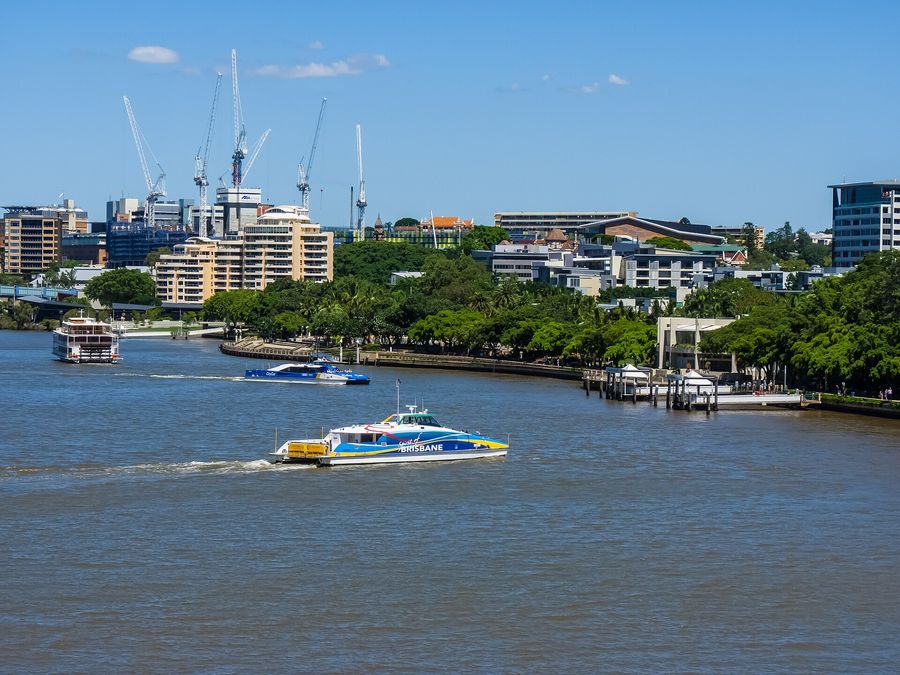
The CityCat is the bigger, faster catamaran — the blue-and-white boat pictured above — and it runs the full length of the river, from the University of Queensland in the west to Hamilton's Northshore in the east, stopping at 22 wharves along the way. Unlike the CityHopper it costs the standard 50-cent fare, but for that you get the city's signature ride: an open upper deck, the skyline sliding past the Kangaroo Point cliffs, and a genuinely fast way to cover distances that would crawl by road. Treat a CityCat trip out to the university and back as a sightseeing activity in its own right.
How do Brisbane's trains and buses work?
Where the river doesn't reach, trains and buses take over at the same flat 50-cent fare. Frequent, air-conditioned suburban trains handle longer hops toward the Gold and Sunshine Coasts, while buses run partly on dedicated busways—grade-separated roads that skip traffic. The Cultural Centre and King George Square stations are the busiest hubs.
Where the river doesn't reach, the rest of the network takes over, and at fifty cents a ride there is no reason to walk a route you could take the train for.
Trains are the backbone for longer hops — out to the suburbs, down the coast, and along the river valley. Brisbane's suburban rail is frequent and air-conditioned, and the same flat fare applies, which makes day trips toward the Gold Coast or the Sunshine Coast almost free to reach.
Buses fill in everything else, and Brisbane's run partly on dedicated busways — grade-separated roads reserved for buses that let them skip the city's traffic entirely. The Cultural Centre and King George Square underground stations are the two hubs you'll use most. The busway network is also how you reach the one major attraction that sits well outside the centre, covered next.
How do you reach the sights outside central Brisbane?
Lone Pine Koala Sanctuary, 12 km upriver, is the trip needing planning: take bus 445 from the Cultural Centre (around 40 minutes) or the heritage MV Mirimar cruise from North Quay to its jetty. For the Story Bridge Adventure Climb, the CityHopper or a short CBD walk reaches the Kangaroo Point base.
Lone Pine Koala Sanctuary is the trip that needs a little planning. The world's oldest koala sanctuary sits about 12 km upriver, southwest of the CBD, and there are two car-free ways to get there. The straightforward option is bus 445, which leaves from the Cultural Centre stop near South Bank and takes around 40 minutes. The memorable option is the MV Mirimar, a heritage river cruise that departs North Quay mid-morning and meanders downriver to the sanctuary's own jetty — slower, but a lovely half-day in itself. Either way, plan around the koala-cuddle and feeding times, and remember that Lone Pine Koala Sanctuary charges entry separately from any transport.
For the Story Bridge Adventure Climb, you don't need a car either: the CityHopper or a short walk from the CBD gets you to the base at Kangaroo Point, and dawn climbers will find ride-hailing the easiest way to arrive before the ferries get going.
Are e-scooters, e-bikes, and walking good options in Brisbane?
Brisbane's docking-free e-scooters and e-bikes (Neuron and Beam) suit the flat riverside bikeway linking South Bank, the Botanic Gardens, and New Farm; helmets are legally required and usually clipped on. Walking works well too—the compact CBD, the pedestrian Goodwill and Kurilpa bridges, and the riverwalk turn many map distances into ten-minute strolls.
Brisbane was an early adopter of shared e-scooters and e-bikes, and the council-permitted schemes (Neuron and Beam among them) have docking-free fleets scattered across the inner city. Unlock one through the operator's app, and they're well suited to the flat riverside bikeway that runs along much of the city reach — a pleasant way to link South Bank with the Botanic Gardens or New Farm. Helmets are legally required in Queensland and are usually clipped to the scooter; ride on the bikeways, not the footpaths, in the busy core.
Don't overlook walking, either. The CBD is compact and largely flat, the Goodwill Bridge and Kurilpa Bridge are pedestrian-only river crossings that knit the two banks together, and the riverwalk from the city out to New Farm is one of Brisbane's nicest free experiences. Many of the distances that look daunting on a map are a ten-minute stroll along the water.
When should you use taxis or ride-hailing in Brisbane?
When the ferries wind down or you're crossing town late, taxis and ride-hailing apps both work reliably across greater Brisbane. Metered taxis wait at ranks outside major hotels and transit hubs, while the usual apps operate citywide, often cheaper and easier. For three or four sharing, a single car can rival public transport, especially with luggage.
When the ferries wind down or you're crossing town late, taxis and ride-hailing apps both operate reliably across greater Brisbane. Metered taxis wait at ranks outside the major hotels and the transit hubs, and the usual ride-hailing apps work citywide, often a little cheaper and easier when you'd rather not explain a destination. For a group of three or four splitting the fare, a single car across the city centre can rival the convenience of public transport, especially with luggage or after a late dinner in Fortitude Valley.
How do you get from Brisbane Airport into the city?
Brisbane Airport sits about 13 km northeast of the CBD, and the fast link is the Airtrain, reaching Central station in roughly 20 minutes and running every 15 to 30 minutes. It is the one TransLink service excluded from the 50-cent fare, so budget around A$22 one way. Taxis and ride-hailing take 20-30 minutes but cost more.
Brisbane Airport (BNE) sits about 13 km northeast of the CBD, and the fast link is the Airtrain. It reaches Central station in roughly 20 minutes and runs about every 15 to 30 minutes through the day, connecting both the domestic and international terminals. Note the catch flagged earlier: the Airtrain is the one TransLink-linked service excluded from the 50-cent fare, so budget around A$22 for a one-way adult ticket — still far cheaper and more predictable than a taxi at peak hour. Booking online shaves a little off the gate price.
A taxi or ride-hailing trip into the city takes 20 to 30 minutes depending on traffic and costs considerably more than the Airtrain, but it makes sense for very early or late flights, for groups, or when you're laden with bags and headed somewhere off the rail line.
How much should you budget for getting around Brisbane?
Thanks to the flat fare, in-city transport is almost a rounding error—even a week of heavy ferry-and-train use struggles to top a few dollars per person. The real costs are the Airtrain (about A$22 each way) and paid experiences like the Story Bridge climb, Lone Pine entry, or the MV Mirimar cruise.
This is the easy part. Thanks to the flat fare, your in-city transport budget is close to a rounding error: even a week of heavy ferry-and-train use, several rides a day, struggles to add up to more than a few dollars per person. The real costs to plan for are the Airtrain at each end of your trip (roughly A$22 a head, each way) and any guided experiences that carry their own pricing — the Story Bridge climb, Lone Pine entry, or the MV Mirimar cruise. For a full breakdown of typical tour and guide pricing across the country, the Australia country guide sets out what to expect, and most Brisbane walking tours assume you can reach the meeting point on your own fifty-cent fare.
How should you time your days in Brisbane?
Brisbane's subtropical rhythm rewards planning. In the cooler, drier months from June to August the light is gorgeous; in summer from December to February, heat builds and thunderstorms arrive after about 2 PM, so schedule open-deck CityCat rides and riverside walks for the morning. Commuter rush hours barely touch the tourist ferries.
Brisbane's subtropical rhythm rewards a little planning around the clock and the calendar. In the cooler, drier months from June to August, the light is gorgeous and the ferries are a joy; in the summer months from December to February, the heat and humidity build through the afternoon, and thunderstorms arrive with some predictability after about 2 PM — schedule the open-deck CityCat rides and the riverside walks for the morning, and keep the air-conditioned museums for the heat of the day. Commuter rush hours, roughly 7:30 to 9 AM and 4:30 to 6 PM, fill the trains and busways but barely touch the tourist ferries. And if you're tempted by the Story Bridge climb, the dawn slots in autumn and winter deliver the most dramatic light of all — just arrange your ride to Kangaroo Point the night before, since the ferries won't yet be running.
Why does a local guide still help in Brisbane?
Once you've tapped on, none of this is hard, but a local guide smooths the small frictions: which CityCat wharf is nearest your hotel, whether to bus or cruise to Lone Pine given the tides, and which side of the upper deck frames the skyline. A half-day walking tour doubles as transport orientation.
None of this is difficult once you've tapped on for the first time, but a local guide collapses the small frictions that eat a first day: which CityCat wharf is closest to your hotel, whether to bus or cruise to Lone Pine given the day's tides and timetable, and which side of the upper deck to sit on for the skyline. A good half-day walking tour also doubles as a transport orientation — you finish it knowing how the ferries, the busways, and the river crossings fit together, which turns the rest of your visit into a series of confident fifty-cent hops. For a first-time visitor, pairing a guided morning with a tapped-on card in your pocket is the fastest route to feeling like the river city is yours.
Related Guides
- Getting Around Buenos Aires: A Practical Transport Guide — how another river-and-rail capital handles transit cards, buses, and airport transfers
- Getting Around Tokyo: A Practical Transport Guide — tap-card logistics and rush-hour timing in one of the world's great metro cities
Sort out a tap-on card on day one, learn the difference between the free CityHopper and the fast CityCat, and the rest of Brisbane opens up for fifty cents a ride. Let the river do the sightseeing for you, save the Airtrain for the airport runs, and you'll spend your budget on koalas and bridge climbs rather than on getting between them.
Hero photograph of CityCats approaching the South Bank ferry terminal by John Robert McPherson, licensed CC BY-SA 4.0 via Wikimedia Commons.
Frequently Asked Questions
Do I need a go card to use public transport in Brisbane?
Not strictly — Brisbane's TransLink network now accepts contactless bank cards and phones (Smart Ticketing) on trains, buses, and ferries, so a tap-and-go card works fine for a short visit. A reloadable go card is still handy if your card is foreign, but either way the fare is the same flat rate.
How much does public transport cost in Brisbane?
Almost nothing. Since 2024 a flat 50-cent fare applies to every go card or Smart Ticketing journey on TransLink trains, buses, and ferries, regardless of distance, after the Queensland government abolished the old zone system. The main exception is the Airtrain to the airport, which keeps its own higher fare of around A$22.
Is the CityCat ferry the same as the free CityHopper?
No. The free CityHopper is a small inner-city ferry that loops between North Quay, South Bank, the CBD, Kangaroo Point, and New Farm with no ticket needed. The CityCat is the larger fast catamaran that runs the length of the river to the University of Queensland and Hamilton, and it costs the standard 50-cent fare.
How do I get from Brisbane Airport into the city?
The Airtrain reaches Central station in about 20 minutes and runs roughly every 15 to 30 minutes; a one-way adult fare is around A$22. A taxi or ride-hailing trip into the CBD takes 20 to 30 minutes and costs considerably more, but suits late arrivals or groups with luggage.
How do you reach Lone Pine Koala Sanctuary without a car?
Take bus 445 from the Cultural Centre stop near South Bank — about a 40-minute ride — or, for a scenic alternative, board the MV Mirimar river cruise from North Quay, which departs mid-morning and glides downriver to the sanctuary's private jetty. Sanctuary entry is priced separately.