
Best Time to Visit Húsavík: Whales, Weather and the Diamond Circle
Húsavík lives by the whale-watching calendar in Skjálfandi Bay. Here is how to choose your months — for humpbacks and blue whales.
Read the full guideUpdated · 9 min read
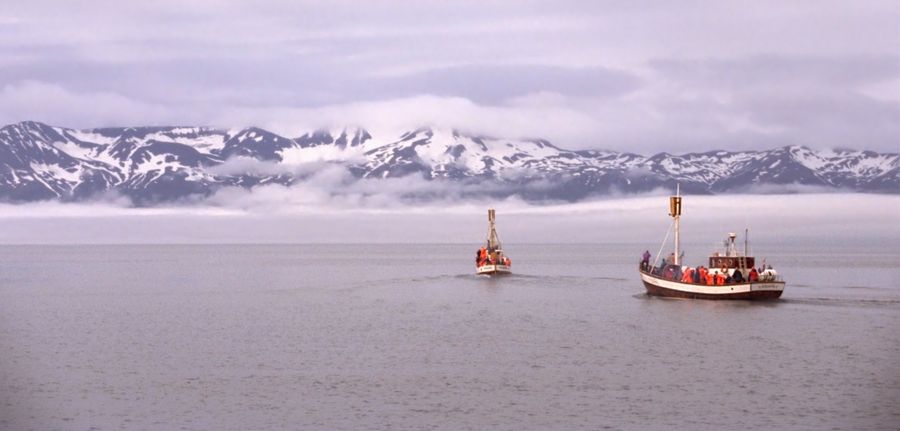
The best time to visit Húsavík is June to August, when humpback whales feed heavily in Skjálfandi Bay, blue whales appear most often, and the Diamond Circle roads are fully open. May and September offer nearly the same whale odds with fewer boats and lower prices, while winter trades reliable sightings for the chance to watch the Northern Lights from the water.
Most towns have a high season shaped by weather or school holidays. Húsavík has one shaped by biology. The town's identity is built almost entirely on the whales that gather to feed in Skjálfandi Bay, and their calendar — not the thermometer — decides when a visit is at its best. Get the months right and you can watch a humpback lunge-feed a few metres from a wooden boat with snow still on the mountains behind; get them wrong and you may find the harbour quiet and half the operators shut for the season.
This guide is about choosing those months deliberately: when the whales are most active, when the Diamond Circle opens up, when prices ease, and how the practicalities of reaching this corner of northeast Iceland shift through the year.
What is the short answer on when to visit Húsavík?
For the fullest experience, come between June and August, when whale activity peaks, daylight is nearly endless, and every road and operator is running. Travellers who prioritise value or quiet should target May or September; those chasing the aurora should accept winter's trade-offs.
- Peak whales, midnight sun, open roads: June to August
- Almost the same whales, fewer crowds, better prices: May and September
- Northern Lights from the water, deep quiet: late October to March
- Avoid if whales are the whole point: November and December, the shortest and roughest window
How does the whale watching change month by month?
Skjálfandi Bay is productive across a long season, but the species mix and the odds shift as the water warms and the capelin and herring move in. Humpbacks are the backbone of the season from May to October, minkes are present all year, and the blue whale — the largest animal that has ever lived — is a June-and-July prize.
The bay's shallow, nutrient-rich water concentrates the small fish that draw whales close to shore, which is why Húsavík operators report sighting rates above 98% across the core season. The table below sets out what each part of the year typically delivers.
| Period | Whale outlook | Notes |
|---|---|---|
| Apr–early May | Season opening; humpbacks arriving | Fewer daily departures, variable seas |
| Jun–Jul | Peak; humpbacks abundant, best blue-whale odds | Long daylight, busiest and priciest |
| Aug | Excellent humpback activity | Slightly quieter than midsummer |
| Sep | Strong; humpbacks still feeding | Prices ease, shoulder-season calm |
| Oct | Tailing off; humpbacks and minkes | Shorter days, more weather cancellations |
| Nov–Mar | Minkes year-round; sightings unreliable | Focus shifts to aurora sailings |
If your single goal is the widest range of species and the best chance at a blue whale, book June or July. If you would trade a fraction of that probability for smaller boats and lower fares, September is the connoisseur's month.
Which tour should you choose, and when?
Húsavík's operators run three broadly different experiences, and the right one depends as much on the season as on your budget. Traditional oak boats suit most summer visitors; zodiacs reward those who want speed and spray; aurora sailings only make sense in the dark half of the year.
| Tour type | Best months | Approx. price (per person) | Character |
|---|---|---|---|
| Traditional oak boat (2–3 hrs) | May–Sep | ISK 12,000–18,000 (~$85–130) | Slow, low to the water, atmospheric |
| Rigid inflatable zodiac (2 hrs) | Jun–Aug | ISK 14,000–20,000 (~$100–145) | Fast, agile, reaches whales quickly |
| Northern Lights sailing | Nov–Mar | Varies by operator | Aurora over the bay on clear nights |
The restored oak vessels — some are former fishing and herring boats — move gently and sit close to the surface, which many travellers find more immersive when a humpback surfaces alongside. Zodiacs cover the fjord faster and are the better bet on a busy day when whales are reported far out. Whichever you pick, book the first morning departure: the bay is usually calmest early, and you keep the rest of the day free for the Whale Museum, whose full-scale skeletons — including a blue whale — make far more sense after you have seen the animals alive.
When is the Diamond Circle fully open?
The Diamond Circle — the northeast loop linking Goðafoss, Ásbyrgi, Dettifoss and Húsavík — is at its most accessible from mid-June to September, when the higher roads are reliably clear of snow. Outside that window, the falls remain reachable with more planning, but casual self-driving gets harder.
Húsavík is the natural overnight base for this circuit. Ásbyrgi, the horseshoe canyon 65 km to the northeast, is easy to reach on a good road for much of the year. Dettifoss, Europe's most powerful waterfall by flow, sits 90 km east on higher ground where the approach roads can hold snow well into spring and close early in autumn; in deep winter, reaching it usually means a guided super-jeep or snowmobile trip rather than a rental car. Goðafoss, 90 km southwest toward Akureyri, stays accessible year-round and pairs neatly with the drive in or out. If a full self-driven loop is central to your plan, favour July or August, when every section is open and daylight gives you the hours the 300-plus-kilometre circuit demands.
What should you budget, and when do prices drop?
Iceland is expensive, and Húsavík's tours are no exception, but shoulder-season timing shaves a meaningful amount off both fares and beds. The headline costs are the whale trip itself and, if you want it, a guided Diamond Circle day.
| Experience | Typical price |
|---|---|
| Whale watching (oak boat) | ISK 12,000–18,000 (~$85–130) |
| Whale watching (zodiac) | ISK 14,000–20,000 (~$100–145) |
| Diamond Circle guided day tour | ISK 20,000–28,000 (~$145–200) |
| Ásbyrgi + Dettifoss guided half-day | ISK 15,000–22,000 (~$110–160) |
| Private guide (half-day, up to 6) | ISK 45,000–65,000 (~$325–470) |
Two habits save real money. First, book directly with Icelandic operators where you can — direct fares are often noticeably cheaper than international resale platforms, and many operators offer a free repeat trip if no whale is sighted. Second, travel in May or September rather than midsummer: whale odds are barely lower, but accommodation in and around the harbour is easier to find and priced below the June-to-August peak.
How do you get to Húsavík and get around?
Húsavík's core sights cluster around a compact, walkable harbour, so once you arrive you need no transport to reach the boats, the church and the museums. Getting to town, and out onto the Diamond Circle, is where the planning sits — and it changes with the season.
Most visitors arrive from Akureyri, 90 km southwest and home to the region's airport and largest choice of hotels. In summer, the seasonal Strætó bus links the two towns in about 90 minutes, a workable option if you only want a whale tour and a wander. For the Diamond Circle, though, a rental car is close to essential outside the guided-tour route, and a few practicalities are worth knowing before you go:
- Everything central is walkable. The whale-watching piers on Húsavík Harbour, the Húsavíkurkirkja — the red-and-white wooden church built in 1907 from Norwegian timber — the Whale Museum and the Exploration Museum are all within a few minutes of each other.
- Dress for the water, not the town. Even on a warm July day, Skjálfandi Bay is cold and open; operators lend flotation overalls, but bring a windproof layer, a hat and gloves regardless of the calendar.
- Build in a weather buffer. Sailings and higher Diamond Circle roads are weather-dependent, so in shoulder and winter months leave a spare day rather than pinning everything to a single afternoon.
What is the bottom line on timing a Húsavík visit?
If you want the whales at their best with everything open, come between June and August and take the earliest sailing you can. If value and calm matter more, May and September give you nearly the same bay for less. And if you are chasing the Northern Lights over the water, accept that winter's whale count is a bonus, not a promise.
Húsavík rewards travellers who plan around its one great variable. Decide first whether you are here for the whales, the Diamond Circle, the aurora, or some combination, then let that choice fix your months — because in a town this closely tied to the rhythms of Skjálfandi Bay, the calendar is the itinerary.
Hero photograph of traditional oak whale-watching boats on Skjálfandi Bay off Húsavík by Andreas Tille, licensed CC BY-SA 4.0 via Wikimedia Commons.
Frequently Asked Questions
When is the best time to visit Húsavík for whale watching?
June and July, when humpback activity in Skjálfandi Bay is at its peak and blue whales appear most often. Sighting rates run above 98% across the core May-to-September season, so August and the May and September shoulders are still excellent while a little cheaper and quieter.
Can you see whales in Húsavík in winter?
Departures thin out sharply from November to March and seas are rough, but minke whales are present year-round and a handful of operators run winter sailings. The real winter draw is watching the Northern Lights from the water on a clear, calm night, rather than a reliable whale count.
When is the Diamond Circle fully accessible from Húsavík?
Roughly mid-June to September, when the mountain roads to Dettifoss and the Ásbyrgi approaches are clear of snow and open without restriction. In shoulder months some sections need care, and in deep winter Dettifoss access can require a super-jeep or snowmobile tour.
Is Húsavík worth an overnight stay or just a day trip from Akureyri?
An overnight stay pays off. Many visitors drive the 90 km from Akureyri for a single tour, but staying lets you take an early or late sailing when the bay is calmest, add a Diamond Circle day, and visit the Whale Museum and harbour without rushing the return.