
Collection Highlights
Bonjour Monsieur Courbet (La Rencontre) — Gustave Courbet (1854)
Courbet paints himself as a proud, travel-worn artist greeting his Montpellier patron Alfred Bruyas and his servant on a sun-struck Languedoc road. At once a defiant self-portrait and a manifesto of the independent painter who answers to no academy, it is the single work most visitors come to the Fabre to see.
Les Baigneuses — Gustave Courbet (1853)
A heavy, unidealised nude bather turns her back to the viewer at the edge of a woodland pool, a frank treatment of the female body that scandalised the 1853 Salon. Acquired by Bruyas and given to the museum, it is one of the boldest early statements of Courbet's Realism.
Vue de village — Frédéric Bazille (1868)
A young woman sits in dappled shade above a sunlit village near Montpellier, painted outdoors in the clear southern light his friends Monet and Renoir admired. The Fabre holds one of the world's richest collections of this Montpellier-born Impressionist, who was killed in battle at 28.
Femmes d'Alger dans leur appartement — Eugène Delacroix (1849)
A second, smaller version of Delacroix's celebrated harem interior, painted five years after the 1834 canvas now in the Louvre. Its glowing colour and hushed domestic calm made the subject a touchstone for later painters from Renoir to Matisse.
The Soulages galleries
An entire wing is given over to Pierre Soulages's outrenoir - "beyond black" - paintings, close to twenty of which the artist and his wife Colette donated to the museum. Raked, scored, and ridged black paint catches and throws light differently as you move, making reflection itself the subject.
The Old Master galleries
Fabre's founding 1825 gift and the 1836 Valedau bequest fill these rooms with Italian and Spanish Golden Age painting - Veronese and Zurbarán among them - alongside the Flemish Baroque of Rubens and Teniers and sculpture by Jean-Antoine Houdon.
Hôtel de Cabrières-Sabatier d'Espeyran
Reached on the same combined ticket, this richly furnished 19th-century mansion preserves period salons, silver, porcelain, and furniture - a rare intact portrait of bourgeois domestic life in Second Empire Montpellier.
Collections Highlights
The Fabre reads best as a chronological climb through five centuries, and a handful of rooms reward the lion's share of your time:
- The Bruyas gallery - The core of the museum's fame: Courbet's Bonjour Monsieur Courbet (La Rencontre, 1854), in which the painter greets his patron on a dusty Languedoc road, hangs near the monumental Les Baigneuses (1853) and a remarkable run of portraits of Alfred Bruyas by Courbet, Delacroix, and Cabanel.
- The Bazille rooms - One of the world's richest holdings of Montpellier-born Frédéric Bazille, the Impressionist killed at 28 in the Franco-Prussian War; Vue de village (1868) captures the clear southern light his friend Monet envied.
- Delacroix and the Romantics - A second version of Eugène Delacroix's Femmes d'Alger dans leur appartement, painted in 1849, five years after the celebrated canvas now in the Louvre.
- The Soulages wing - An entire suite given over to Pierre Soulages's outrenoir, where raked and furrowed black paint turns reflected light into the true subject of each canvas.
- The Old Masters - Fabre's founding core and the Valedau bequest: Italian and Spanish Golden Age painting with Veronese and Zurbarán, the Flemish Baroque of Rubens and Teniers, and sculpture by Jean-Antoine Houdon.
- Hôtel de Cabrières-Sabatier d'Espeyran - The decorative-arts annex, a lavishly furnished 19th-century mansion of period rooms, silver, and porcelain reached on the same ticket.
Guided Tours
Collection navigation: some 800 works on display across more than 9,000 m² mean a guide earns their fee simply by prioritising the highlights that match your interests. Soulages expertise: grasping the outrenoir philosophy takes context that transforms apparently uniform black canvases into meditations on reflected light. The Bruyas story: a guide unpacks the friendship between Courbet and his Montpellier patron that gave the museum its Realist core and its most famous painting. Art-historical context: works connect to the broader European sweep from the Renaissance through Romanticism to postwar abstraction. Local painters: the Montpellier-born Bazille and Cabanel anchor the collection to the city you are standing in, a thread guides draw out as you move toward the Écusson.
Musée Fabre timeline
-
Fabre gives his collection to Montpellier
The painter François-Xavier Fabre, a pupil of Jacques-Louis David who had spent decades in Florence, donates his paintings, drawings, and library to his native city.
-
The museum opens to the public
Fabre's gift is installed in the former Hôtel de Massilian beside the old Jesuit college, the nucleus of the museum that still bears his name.
-
The Valedau bequest
The collector Antoine Valedau leaves a cabinet of Dutch and Flemish painting - including Rubens, Gerrit Dou, and David Teniers - broadening the young museum beyond its French core.
-
Alfred Bruyas's donation
The Montpellier patron who bankrolled Gustave Courbet gives his collection, bringing a wall of Courbet alongside Delacroix, Corot, and Millet and turning a provincial gallery into a serious record of 19th-century art.
-
Reopening and the Soulages galleries
A 2003-2007 renovation by the architects Brochet-Lajus-Pueyo more than doubles the museum to over 9,000 m² and unveils a wing dedicated to Pierre Soulages's outrenoir paintings.
When to Visit
Hours: Tuesday-Sunday, 10:00-18:00. Closed: Mondays, 1 January, 1 May, and 25 December. Because every gallery is climate-controlled, the Fabre is a genuine year-round destination - our month ratings dip only across June-August, when summer exhibitions and holiday crowds thicken the rooms. Best time: weekday mornings, and the quiet stretches of January-February and September-November, are ideal for lingering over the Soulages canvases and the Delacroix without a crowd at your shoulder. The first Sunday of each month brings free admission but also the busiest galleries, so arrive at opening if you come then.
Admission and Costs
Full ticket: €8 ($9); reduced €6 ($6.50) for students and seniors; free for under-18s and, on the first Sunday of each month, for everyone. A combined ticket adds the neighbouring Hôtel de Cabrières-Sabatier d'Espeyran decorative-arts museum, and an audio guide runs about €3 ($3.30). A small-group guided tour costs roughly €12-18 ($13-20) per person, while a private guide for two hours is about €150-220 ($165-240). Check the museum's official site for current rates and temporary-exhibition surcharges, which are ticketed separately from the permanent collection.
The Case for a Guide
The Fabre hangs its masterpieces with sparse labelling, and much of what makes the collection extraordinary is the web of relationships behind the frames - a guide turns a handsome gallery visit into a story.
- The Bruyas thread - A guide traces how one Montpellier collector's friendship with Courbet shaped half the 19th-century rooms, so Bonjour Monsieur Courbet reads as biography rather than backdrop.
- Reading Soulages - Outrenoir baffles first-time viewers; a guide explains why Soulages abandoned colour for the light trapped in textured black, and where to stand as it shifts.
- Local roots - The stories of Montpellier's own Bazille and Cabanel land harder told on the spot, a short walk from the streets where both men grew up.
- An efficient route - With old masters, Romantics, Impressionists, and postwar abstraction under one roof, a guide threads a logical path instead of a tiring zig-zag across five centuries.
Tips for Visitors
- Start with Soulages. The outrenoir wing is the most popular in the building, so see it first thing before groups arrive, then work back through the chronology.
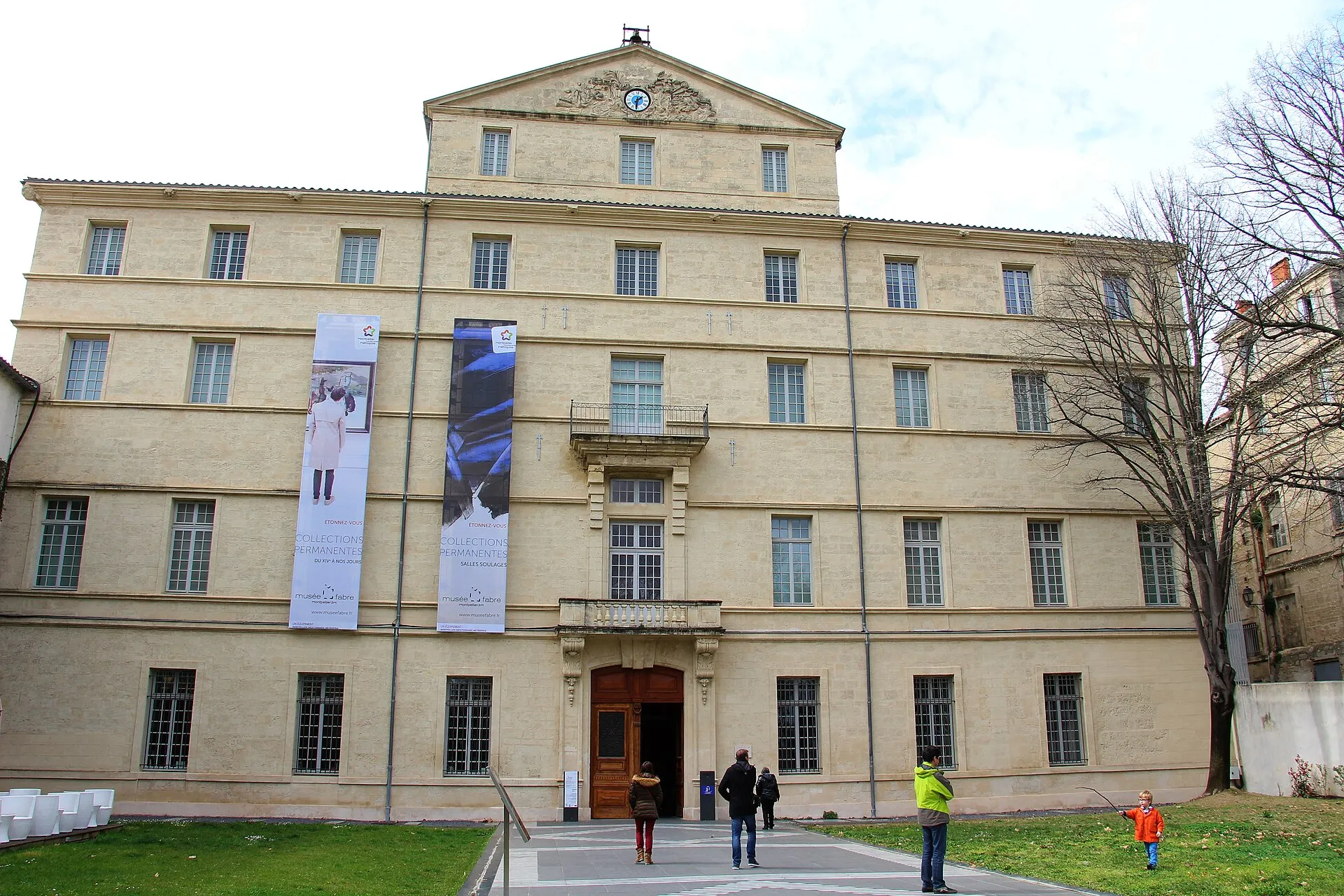
- Allow 2-3 hours. The museum is far larger than its façade suggests - over 9,000 m² - and the Cabrières-Sabatier annex adds another half-hour.
- Photography is permitted without flash in the permanent collection; temporary exhibitions may restrict it.
- The café terrace overlooks the Esplanade Charles-de-Gaulle, and the bookshop carries an excellent, partly English-language art list.
- Combine the visit with Place de la Comédie and the medieval Écusson, both a short walk away, or arrive on the tram at the nearby Comédie and Corum stops.
- Accessibility: the renovated galleries are largely step-free and served by lifts, with wheelchairs available on loan at the entrance.
Frequently Asked Questions
When should art lovers plan their visit to the Musée Fabre?
The galleries are fully climate-controlled, so the Fabre is a rewarding year-round destination, but January, February, and the autumn stretch from September through November offer the quietest rooms for contemplating the Soulages paintings and the Delacroix without a crowd at your shoulder. The first Sunday of each month brings free admission but also the busiest galleries. Summer special exhibitions draw larger audiences, so weekday mornings are the safest bet for a peaceful visit from June through August.
What are the opening hours of the Musée Fabre?
The museum opens Tuesday to Sunday, 10:00 to 18:00, and closes on Mondays as well as 1 January, 1 May, and 25 December. Weekday mornings are the calmest time for quiet contemplation, while the first Sunday of the month is free to enter but noticeably more crowded. Rooms begin to clear a little before 18:00, so leave the final hour for the galleries you most want to linger in.
How much does it cost to visit the Musée Fabre?
Full admission is €8 (about $9), with a reduced €6 ($6.50) rate for students and seniors and free entry for under-18s; the first Sunday of each month is free for everyone. A combined ticket adds the neighbouring Hôtel de Cabrières-Sabatier d'Espeyran decorative-arts museum, and an audio guide costs around €3 ($3.30). A small-group guided tour runs roughly €12-18 ($13-20) per person, while a private guide for two hours is about €150-220 ($165-240).
What should visitors know about timing and photography at the Musée Fabre?
Allow two to three hours, as the museum is far larger than its façade suggests - more than 9,000 m² across its historic and contemporary wings, with the Cabrières-Sabatier annex adding another half-hour. Start with the Soulages galleries before the crowds arrive, then work back through the chronology. Photography is allowed without flash in the permanent collection, though temporary exhibitions may restrict it.
Who founded the Musée Fabre and why does its collection matter?
The museum grew from a homecoming gift: the Montpellier-born painter François-Xavier Fabre, a pupil of Jacques-Louis David, donated his paintings and library to his native city in 1825, and the collection opened to the public in 1828. Later bequests from Antoine Valedau and the Courbet patron Alfred Bruyas turned it into one of the richest fine-art museums in France outside Paris, spanning Italian and Spanish old masters, 19th-century French painting, and the modern black canvases of Pierre Soulages.