
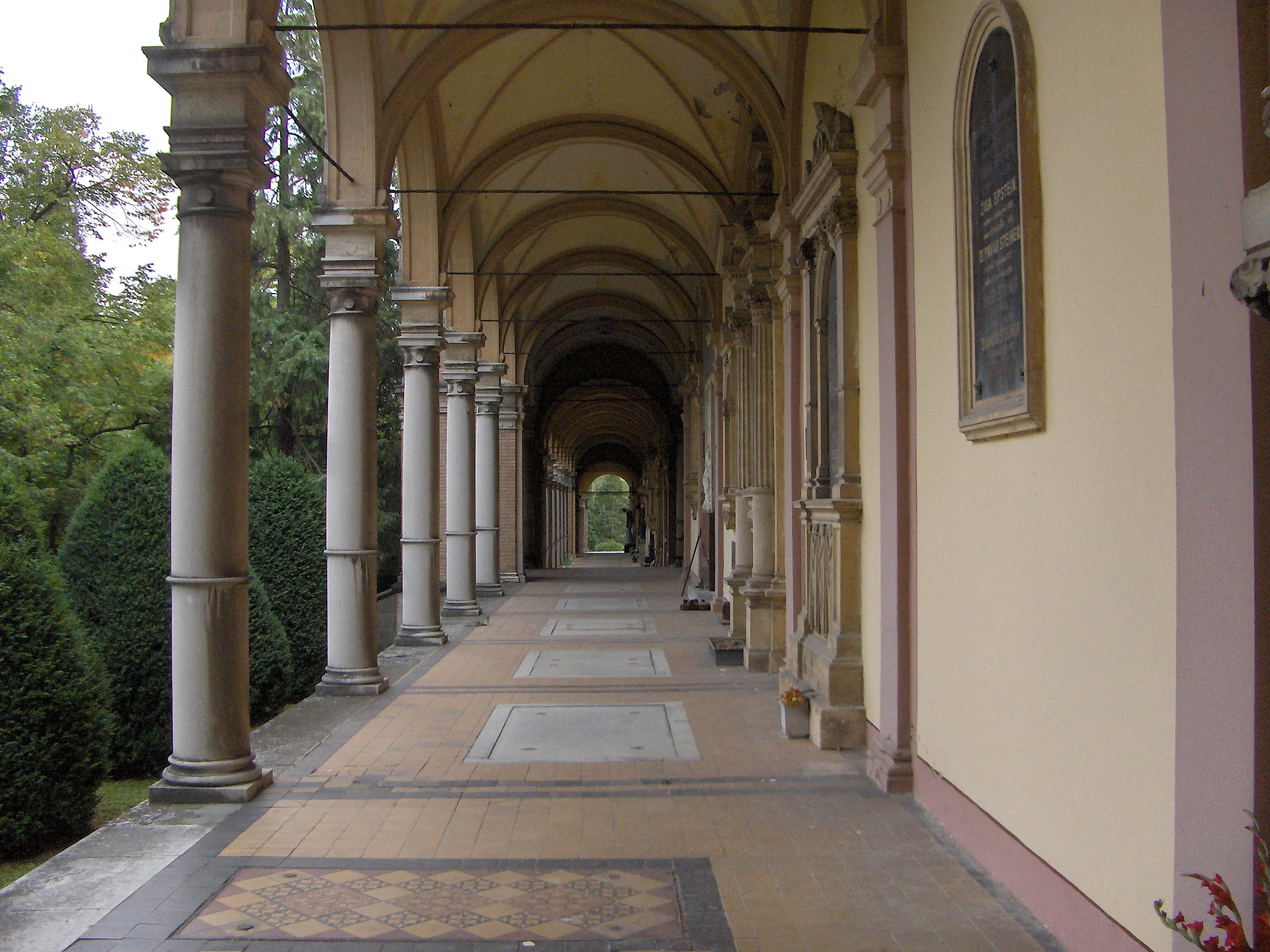
Architecture
The glory of Mirogoj is Bollé's arcade, begun in 1879 and extended over decades: a long neo-Renaissance colonnade of round-arched bays, each a family burial chapel, running the length of the western and southern boundary. Above the galleries rises a sequence of cupolas punctuated by two monumental domes at the main entrance, their coppered roofs green with age.
The outer wall, now blanketed in ivy, reads from the approach like the façade of a grand palazzo rather than a cemetery. The composition is deliberately theatrical — symmetry, repetition, and a processional rhythm that draws the eye down the colonnade — and it set the template for monumental cemetery design across the region. It is Bollé at his most confident, working in stone what he elsewhere worked in neo-Gothic.
Historical Significance
Before the cemetery, the Mirogoj estate belonged to the polymath Ljudevit Gaj, a leader of the 19th-century Croatian national revival. The city bought the land and opened the cemetery in 1876, and over the following century it became the principal resting place of the Croatian elite.
Mirogoj is effectively a national necropolis: to be buried in its arcades is a mark of standing in Croatian cultural and political life. Its multi-confessional layout also records the city's history as a meeting point of Catholic, Orthodox, Jewish, and Muslim communities. For visitors, it offers a uniquely concentrated reading of who and what modern Zagreb chose to honour — a history lesson written in avenues of stone.
When to Visit
Mirogoj is open daily, generally from around 6 AM to 8 PM in summer and closing earlier (about 6 PM) in winter, with the central arcades accessible throughout opening hours. Entry is free.
Allow 60–90 minutes to walk the arcades and the main avenues at a respectful pace; longer if you set out to find particular graves. Autumn is the most atmospheric season, when the ivy on the arcade wall turns red-gold, while All Saints' Day (1 November) sees the whole cemetery ablaze with candles and flowers — beautiful but very busy. Mornings and weekdays are the quietest times to visit.
Admission and Costs
There is no admission charge to Mirogoj; it is a public cemetery open to all. The simplest way to reach it is bus 106, which runs from the stop beside Zagreb Cathedral on Kaptol up to the cemetery's main gate in about ten to fifteen minutes.
A private guided tour that includes Mirogoj, usually paired with the cathedral and the Bollé architectural story, runs roughly €90–150 (about $97–162) for a small group. Bring a little cash if you want to buy candles or flowers from the stalls at the entrance, as many locals do.
The Case for a Guide
Mirogoj can be wandered freely, but a Zagreb guide turns a beautiful walk into a tour of the nation's memory.
- Finding the graves: The grounds are large; a guide leads you straight to Tuđman, Petrović, Bukovac, and others you would struggle to locate alone
- The Bollé thread: A guide links Mirogoj's arcades to the same architect's cathedral and St Mark's roof, revealing a single vision across the city
- Reading the sculpture: Many tombs are significant works of Croatian funerary art; a guide explains the sculptors and symbolism
- The multi-faith story: A guide walks you between the Catholic, Orthodox, Jewish, and Muslim sections and what their coexistence says about Zagreb
- National history in stone: The people buried here are modern Croatia's founders; a guide ties their graves to the events that made the country
Tips for Visitors
Go in autumn if you can: The ivy-clad arcade is at its most spectacular in October and November. Walk the full colonnade: Many visitors photograph the entrance domes and leave, missing the quarter-kilometre run of galleries that is the real wonder. Take bus 106 from the cathedral: It is far easier than walking the uphill route.
Mind the occasion: This is an active cemetery — keep your voice down, stay on the paths near funerals, and photograph architecture rather than mourners. Avoid 1 November unless you want the crowds: All Saints' Day is moving but packed; a quiet weekday morning gives you the arcades almost to yourself.
Frequently Asked Questions
Is Mirogoj worth visiting if it is a working cemetery?
Yes — Mirogoj is widely rated among the most beautiful cemeteries in Europe, and it is as much an open-air sculpture park and architectural monument as a burial ground. The great draw is Hermann Bollé's arcade: a quarter-kilometre run of ivy-clad neo-Renaissance galleries crowned with domes, framing the resting places of Croatia's most notable figures.
It remains an active cemetery, so visit with the quiet respect you would show anywhere people come to mourn. Within that, walking the arcades is free, moving, and genuinely one of Zagreb's most rewarding sights — especially in autumn, when the ivy turns and the light falls long through the colonnades.
Who is buried at Mirogoj Cemetery?
Mirogoj holds the graves of much of Croatia's pantheon. Among them are Franjo Tuđman, the country's first president; the political leader Stjepan Radić; the painter Vlaho Bukovac; the Nobel-winning chemist Vladimir Prelog; and the basketball star Dražen Petrović, whose bronze memorial is among the most visited.
Part of what makes Mirogoj remarkable is that it is multi-confessional: Catholic, Orthodox, Jewish, Muslim, and Protestant graves lie side by side, along with a secular section, reflecting the mixed city that built it. A guide or the cemetery map helps you find specific memorials among the sprawling grounds.