
Architecture
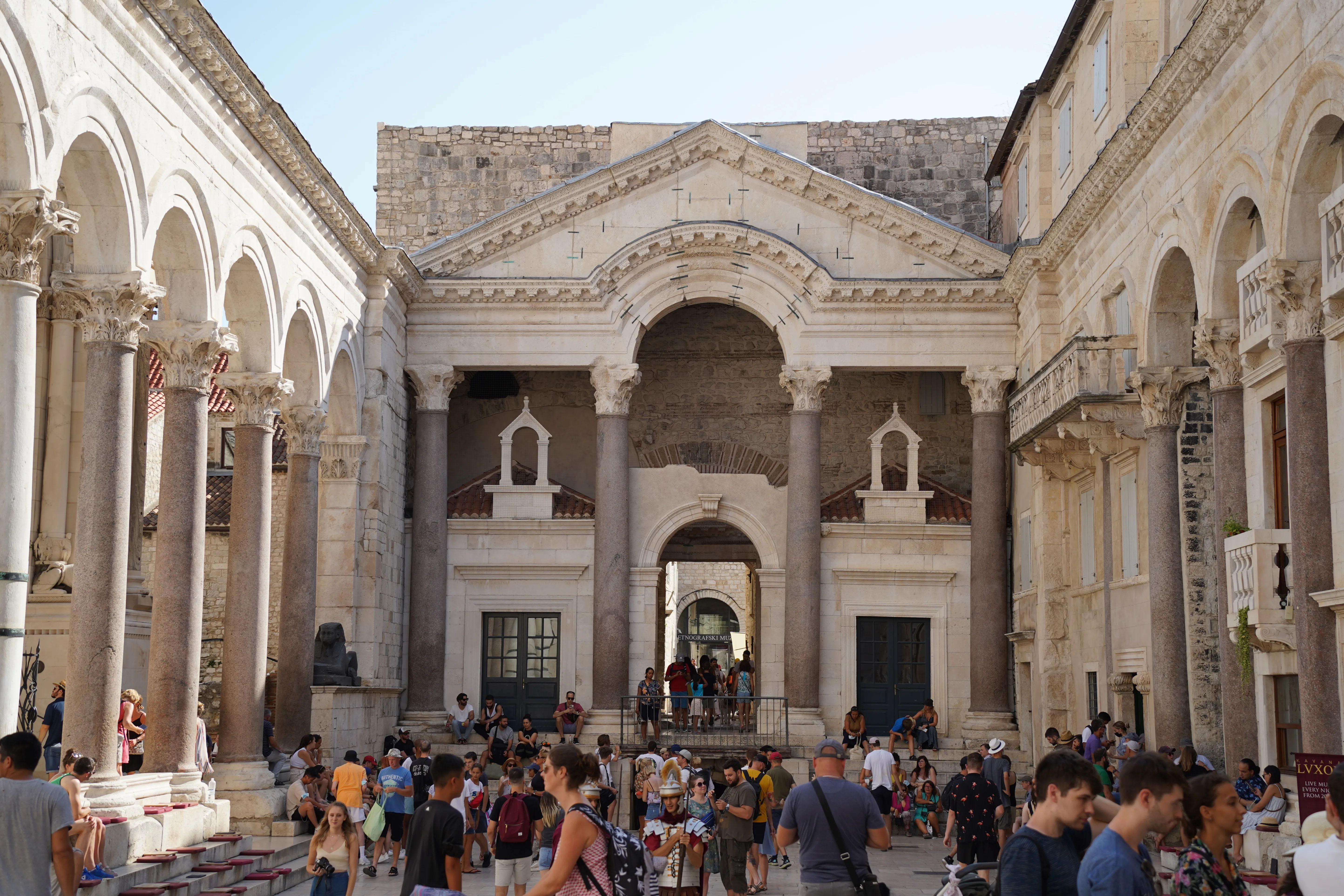
Peristyle courtyard: The colonnaded ceremonial square at the palace's heart, where the emperor processed from his private apartments to the mausoleum. The Prothyron arch surmounting the vestibule entrance is among the finest surviving examples of late Roman architectural ornament. Substructure (cellars): The vast basement — built to level the coastal terrain — covers 6,500 square metres in a room plan mirroring the imperial apartments above; intact Roman vaults, arches, and drainage channels make this the most photographable and spatially dramatic part of the palace. Mausoleum (now Cathedral of St Domnius): Diocletian's octagonal personal tomb, converted to a church around the 7th century CE. The exterior is embellished with a frieze of hunting scenes and busts; the interior retains the Roman coffered ceiling of the vestibule. Golden Gate (Porta Aurea): The northern land gate, the most ornate of the palace's four gates; outside it stands Ivan Meštrović's colossal bronze statue of Bishop Grgur Ninski (Gregory of Nin), who championed the use of Croatian rather than Latin in the liturgy. Iron Gate and Silver Gate: The western and eastern gates; the Iron Gate's interior passage contains the medieval church of Our Lady of the Belfry, built into the Roman gatehouse structure.
Historical Significance
Diocletian's Palace represents an extraordinary juncture in Roman history — built by an emperor who did the unthinkable by retiring voluntarily, it became the refuge of another civilisation's survivors, and then the foundation of a city that has never stopped growing. The palace is simultaneously the reason Split exists, the city's archaeological museum, and its most densely inhabited neighbourhood. No other site in Europe so vividly demonstrates how ancient and modern can occupy the same physical space across seventeen centuries of continuous use.
When to Visit
The palace never closes — its streets are a public neighbourhood. The underground cellars open 8 AM–9 PM in summer, 8 AM–4 PM in winter. Cathedral hours vary by mass schedule and season. Best times: Early morning (8–10 AM) for the cellars with good light and no crowds; late afternoon for the Peristyle in golden-hour light. Duration: Cellars alone take 45–60 minutes; full palace circuit with a guide takes 2.5–3 hours.
Admission and Costs
Palace streets and Peristyle: Free. Underground cellars: ~€10 adults, €5 children. Cathedral of St Domnius entry: **€5**; bell tower: ~€5 additional. Combined ticket (cellars + cathedral + treasury + baptistery + bell tower): ~€20. Private guide: €100–160 for a half-day for groups up to six. Small-group guided tours: €15–25 per person.
The Case for a Guide
The palace is simultaneously one of Europe's most accessible ancient sites and its most confusing — the layers of habitation, conversion, and construction create a visual complexity that rewards expert interpretation.
- Reading the layers: A guide decodes which walls are Roman, which are Byzantine, which are medieval Croatian, and which are Venetian; without this, the palace looks like a confused building site rather than an extraordinary accretion of history
- The theological paradox of St Domnius Cathedral: Explaining how Diocletian's personal tomb became a church honouring Christians he martyred requires historical context — a guide makes the irony vivid and the architectural evidence clear
- The Sphinx's journey from Egypt: Diocletian ordered multiple Egyptian sphinxes for the palace; only one complete example survives beside the cathedral, and its original meaning — associated with solar worship — contrasts dramatically with its current location outside a Christian cathedral
- Substructure navigation: The underground cellars are extensive enough to disorient without guidance; a guide routes the visit to hit the most dramatic vaulted chambers and explains the relationship between the basement layout and the imperial apartments above
- Finding the hidden corners: The medieval warren that grew inside the Roman walls contains Romanesque chapels, Renaissance loggias, and views of original Roman exterior stonework that most visitors walk past without recognising — a guide knows exactly where to look
Tips for Visitors
Enter the cellars first: The substructure at 8 AM is quiet, dramatically lit, and the best physical introduction to the palace's scale. Watch where you walk: The Peristyle pavement is original Roman limestone, smooth and occasionally slippery; the streets throughout the old town are similarly uneven. Cathedral mass times: The morning mass (typically 8 AM) is worth attending for the acoustic experience of the octagonal space — the only time you hear the cathedral as it was intended. Avoid peak midday: July–August between 11 AM and 3 PM is extremely crowded in the central Peristyle; morning and evening visits are dramatically different experiences. Stay for evening: The Peristyle at night, lit by café lanterns and the floodlit cathedral, is one of the most atmospheric urban spaces in Europe.
Frequently Asked Questions
What makes Diocletian's Palace different from other Roman sites?
Almost every Roman monument in Europe is a ruin — visited, photographed, and then left behind. Diocletian's Palace is a living city inside a ruin. Some 3,000 people live within its walls. The medieval and Renaissance houses built inside the Roman structure share walls with the emperor's original chambers; the streets are Roman streets; the plumbing runs through Roman foundations. You can eat dinner inside the Peristyle courtyard, drink coffee below a Roman arch, or rent an apartment in a building whose ground floor is a 1,700-year-old colonnade. No other Roman site offers this — not Rome, not Pompeii, not Ostia Antica.
How do you get the most from a visit to Diocletian's Palace?
A licensed guide is the single most important investment you can make at the palace. The site has no comprehensive museum entry — it is an inhabited neighbourhood where the monuments are embedded in daily life, and understanding what you are seeing requires someone who can decode the layers: original Roman, 7th-century Byzantine adaptation, medieval Croatian overlay, Venetian period, 19th-century Austrian addition. The underground cellars (substructure) are the most photogenic introduction — a vast Roman basement that preserved the palace plan intact. The Peristyle courtyard above is where Diocletian processed toward his mausoleum. The Cathedral of St Domnius in that mausoleum is a theological and architectural paradox requiring explanation.
How much does it cost to enter Diocletian's Palace?
The palace itself — its streets and the Peristyle — is free to enter. Individual monuments charge separately: the underground cellars cost approximately €10 adults; the Cathedral of St Domnius (including bell tower access) costs approximately €10 adults. A combined ticket covering the cellars, cathedral, treasury, baptistery, and bell tower costs approximately €20. Guided tours of the palace range from €15–25 per person in small groups to €100–160 for a private half-day guide.