
Collection Highlights
The hall of ship figureheads
Carved wooden mascarones de proa — figureheads salvaged from scrapped sailing ships and bought from European dealers — preside over the main hall as the house's presiding spirits. Neruda read the sea as the figure of freedom and the unconscious, and these female prows anchor that obsession at the heart of a house 450 kilometres from the coast where he grew up.
Diego Rivera's double portrait of Matilde
The dining-room showpiece — a 1953 canvas in which Diego Rivera gives Matilde two faces and hides Neruda's profile inside her flowing red hair, encoding the lovers' then-secret affair in a single painting. It is the most quoted object in the house and the key to reading Matilde's presence in every room.
The ship-cabin bar
Neruda loved to play host and designed a bar with the feel of a vessel's cabin — low ceilings, porthole-style windows, and nautical fittings — where he mixed drinks for the writers, painters, and political friends who filled the house. The bar fixes the maritime fantasy that runs through all three of his homes.
The coloured-glass collection
Ranks of antique bottles and vessels arranged by colour turn ordinary windows into filters that wash the rooms in bands of amber, green, and rose. Neruda believed wine and water simply tasted better from coloured glass, and the collection is one of the house's quietest and most characteristic pleasures.
Neruda's library and study
The poet's book-lined working rooms hold editions, maps, antique globes, and shells among the furniture of a lifelong reader. Many volumes were burned during the 1973 ransacking; the restored shelves stand as both a writer's workspace and a memorial to what the vandals destroyed.
The hand-painted wine labels
Neruda designed whimsical labels for the bottles of his private cellar, part of the same playful impulse that named rooms and renamed objects throughout the house. They show the poet as a maker of small domestic artworks, not only of verse.
Matilde's bedroom and the hidden doorways
Private rooms reached by narrow internal staircases and concealed passages reveal the architectural discretion Neruda demanded — a house with no obvious entrance, designed so a secret life could be lived inside it. The sightlines frame San Cristóbal Hill rising directly behind the property.
The terraced garden and watercourse
A small hillside garden with a channelled stream threads the separate structures together and once supplied the irrigation water that attackers turned against the house in 1973. Today it is the calmest corner of the visit and the best place to grasp how the house climbs its slope.
Guided Tours
La Chascona is only ever visited as a timed, one-way circuit through the rooms, so the choice is really between two ways of reading it:
- Self-guided audio tour — Included in the entry ticket and offered in English, Spanish, French, and several other languages, the audio guide walks you room by room in 45–60 minutes. It is the default experience and perfectly serviceable, but it treats the house as a sequence of objects rather than a single argument.
- Guided tour — Pre-booked through the Fundación Pablo Neruda, a live guide stretches the visit to about 90 minutes and connects each room to the poetry and the politics — which sonnet a given collection answers, why the figureheads face the way they do, what the 1973 flood reached. This is the version worth booking if you have read any Neruda at all.
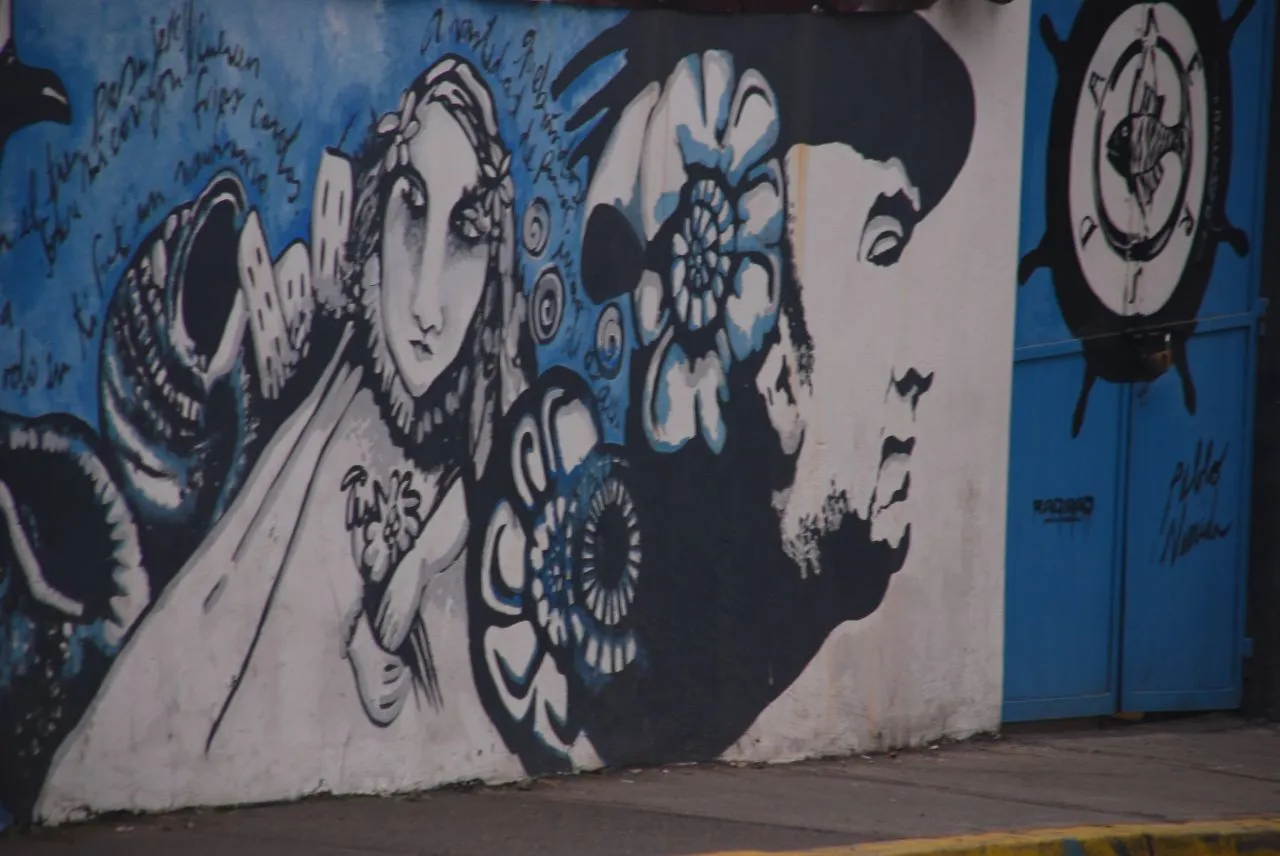
Many visitors fold La Chascona into a Neruda literary circuit of Bellavista with an independent Santiago guide, combining the house with the street art and bars of the surrounding quarter and often the funicular up San Cristóbal Hill; such a half-day typically runs CLP 100,000–200,000 ($120–235) per small group. Photography is permitted throughout without flash, so the circuit also suits visitors who want to work slowly with a camera.
La Chascona Museum timeline
-
Neruda begins the house
Neruda commissions the Catalan émigré architect Germán Rodríguez Arias to build a hidden retreat for Matilde Urrutia on the Bellavista hillside, the same friend who shaped his coastal house at Isla Negra.
-
Cien Sonetos de Amor published
The hundred love sonnets dedicated to Matilde appear in print, fixing "la chascona" and her tangled red hair at the centre of Neruda's mature love poetry.
-
Nobel Prize in Literature
Neruda receives the Nobel Prize, following Gabriela Mistral (1945) as Chile's second laureate in the field.
-
Coup, ransacking and Neruda's death
Days after the September 11 coup the house is broken into, its books burned and lower rooms flooded; Neruda dies on September 23 and his wake is held among the wreckage.
-
Matilde completes the restoration
Matilde Urrutia, who rebuilt the ruined house and lived in it until her death in January 1985, leaves it to a foundation created to protect Neruda's three homes.
-
La Chascona opens to the public
The Fundación Pablo Neruda opens the restored house as a museum, reconstructing the collections from photographs and the testimony of those who had known it.
-
The couple reburied at Isla Negra
With democracy restored, the remains of Neruda and Matilde are moved to the Casa de Isla Negra overlooking the Pacific, fulfilling the poet's long-stated wish to rest beside the sea.
When to Visit
Tuesday–Sunday: 10 AM–6 PM (last entry 5 PM); closed Mondays. The house is small and strictly one-way, so queues build fastest around midday and on Saturday afternoons when group tours concentrate — weekday mornings give you the emptiest rooms and the quietest audio track.
Getting there is easy: La Chascona is a 10-minute walk from Baquedano metro station (Lines 1 and 5) across the Mapocho into Bellavista, and two minutes from the Pío Nono funicular base. Allow 45–90 minutes inside depending on whether you take the audio guide or a live guide.
A note on access: because the house climbs the hillside through narrow staircases, low doorways, and split levels, the upper rooms are not wheelchair accessible. The courtyard, garden, ground-floor rooms, and the Foundation shop are reachable without stairs; contact the Foundation ahead of time if step-free viewing matters for your visit.
Admission and Costs
Entry: CLP 7,000 (~$8 USD) adults; CLP 3,500 students and seniors with ID. The multilingual audio guide is included in the ticket at no extra charge. A pre-booked live guided tour adds roughly CLP 5,000–10,000 ($6–12) per person. Photography is permitted in all areas without flash. The adjacent Fundación Pablo Neruda shop sells authorised editions of Neruda's poetry in several languages — a good place to buy the Cien Sonetos de Amor you should ideally have read first — along with reproductions of objects from the house. Tickets are often best reserved online in high season (spring and autumn), when the small rooms reach capacity by late morning.
The Case for a Guide
La Chascona's collections are dense and reward context, which a knowledgeable guide supplies on three fronts:
- The nautical iconography — Neruda was born 450 kilometres from the sea and spent his early life in the Andean south; his lifelong hunger for maritime objects is psychological rather than biographical. A guide who knows the poetry explains how the sea works in his verse as the figure of freedom and the unconscious, and connects each figurehead, globe, and porthole to a specific poem.
- The political dimension — The ransacking of September 1973, and the defiant wake held in the flooded rooms, is one of the most charged intersections of art and politics in Chilean history. A guide sets La Chascona inside the wider story of what the dictatorship did to the country's cultural life — the same story told at the Plaza de Armas and across central Santiago.
- The love-poetry geography — Matilde Urrutia is embedded in every design choice, from the Rivera portrait to the rooms built for her delight. A guide who knows the Cien Sonetos de Amor can match individual poems to individual rooms, turning an eccentric collection into a coherent, room-by-room love letter.
Tips for Visitors
Read the poems first. Even a dozen sonnets from the Cien Sonetos de Amor transform the house from an eccentric hoard into a coherent expression of a specific love — the collections make far more sense when you know what Neruda was writing as he assembled them. Arrive early: the house is small and concentrated groups make the rooms feel cramped, so a weekday-morning slot is by far the most comfortable. Combine with Bellavista: the quarter around La Chascona is Santiago's most bohemian — street art, craft-beer bars, and excellent restaurants within five minutes' walk — so allow an afternoon in the area afterwards, ideally continuing to the galleries and bookshops of the Lastarria neighbourhood across the river. San Cristóbal funicular: the Pío Nono funicular base is two minutes away, making La Chascona and San Cristóbal Hill a natural Bellavista half-day.
Frequently Asked Questions
Who was Pablo Neruda and why is La Chascona significant?
Pablo Neruda (1904–1973), born Ricardo Eliécer Neftalí Reyes Basoalto, is Chile's most celebrated writer and one of the most widely read poets in history. He won the Nobel Prize in Literature in 1971 — the second Chilean, after the poet Gabriela Mistral in 1945, to receive it. La Chascona ("tangled-haired woman") was Neruda's secret Santiago home, begun in 1953 for his then-mistress and later third wife, Matilde Urrutia, while he was still married to his second wife. The house name is a nickname for Matilde, whose curly red hair is the subject of some of Neruda's most famous love poems in "Cien Sonetos de Amor" (One Hundred Love Sonnets). The house was ransacked by civilian supporters of the junta in the days after the September 1973 coup — Neruda died 12 days later — and his wake was held among the wreckage before the Fundación Pablo Neruda later restored it.
What is in La Chascona and how long does a visit take?
La Chascona contains Neruda's compulsive collections — carved ship figureheads, maps, antique globes, hand-painted wine labels, a wall of coloured glass, a bar designed to resemble a ship's cabin, a dining room hung with Diego Rivera's double portrait of Matilde, and hundreds of personal objects. The house is also architecturally extraordinary — built into the hillside in separate structures connected by staircases and courtyards, with rooms at different levels joined by narrow passages and hidden doorways. A self-guided audio tour takes 45–60 minutes; a guided tour extends this to about 90 minutes and provides significantly more context.
Is La Chascona's collection authentic to Neruda's era?
Largely yes, though the ransacking in September 1973 destroyed or displaced much of the original contents — books were burned, furniture overturned, and the house flooded when a hillside irrigation channel was diverted into it. The Neruda Foundation undertook a restoration program using photographs, catalogues, and testimony from those who knew the house to recreate the arrangement as faithfully as possible. Some objects are original; others are period-appropriate replacements. The architecture itself is completely original, and the overall effect of the house's character — its obsessive collecting spirit, its nautical references, its intimate scale — authentically reflects what Neruda created.
What is the Diego Rivera portrait of Matilde at La Chascona?
The dining room holds the house's single most famous object — a 1953 portrait of Matilde Urrutia painted by the Mexican muralist Diego Rivera. Rivera gave Matilde two superimposed faces — one looking left, one right — and hid Neruda's profile inside the cascade of her tangled red hair, so the lovers share a single canvas even though, at the time, their relationship was still a secret. It is the clearest visual statement of the double life the house itself was built to conceal, and guides use it to unlock how Matilde is woven into every room.
How do you get to La Chascona, and is the house accessible?
La Chascona sits at Fernando Márquez de la Plata 0192 in Bellavista, a 10-minute walk from Baquedano metro station (Lines 1 and 5) across the Mapocho River, and two minutes from the Pío Nono funicular base up San Cristóbal Hill. Because the house is terraced into a slope and threaded with narrow staircases and low doorways, the upper levels are not wheelchair accessible; the entrance courtyard, garden, ground-level rooms, and the Foundation shop can be reached without stairs. Visitors with limited mobility should contact the Fundación Pablo Neruda before arriving to confirm what is viewable on the day.