
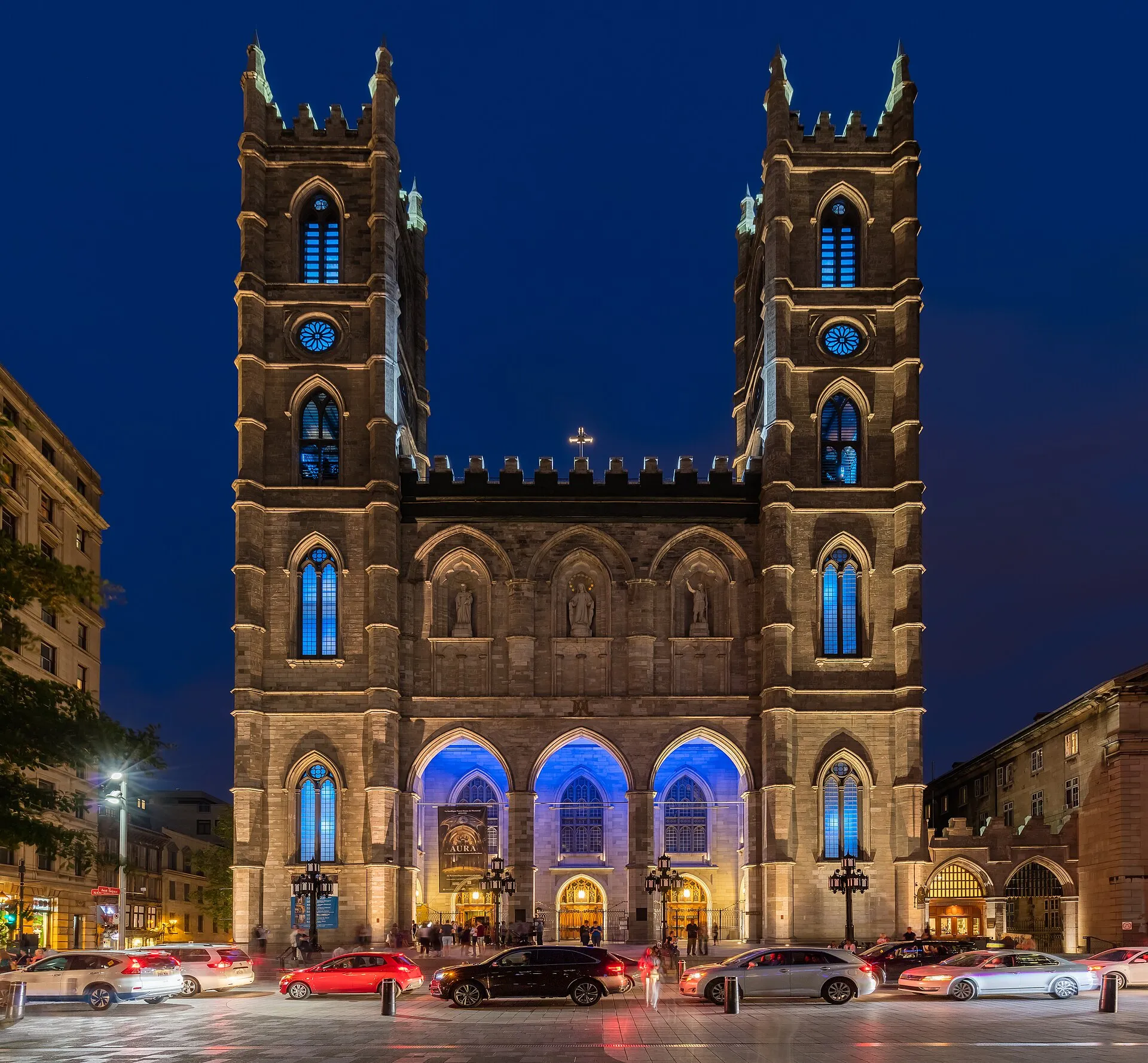
Spiritual Significance
Notre-Dame Basilica embodies the spiritual ambitions of the Sulpician order, who had served as seigneurs of Montreal since 1663 and commissioned the church as a statement of Catholic institutional permanence in a city that was rapidly growing and diversifying. The blue-and-gold interior — the vaulted ceiling painted a deep ultramarine scattered with thousands of gold-leaf stars — creates the impression of standing beneath a celestial canopy, a deliberate theological metaphor connecting the earthly sanctuary with the heavenly realm.
The reredos behind the altar, carved and gilded in linden wood during Victor Bourgeau's 19th-century redesign, depicts scenes of sacrifice, redemption, and New World evangelization specific to the Sulpician mission in Nouvelle-France. The stained-glass windows, designed by Jean-Baptiste Lagacé in 1929, break with European tradition by illustrating Montreal's own religious history — Maisonneuve's founding vow, the arrival of the Sulpicians, and the building of the first chapel — grounding universal Catholic themes in local narrative.
The Casavant Frères organ, installed from 1891 onward with roughly 7,000 pipes spanning four manuals and a pedalboard, fills the nave with sound that resonates physically in the listener's chest — an instrument designed to make the presence of the divine palpable through acoustic power.
Pope John Paul II raised the church to the rank of minor basilica in 1982, and Canada designated it a National Historic Site in 1989 — recognition that the building matters to the nation's heritage as much as to the parish. For the Sulpicians, who still maintain the adjoining seminary of 1685, the oldest building in Montreal, the basilica remains a living statement of the order's enduring presence in the city.
Visitor Etiquette
Notre-Dame Basilica remains an active parish church with regular masses, weddings, funerals, and sacramental celebrations. Visitors are welcome during designated tourist hours, but respectful behaviour is expected at all times. Dress modestly — bare shoulders and very short garments may draw polite requests to cover up. Silence mobile phones and speak in whispers throughout the interior. Photography is permitted during regular visits but flash is strictly prohibited, as the intense light damages the 19th-century pigments on the polychrome woodwork.
During the AURA light show, photography and video are generally permitted but follow the specific guidelines announced at each performance. If you happen to visit during a mass or liturgical event, you are welcome to sit respectfully in the rear pews, but refrain from walking through the nave or photographing the service.
Accessibility note: a step-free entrance beside the main doors admits wheelchairs and strollers, and the nave floor is level, though the galleries and towers are not reachable. If you plan to attend mass rather than tour, enter quietly and follow the congregation's lead on standing, sitting, and silence.
Notre-Dame Basilica timeline
-
Sulpicians become seigneurs of Montreal
The Society of Saint-Sulpice took feudal lordship of the island, beginning two centuries of parish authority that would eventually commission the basilica.
-
James O'Donnell designs the church
The Sulpicians hired the Irish-American architect, whose Gothic Revival plans promised the largest church in North America.
-
The basilica opens for worship
Built on Place d'Armes in roughly five years, the new Notre-Dame dwarfed every church on the continent.
-
The Gros Bourdon bell is cast
The roughly eleven-tonne Jean-Baptiste bell was hung in the east tower, among the largest bells in North America.
-
Casavant Frères installs the grand organ
The Saint-Hyacinthe firm's roughly 7,000-pipe instrument was voiced for the nave's long reverberation.
-
Montreal's own story fills the windows
Jean-Baptiste Lagacé's stained glass broke with European tradition to depict the city's religious history.
-
Elevated to minor basilica
Pope John Paul II granted the honorific title; the fire-ravaged Sacred Heart Chapel reopened the same year.
-
Named a National Historic Site of Canada
The federal government recognised the basilica as a landmark of national heritage.
-
AURA light show debuts
Moment Factory's immersive projection-and-sound experience drew a new nighttime audience into the nave.
When to Visit
Regular visiting hours run Monday to Saturday, 8 AM – 4:30 PM, and Sunday 12:30 PM – 4 PM, though times shift for weddings, funerals, and liturgical events. The AURA light show by Moment Factory runs on select evenings, with performances commonly at 6 PM, 7 PM, and 8:30 PM; confirm the current schedule on the official site before you travel, as it changes seasonally.
Best time: arrive at opening on a weekday morning, when the sanctuary is nearly empty and low sunlight rakes across the blue vault. Busiest period: summer afternoons from noon to 3 PM, when tour groups queue across Place d'Armes. Getting there: the Place-d'Armes métro station on the Orange line sits one block north, so you can skip the scarce Old Montreal parking entirely.
Admission and Costs
General admission is CA$18 (about US$13) per adult and includes a short guided introduction to the basilica's history and architecture; children and families pay reduced rates, and admission is waived for those attending mass. The AURA immersive experience costs CA$30–35 (about US$22–26) per person for the multimedia light-and-sound show that drapes the interior in projections, orchestral sound, and moving light.
A standard daytime guided tour is bundled into the admission ticket, with guides covering the construction story, the Casavant organ, and the stained-glass windows. Book AURA online ahead of your visit, since evening shows sell out on weekends and in peak season. Combine both on one trip and budget roughly CA$50 (about US$37) per adult for a daytime visit plus an evening performance.
The Case for a Guide
Notre-Dame Basilica's interior dazzles immediately, but a guide unlocks the layers of acoustic engineering, theological symbolism, and Montreal history embedded in every carved surface and stained-glass panel.
- The Casavant Frères organ — from rural workshop to world stage: The 1891 instrument's roughly 7,000 pipes and four manuals were engineered by the Saint-Hyacinthe firm specifically for this nave's reverb time, with each pipe rank positioned to fill some 3,800 seats without electronic amplification; a guide traces how the Notre-Dame commission transformed a rural Quebec family trade into one of the world's most prolific pipe-organ manufacturers, whose instruments now span six continents.
- Pointed star ceiling symbolism: Each of the thousands of gold-leaf stars on the deep blue vault was hand-painted and carries specific theological meaning; guides decode the celestial canopy as a deliberate metaphor for the heavenly Jerusalem, not mere decoration.
- The Sacred Heart Chapel behind the altar: Known as the Chapelle des mariages (wedding chapel), the rear chapel was gutted by an arsonist in 1978 and rebuilt by 1982, marrying salvaged Gothic vaulting to a soaring modern bronze altarpiece; a guide explains why Montrealers book weddings here years ahead.
- Céline Dion and Montreal's cultural memory: The basilica hosted René Angélil's 2016 funeral, which drew global attention; guides provide the context of how the basilica's relationship with Montreal's cultural life extends far beyond religious ceremony.
- Vieux-Montréal connection from Place d'Armes: The square outside anchors the entire historic quarter; a guide explains how the basilica's placement was designed to command the commercial and civic grid of what would become Old Montreal.
Tips for Visitors
Buy AURA tickets early: evening shows frequently sell out, especially on weekends — book online at least a few days ahead during peak season. Dress respectfully: while there is no strict dress code, bare shoulders and very short clothing may draw polite requests to cover up, as the basilica remains an active place of worship. Photography is allowed, but flash is prohibited; the dim interior rewards a steady hand or a tripod-friendly phone mount.
Combine with Old Montreal: Place d'Armes sits at the gateway to Vieux-Montreal — walk east along Rue Saint-Paul after your visit to explore the cobblestone quarter without backtracking, and you are minutes from Jean-Talon Market by métro if you want lunch. Organ recitals: free or low-cost concerts are held periodically, so check the basilica's events calendar — hearing the Casavant at full volume is an experience no recording can replicate.
Frequently Asked Questions
Does the season affect visiting Notre-Dame Basilica?
The basilica's stunning Gothic Revival interior is equally spectacular year-round since it is entirely indoors, but summer (June-August) brings the heaviest visitor traffic and longer AURA light show schedules. Spring and fall offer shorter queues while still providing comfortable walking conditions in surrounding Old Montreal, and the winter AURA evening performances gain a special atmosphere when you step from snowy streets into the warmly illuminated nave.
What days is Notre-Dame Basilica open to non-worshippers?
Regular hours: Monday to Saturday 8 AM - 4:30 PM, Sunday 12:30 PM - 4 PM (hours may vary for liturgical events). AURA light show: Evening performances typically at 6 PM, 7 PM, and 8:30 PM — check the schedule online as times shift seasonally.
Does visiting Notre-Dame Basilica require a paid ticket?
General admission: CA$18 (about US$13) per adult, which includes a brief guided introduction to the basilica's history and architecture. Children and families pay reduced rates, and admission is waived for those attending mass.
How far in advance should visitors book tickets for Notre-Dame Basilica?
Buy AURA tickets early: Evening shows frequently sell out, especially on weekends — book online at least a few days ahead during peak season. Daytime admission rarely sells out and can be bought at the door.
Is Notre-Dame Basilica wheelchair accessible?
Yes. A step-free entrance to the right of the main facade admits wheelchairs and strollers, and the nave is level once inside. The upper galleries and towers are not accessible, and the cobblestones around Place d'Armes can be uneven, so allow extra time. Staff can advise on the best accessible seating for the AURA show if you call ahead.
How do you get to Notre-Dame Basilica by public transport?
Take the STM métro Orange line to Place-d'Armes station, one block north of the basilica. From the downtown core it is a 10-15 minute walk through Old Montreal, and several bus routes stop nearby. BIXI bike-share docks ring the square in the warmer months, and there is no need to hunt for scarce street parking.
What is the AURA experience at Notre-Dame Basilica?
AURA is an immersive light-and-sound show created by Moment Factory that projects moving light, orchestral music, and imagery across the basilica's vaults, columns, and altar. Visitors first walk through the illuminated nave, then take a seat for the multimedia finale. It runs on select evenings and is ticketed separately from daytime admission.