
Collection Highlights
Gustav Klimt — The Kiss (1907–1908)
The undisputed star of the collection and the defining image of Viennese modernism, displayed alone against a dark wall for maximum impact. Two lovers kneel at the edge of a flowering meadow, wrapped in a shimmering cloak of gold leaf, spirals, and Byzantine-inspired mosaic patterns. The state bought it in 1908 while the gold period was still unfolding, and it has never left Vienna since.
Gustav Klimt — Judith I (1901)
Klimt's earlier gold-ground provocation hangs in the same suite of rooms — a heavy-lidded, half-smiling Judith cradling the severed head of Holofernes against a gilded frieze of stylised trees. Sensual rather than heroic, it scandalised contemporary critics and shows the Secession's break with academic history painting.
Egon Schiele — Death and the Maiden and the self-portraits
The Belvedere holds a landmark group of works by Klimt's protégé Egon Schiele, headlined by the anguished embrace of Death and the Maiden (1915) and a wall of raw, contorted self-portraits. Schiele's nervous line and psychological intensity mark the shift from Klimt's decorative gold to full-blown Austrian Expressionism.
Franz Xaver Messerschmidt — The Character Heads
A set of the sculptor's uncanny 18th-century Character Heads — grimacing, yawning, and contorting alabaster and lead busts that pull the human face into extreme expressions. Long dismissed as the work of a troubled mind, they are now read as a startlingly modern study of emotion two centuries ahead of their time.
Jacques-Louis David — Napoleon Crossing the Alps
One of the five autograph versions of David's heroic equestrian portrait, showing a wind-swept Napoleon on a rearing horse at the Great St Bernard Pass. A rare piece of French Neoclassical propaganda in an Austrian collection, it makes a pointed contrast with the Habsburg imperial story told across the rest of the palace.
The Marble Hall and the Sala Terrena
The architecture is a highlight in its own right. The Upper Belvedere's two-storey Marble Hall, crowned by Carlo Carlone's ceiling fresco, is where the Austrian State Treaty was signed in 1955; below it, the Sala Terrena's vaulted ceiling rests on four muscular Atlas figures framing the garden entrance.
Collections Highlights
Beyond the individual masterworks, the strength of the Upper Belvedere lies in how completely it tells the story of Austrian art. A themed walk through the galleries reveals distinct collections most visitors rush past on the way to The Kiss:
- The Klimt rooms — The heart of the museum and the world's largest holding of the artist's paintings, gathering the gold-period icons The Kiss and Judith I alongside shimmering landscapes such as Sunflower and Poppy Field from his summers on the Attersee.
- Vienna 1900 and Expressionism — Rooms devoted to Egon Schiele and Oskar Kokoschka trace how the decorative gold of the Secession gave way to a rawer, more anxious modernism in the years before the First World War.
- French Impressionists — Monet, Renoir, and Van Gogh's The Plain of Auvers hang here, giving Klimt's generation the European context they were reacting to and against.
- Medieval and Baroque Austria — Gilded Gothic winged altarpieces and the theatrical Austrian baroque of Franz Anton Maulbertsch anchor the collection's older wing, while Messerschmidt's Character Heads bridge sculpture and psychology.
- The Marmorsaal (Marble Hall) — The Upper Belvedere's grand two-storey centrepiece, its ceiling fresco by Carlo Carlone and its history as the room where Austria signed away its occupation in 1955.
- The gardens and the Lower Belvedere — The tiered baroque parterre with its sphinxes and cascades leads down to Prince Eugene's residential palace, whose Marble Gallery, Golden Room, and former Orangery now host the Belvedere's temporary exhibitions.
Guided Tours
Expert-led tours of the Belvedere frame it as the story of Austrian art rather than a single-painting pilgrimage. Guides open with the Wiener Secession — the 1897 breakaway that put Klimt at the head of a movement declaring "To every age its art, to art its freedom" — before walking you to The Kiss and Judith I with the context that makes the gold period legible. From there the collection spans Austrian Expressionism: guides connect Egon Schiele and Oskar Kokoschka's radical works to the fin-de-siècle anxieties of pre-war Vienna. They also explain Prince Eugene of Savoy — why a Savoyard general became Austria's greatest hero and built a palace grand enough to answer Schönbrunn Palace — and decode Johann Lukas von Hildebrandt's baroque architecture, from the Sala Terrena's Atlas figures to the garden's symbolic program. Because Vienna enforces strict guide licensing, only state-certified guides may lead tours inside the galleries, so a booked guide is also your key to skipping the queue at the Klimt rooms.
Belvedere Palace timeline
-
Lower Belvedere completed
Johann Lukas von Hildebrandt finished Prince Eugene of Savoy's garden residence, the first of the two palaces.
-
Upper Belvedere completed
The grander of the two palaces crowned the sloping garden, conceived as a stage for banquets and receptions.
-
Habsburgs acquire the estate
Empress Maria Theresa bought the Belvedere for the crown sixteen years after Prince Eugene's death.
-
Imperial gallery opened to the public
The Habsburg picture collection moved into the Upper Belvedere and opened to visitors — one of the world's first public museums.
-
Moderne Galerie founded
The state gallery of modern art, forerunner of today's Belvedere museum, was established to champion living Austrian artists.
-
The Kiss enters the collection
The state bought Klimt's masterpiece straight from the Kunstschau exhibition, before the gold period had run its course.
-
Austrian State Treaty signed
The treaty restoring Austria's sovereignty was signed in the Marble Hall and shown from the Upper Belvedere balcony.
When to Visit
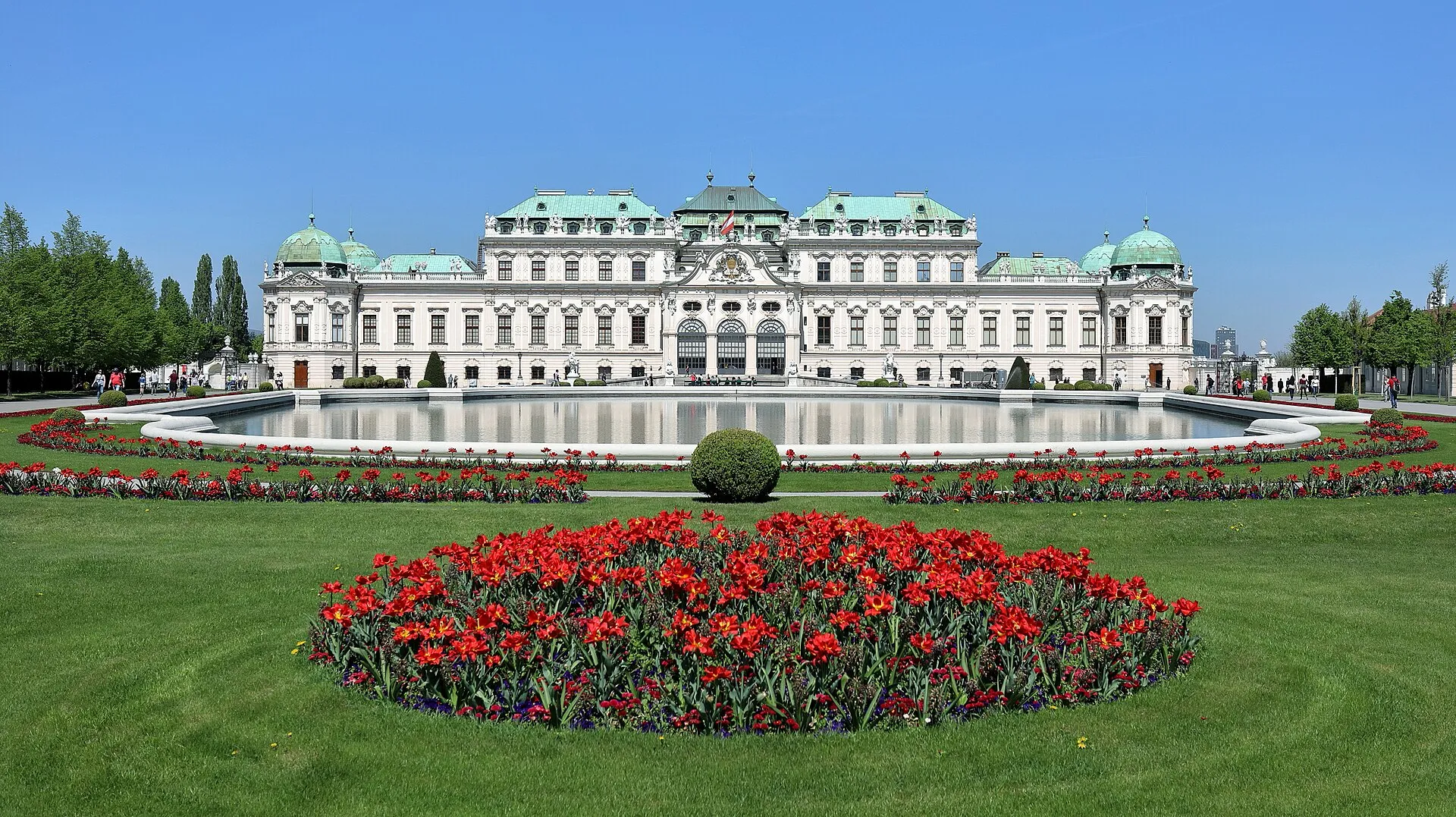
Upper Belvedere: daily 9 AM–6 PM. Lower Belvedere: daily 10 AM–6 PM (Friday until 9 PM during major exhibitions). Gardens: free entry, open daily from 6:30 AM until dusk. Best time: arrive at the 9 AM opening and head straight to the Klimt rooms before the coach groups reach The Kiss mid-morning. Duration: the Upper Belvedere alone takes 1.5–2 hours; both palaces plus the gardens need 3–4 hours. Garden approach: enter through the Lower Belvedere gate and walk up through the parterre for the classic reveal of the Upper palace mirrored in its reflecting pool. Getting there: Tram D stops at Schloss Belvedere (Lower) and Tram 71 at the Upper entrance on Landstraßer Gürtel; Wien Hauptbahnhof and the U1 at Südtiroler Platz are both a 10-minute walk away.
Admission and Costs
Upper Belvedere: €17.10 adults (permanent collection including Klimt). Combo ticket (Upper + Lower): €28 adults. All-Belvedere ticket (all venues, valid 30 days): €39.10 adults. Under 19: free entry to all Belvedere museums, and Vienna school groups visit at no charge. Gardens between the palaces: free, no ticket required. Timed online tickets carry no surcharge and let you skip the entrance queue — worth it in summer, when the line for The Kiss backs into the courtyard. Private guided tour: €180–280 for a two-hour, art-focused visit for a small group; the Vienna Pass also includes fast-track Belvedere entry alongside the city's other palaces.
The Case for a Guide
The Belvedere rewards a wander, but a guide turns a rush to one gold-leafed canvas into a coherent walk through the birth of modern art — and knows exactly when to reach The Kiss before the crowd does.
- Reading The Kiss properly: A guide decodes the Byzantine mosaics of Ravenna, the Japanese prints, and the ancient Eros imagery that Klimt fused into the painting, and explains why the state gambled on buying it in 1908 before the gold period was even finished.
- From Klimt to Schiele: Rather than treating the Expressionist rooms as an afterthought, guides trace the mentor-and-protégé thread from Klimt's decorative gold to Egon Schiele's raw, contorted line — the single most important story the collection tells.
- The Messerschmidt puzzle: Guides explain the competing theories behind the sculptor's grimacing Character Heads — mental illness, Enlightenment physiognomy, or deliberate provocation — that a wall label cannot unpack.
- A palace with a political past: Standing in the Marble Hall, a guide reconstructs the 1955 signing of the Austrian State Treaty and Leopold Figl's balcony proclamation, connecting the art museum to the moment modern Austria regained its independence.
- Baroque decoded: Hildebrandt's architecture, Carlone's ceiling frescoes, and the garden's sphinxes and cascades all carry Prince Eugene's self-mythology — a guide reads the building as carefully as the paintings.
Tips for Visitors
Start at the Upper Belvedere: that is where Klimt, Schiele, and the permanent collection hang — the Lower Belvedere and its Orangery host rotating shows. Beat the crowd to The Kiss: the room fills by mid-morning, so go straight there at the 9 AM opening. Photography allowed: non-flash photography is permitted throughout, including of The Kiss. Combine with Karlskirche: the baroque church is a 15-minute walk away and a natural pairing for architecture fans. Don't skip the gardens: they are free, and the terrace behind the Upper Belvedere gives the best photograph of the palace reflected in its pool. Austrian State Treaty: the Marble Hall is where Austria's post-war independence was sealed in 1955 — a guide explains why the Belvedere, and not Hofburg Palace, was chosen for the ceremony.
Frequently Asked Questions
What is the best season to visit Belvedere Palace?
The tiered gardens between Upper and Lower Belvedere are at their finest from late April through September, when the reflecting pool, cascades, and sphinx-lined promenades are most photogenic under summer skies. July typically sees peak visitor numbers but also the longest opening hours; for a quieter viewing of Klimt's The Kiss, aim for the first hour after the Upper Belvedere opens at 9 AM, before the coach groups and school parties arrive. Winter has its own reward — the courtyard hosts one of Vienna's most atmospheric Christmas markets from mid-November.
What tips help first-time visitors to Belvedere Palace?
Start at the Upper Belvedere: that is where Klimt, Schiele, and the permanent collection hang — the Lower Belvedere and its Orangery host rotating exhibitions. Approach on foot through the gardens from the Lower gate for the grand reveal of the Upper palace, and book a timed ticket online to skip the entrance queue at The Kiss.
What does admission to Belvedere Palace cost?
Upper Belvedere: €17.10 adults (permanent collection including Klimt). Combo ticket (Upper + Lower): €28 adults. All-Belvedere ticket (all venues, valid 30 days): €39.10 adults. Under 19: free entry to all Belvedere museums. The gardens between the two palaces are free and open daily.
What context does a guide provide about Klimt's works at Belvedere Palace?
A guide places The Kiss inside the Vienna Secession movement and Klimt's gold period, explains the Byzantine mosaics and Japanese prints that inspired it, and traces the thread from Klimt to his protégé Egon Schiele — turning a single famous canvas into the story of Viennese modernism. The Belvedere holds the world's largest Klimt collection, so the context extends well beyond one painting.