
Architecture
The five-courtyard layout encodes a Confucian progression from public civic space to sacred scholarly sanctuary, unfolding along a single ceremonial axis roughly 350 metres long and enclosed by original brick perimeter walls:
- First Courtyard — the ceremonial approach, entered through the triple-arched Van Mieu Gate (Great Gate) and flanked by two stone lions and the Confucian inscriptions Hien Tai (Talented People) and Dai Thanh (Great Achievement); its symmetry and the shaded frangipani trees make it the best spot for a framed establishing photograph
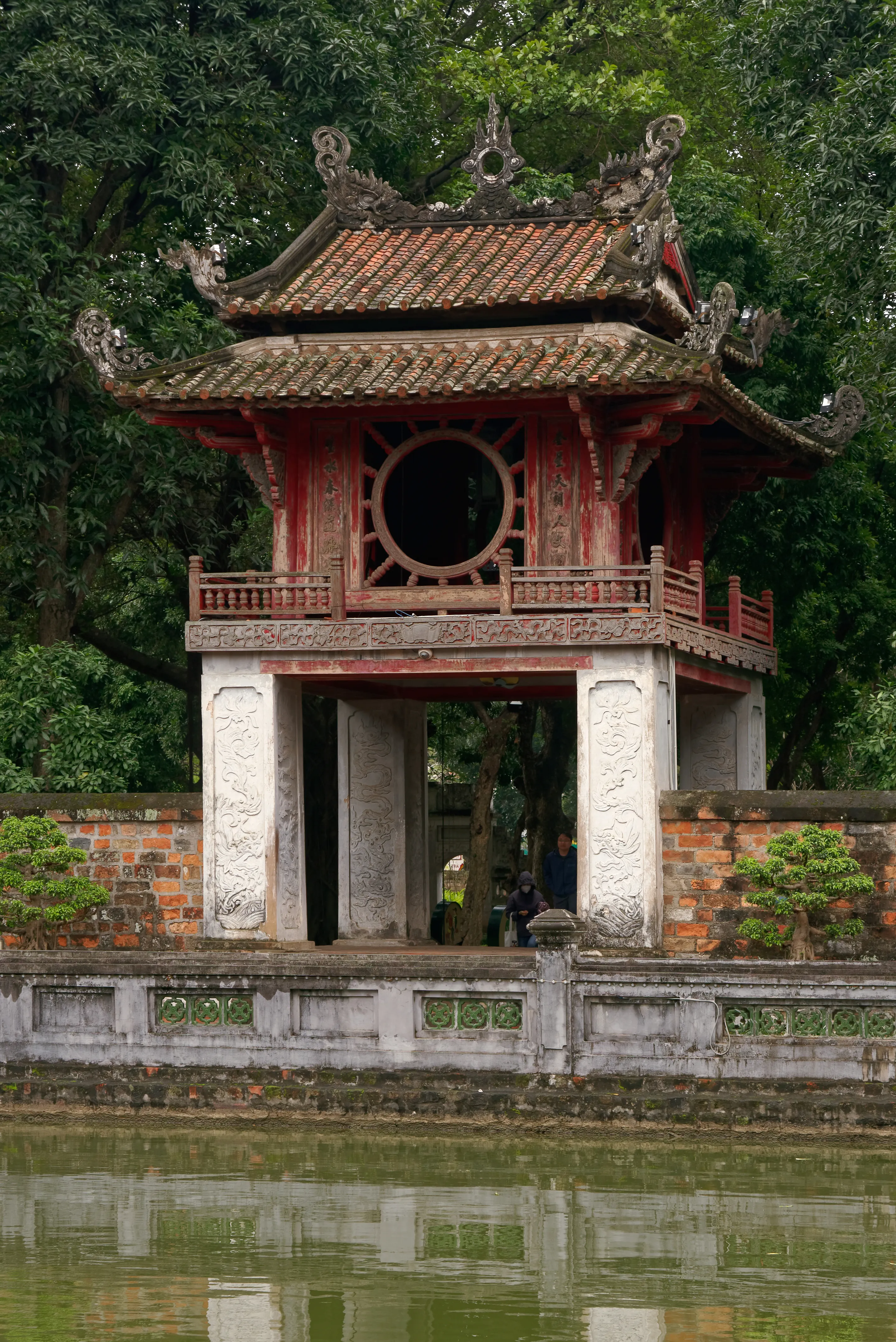
- Second Courtyard — formal ceremonial grounds dominated by the Khue Van Cac (Pavilion of the Constellation of Literature), an 1805 timber-and-brick tower whose four circular windows represent the Khue star, the celestial patron of literature; the pavilion is Hanoi's most reproduced emblem and appears on the 100,000 VND banknote
- Third Courtyard — the 82 stone doctoral steles on turtle pedestals stand in two long ranks either side of the square Thien Quang Well (Well of Heavenly Clarity), whose reflective surface was used by candidates to check their court dress before examinations and today mirrors the Khue Van Cac for the site's signature photograph
- Fourth Courtyard — the Great House of Ceremonies (Dai Bai Duong) shelters the altar of Confucius beneath a sweeping tiled roof and gilded lacquerwork, flanked by two smaller houses once dedicated to his disciples and the academy's most honoured teachers
- Fifth Courtyard — the former Quoc Tu Giam (Imperial Academy) teaching halls; the two-storey Thai Hoc hall standing here was reconstructed in 2000 for Hanoi's 990th anniversary after the French-era demolition of the originals, and now hosts the traditional music performances and a small museum of examination artefacts
Historical Significance
The Temple of Literature's founding in 1070 under Emperor Ly Thanh Tong marks a pivotal moment in Vietnamese self-definition: the conscious adoption of Confucian scholarship as the basis for national governance — a direct response to centuries of Chinese cultural dominance that paradoxically affirmed Vietnamese intellectual independence by mastering the conqueror's canonical texts.
For nearly 700 years (1076–1779), the Quoc Tu Giam trained Vietnam's administrative class through a rigorous examination system requiring mastery of the Four Books and Five Classics of Confucian scholarship. Candidates arrived from every province of the kingdom; the metropolitan examinations were held roughly every three years; and the names of those who reached doctoral rank were carved onto the steles that still stand. The academy's most revered teacher, Chu Van An — the 14th-century scholar and rector remembered as the father of Vietnamese education — is honoured in the fifth courtyard, and the system produced statesmen such as Nguyen Trai, the 15th-century philosopher-strategist and resistance hero who helped end Ming occupation.
The French colonial administration's abolition of the mandarin examination system in 1919 ended the Quoc Tu Giam's centuries-long function, and much of the academy was later demolished. The core complex survived largely intact because the colonial authorities recognised its historical value — a rare instance of colonial preservation that Vietnamese historians note with some irony. Careful restoration through the 20th century, culminating in the year-2000 rebuilding of the Thai Hoc hall, returned the site to something close to its imperial-era dignity; it now anchors the cultural circuit of the capital alongside Hoan Kiem Lake and Hoa Lo Prison.
When to Visit
- Opening hours: Daily 8:00 AM – 5:00 PM (last admission 4:30 PM); open every day including public holidays
- Best time: 9:00–11:00 AM on weekdays for lowest crowds and the traditional music performances
- Golden hour for photos: The first hour after opening gives soft, even light on the Khue Van Cac and glassy water in the Thien Quang Well before the tour buses arrive
- Traditional music: Scheduled performances in the fourth courtyard; typically 9–11 AM on Tuesday–Sunday; confirm current schedule at the gate
- Graduation season: May–July sees large groups of Vietnamese university graduates in ceremonial dress posing for photos — atmospheric but occasionally crowded
- Duration: Allow 45–60 minutes self-guided; 90–120 minutes with a guide
Admission and Costs
- Admission: 30,000 VND ($1.20 USD) per adult; 15,000 VND for children 6–15; free for children under 6
- Audio guide rental: 30,000 VND (available in English, French, Chinese, Japanese, Korean)
- Guided tour add-on: Most walking tour operators include Temple of Literature in their Hanoi itineraries; expect 200,000–400,000 VND per person for a private guide
- Getting there: A Grab car from the Old Quarter costs roughly 40,000–60,000 VND ($1.60–2.40 USD); a public bus is 7,000 VND
The Case for a Guide
The Temple of Literature is easy to walk through and hard to truly read — the courtyards look serene and self-explanatory, yet almost every wall, inscription, and ritual carries a layer of meaning invisible to the unguided visitor. This is where a knowledgeable Hanoi guide earns their fee.
- Decoding the steles: The 82 tortoise-borne stones are written in classical Chinese characters that even most Vietnamese visitors cannot read. A guide translates a sample inscription, explains how a scholar's home village and rank were recorded, and connects the Stone Stele Records to their UNESCO Memory of the World status
- The examination world: A guide reconstructs what the triennial exams actually demanded — days sealed in bamboo cells, the memorisation of the Four Books and Five Classics, and the social transformation that a single doctoral pass could bring to an entire family and village
- Reading the architecture: The progression from the Great Gate to the sanctuary is a deliberate spatial argument about knowledge and virtue; a guide shows how each gate, well, and pavilion marks a stage in that Confucian journey rather than a random ornament
- Living ritual: When students crowd the tortoises before exam season, a guide explains the etiquette, the belief, and why the practice endures — turning a puzzling scrum into a window on contemporary Vietnamese culture
- Stitching the circuit together: The strongest half-day in Hanoi links this temple with Hoan Kiem Lake and Hoa Lo Prison; a guide sequences the walk, times the traditional-music performance, and threads a coffee stop in between, as sketched in our Hanoi and Halong Bay planning guide
Tips for Visitors
- Wear comfortable shoes — the five-courtyard walk is entirely on stone paving; flat surfaces but can be slippery after rain
- Arrive before 9 AM on weekdays for the traditional music and near-empty courtyards — by 10 AM tour buses begin arriving
- Shoot the reflection — the classic composition is the Khue Van Cac pavilion mirrored in the Thien Quang Well; stand on the southern edge of the well in early light for the cleanest reflection
- Touch the turtles — Vietnamese university students rub the stone tortoise heads before examinations; joining this ritual, explained by a guide, connects you to a 600-year-old scholarship tradition
- Dress modestly — as a cultural monument rather than an active temple the dress code is relaxed, but shoulders and knees covered shows respect and is required for the innermost sanctuary
- Combine with nearby sites — the Temple of Literature is 1.5 km west of Hoan Kiem Lake and about 2 km from Hoa Lo Prison; a guide can walk between them with a coffee stop at a colonial-era café on Dien Bien Phu Street
Frequently Asked Questions
What is the Temple of Literature and why was it built?
The Van Mieu–Quoc Tu Giam (Temple of Literature and National Academy) was founded in 1070 CE by Emperor Ly Thanh Tong to honour Confucius and the Confucian canon of knowledge. Six years later, in 1076, Emperor Ly Nhan Tong established the Quoc Tu Giam (Imperial Academy) on the same grounds — the first institution of higher education in Vietnamese history, initially reserved for the sons of the royal family and nobility, and later opened to outstanding commoner scholars. For nearly 700 years, the academy trained Vietnam's mandarins, poets, and imperial administrators through an examination system modelled on the Chinese civil service exams. The complex is not a place of active religious worship but a monument to the Confucian values of learning, discipline, and public service that shaped Vietnamese governance for centuries.
What are the 82 doctoral steles and why are they significant?
The 82 stone steles in the third courtyard are the Temple of Literature's most intellectually significant artefacts — and among the most important historical documents in Southeast Asia. Each stele, mounted on the back of a stone tortoise (the Vietnamese symbol of longevity and scholarship), records the names, home villages, and ranks of the doctoral graduates from the royal examinations held between 1442 and 1779 — a total of 1,307 scholars across 82 examination sessions. UNESCO added the steles to its Memory of the World Register as the Stone Stele Records of Royal Examinations of the Le and Mac Dynasties, recognising them as the primary biographical record of medieval Vietnamese intellectual life. Vietnamese university graduates still rub the turtles' heads for good luck before examinations — a ritual a guide can explain with reference to both the Confucian examination tradition and its contemporary resonance.
How long does a visit to the Temple of Literature take?
A self-guided walk through all five courtyards takes approximately 45–60 minutes at a relaxed pace. A guided visit with interpretation of the architectural sequence, the stele inscriptions, the examination process, and the relationship between Confucian scholarship and Vietnamese imperial governance runs 90–120 minutes and is dramatically more rewarding. Traditional music performances (quan ho folk singing and ca tru chamber music) are scheduled in the fourth courtyard on weekday mornings — arrive by 9 AM to catch a session. The temple is least crowded on weekday mornings, particularly Tuesday through Thursday; weekend afternoons attract large groups of domestic tourists and student graduation photo sessions.
How do you get to the Temple of Literature and is it accessible?
The temple occupies a full block at 58 Quoc Tu Giam Street in the Dong Da district, roughly 1.5 km west of Hoan Kiem Lake and about 2 km from the Old Quarter — a flat 20–25 minute walk, a 5-minute Grab car or motorbike ride, or a short hop on public buses 02, 23, 32, 38, or 41, which stop on the surrounding Quoc Tu Giam and Nguyen Thai Hoc streets. The five courtyards are linked by broad, level stone paving that is largely step-free, so wheelchair and stroller users can follow the central axis comfortably; the main obstacles are the low raised thresholds at the ceremonial gates and the shallow steps up into the Great House of Ceremonies and the rebuilt Thai Hoc hall. Accessible toilets and a small on-site museum sit at the rear of the fifth courtyard.
What are the best photo opportunities at the Temple of Literature?
The signature shot is the Khue Van Cac (Pavilion of the Constellation of Literature) mirrored in the still water of the Thien Quang Well in the third courtyard — best in soft morning light before 9 AM, when the courtyards are near-empty. The Great Gate and its flanking stone lions frame a clean symmetrical composition from the first courtyard, while the two long rows of tortoise-borne steles reward a low, wide angle that compresses them into a receding colonnade. Inside the fourth courtyard, the red-lacquered and gilded altar of Confucius under its carved timber roof is the strongest interior frame; a tripod is unnecessary but a fast lens helps in the shaded halls. During graduation season (May–July) the courtyards fill with students in scarlet ao dai and academic gowns, adding vivid colour to any wide shot.