
Observation Spots
Activities
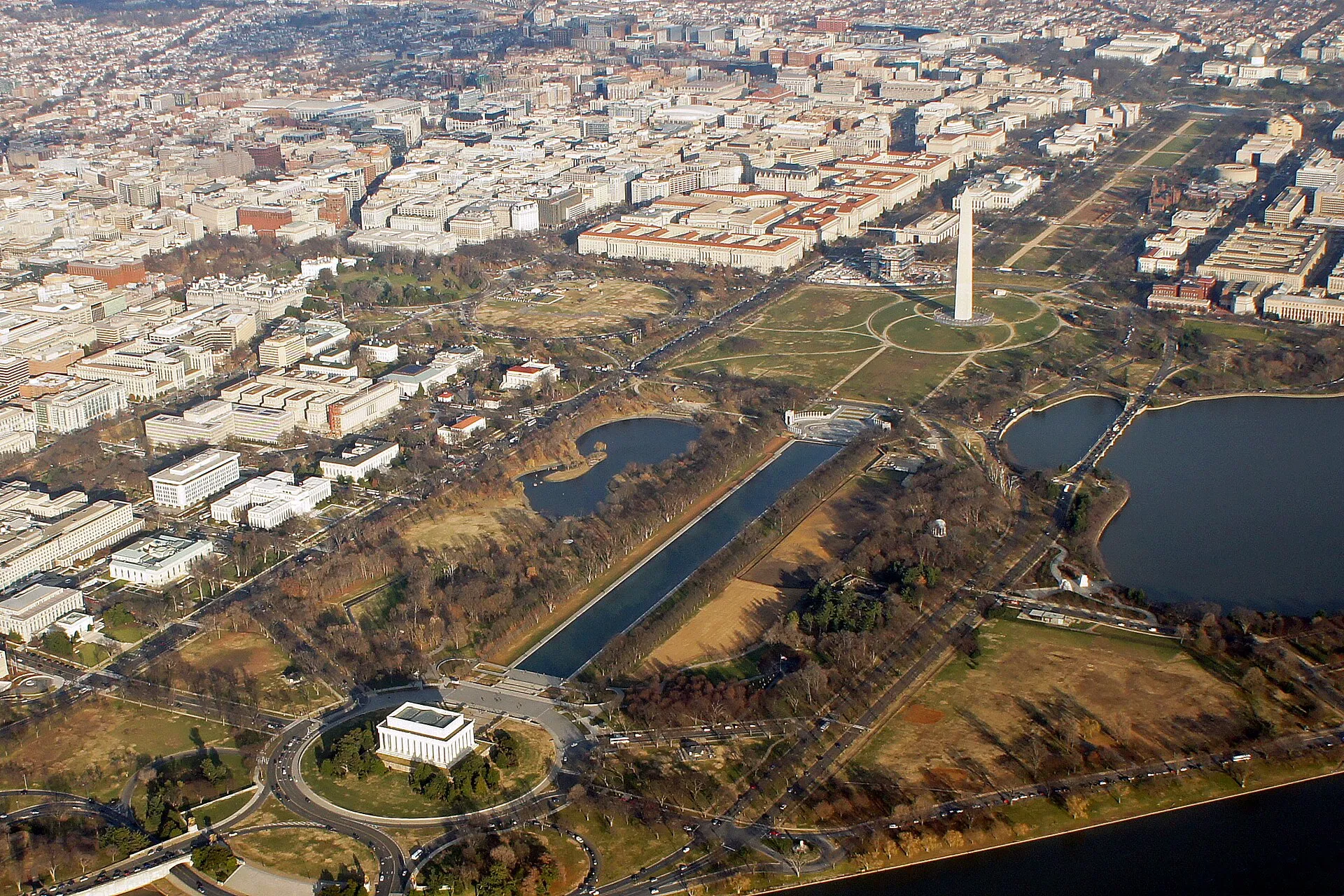
The Mall is best treated as a sequence of destinations rather than a single lawn to cross. Working from the centre outward:
- Washington Monument: The 555-foot marble obelisk at the Mall's heart; free timed-entry tickets (reserve on recreation.gov) ride an elevator to the observation windows for the best aerial view of the axis.
- Lincoln Memorial: Climb the steps where Dr. King spoke and read the Gettysburg and Second Inaugural addresses carved into the memorial's walls beneath Daniel Chester French's 19-foot seated statue.
- Vietnam Veterans Memorial: Maya Lin's sunken black granite wall, listing more than 58,000 names, designed when she was a 21-year-old Yale undergraduate.
- World War II Memorial: 56 pillars and two triumphal arches around the Rainbow Pool, honouring the 16 million Americans who served.
- Korean War Veterans Memorial: 19 stainless-steel soldiers on patrol, doubling to 38 in the reflective wall for the war's 38th-parallel line.
- Smithsonian museums: The free national museums — Air and Space, Natural History, American History, and more — flank the Mall's eastern half.
Ranger-led walks and free interpretive talks run daily at the major memorials, and the open lawns double as the country's most-used venue for rallies, festivals, and Independence Day fireworks.
Seasonal Highlights
The Mall changes character sharply with the calendar, and timing a visit to a season rather than just a date pays off.
Spring is the marquee moment: from late March into mid-April the National Cherry Blossom Festival draws crowds to the roughly 3,000 flowering trees around the adjacent Tidal Basin, while the greensward greens up and walking weather turns ideal. Summer brings the Mall to its liveliest — the Smithsonian Folklife Festival spreads across the lawns in late June and early July, and hundreds of thousands gather for the Fourth of July fireworks launched over the Reflecting Pool — but it also brings punishing heat, humidity, and thin shade, so early mornings are essential.
Autumn may be the connoisseur's season: September and October deliver crisp air, elms turning gold along the gravel paths, and markedly smaller crowds than spring or summer. Winter is cold and quiet, with the memorials floodlit against bare trees and low sun; a mid-week December walk can feel like having the front yard of the nation to yourself.
National Mall timeline
-
L'Enfant plans the grand avenue
Pierre Charles L'Enfant laid out a mile-long ceremonial "grand avenue" west of the Capitol as the centrepiece of the new federal city.
-
Washington Monument cornerstone laid
Construction of the marble obelisk began on 4 July 1848, but funding disputes and the Civil War stalled it for over two decades.
-
Washington Monument opens
Completed in 1884 and opened to the public in 1888, the 555-foot obelisk still shows a colour change where work resumed after the pause.
-
McMillan Plan clears the greensward
The Senate Park Commission swept away Victorian gardens and a railway depot, restoring the open, tree-lined vista L'Enfant imagined.
-
Lincoln Memorial and Reflecting Pool completed
The western terminus was closed with Henry Bacon's marble temple and the long Reflecting Pool, fixing the Mall's grand east–west axis.
-
March on Washington
Roughly 250,000 people filled the Mall as Martin Luther King Jr. delivered the "I Have a Dream" speech from the Lincoln Memorial steps.
-
Vietnam Veterans Memorial dedicated
Maya Lin's sunken black granite wall, listing more than 58,000 names, introduced a starkly modern language of remembrance to the Mall.
-
Korean War Veterans Memorial dedicated
Nineteen stainless-steel soldiers advance through juniper, doubling to 38 in the reflecting wall for the war's 38th-parallel dividing line.
-
World War II Memorial dedicated
Fifty-six pillars and two arches finally honoured the 16 million who served, placed on the central axis between the obelisk and Lincoln.
-
African American History museum opens
The Smithsonian's bronze-lattice National Museum of African American History and Culture became the newest landmark flanking the Mall.
When to Visit
The Mall itself is open 24 hours a day, 365 days a year as an open public park, and admission is always free. National Park Service rangers staff the major memorials from roughly 9:30 AM to 10:00 PM, giving free interpretive talks throughout the day.
The rewarding windows are the quiet ones:
- Before 8 AM, the pathways are empty and the Reflecting Pool lies mirror-still — the best light for photographing the Washington Monument and the Lincoln Memorial.
- Late afternoon into sunset warms the western memorials to gold; the Lincoln Memorial steps facing east are one of Washington's great experiences.
- After dark, the memorials are dramatically illuminated and far less crowded, an entirely different, more solemn atmosphere.
- Avoid midday in summer, when heat, humidity, and tour crowds converge on the treeless central stretch.
Because the Mall never closes, it slots onto either end of a Washington day — dawn here before the Smithsonian museums open, or a floodlit finale after dinner.
Admission and Costs
Almost everything on the Mall is free:
- Walking the Mall: No tickets or reservations, at any hour.
- All memorials: Free to visit, including the Lincoln, World War II, Vietnam Veterans, Korean War Veterans, and (just south) FDR and Jefferson memorials.
- Smithsonian museums: Free admission to the museums flanking the greensward.
- Washington Monument: Free, but requires a timed-entry ticket released daily on recreation.gov (a small online service fee applies).
Guided experiences are where costs appear:
- Group walking tours: $35-50 per person for 2-3 hour walks covering the full Mall and its memorials.
- Private guide: $250-400 for a half-day private Mall-and-monuments tour for up to six people.
- Self-guided audio apps: $5-10 for narrated tours you follow at your own pace.
The Case for a Guide
The Mall is free, open around the clock, and instantly familiar from photographs — which is exactly why so many visitors exhaust themselves crisscrossing the same ground, missing half the essential sites while lingering too long at others. It is deceptively vast, and its landmarks are scattered rather than arranged in any obvious sequence. A guide's real value is structure and story: an efficient route matched to your time and stamina, plus the layers of meaning that plaques cannot convey.
- A route that beats the sun and the crowds: Guides sequence the walk so you reach the Lincoln Memorial at golden hour rather than midday, pause at the Vietnam wall in raking morning light, and arrive at the Smithsonian museums as the doors open.
- The symbolism behind the stone: Why the World War II Memorial's 56 pillars each carry a state or territory, how Maya Lin cut the Vietnam wall into the earth like a wound, and how the Korean War's 19 soldiers become 38 in reflection for the 38th parallel.
- The hidden design of the axis: How the 1902 McMillan Plan staged the Mall as a sequence of democratic symbols running unbroken from the US Capitol through the Washington Monument to Lincoln.
- Photographer's angles and timing: The exact points where the Capitol dome frames cleanly, where the Reflecting Pool mirrors the obelisk at dawn, and where late light rakes the Lincoln colonnade.
- The civil-rights layer: Where Marian Anderson sang in 1939 and King spoke in 1963, connecting the memorials to the marches the Mall has always hosted.
Tips for Visitors
Wear proper shoes and carry water: The full Mall and back is roughly 4-5 miles on hard, largely shadeless surfaces, so hydration matters most from May through September; refill stations and benches sit near the WWII and FDR memorials.
Getting there: The Smithsonian Metro station (Blue/Orange/Silver lines) exits onto the centre of the Mall; L'Enfant Plaza, Federal Triangle, and Archives–Navy Memorial serve the eastern half, and Foggy Bottom the western memorials. Driving is discouraged — parking is scarce and often restricted during events.
Getting around: Cycling is restricted on some Mall walkways, but bike-share docks ring the perimeter, and a seasonal paid shuttle loops the monuments for those who want to spare their feet.
Food and rest stops: Vendors on the Mall itself are limited, but food trucks cluster near the Smithsonian museums and cafés operate inside several of them.
Find shade and quiet: The gravel walkways are lined with one of North America's largest surviving stands of American elms, and the willow-fringed lake at Constitution Gardens, just north of the Reflecting Pool, is the coolest place to rest on a hot afternoon — its small island honours the 56 signers of the Declaration of Independence and rarely draws a crowd.
Seek out the overlooked landmarks: Two small monuments reward anyone who steps off the central axis. Tucked in a grove of elms just south of the Reflecting Pool, the domed marble DC War Memorial — dedicated in 1931 to the 499 District of Columbia residents killed in the First World War — is the only local war memorial on the Mall, and its circular bandstand was built wide enough to hold the entire United States Marine Band. Near the corner of 17th Street and Constitution Avenue stands the Lockkeeper's House, a plain stone cottage from 1837 that is the oldest surviving structure on the Mall, a lone remnant of the long-buried Washington City Canal that once carried barges through the heart of the city. Both draw a fraction of the crowds that ring the marble giants.
Go at night: The memorials are illuminated after dark and far less crowded, creating a completely different, more contemplative atmosphere — one of the best free experiences in the city. The central axis from the Washington Monument to the Lincoln Memorial is well-lit and patrolled by the U.S. Park Police, and rangers remain on hand at the major memorials until about 10 PM, so an evening walk along the paved core is a well-travelled routine rather than an adventurous one. Time your return around the Metro, which stops running before midnight on weeknights and later on weekends: aim to reach the Smithsonian or Foggy Bottom station with a comfortable margin rather than walking back to the Capitol end in the dark, and check the current closing time on the WMATA site before you set out.
Frequently Asked Questions
What months are best for visiting the National Mall?
April and May are the finest weeks, pairing mild walking weather with the cherry blossoms that peak around the nearby Tidal Basin, while late September and October bring crisp air and golden foliage with noticeably thinner crowds. July and August combine Washington's heavy heat and humidity with almost no shade along the exposed Reflecting Pool, making the four-to-five-mile round trip genuinely draining. Winter is cold but quiet, and the memorials floodlit against a low sun can be the most memorable time of all.
Is the National Mall free to visit, and does anything need a ticket?
Walking the Mall and every one of its memorials — including the Lincoln, Vietnam Veterans, Korean War Veterans, and World War II memorials — is completely free, with no ticket or reservation required. The Smithsonian museums lining the greensward are also free to enter. The only exception is climbing the Washington Monument, which needs a free timed-entry ticket released daily on recreation.gov (a small booking fee applies online), so reserve it before you arrive rather than counting on same-day walk-ups.
How much walking does the National Mall involve, and how do I pace it?
From the Capitol's west front to the Lincoln Memorial is a two-mile straight line, so seeing both ends and returning is roughly four to five miles on hard, largely shadeless paths. Most visitors underestimate the scale and burn out crisscrossing the same ground. A guided walk or a planned loop — starting early at one end, working past the Washington Monument and war memorials, then reaching the Lincoln Memorial for late light — keeps the distance manageable and the sightlines in your favour.
How do I get to the National Mall by Metro?
The Smithsonian station on the Blue, Orange, and Silver lines exits directly onto the Mall between the Washington Monument and the museums, making it the most central drop-off. L'Enfant Plaza, Federal Triangle, and Archives–Navy Memorial stations are all short walks to the eastern half, and Foggy Bottom serves the western memorials. Driving is discouraged: on-street parking is scarce and often restricted during events.
What are the best times of day for photographing the monuments?
Arrive before 8 AM: the Reflecting Pool mirrors the Washington Monument perfectly when no wind ripples the surface, and the pathways are empty. Late afternoon warms the Lincoln Memorial's columns to a soft gold, and after dark the memorials are dramatically floodlit with a fraction of the daytime crowd. Midday in summer is the least flattering window — harsh overhead light, heat haze, and the thickest crowds all converge on the treeless central stretch.
How long should I plan to spend at the National Mall?
Budget at least a half day — three to four hours — to walk the two-mile core from the Capitol to the Lincoln Memorial and pause at the major war memorials without rushing. If you also want to step inside the free Smithsonian museums that flank the greensward, a full day is realistic and even then you will only sample two or three collections. Visitors on a tight schedule often split the Mall into two shorter visits: the memorials at dawn or after dark for the atmosphere and quiet, and the museums during opening hours.
Is the National Mall wheelchair accessible?
Yes. The central lawns are firm crushed-stone and paved paths that stay largely flat across the two-mile axis, and every major memorial has a step-free route — ramps at the Lincoln and World War II memorials and an elevator to the Washington Monument observation level. Accessible restrooms sit at the memorial comfort stations and inside each Smithsonian museum, and designated accessible parking is available near the Lincoln Memorial. The main challenge is simply distance, so a wheelchair user or anyone with limited mobility should plan rest stops or use the perimeter shuttle rather than covering the whole Mall on foot in one push.
Where can I find restrooms, water, and food on the National Mall?
Public restrooms and bottle-filling fountains cluster at the Washington Monument lodge and at the Lincoln, World War II, and Vietnam Veterans memorial comfort stations, and every Smithsonian museum has free restrooms and water inside. Hot food on the greensward itself is limited to a scatter of snack kiosks and food trucks that gather along the museum side near Jefferson Drive; for a proper sit-down meal most visitors walk north to Penn Quarter or west to Georgetown. Carry a refillable bottle from May through September, because shade is scarce and the round-trip walk is long.
Will protests, festivals, or events get in the way of a visit?
Possibly, and it is part of what makes the Mall the Mall: as the nation's foremost gathering place it hosts rallies, marches, the Smithsonian Folklife Festival, and the vast Fourth of July celebration, any of which can fence off stretches of lawn or the ground around a specific memorial for days at a time. The memorials themselves almost always stay open even during large gatherings, and the National Park Service publishes permitted demonstrations and closures ahead of time, so a quick check before you set out tells you whether the central lawns near the Washington Monument will be occupied. For the quiet, monument-focused walk, steer clear of the days around Independence Day, the presidential inauguration held every four years in January, and any major announced march.
What else is worth pairing with a National Mall visit?
The Mall sits at the centre of monumental Washington, so several landmarks fold naturally into the same day. The White House is two blocks north of the Washington Monument, the US Capitol closes the eastern end, and Arlington National Cemetery lies just across Memorial Bridge beyond the Lincoln Memorial. For an evening change of pace, historic Georgetown and its C&O Canal waterfront are a short ride west, trading marble monuments for cobblestone streets, shops, and restaurants.