
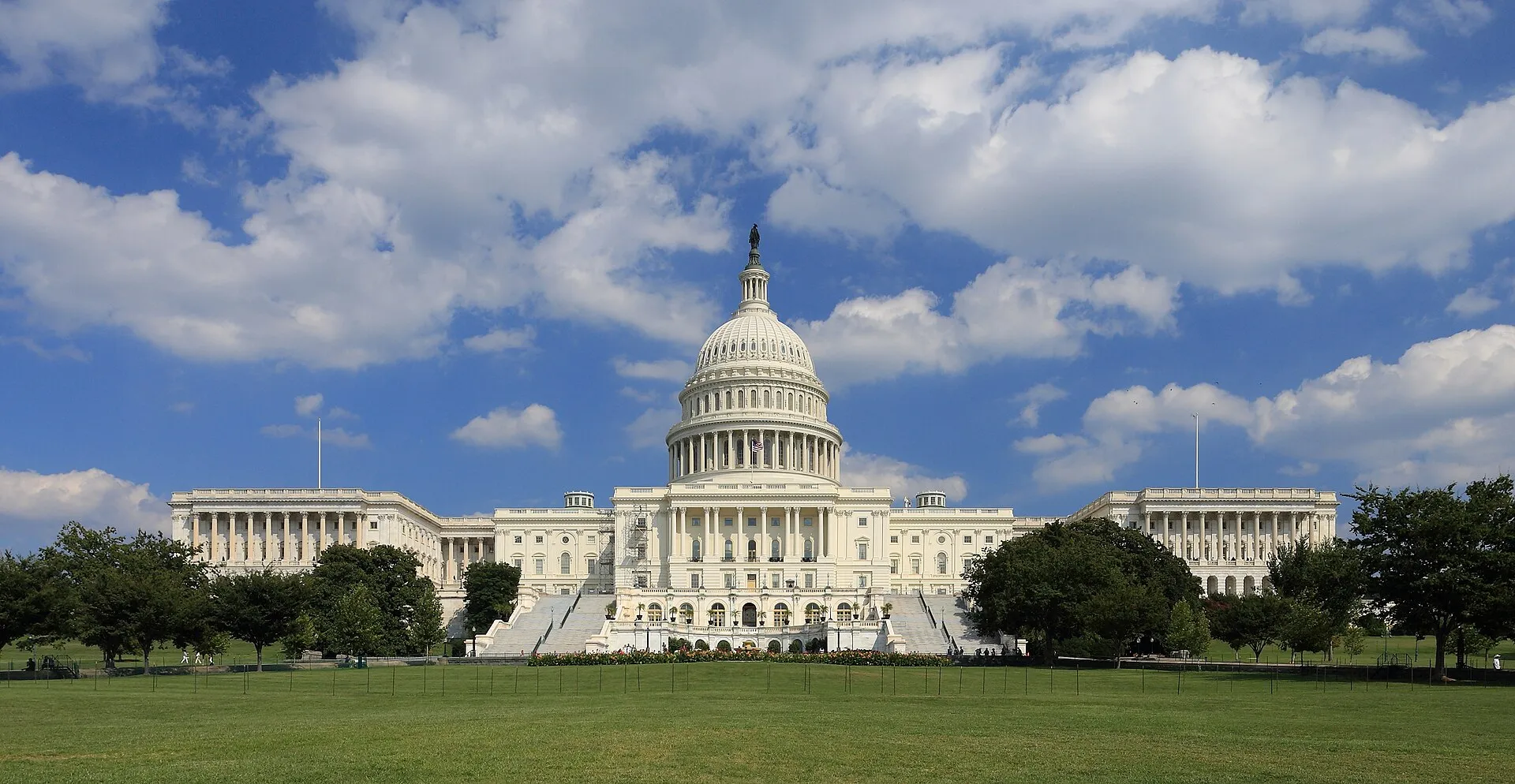
US Capitol timeline
-
Cornerstone laid
George Washington laid the cornerstone on 18 September 1793 in a Masonic ceremony, following Dr. William Thornton's prize-winning design.
-
Congress moves in
The north wing opened and Congress relocated from Philadelphia, sharing the building with the Supreme Court and the Library of Congress.
-
Burned by the British
British troops set fire to the Capitol on 24 August 1814; a sudden thunderstorm spared the shell from total ruin.
-
Bulfinch dome completed
Charles Bulfinch finished the reconstruction and a low copper-clad wooden dome, giving the building its first unified silhouette.
-
New marble wings open
Thomas U. Walter's extension delivered the current House chamber (1857) and Senate chamber (1859), doubling the building's length.
-
Statue of Freedom raised
The bronze Statue of Freedom was hoisted atop the new cast-iron dome on 2 December 1863, as construction pressed on through the Civil War.
-
Cast-iron dome finished
Walter's nearly 9-million-pound iron dome was completed, crowned inside by Brumidi's Apotheosis of Washington fresco of 1865.
-
Visitor Center opens
The 580,000-square-foot underground Capitol Visitor Center opened on 2 December 2008, the largest single addition in the building's history.
Architecture
The Capitol grew by accretion, and its architecture is a layered record of that growth. Dr. William Thornton, a physician with no formal training, won Washington's 1792 design competition with a domed neoclassical scheme the president praised for its "grandeur, simplicity and convenience." Benjamin Henry Latrobe refined the interiors after 1803, adding distinctly American touches — the famous corncob and tobacco-leaf column capitals of the small vestibules — before the British burning of 1814 gutted the young building.
The dome you see today is the building's third and boldest crown. When Thomas U. Walter's marble House and Senate wings stretched the Capitol to 751 feet, Charles Bulfinch's earlier copper-clad wooden dome suddenly looked squat and out of scale. Walter answered with a fireproof cast-iron dome begun in 1855: two nested shells of painted iron that, according to the Architect of the Capitol, weigh nearly 9 million pounds yet were engineered light enough to rest on the old sandstone walls. Its 108 windows and forced-perspective coffering make the interior soar far higher than its true stone base would allow. A 2014–2016 restoration — the dome's first thorough overhaul since 1960 — repaired more than 1,300 cracks and deficiencies in the cast iron and stripped decades of paint, work wrapped in scaffolding that visitors on those tours watched from below.
The Union is going on. If people see the Capitol going on, it is a sign we intend the Union shall go on.
Lincoln reportedly insisted the work continue through the Civil War, and on 2 December 1863 the bronze Statue of Freedom — Thomas Crawford's 19.5-foot, roughly 15,000-pound figure — was hoisted in sections to the top of the dome, a moment marked by a 35-gun salute. The bronze was cast at Clark Mills's foundry outside the city, where — as the Architect of the Capitol records — the enslaved craftsman Philip Reid worked out how to separate Crawford's plaster model into its five sections for moving, after the Italian workman who had assembled it demanded a raise and refused to reveal the trick. Reid was freed by the District's Compensated Emancipation Act on 16 April 1862, a year before the statue he helped cast was set atop the dome. Inside the eye of the dome floats Brumidi's Apotheosis of Washington (1865), a 4,664-square-foot fresco hanging 180 feet above the Rotunda floor. Look for the ring of the Frieze of American History below it, painted in grisaille to imitate carved stone and finished across three artists and 75 years, from Brumidi through Filippo Costaggini to Allyn Cox in 1953 — the single best close-up detail to seek out on the standard tour.
Historical Significance
The Capitol Visitor Center tour covers the highlights efficiently, but it cannot explain how legislation actually moves through the building you are walking through. Understanding that process requires a narrator who can describe the parliamentary maneuvers, the committee rooms where bills live or die, and the informal spaces where deals are struck away from cameras. The building is not merely beautiful; it is a machine for making laws, and appreciating its function transforms a pretty room into the engine of American democracy.
The National Statuary Hall Collection contains bronze and marble figures sent by each state — from Sam Houston to Rosa Parks — each statue carrying the weight of its home state's values and aspirations. These artworks demand interpretation. Who chose which figures represent each state, and what does that selection reveal about how Americans wish to remember themselves? A guide versed in Capitol art history answers those questions while you stand before the works, and can walk you to the marble marker where John Quincy Adams' desk once stood — the spot where the old chamber's whispering-gallery acoustics let him eavesdrop on rivals across the room.
The building's origins carry a harder history the free tour mentions only in passing. Enslaved African Americans, rented from their owners, labored at nearly every stage of the early Capitol — quarrying the Aquia Creek sandstone, firing brick, and sawing timber for wages paid to the people who claimed them. Congress named the underground great hall of the Capitol Visitor Center Emancipation Hall in 2007 to honor that overlooked workforce, and the original plaster Statue of Freedom — the model Philip Reid helped disassemble — now stands there, the first thing most visitors see as they arrive for a tour.
The Capitol's history includes moments of violence and crisis that the standard tour touches only lightly:
- British soldiers burned the building in 1814, and only a downpour saved the walls.
- Representative Preston Brooks beat Senator Charles Sumner nearly to death on the Senate floor in 1856, a brutal prelude to the Civil War.
- Abraham Lincoln took his oath on the Capitol's unfinished steps in 1861 while cranes loomed overhead and the nation teetered toward war.
More recent events have again tested the building's security and the democracy it houses. Guides can contextualize these moments, connecting them to the National Mall stretching westward toward the Lincoln Memorial and to the Library of Congress and Supreme Court just steps away on Capitol Hill.
When to Visit
The Capitol is open for tours Monday through Saturday, 8:30 AM to 4:30 PM, with groups departing every few minutes. It is closed on Sundays, Thanksgiving, Christmas, New Year's Day, and Inauguration Day.
- Book ahead. Reserve free timed tour passes online through the Capitol Visitor Center, especially from March through July when school groups fill the calendar. A limited number of same-day passes are released at the Visitor Center each morning, but they vanish fast in peak season.
- Arrive early. The 8:30–9:00 AM tours have the smallest groups and the shortest security lines; by late morning the queue at the underground entrance can stretch outdoors.
- Budget for security. Everyone passes through airport-style screening, and there is no bag storage, so travel light — oversized bags, food, and liquids are turned away at the door.
- To watch a floor debate, request separate gallery passes from your U.S. representative's or senator's office; these admit you to the public galleries above the chambers only when Congress is in session.
Allow at least 90 minutes for the film, the Exhibition Hall, and the guided walk through the historic core, and more if you plan to add the Library of Congress or the galleries.
Admission and Costs
The Capitol itself costs nothing to visit:
- Guided Capitol tour: completely free, including the Visitor Center's Exhibition Hall and the orientation film.
- Gallery passes: free, obtained through your member of Congress's office.
- Library of Congress: free entry and free tours of the world's largest library, just across the plaza.
- Supreme Court: free; you can hear courtroom lectures when the Court is not sitting.
Where money enters is with private, licensed guiding on Capitol Hill:
- Group Capitol Hill tours: $30–50 per person for 2-hour walks covering the Capitol exterior, Supreme Court, and Library of Congress.
- Private Capitol Hill guide: $250–450 for a half-day experience linking all three buildings, often paired with the eastern end of the National Mall.
Because the admission fees are zero, a guide's fee buys interpretation and access logistics rather than entry — value that rises sharply once you understand how little the free tour's script explains.
The Case for a Guide
The Capitol's free tour is genuinely good, but it is deliberately broad: a 50-minute loop through the Crypt, Rotunda, and Statuary Hall that must serve everyone from first-graders to foreign heads of state. A specialist guide fills in what that script cannot, and handles the logistics that trip up independent visitors.
- The parts the free tour skips. The Old Senate Chamber, the Old Supreme Court Chamber, and the Brumidi Corridors are not on the standard route; a guide who knows the building's rhythm can time your visit to catch the ones open that day.
- How a bill actually moves. Guides with a policy background trace the path from committee markup to floor vote to conference, pointing out the very rooms and lobbies where the work happens.
- Reading the art. The Apotheosis of Washington, the eight Rotunda history paintings, and the Statuary Hall figures are dense with symbolism most visitors photograph without decoding.
- The whispering-gallery trick. In Statuary Hall a guide positions you on the exact spot where a whisper carries clear across the room, a quirk of the old House chamber's curved ceiling.
- Stitching the Hill together. A good guide sequences the Capitol, Library of Congress, and Supreme Court into one efficient morning, and connects them to the Smithsonian Museums and monuments along the National Mall.
Tips for Visitors
What to see inside:
- The Rotunda — the 96-foot-wide, 180-foot-high ceremonial heart of the building, capped by Brumidi's Apotheosis of Washington and ringed by eight monumental history paintings; four are by John Trumbull, including the Declaration of Independence reproduced on the back of the $2 bill.
- National Statuary Hall — the semicircular former House chamber, now holding a rotating selection from the collection of 100 state statues, two per state.
- The Brumidi Corridors — Senate-side hallways frescoed in Renaissance style by Constantino Brumidi over roughly 25 years, until his death in 1880.
- The Crypt — the circular room of 40 Doric columns beneath the Rotunda, built to hold George Washington's tomb (he chose to rest at Mount Vernon instead) and now displaying the compass stone that marks the city's four quadrants.
Best photo opportunities:
- The west front across the National Mall at golden hour, with the dome catching the last light — the classic Capitol shot.
- The east front plaza, where the broad steps and columned portico frame the Statue of Freedom directly overhead.
- Straight up into the oculus of the dome from the center of the Rotunda floor, aligning the fresco within the coffered rings.
- The reflecting pool on the west side at dawn, mirroring the dome before the wind stirs the water.
Nearby, all free: the Library of Congress — the world's largest library, holding more than 170 million items in a breathtaking Beaux-Arts building linked to the Capitol by tunnel — and the Supreme Court's marble temple of justice across First Street. Frederick Law Olmsted landscaped the surrounding Capitol Grounds in the 1870s with more than 100 varieties of trees and his hidden brick Summerhouse, a shaded spot most visitors walk right past. Metro riders should use Capitol South (Blue/Orange/Silver) or Union Station (Red) rather than driving, as public parking on the Hill is scarce.
Making a day of it: the Capitol anchors the east end of the National Mall, so most itineraries run westward — past the Smithsonian Museums toward the monuments — rather than doubling back. The White House lies about a mile and a half northwest along Pennsylvania Avenue, the inaugural parade route, but plan that pairing carefully: unlike the walk-up Capitol tour, White House visits must be requested weeks ahead through your member of Congress, so secure that pass before you build a two-stop day around it.
Frequently Asked Questions
What is the best time of year to tour the US Capitol?
April through May and September through October combine comfortable weather for approaching the Capitol grounds with shorter wait times than the crush of summer field trips and family vacations. Spring brings cherry blossoms to the Capitol grounds, and fall offers golden light against the white dome. The Visitor Center is climate-controlled, making the interior tour comfortable regardless of season, but Congress is in recess during August, so visitors hoping to observe a session should plan around the legislative calendar.
Are there free concerts or seasonal events at the US Capitol?
Beyond the daily tour, the Capitol's West Front Lawn hosts several free, open-air events each year. The National Memorial Day Concert is staged on the Sunday evening before Memorial Day, and A Capitol Fourth draws crowds to the lawn for the Independence Day fireworks over the National Mall on 4 July — both are free, un-ticketed, and broadcast nationally on PBS. From late November into January the Capitol Christmas Tree, a conifer trucked in from a different national forest each year and hung with thousands of handmade ornaments, stands lit on the West Lawn. None of these require a tour reservation; you simply arrive at the grounds, though the Fourth of July crowd fills the lawn and clears security hours before dusk, so come early.
What is the highlight of the US Capitol Rotunda?
The domed ceiling is the showstopper. Suspended 180 feet overhead is Constantino Brumidi's fresco The Apotheosis of Washington, painted in 1865 across 4,664 square feet so its figures still read clearly from the floor below. Ringing the walls are eight monumental history paintings — four by John Trumbull, including the Declaration of Independence familiar from the back of the $2 bill — set above the Frieze of American History, a band of grey grisaille painted to mimic carved stone. The Rotunda is also the room where eminent Americans have lain in state, from Abraham Lincoln to Rosa Parks, which is why guided groups tend to linger here longest.
Can visitors see the Old Senate Chamber and Old Supreme Court Chamber?
Yes, when staffing allows. Both restored rooms sit on the Capitol's first floor, just off the standard tour route, and open to visitors on a rotating basis rather than every day. The Old Senate Chamber — home to the Senate from 1810 to 1859, and then to the Supreme Court until 1935 — is where Henry Clay, Daniel Webster, and John C. Calhoun waged the great antebellum debates; it has been returned to its 1850s look, with red-draped mahogany desks beneath a curved visitors' gallery. One floor below, the Old Supreme Court Chamber housed the Court from 1819 to 1860 and survives as the oldest room designed by Benjamin Henry Latrobe, its umbrella-vaulted ceiling a quiet engineering showpiece. Ask your tour guide or the Visitor Center information desk which of the two is open the day you visit.
How do I watch Congress in session from the galleries?
Watching a floor debate is separate from the guided building tour. You need a gallery pass, which is free but must come from the office of your own U.S. representative or senator (international visitors request House and Senate passes at the respective appointments desks inside the Capitol Visitor Center). Passes admit you to the public galleries above the chambers only when that chamber is in session — check the House and Senate floor schedules, and remember both bodies are usually out during the August recess. No bags, food, or cameras are allowed into the galleries, so plan a coat-check stop first.
Is the US Capitol accessible for visitors with disabilities?
Yes. The Capitol Visitor Center is fully wheelchair accessible, with step-free routes, elevators to every tour level, and accessible restrooms; standard wheelchairs are available free on a first-come basis at the coat check. Assistive listening devices and sign-language interpreters can be arranged in advance through the Visitor Services office, and service animals are welcome. Because the guided route covers long marble corridors and can involve waiting, request accommodations when you reserve your timed tour pass rather than on the day.
Where do you enter the US Capitol for a tour?
All public tours begin at the underground Capitol Visitor Center, whose entrance sits below the East Front plaza — walk toward the building from First Street between Constitution and Independence Avenues and follow the ramps down to the doors, not up the marble steps. Everyone clears airport-style security here, and because there is no coat or bag check for large items, oversized luggage, aerosols, and food are turned away, so leave them at your hotel. Metro riders should surface at Capitol South (Blue/Orange/Silver) or Union Station (Red), each about a ten-minute walk to the East Front.
How long does the US Capitol tour take?
The guided walk through the historic core — the Crypt, the Rotunda, and National Statuary Hall — runs roughly 50 minutes to an hour. Add the 13-minute orientation film "Out of Many, One" and time in the Exhibition Hall, and most visitors spend about 90 minutes inside the Capitol itself. Build in extra time if you are also collecting gallery passes to watch a floor session or crossing the tunnel to the Library of Congress, which many pair into the same morning.
Can you go to the top of the US Capitol dome?
The top of the dome is not part of the regular public tour. The strenuous climb of several hundred steps up the cast-iron Dome is offered only occasionally and only to constituents, arranged in advance through your own U.S. representative or senator, and it fills months ahead. Everyone else sees the dome from the inside of the Rotunda, gazing 180 feet up to Brumidi's Apotheosis of Washington fresco — the view that anchors the standard tour.
Is photography allowed inside the US Capitol?
Yes — visitors may take photos throughout the public tour route, including the Rotunda and Statuary Hall, and handheld cameras and phones are welcome. The one firm exception is the House and Senate galleries: no cameras, phones, bags, food, or drink are permitted inside when a chamber is in session, so those items must be checked before you go up. Tripods and commercial photography require separate advance permission from the Architect of the Capitol.