
Collection Highlights
The Glasshouse
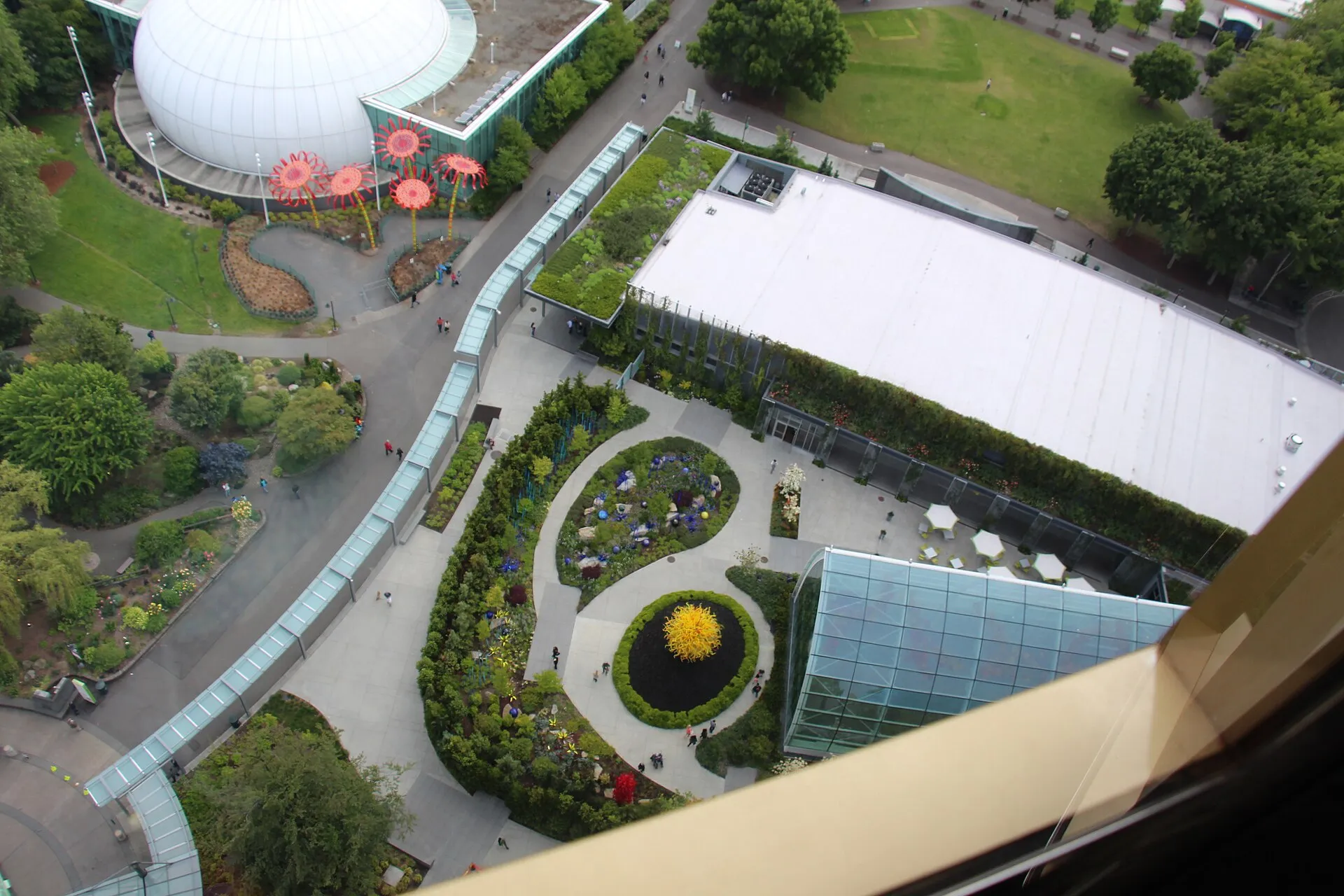
The exhibition's centrepiece is a 40-foot-tall glass-and-steel pavilion, inspired by the great Victorian conservatories, that holds one of Dale Chihuly's largest suspended sculptures — a roughly 100-foot ribbon of blown forms in reds, ambers, oranges, and yellows floating overhead. Sunlight pouring through the curved ceiling shifts the colours through the day, and the room frames the Space Needle rising directly beyond the glass.
The Garden
Outdoors, glass towers, orbs, blue Reeds, and twisting Sun sculptures erupt from beds of ferns, grasses, and seasonal blooms, so the boundary between horticulture and art dissolves. Plantings were chosen to complement the colours of the glass, and the garden looks different every month as the beds change and, after dusk, dramatic uplighting transforms the sculptures.
Sealife Room
A gallery devoted to Chihuly's Seaforms and Persians arranged around a towering blue Sealife Tower, its translucent bowls, shells, and tendrils evoking the tidal pools and kelp forests of the Pacific coast. The thin, ribbed forms show how the artist let gravity and centrifugal spinning shape molten glass into sea-creature silhouettes.
Persian Ceiling
One of the most photographed rooms in the building, a corridor roofed entirely in hundreds of brightly coloured Persian forms lit from above. Walk beneath the glass ceiling and the whole passage floods with shifting reds, golds, blues, and greens projected down onto visitors and floor alike.
Mille Fiori
Italian for "a thousand flowers," this darkened gallery holds a dense, room-length landscape of glass reeds, herons, and blossoms rising from a black reflective platform. It is Chihuly's evocation of his mother's garden in Tacoma, and its scale makes it one of the exhibition's signature immersive spaces.
Glass Forest
An early gallery of tall, tree-like blown forms — a modern take on the "Glass Forest" installations Chihuly and collaborator James Carpenter first created in 1971-72 — glowing with neon and argon in a dim room that sets the tone for the galleries ahead.
Northwest Room
A quieter gallery pairing Chihuly's early Cylinders and Baskets with objects from his personal collections, including Native American trade blankets and woven baskets from the Pacific Northwest. The Baskets series was directly inspired by slumping, sagging Native baskets he saw in a Tacoma museum.
Chandeliers and Ikebana
Galleries showcasing Chihuly's elaborate Chandeliers — massed clusters of individually blown elements, some containing hundreds of pieces assembled over weeks — alongside the Ikebana and Float Boat installation, where glass forms modelled on Japanese flower arranging spill from a wooden rowboat.
Macchia Forest
A stand of the artist's Macchia (Italian for "spotted"), giant speckled bowls in wildly clashing colours raised on pedestals so light passes through their thin walls. The series pushed Chihuly's palette to its extremes, with "spirit lines" of contrasting glass separating the interior and exterior colours.
Guided Tours
Several formats suit different visitors, so it helps to match the tour to how much time and background you want. Most people simply walk the galleries at their own pace, but a guided option adds structure that a self-guided visit can't.
- Self-guided with the audio companion: the venue's own audio guide is the lightest option, letting you linger on the pieces that catch your eye while narration fills in context gallery by gallery.
- Docent-led exhibition tours: scheduled walk-throughs run roughly 60–90 minutes and keep groups small so everyone can hear; they follow a set route through the eight galleries, the Glasshouse, and the Garden.
- Small-group art tours: independent art guides offer 1–1.5 hour sessions for a handful of people, pacing the visit around questions rather than a fixed script.
- Private and combination tours: a private guide can tailor the timing to your group and fold the exhibition into a wider Seattle Center itinerary rather than treating it as a single stop.
Booking ahead matters more than the format: timed-entry tickets sell out on summer afternoons, and the most forgiving light for photography falls in the first hour after opening and again near dusk.
Because the exhibition sits within Seattle Center, most guided options fold neighbouring landmarks into the same outing — the Space Needle rising overhead, the Museum of Pop Culture next door, a short climb to Kerry Park for the postcard skyline, or a walk to Pike Place Market about fifteen minutes away.
Collections Highlights
- Allow enough time: most visitors spend 60–90 minutes, but art lovers and photographers often stay two hours or more across the galleries, Glasshouse, and Garden.
- Accessibility: the exhibition is fully accessible, with wide pathways, elevators between levels, and benches throughout — comfortable for wheelchairs and strollers alike.
- Photography: flash is prohibited inside the galleries, but natural-light and phone photography are encouraged; tripods and monopods are not permitted, so bring a steady hand or a phone stabiliser.
- Collections Café and shop: the café sits amid Chihuly's own vintage collections, and the shop carries prints, small glass pieces, and books that make memorable souvenirs.
- Combine with neighbours: the Space Needle is a two-minute walk and the Museum of Pop Culture barely five, while Pike Place Market is about 15 minutes away on foot or a short monorail ride.
When to Visit
- Regular hours: daily 10:00 AM – 7:00 PM, extended to 8:00 PM on Fridays and Saturdays in summer; hours shift around holidays, so confirm before planning a late visit.
- Best light: the outdoor Garden glows during golden hour, when low sun rakes warm light through the glass; the Persian Ceiling and Glasshouse are most vivid on bright midday visits.
- Evening magic: after dusk the Garden's uplighting transforms the sculptures, and summer's later closing on weekends is the only chance to see the glass lit against a dark sky.
- Quietest windows: weekday mornings right at opening give the most room to linger in the galleries before tour groups and combo-ticket crowds arrive from the Space Needle.
- Seasonal note: the Garden's plantings change through the year, so spring and summer visits are especially lush — the month ratings above crest from June to September.
Admission and Costs
- Adult admission: $32 for general entry (timed tickets are recommended in peak season).
- Children (5–12): $22; kids under 5 enter free.
- Chihuly + Space Needle combo: $57–62, saving roughly $10 versus buying each ticket separately.
- Seattle CityPASS: bundles Chihuly with the Space Needle, Museum of Pop Culture, and other major sights at a meaningful discount if you are visiting several attractions.
- Art-focused guided tours: $40–60 per person (1–1.5 hours, covering technique, biography, and gallery context).
- Private Seattle Center guide: $200–325 for groups up to 6, combining Chihuly with the surrounding campus landmarks.
The Case for a Guide
Chihuly's sculptures look effortless, but almost everything that makes them remarkable — the technique, the biography, the logic that links one gallery to the next — is invisible unless someone reads it for you. A guide turns a stroll past pretty glass into the story of how a single artist reshaped an entire medium.
- Decoding the technique: guides explain how teams gather, blow, and shape molten glass at temperatures above 2,000°F, and why a single Chandelier can take weeks to assemble from hundreds of individual elements.
- The biography behind the work: the 1976 car accident and 1979 surfing injury that ended Chihuly's own blowing become the key to understanding his shift from soloist to director of teams.
- Threading the series together: from Baskets and Seaforms to Macchia and Persians, a guide weaves the eight galleries into one coherent arc of artistic evolution rather than a set of disconnected rooms.
- Reading the Glasshouse and Garden: guides point out how the suspended sculpture is lit by the sky above and how the outdoor plantings were chosen to echo the colours of the glass.
- Building the wider day: guides extend the visit to the Space Needle overhead, the Museum of Pop Culture next door, Kerry Park for the skyline, or Pike Place Market for lunch.
Tips for Visitors
- Space Needle framing: the outdoor Garden offers unique low angles of the Space Needle rising directly above the glass sculptures — the signature shot most visitors come away with.
- Persian Ceiling: linger under the glass-roofed corridor and let the projected colour wash over you; it photographs best when the room is briefly empty of other visitors.
- Golden hour in the Garden: warm late-afternoon light through the glass forms is the most flattering, while after-dusk uplighting on summer weekends gives a completely different, dramatic mood.
- Watch a live demo: glassblowing demonstrations and talks run on a rotating schedule — check the day's programming on arrival to catch a gaffer working molten glass in person.
- Start indoors, finish outside: move through the galleries first, then end in the Glasshouse and Garden so you exit into open air with the Space Needle overhead rather than backtracking through the dim rooms.
Frequently Asked Questions
What are the opening hours at Chihuly Garden and Glass?
Regular hours: Daily 10:00 AM - 7:00 PM (hours extended to 8:00 PM on Fridays and Saturdays in summer). Best for photography: Visit the outdoor garden during golden hour for warm light filtering through the glass sculptures.
What does admission to Chihuly Garden and Glass cost?
Adult admission: $32 for general entry. Children (5-12): $22; kids under 5 are free. Chihuly + Space Needle combo: $57-62, saving roughly $10 compared to buying each ticket separately.
What is the highlight of Chihuly Garden and Glass?
The Glasshouse: Stand beneath a 40-foot-tall glass ceiling holding a roughly 100-foot suspended sculpture in fiery reds, ambers, oranges, and yellows — one of the largest works Dale Chihuly has ever made.
Who was Dale Chihuly and why is his glass so famous?
Dale Chihuly, born in Tacoma in 1941, co-founded the Pilchuck Glass School in 1971 and pioneered a team approach to blown glass after a 1976 car accident and a 1979 surfing injury ended his own days at the blowpipe. He is credited with moving studio glass from craft workshops into major museums and public spaces worldwide.
How much time should I plan for a visit?
Most visitors spend 60 to 90 minutes across the eight galleries, the Glasshouse, and the Garden, though art lovers and photographers often stay two hours or more. The exhibition is fully accessible, with wide pathways and elevators between levels.