Empire State Building timeline
-
The Waldorf-Astoria comes down
Developer John J. Raskob's syndicate cleared the original Waldorf-Astoria Hotel from the Fifth Avenue block between 33rd and 34th Streets, launching the project just weeks before the October stock-market crash that would define the Depression decade the tower rose through.
-
Steel at four and a half floors a week
Excavation began in January and the riveted steel frame climbed at a record pace of about four and a half floors per week, with ironworkers eating lunch on open girders a thousand feet above Midtown — scenes later captured in Lewis Hine's construction photographs.
-
President Hoover lights the tower
The building opened on May 1, when President Herbert Hoover pressed a button in Washington to switch on the lights. At 1,250 feet it was the world's tallest building, finished in just thirteen months and under budget.
-
King Kong scales the mast
The film King Kong placed its giant ape atop the new tower, sealing the building's place in popular culture barely two years after it opened and beginning a run of more than 250 film appearances.
-
A B-25 bomber strikes the 79th floor
On a fog-bound July morning a U.S. Army Air Forces B-25 Mitchell crashed into the north face between the 79th and 80th floors, killing fourteen people. The structure held, and most offices reopened within days — a testament to the riveted steel frame.
-
The 40-year reign ends
The North Tower of the World Trade Center rose past the Empire State Building, ending its run as the tallest building in New York and the world — a title it had held since opening day in 1931.
-
A Depression-era icon goes green
A deep energy retrofit re-glazed all 6,514 windows on site and overhauled heating and cooling, cutting the tower's energy use by roughly a third and turning a 1931 landmark into a model for sustainable skyscraper renovation.
-
The 102nd floor is reimagined
A multi-year, $165-million observatory redesign reopened the 102nd floor with floor-to-ceiling glass and a new glass-walled elevator, alongside a rebuilt second-floor museum tracing the building's construction and cultural history.
Historical Significance
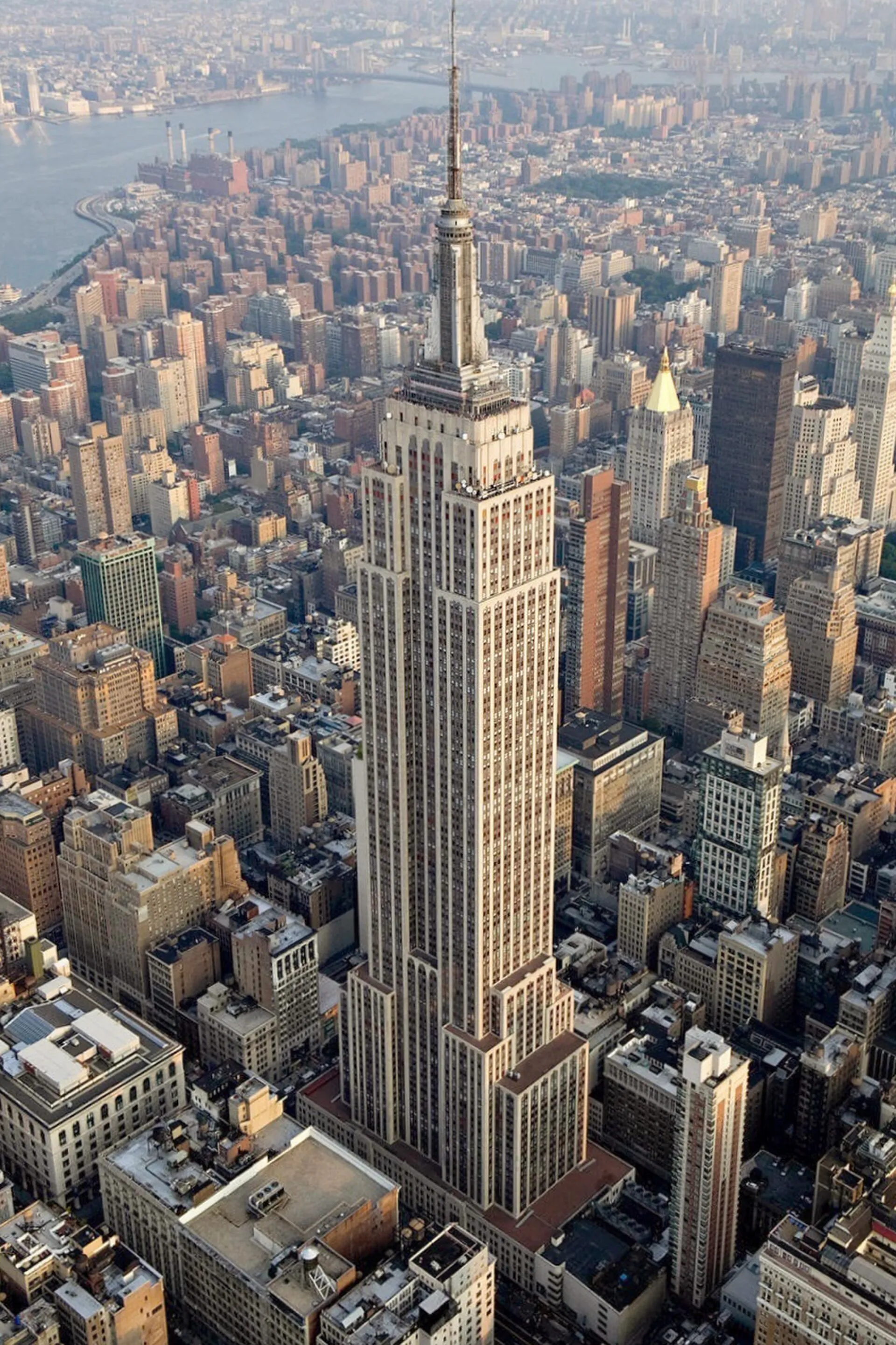
Workers erected the steel frame at a pace of four and a half floors per week, completing 102 stories in just 13 months during the depths of the Great Depression. Only five workers died during construction, a remarkably low toll for the era. The building's Art Deco mooring mast was originally designed to dock airships, but high winds made the idea impractical after a single dramatic test.
The Empire State Building held the title of world's tallest building from 1931 to 1970, when the World Trade Center surpassed it. After September 11, 2001, it briefly reclaimed the title as the tallest building in New York before One World Observatory opened in 2014. The building has appeared in over 250 films, most iconically King Kong (1933).
Architecture
The lobby's Art Deco ceiling mural, marble walls, and original brass fixtures represent some of the finest decorative metalwork of the 1930s. The building's exterior features a distinctive setback design mandated by New York's 1916 Zoning Resolution, creating the iconic stepped silhouette.
86th floor outdoor deck: Open-air 360-degree views and the best photo opportunities. 102nd floor: Recently renovated with floor-to-ceiling windows and the building's highest vantage point at 1,250 feet. Second-floor galleries: Exhibits on construction history, sustainability, and the building's role in pop culture. The nightly light show illuminates the tower in colors marking holidays and causes.
When to Visit
Hours: Daily 9:00 AM - midnight (last elevator 11:15 PM). Best for views: Sunset (arrive 1 hour before) for day and night panoramas. Least crowded: 8-11 AM or after 10 PM. Most crowded: 2-5 PM, weekends, holidays. Clear visibility: Check weather - fog and rain obscure views
Admission and Costs
86th floor standard: $44 adults, $38 children. 86th + 102nd floors: $77 adults, $71 children. Express pass (skip-the-line): $80+ (can save 2-3 hours wait). Sunrise package: $120 for 6-8 AM access with continental breakfast.
Guided tours: $65-90 per person including history walk and priority access. Private guide: $350-500 for up to 6 people with customized itinerary covering the building's Art Deco details, construction history, and observation deck experience.
The Case for a Guide
Riding the elevator to the 86th floor observation deck is easy enough alone — but the building's extraordinary story, from Depression-era construction miracle to accidental cultural icon, only becomes accessible when someone who knows it walks you through both the lobby and the history simultaneously.
- Art Deco lobby details that most visitors walk past: The original 1931 lobby ceiling mural depicting the eight modern wonders of the world (including the Empire State Building itself), the chrome elevator doors, and the brass fixtures represent some of the finest decorative metalwork of the interwar period — guides stop here before you even reach an elevator.
- The mooring mast's zeppelin history: The distinctive spire was engineered as a dirigible docking station — transatlantic airships would tie up here while passengers descended by gangway to the 102nd floor. Guides explain the two actual attempts and why high-altitude wind turbulence made the idea impossible in practice.
- Depression-era construction stories: The steel frame rose at 4.5 floors per week through 1930, with workers eating lunch on open girders 1,000 feet above Midtown — guides share specific documented accounts from the construction archive and explain the economic desperation that drove the pace.
- Observation deck photography timing: Guides explain why the 86th floor offers superior photography to the enclosed 102nd floor (open air, more angles), and which compass direction faces what landmark at which time of day — the precise knowledge that separates memorable shots from tourist snapshots.
- Directional landmarks from each tier: From the 86th floor, guides orient you to the Hudson and East Rivers, identify the bridges by name, point out the World Trade Center complex to the south and Central Park's green rectangle to the north — turning a view into a legible map of the city.
Tips for Visitors
Security screening: Airport-style -- no large bags, allow 15-20 minutes. Weather layer: The outdoor 86th-floor deck is windy; bring a jacket even in summer. Wait times: Can exceed 2 hours without express pass during peak times. Photography: Professional cameras allowed, tripods prohibited.
Food options: STATE Grill and Bar on ground floor, Starbucks nearby. Compare options: Top of the Rock at Rockefeller Center offers the Empire State Building in your views. Getting here: The entrance is on West 34th Street near Fifth Avenue, a short walk from the 34th Street-Herald Square subway hub (B, D, F, M, N, Q, R, W) and Penn Station.
Combine with Times Square ten minutes north for a full Midtown day, or pair a daytime visit with an afternoon stroll on the High Line and the shops of Chelsea. Families often follow a morning deck visit with the open lawns of Central Park; photographers chasing the skyline frequently end the day walking across the Brooklyn Bridge at dusk, with the tower's nightly colored lights behind them.
Frequently Asked Questions
What months offer the clearest views from the Empire State Building?
September through November consistently delivers the sharpest visibility from the observation deck, with crisp autumn air and fewer hazy days than summer. Spring evenings in April and May are also excellent, with longer daylight for sunset visits. Winter can produce stunning clear-day panoramas but the outdoor deck is exposed and bitterly cold; summer afternoons often bring humidity and haze that limit sightlines.
When can visitors tour Empire State Building?
Hours: Daily 9:00 AM - midnight (last elevator 11:15 PM). Best for views: Sunset (arrive 1 hour before) for day and night panoramas. Least crowded: 8-11 AM or after 10 PM. Most crowded: 2-5 PM, weekends, holidays.
How much is the entrance fee for Empire State Building?
86th floor standard: $44 adults, $38 children. 86th + 102nd floors: $77 adults, $71 children. Express pass (skip-the-line): $80+. Sunrise package: $120. Guided tours: $65-90 per person.
How long are the queues for Empire State Building during peak season?
Reaching the observation deck without a guide means waiting in queues that can stretch past two hours during peak season.
Should I book Empire State Building tickets in advance?
Yes. Booking a timed-entry ticket online secures a fixed arrival window and lets you skip the ground-floor ticket line, which is the longest of the several queues inside. Walk-up tickets are sold, but on weekends and holidays the combined ticketing, security, and elevator waits can exceed two hours. If your schedule is flexible, an early-morning (opens 9:00 AM) or late-evening (after 10:00 PM) slot is both cheaper to reach quickly and far less crowded than the 2-5 PM peak.
Is the Empire State Building accessible for wheelchair users?
Both the 86th- and 102nd-floor observatories are wheelchair accessible by elevator, and the second-floor museum galleries, ticketing, and security areas are step-free. Accessible restrooms are available, and standard-height viewing windows on the enclosed 102nd floor suit seated visitors well. The 86th-floor outdoor deck has a protective safety fence with gaps positioned for photography; staff can direct visitors to the lowest viewing sections.
How much time should I budget for a visit?
Plan for 1.5 to 2 hours door to door: roughly 15-20 minutes for security and ticketing, time in the second-floor exhibits on the building's construction and pop-culture history, the elevator ride, and 30-45 minutes on the decks themselves. Sunset visitors who want to see both daytime and illuminated-city views should add another 30-45 minutes to stay through dusk, so budget closer to 2.5 hours for that experience.