
Collection Highlights
The Louisiana Memorial Pavilion and the Higgins boat
The original building that opened in 2000 still anchors the campus, and its centrepiece is a restored LCVP, the shallow-draft Higgins boat designed and built in New Orleans that carried Allied troops onto the Normandy and Pacific beaches. Standing beside the ramp that dropped soldiers into gunfire makes the opening galleries hit harder than any photograph.
Beyond All Boundaries in the Solomon Victory Theater
Produced by and narrated by Tom Hanks, this 4D cinematic experience uses a wraparound screen, vibrating seats, falling snow, and physical set pieces to compress the global war into 45 minutes. It requires a timed add-on ticket and is worth planning your day around.
US Freedom Pavilion - The Boeing Center
A cavernous hangar suspends a B-17 Flying Fortress, a B-25 Mitchell, a Supermarine Spitfire, a P-51 Mustang, and other restored aircraft at eye level and overhead, viewed from vertigo-inducing catwalks. The pavilion also houses the Final Mission USS Tang Submarine Experience, a role-playing recreation of the submarine's last patrol.
Campaigns of Courage - Road to Berlin
This immersive gallery marches visitors from North Africa and Italy through the hedgerows of Normandy to the fall of the Reich, using full-scale environments, artifacts, and audio to recreate the European theater step by step. It sets the emotional and strategic stage for its Pacific counterpart next door.
Campaigns of Courage - Road to Tokyo
The companion gallery traces the island-hopping Pacific war from Pearl Harbor through Guadalcanal, Iwo Jima, and Okinawa to the Japanese surrender, framing the very different terrain, tactics, and stakes of the war against Japan. Together the two halls are the heart of a modern visit.
Liberation Pavilion
The newest pavilion, opened in 2023, confronts the end of the war and what came after - the liberation of the concentration camps, the return home, the Nuremberg trials, and the fragile peace that followed. Its three floors give the museum the reckoning with legacy that earlier galleries deliberately build toward.
The oral history archive
Touchscreen stations throughout the galleries play from an archive of thousands of filmed interviews with veterans, home-front workers, and survivors describing the war in their own words. These unfiltered testimonies, recorded before a generation passed, are the museum's most powerful and irreplaceable resource.
The Arsenal of Democracy and the Home Front
Often overlooked by visitors focused on combat, this gallery in the Louisiana Memorial Pavilion explores rationing, women in the factories, war-bond drives, Japanese American internment, and the industrial surge that made Andrew Higgins and New Orleans central to the Allied victory.
The Bollinger Canopy of Peace
Completed in 2022, the soaring white canopy floats 150 feet above the campus and unifies the pavilions into a single architectural statement visible across the Warehouse District. It is the signature exterior image of the modern museum and a landmark in its own right.
Guided Tours
Two formats dominate the guided options on the campus. A guided group tour runs about $65-85 per person for roughly 3 hours with the museum admission ticket folded into the price, and it typically covers the Louisiana Memorial Pavilion and Higgins boat, a walk through both Road to Berlin and Road to Tokyo, and the aircraft of the US Freedom Pavilion, leaving you free to revisit any gallery on your own afterward.
A private guide costs $200-350 for a party of up to 6 (museum tickets purchased separately), which lets the itinerary bend entirely to your timetable — a focused two-hour highlights loop, or a full day that lingers in the Home Front galleries and the oral-history stations.
Booking a guide also smooths the logistics that trip up walk-up visitors. Reserved group entry sidesteps the general-admission line at peak times, and because the Beyond All Boundaries 4D film ($7.00) and the Final Mission: USS Tang submarine experience ($8.00) run on timed tickets, a guide slots those bookings between galleries so you never queue twice or backtrack across the six-acre campus. Most tours end at the Liberation Pavilion by design, then release you beside the American Sector restaurant and the gift shop near the exit.
Collections Highlights
The campus rewards a plan of attack more than a lap of every gallery, and knowing how the six pavilions fit together saves hours of backtracking:
- Louisiana Memorial Pavilion — the original 2000 building, home to the restored Higgins boat, the Arsenal of Democracy Home Front gallery, and the ticketing and orientation hub where most visits begin.
- Campaigns of Courage — the immersive twin galleries, Road to Berlin and Road to Tokyo, that chronologically recreate the European and Pacific theaters with full-scale battle environments. This is the narrative heart of a modern visit.
- US Freedom Pavilion: The Boeing Center — a hangar of suspended warplanes viewed from multi-level catwalks, plus the role-playing Final Mission: USS Tang Submarine Experience.
- Solomon Victory Theater — the Tom Hanks-narrated 4D film Beyond All Boundaries, a timed add-on worth scheduling around.
- Liberation Pavilion — the 2023 addition that carries the story past V-E and V-J Day into liberation of the camps, the homecoming, and the war's lasting legacy.
Reserve timed tickets for the film and the submarine experience when you book, and leave the Liberation Pavilion for the end — it is designed to be the emotional close to everything that comes before it.
National WWII Museum timeline
- June 6, 2000
Opens as the National D-Day Museum
Historian Stephen Ambrose and Nick Mueller open the museum on the 56th anniversary of D-Day, honouring the Higgins boats designed and built in New Orleans.
-
Designated the National WWII Museum
Congress names it America's official National WWII Museum, broadening the mission from D-Day to the entire American experience across the European and Pacific theaters.
-
Solomon Victory Theater opens
The campus expansion launches with the Tom Hanks-narrated 4D film Beyond All Boundaries, beginning a decade of new pavilions on Magazine Street.
-
US Freedom Pavilion opens
The Boeing Center hangs restored warplanes on multi-level catwalks and adds the Final Mission USS Tang submarine experience.
- 2014-2015
Campaigns of Courage opens
The Road to Berlin and Road to Tokyo immersive galleries walk visitors chronologically through the European and Pacific campaigns.
-
Hall of Democracy and Higgins Hotel open
An education and broadcast centre plus an on-campus hotel anchor the museum as a full-day destination in the Warehouse District.
- November 2023
Liberation Pavilion opens
The final major pavilion explores the war's end, the Holocaust, the homecoming, and the conflict's lasting legacy, completing the long-planned master plan.
When to Visit
General hours: Open daily 9:00 AM to 5:00 PM, with last admission at 4:00 PM. Closed: Mardi Gras Day, Thanksgiving, Christmas Eve, and Christmas Day. Best strategy: Arrive right at 9:00 AM opening. The campus is vast enough that early arrivals can explore the most popular galleries before midday crowds arrive. Weekday advantage: Tuesday through Thursday sees the lightest attendance, especially during the school year. Weekend mornings and holidays bring the heaviest traffic.
Time commitment: Plan a minimum of 4 hours for a thorough visit across the six pavilions. Many visitors, particularly those with family connections to the war, spend 6-8 hours. If you want to see the Beyond All Boundaries film or the Final Mission: USS Tang submarine experience, reserve those timed slots when you buy your ticket so they fall naturally between galleries.
Admission and Costs
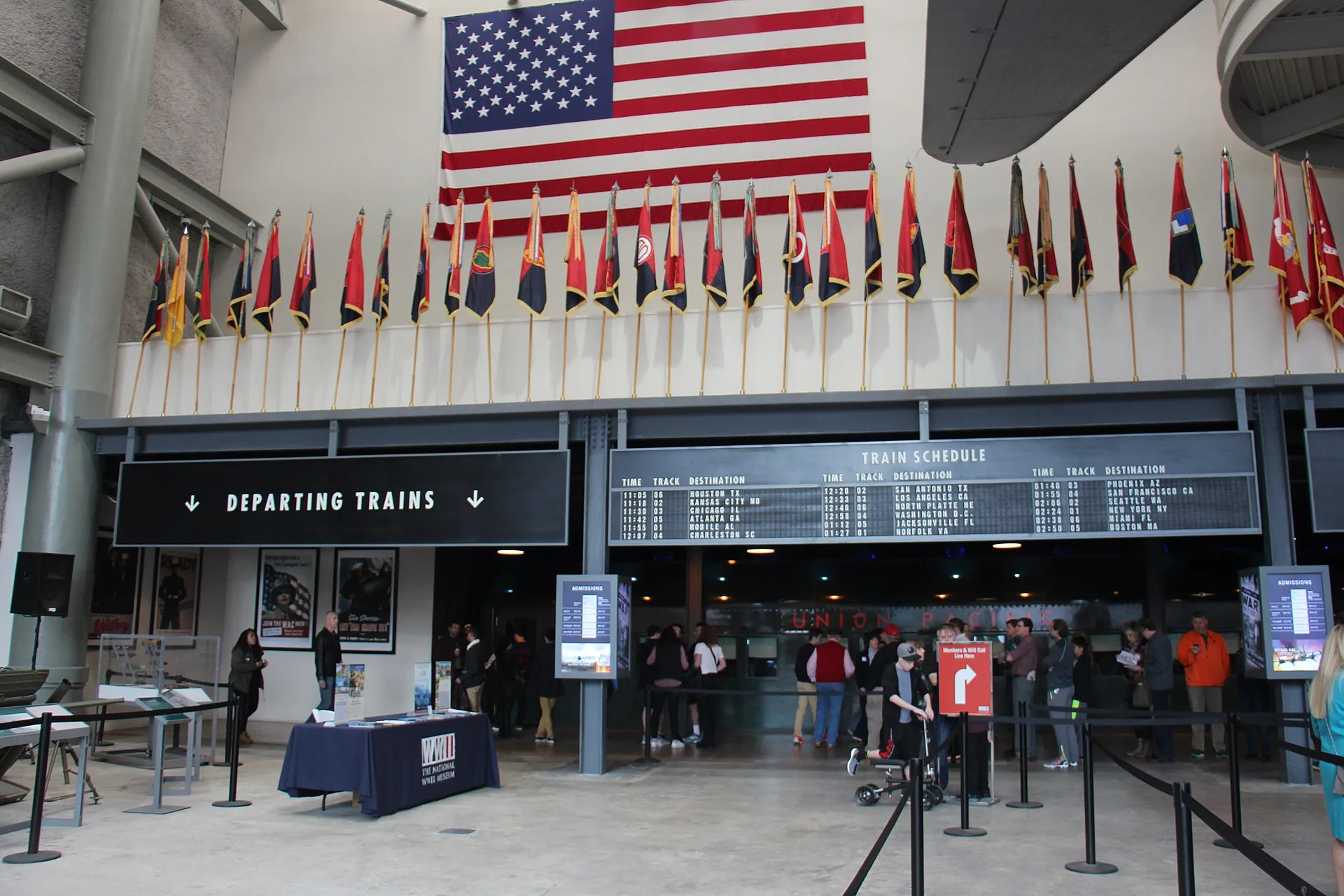
General admission: $31.50 adults; $27.50 seniors (65+); $22.50 students and active/retired military with ID; $19.50 children ages 5-11; free under 5, and free for WWII veterans. Beyond All Boundaries 4D film (Tom Hanks narrated): additional $7.00 per person — worth the cost. Final Mission: USS Tang submarine experience: additional $8.00.
Annual membership: $75 individual, $100 family — includes unlimited visits and a 10% museum store discount. Guided group tour: $65-85 per person (approximately 3 hours, museum ticket included). Private guide: $200-350 for up to 6 people (museum tickets separate). Parking in the adjacent garage: $15-20 flat rate.
The Case for a Guide
Six acres and more than 250,000 artifacts across six pavilions defeat most visitors before they finish — people linger too long in the early European galleries, run out of energy before the Pacific theater or the Home Front, and miss the connective tissue that ties it all together. A guide who knows the campus turns an overwhelming institution into a paced, coherent story built around your available hours and interests.
- Sequencing the pavilions: A guide routes you so the chronology holds together — the Louisiana Memorial Pavilion and the Higgins boat first, then Road to Berlin and Road to Tokyo, the aircraft of the US Freedom Pavilion, and finally the reckoning of the Liberation Pavilion — instead of a random lap that leaves the war's arc scrambled.
- Emotional pacing: The content is genuinely heavy — combat footage, the personal effects of fallen soldiers, letters written hours before deaths that followed. Experienced guides alternate intense galleries with quieter personal stories and build in moments of reflection.
- Connecting family stories: Many visitors come to honour relatives who served, and guides with research backgrounds help link a family campaign or unit to the specific exhibits and oral histories in the collection.
- The New Orleans connection: The Higgins boat story ties this museum to New Orleans in ways most visitors never fully appreciate, and a guide explains why Eisenhower credited Andrew Higgins as "the man who won the war for us."
Tips for Visitors
Allow more time than you think: Nearly everyone underestimates how long this museum takes. Four hours is a reasonable minimum; six hours allows a comprehensive visit without rushing. Eat on campus: the American Sector restaurant serves 1940s-inspired American cuisine in a period dining room, and BB's Stage Door Canteen stages live music in a wartime setting — both keep you within the museum's atmosphere.
Bring tissues: The oral history stations and certain personal exhibits (letters home, last effects, Gold Star Mother tributes) are genuinely moving. Visitors regularly find themselves in tears, and that is by design. Accessible throughout: The museum is fully wheelchair accessible with elevators in every pavilion. Audio description and assistive listening devices are available at the front desk. Photography permitted: Still photography without flash is allowed in most galleries. Some special exhibitions and the cinema experiences restrict cameras.
Pair with the Garden District: The museum sits in the Warehouse District, a 15-minute walk from the Garden District's oak-lined mansions, and the French Quarter with St. Louis Cathedral is a similar walk the other way. Combining them makes a full day of New Orleans. Gift shop: One of the best museum shops in the country, with an extensive book section, reproduction items, and proceeds supporting the museum's educational mission. Located near the exit so you do not need to carry purchases through galleries.
Frequently Asked Questions
What are the opening hours at National WWII Museum?
General hours: Open daily 9:00 AM to 5:00 PM, with last admission at 4:00 PM. Closed: Mardi Gras Day, Thanksgiving, Christmas Eve, and Christmas Day. Best strategy: Arrive right at 9:00 AM opening.
What does admission to National WWII Museum cost?
General admission: $31.50 adults, $27.50 seniors, $22.50 students/military, $19.50 children 5-11, free under 5. Beyond All Boundaries 4D film is an additional $7.00; the Final Mission: USS Tang submarine experience is $8.00 extra.
How do you get to the National WWII Museum?
The museum fills a campus at 945 Magazine Street in the Warehouse District, a 15-minute walk from the French Quarter and a short ride on the St. Charles Avenue streetcar. The adjacent parking garage runs about $15-20 flat, and the Garden District is only a 15-minute walk further uptown.
How much time should you plan for the National WWII Museum?
Allow at least 4 hours to move through the six pavilions without rushing; visitors with a personal connection to the war routinely spend 6-8 hours. Buy the optional Beyond All Boundaries film and the USS Tang submarine experience when you book so you can slot them between galleries rather than queue twice.
What practical tips make a visit to National WWII Museum more rewarding?
Eat at the American Sector restaurant or BB's Stage Door Canteen for a 1940s-inspired lunch break. Bring tissues - oral history stations and personal exhibits are genuinely moving. Pair with the Garden District for a full day exploring Uptown New Orleans.