
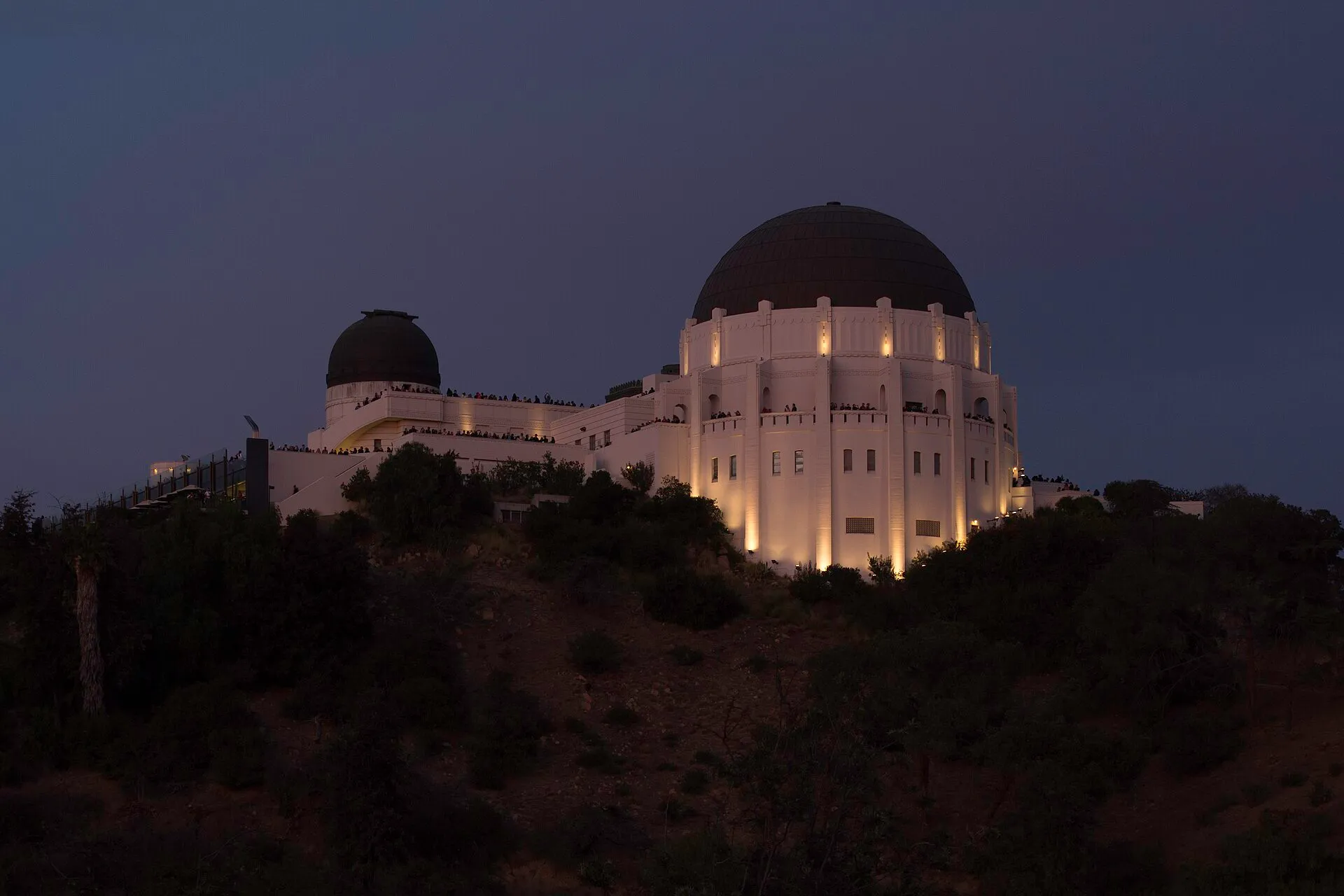
Collections Highlights
The Big Picture anchors the Gunther Depths of Space hall — measuring 152 feet wide and 20 feet tall, it is the largest astronomically accurate image ever assembled, a single deep-sky exposure holding roughly a million galaxies, stars, and asteroids that visitors examine up close through a mounted brass telescope. In the Wilder Hall of the Eye, a crackling Tesla coil demonstrates how humans learned to harness electricity, one of the museum's most theatrical draws. The central rotunda holds the Foucault pendulum, whose 240-pound brass ball swings in a slowly rotating plane that quietly proves the Earth turns beneath your feet, framed by Hugo Ballin's 1935 zodiac murals overhead.
Downstairs, the Leonard Nimoy Event Horizon theater screens the observatory's history, while the Cosmic Connection corridor lines a 150-foot wall with celestial-themed jewelry tracing the timeline of the universe. Don't miss the meteorite specimens, the walk-on scale model of the solar system in the Gottlieb Transit Corridor, and the camera obscura tucked off the main lobby — a 1935 original that projects a live, rotating image of the surrounding Los Angeles hills onto a viewing table.
Guided Tours
Griffith Observatory offers free guided tours led by its team of Museum Guides, who circulate through the halls daily and can be flagged down for on-the-spot explanations or scheduled walk-throughs that unpack the building's Art Deco symbolism and the science behind each exhibit. The signature "Once a Day" talk gathers visitors in the central rotunda for a short, lively primer on what makes the observatory unique before pointing them toward the day's highlights.
Every clear evening the observatory is open, staff run free telescope demonstrations on the roof and front lawn, guiding the public through the Zeiss 12-inch refractor — the most-used telescope on Earth — and portable scopes trained on the Moon, planets, and bright stars. Monthly public star parties, hosted with the Los Angeles Astronomical Society, the Sidewalk Astronomers, and the Planetary Society, fill the lawn with dozens of amateur telescopes and expert volunteers.
Inside the Samuel Oschin Planetarium, live presenters — not recordings — narrate each show beneath the Zeiss star projector, answering questions in real time. Private and group astronomy tours can also be booked, and many pair a docent-led visit with a walk toward the nearby Hollywood Sign.
Griffith Observatory timeline
-
Griffith deeds the parkland to Los Angeles
Colonel Griffith J. Griffith donates more than 3,000 acres of his Rancho Los Feliz estate to the city, the future home of both Griffith Park and the observatory.
-
A bequest funds the observatory
On his death Griffith leaves a trust to build a public observatory and hall of science, stipulating that admission must always be free.
-
Griffith Observatory opens
The Art Deco building opens to the public on May 14, drawing thousands in its first days to look through the new Zeiss refracting telescope.
-
Rebel Without a Cause films on site
James Dean's planetarium and knife-fight scenes cement the observatory as a Hollywood landmark; a bronze bust of the actor is later placed on the west lawn.
- 2002-2006
A $93 million renovation and expansion
A four-year closure restores the historic halls and adds the Gottlieb Transit Corridor and the underground Leonard Nimoy Event Horizon theater, roughly doubling the exhibit space.
When to Visit
Tuesday through Friday: 12:00 PM - 10:00 PM. Saturday and Sunday: 10:00 AM - 10:00 PM. Closed Mondays: the observatory is always closed on Mondays, and it also shuts on Thanksgiving and Christmas Day.
Best for views: arrive 60-90 minutes before sunset to watch the terrace shift from daylight to a carpet of city lights — the single most rewarding window of the day. Telescope viewing: free public access to the roof telescopes every clear evening the building is open, typically until about 9:45 PM. Least crowded: Tuesday and Wednesday evenings after 7 PM, and weekday mornings before the school groups arrive. Marine-layer mornings in May and June can leave the terrace fogged in until midday, so an afternoon-into-evening plan is the safer bet in late spring.
Admission and Costs
Observatory admission: completely free, including all exhibits and telescope viewing — a rarity for a science museum of this stature. Samuel Oschin Planetarium: $7 adults, $5 students and seniors, $3 children (5-12); children under 5 are admitted only to the first show of the day. Parking on-site: $10 per hour along the summit roads and lots (cash and card accepted), and it fills fast on clear weekend evenings.
DASH Observatory shuttle from the Vermont/Sunset Metro B Line station: $0.50 each way, running roughly every 20 minutes on weekends and holidays — the cheapest and least stressful way up the hill. Guided group tours: $45-70 per person (2-3 hours, usually including hotel pickup in Hollywood). Private astronomy tours: $250-400 for up to 6 people, with dedicated telescope time and expert narration.
The Case for a Guide
The observatory hands you free exhibits and free telescopes, but it does not hand you context — and the gap between glancing at the Big Picture and understanding that you are looking at a million real galaxies is exactly what a knowledgeable guide fills.
- Beating the parking and planetarium crunch: A local guide knows to approach from the Fern Dell or Greek Theatre lots when the summit fills, and to buy planetarium tickets the moment you arrive, because they sell out within the first hour and cannot be booked online.
- Reading the Art Deco iconography: The zodiac murals, terrazzo star maps, and ceiling medallions all encode a program of celestial symbolism most visitors walk straight past; a guide decodes what Hugo Ballin painted overhead in 1935 and why.
- Timing the Zeiss telescope queue: The line for the 12-inch refractor can run an hour on clear nights; guides know which evenings the sky cooperates and how to slot the roof visit around the planetarium show rather than waiting twice.
- Connecting the instruments to the story: From the Foucault pendulum quietly proving the Earth turns to the Tesla coil's crackling demonstration, a guide turns a room of hardware into a single narrative about how humanity learned to measure the sky.
- Building the wider itinerary: The best guides fold the observatory into a Griffith Park day that can take in the Hollywood Sign trails, then point you onward to Universal Studios or the coast at Santa Monica Pier.
Tips for Visitors
Arrive before sunset: this is the single most popular window, and watching day turn to night from the terrace is worth planning the whole visit around. Layer up for evenings: the hilltop temperature drops quickly after dark even in summer, so bring a jacket if you plan to stay for telescope viewing.
Planetarium tickets sell out: buy them at the box office when you arrive since they cannot be purchased online, and popular shows fill within the first hour. Combine with a Hollywood Sign hike: the sign is visible from the grounds and several Griffith Park trails connect the two. Go car-free: the Metro B Line to Vermont/Sunset plus the DASH Observatory shuttle drops you at the door. Photography gear: bring a tripod for the city-lights long exposures and a telephoto lens for framing the sign; to round out the day, cap the evening down the coast at Venice Beach.
Frequently Asked Questions
Is Griffith Observatory really free to visit?
Yes. General admission, every exhibit, and the evening telescope viewing have all been free since the observatory opened in 1935, honoring Colonel Griffith's founding condition that astronomy stay accessible to everyone. The only paid extras are the Samuel Oschin Planetarium shows ($7 adults, $5 students and seniors, $3 children 5-12) and on-site parking at $10 per hour.
What is the best time of day to visit Griffith Observatory?
Arrive 60 to 90 minutes before sunset. You catch the terrace in daylight, watch the city lights switch on, and are already in place for the free public telescope viewing that runs every clear evening until roughly 9:45 PM. Tuesday and Wednesday evenings are the least crowded.
When is Griffith Observatory open, and when is it closed?
Tuesday to Friday it opens at 12:00 PM and closes at 10:00 PM; on Saturday and Sunday it opens earlier, at 10:00 AM. It is closed all day Monday, plus Thanksgiving and Christmas Day. The grounds and their views stay open even when the building itself is shut.
How do I reach Griffith Observatory without a car?
Take the Metro B (Red) Line to Vermont/Sunset, then transfer to the DASH Observatory shuttle, which runs about every 20 minutes on weekends and holidays for $0.50 each way and drops you at the front door. It sidesteps the summit parking crunch on busy evenings entirely.
Which months offer the clearest views from Griffith Observatory?
July through October brings LA's clearest skies and the sharpest panoramas, stretching from downtown to the Pacific, especially on the crisp evenings after an autumn rain. Late-spring mornings can be hazed in by the coastal marine layer, so an afternoon-into-evening visit is the safer bet then.