
Collection Highlights
Van Gogh's Irises in the West Pavilion
Painted in 1889 in the garden of the asylum at Saint-Rémy-de-Provence, a year before the artist's death, this luminous canvas is the museum's most beloved work. When it sold at a New York auction in 1987 for $53.9 million it briefly became the most expensive painting ever bought, and the Getty acquired it in 1990 — a headline sum for a picture the artist called simply a lightning conductor for his illness. Knowing that the irises grew outside Van Gogh's window changes the painting from a study of flowers into the record of a man steadying himself through his art.
Rembrandt's The Abduction of Europa
One of the Dutch master's rare mythological landscapes, this 1632 painting shows Zeus, disguised as a white bull, carrying Europa across the water while her companions recoil on the shore. Its shimmering light on water is a cornerstone of the Getty's Baroque holdings in the East Pavilion.
Pontormo's Portrait of a Halberdier
This coolly self-possessed young Florentine, painted around 1530 by the Mannerist Jacopo Pontormo, ranks among the Getty's boldest purchases — bought at auction in 1989, it set a record price for an Old Master painting at the time. Long thought to show the duke Cosimo de' Medici, the sitter is now usually identified as a soldier who defended the republic during the 1529-30 siege of Florence, which gives the guarded stare its edge.
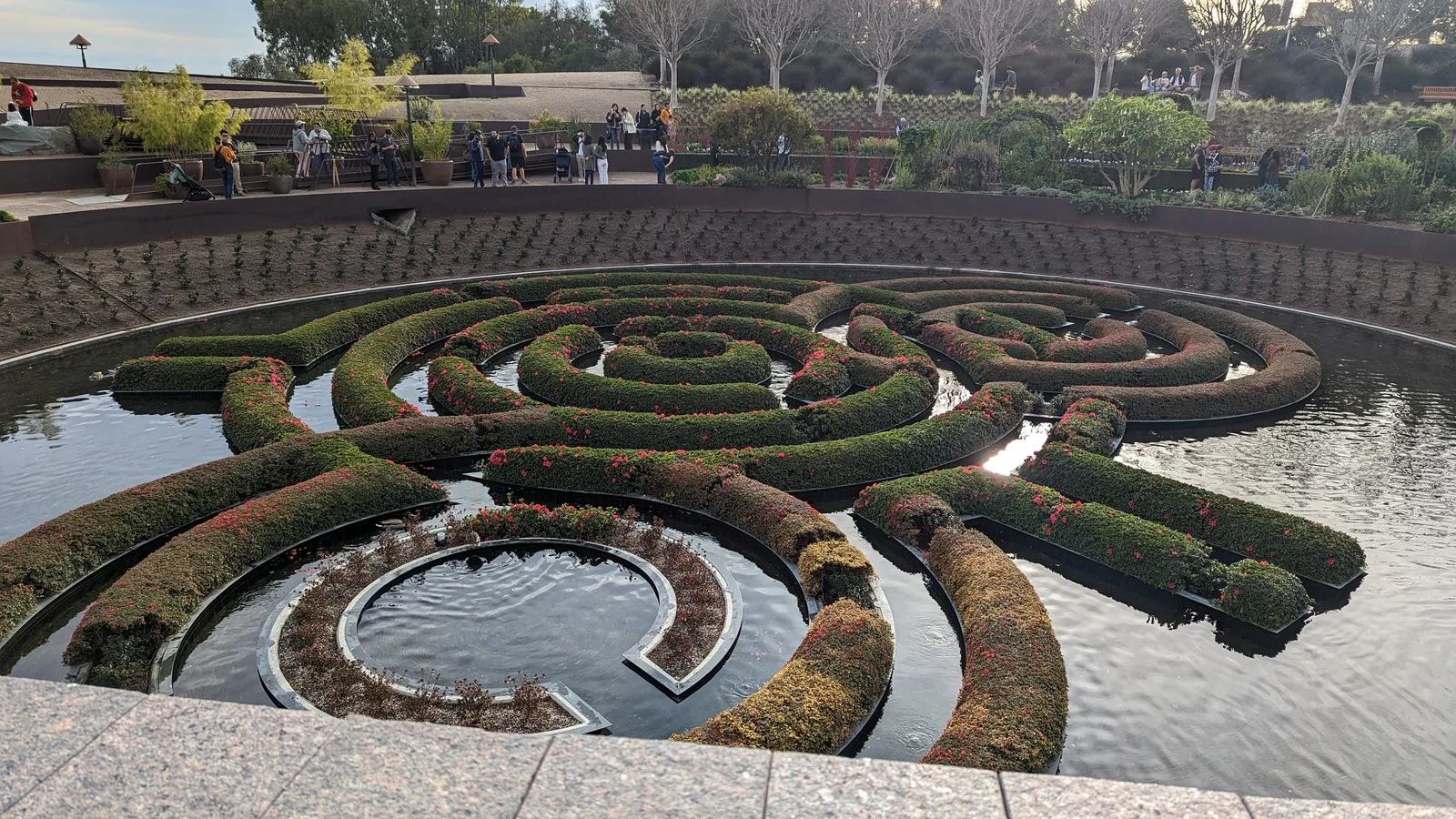
The Central Garden by Robert Irwin
Conceived by the light-and-space artist as a living sculpture rather than a formal garden, a tree-lined stream descends 134 feet to a maze of azaleas floating in a circular pool. Purpose-built steel-rebar arbors near the top bloom with bougainvillea into towering flowering parasols, one of the garden's signature sights. More than 500 plant varieties are chosen so the palette shifts through the year; Irwin's inscription reads "Always changing, never twice the same."
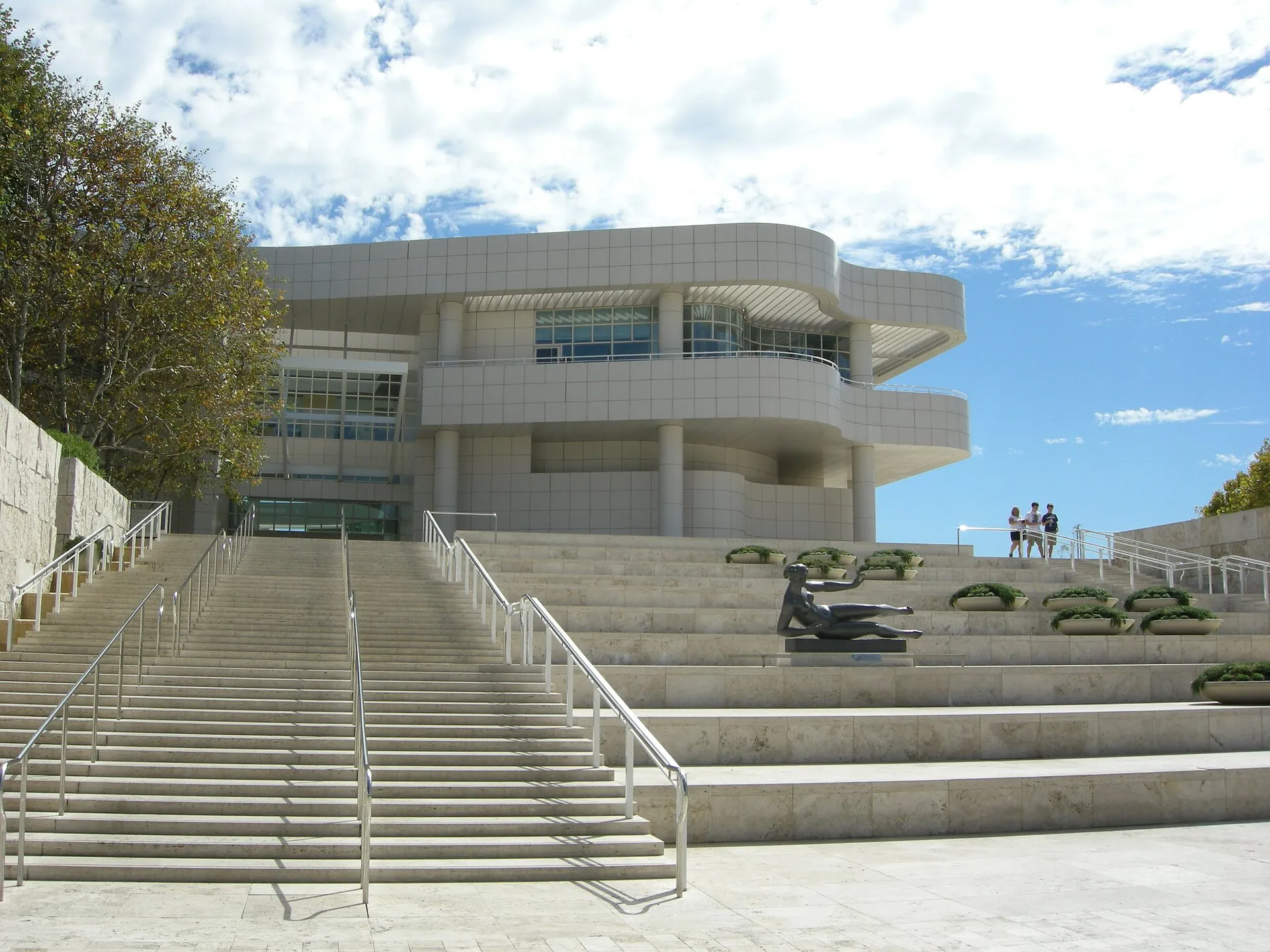
Richard Meier's travertine architecture
The campus is clad in 16,000 tons of Italian travertine split rather than sawn, so the cleft faces reveal fossil leaves, feathers, and shells embedded 8,000 millennia ago near Tivoli. Meier disciplined the whole hilltop to a 30-inch square grid taken from the size of a single travertine block, so the paving, walls, windows, and even the handrails line up on one hidden module — once you notice it you cannot stop seeing it. Run a hand across a wall and you are touching the fossilised bed of an ancient hot spring quarried from the same source as much of imperial Rome.
The illuminated manuscripts galleries
The Getty holds one of North America's finest collections of medieval and Renaissance manuscripts, from jewel-like Gospel books to lavishly painted books of hours. Because the pigments are light-sensitive, the folios on view are rotated regularly, so no two visits show quite the same pages.
The Center for Photographs
Assembled largely from several private collections acquired at once in 1984, the Getty's photography holdings rank among the world's greatest, spanning early daguerreotypes to twentieth-century masters. Prints are shown in changing exhibitions rather than a fixed hang, so photography lovers should check what is currently on display.
The decorative arts period rooms
The South Pavilion recreates panelled French interiors of the seventeenth and eighteenth centuries, filled with gilded furniture, Sèvres porcelain, and boiserie brought from Paris. The rooms let you step inside the world that produced the paintings hanging elsewhere on the hill.
The tram ride up the Sepulveda Pass
A cable-hauled Otis Hovair people mover climbs three-quarters of a mile from the garage to the arrival plaza, gliding on a thin cushion of compressed air rather than wheels or rails so the ascent is almost silent. The ride frames widening views of the Sepulveda Pass and the Santa Monica Mountains and sets a deliberately slow, ceremonial tone before you ever reach the galleries.
The terrace views from downtown to the Pacific
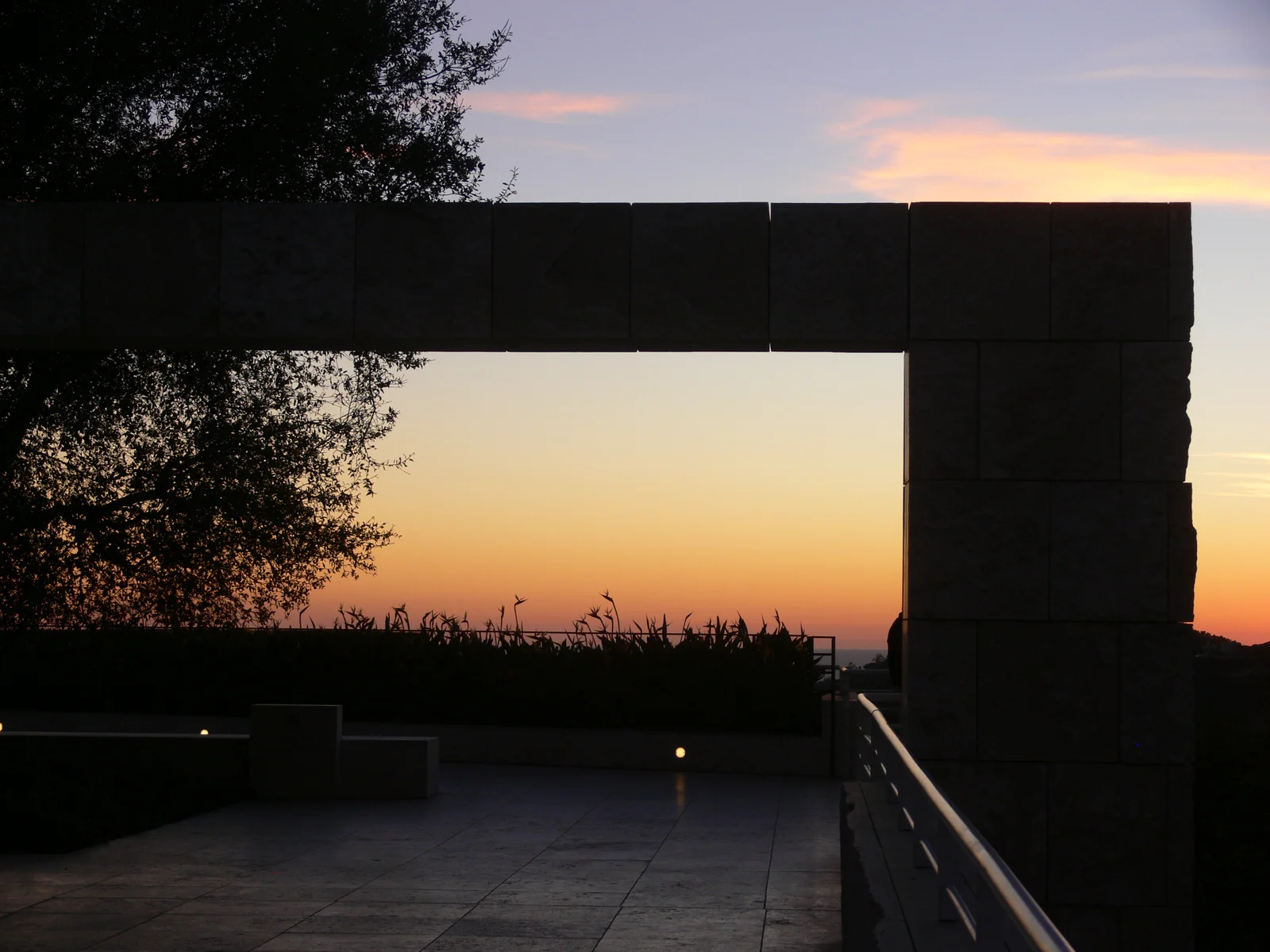
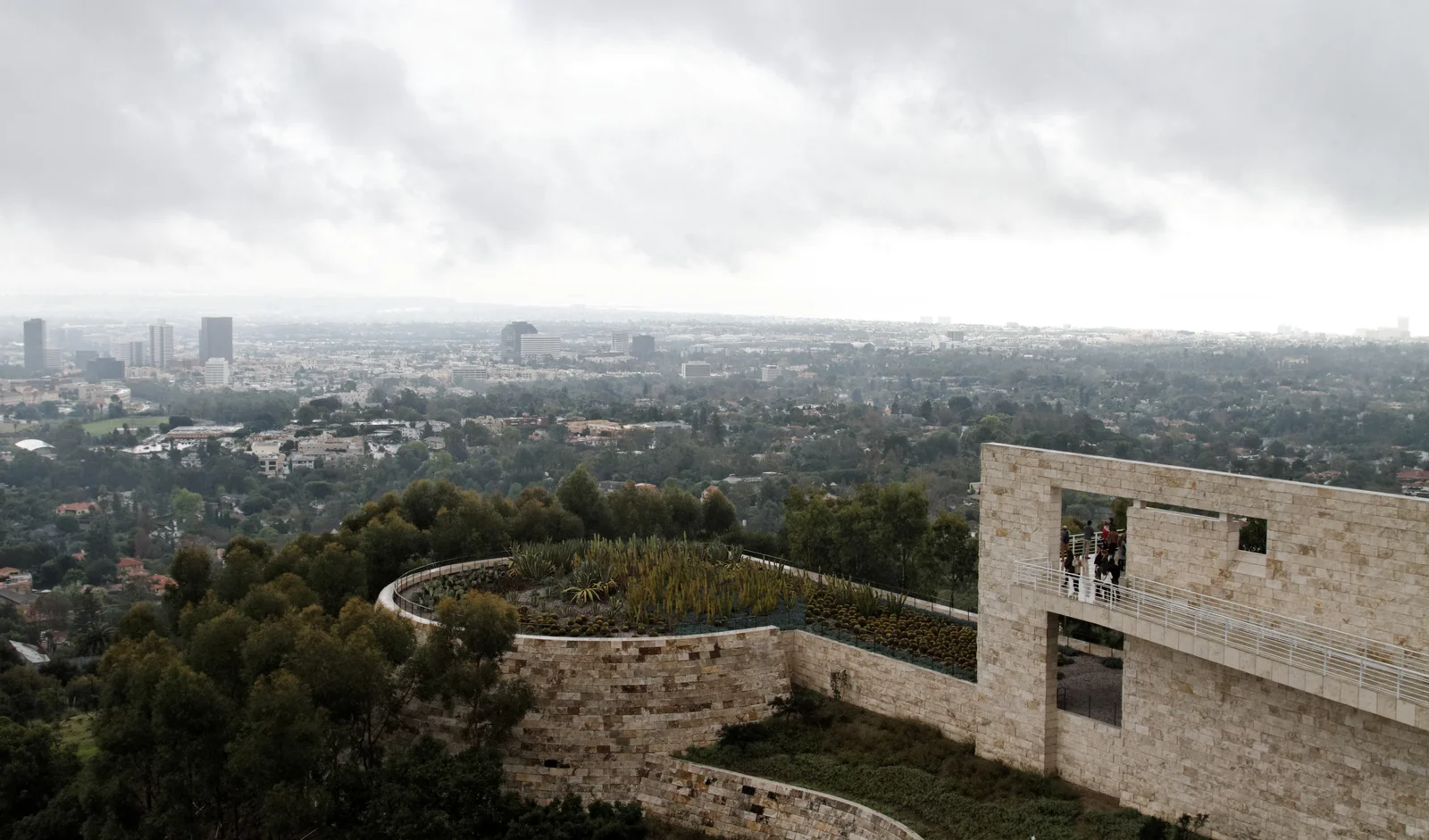
From the west-facing terraces the panorama sweeps from the San Gabriel Mountains across the Los Angeles basin to the Pacific, taking in downtown's towers on a clear day. Late Saturday afternoons, as the sun drops toward the ocean, are the finest hour to stand here.
The cactus garden on the South Promontory
Reached by a short path off the South Pavilion, this spiky desert garden juts out on the highest spur of the ridge and frames the single best photograph on the campus — a foreground of golden barrel cactus and agave against the distant downtown skyline. Most visitors never walk out to it, so it stays quiet even on a busy Saturday.
Collections Highlights
The Getty's galleries are spread across four numbered pavilions ringing the plaza, arranged roughly by period, and knowing the layout turns an overwhelming museum into a manageable route:
- North Pavilion — the earliest works: medieval and Renaissance paintings, sculpture, and the rotating displays of illuminated manuscripts, whose fragile folios are changed often to protect the pigments.
- East Pavilion — the Baroque, anchored by Rembrandt's The Abduction of Europa and Dutch and Flemish masters, with strong Italian and Spanish rooms.
- South Pavilion — French decorative arts and panelled period rooms, gilded furniture, and Sèvres porcelain recreating eighteenth-century interiors.
- West Pavilion — the nineteenth century and the crowd favourite, Van Gogh's Irises, alongside Monet, Manet, and Degas.
Several spaces reward a detour beyond the pavilions. The Center for Photographs stages changing exhibitions from one of the finest photography collections anywhere; the Central Garden is best treated as a gallery you walk through rather than a shortcut; and the drum-shaped Getty Research Institute across the plaza mounts its own free rotating shows drawn from a vast art library. Twentieth-century sculpture from the Fran and Ray Stark collection — Moore, Maillol, Calder — is scattered across the terraces and lawns, so keep an eye out as you cross between buildings. Special loan exhibitions rotate through the year and, though free, occasionally require a timed ticket booked in advance.
A route that works for a first visit of three or four hours: step off the tram, cross the arrival plaza to the museum entrance hall, then walk the pavilions clockwise in chronological order — North for the manuscripts and early paintings, East for Rembrandt's Europa, South for the French period rooms, and West for Van Gogh's Irises to finish on the crowd favourite. That loop keeps you moving forward in time and returns you to the plaza without backtracking. From there drop down the ramp into Robert Irwin's Central Garden, follow the tree-lined stream to the azalea pool, and climb back up. If daylight and legs remain, the five-minute path to the cactus garden on the South Promontory delivers the campus's best skyline photograph before you ride the tram back down. Reverse the whole sequence on a Saturday so the West Pavilion and the terraces land at golden hour.
Guided Tours
You do not have to hire anyone to get expert framing here. The Getty runs free daily tours led by its own docents — a rotating menu that usually includes an architecture walk of the Meier campus, a Central Garden tour, and collection highlights — with times posted at the information desk and in the GettyGuide app. These fill on a first-come basis, so check the schedule when you step off the tram.
For something tailored, independent art historians offer paid private walks focused on a single thread — Impressionism, the photography collection, or the decorative-arts rooms — and pace the visit to your interests rather than a fixed loop. Whichever you choose, treat the visit as an edit rather than a march: pick two pavilions and the garden, go deep, and leave the rest for a return trip. After the hilltop, many visitors continue west to Santa Monica Pier or the boardwalk at Venice Beach for a coastal end to the day; those wanting a different side of the city instead head east to the Hollywood Walk of Fame and the viewpoints below the Hollywood Sign, or over the pass to the studio backlot tour at Universal Studios Hollywood.
Getty Center timeline
-
Getty opens a museum in his home
Oil magnate J. Paul Getty first showed his growing collection of antiquities, paintings, and French furniture in a gallery wing of his ranch house in Pacific Palisades, admitting the public by appointment and free of charge — the free-admission principle the hilltop still honours.
-
The Getty Villa opens
Getty replaced the crowded ranch house with a re-creation of the Roman Villa dei Papiri near Herculaneum, purpose-built to hold his Greek and Roman antiquities. It remains the separate coastal home of the collection's classical art today.
-
A record bequest endows the trust
Getty died in England without ever seeing the Villa, leaving the bulk of his fortune to his museum. By the early 1980s the gift had swelled past a billion dollars, making the Getty the wealthiest art institution in the world and forcing it to spend on a scale nothing else could match.
-
The Brentwood ridge is acquired
The trust bought a 110-acre hilltop above the San Diego (405) Freeway at the mouth of the Sepulveda Pass, choosing a commanding but fire-prone site that would shape every later engineering decision.
-
Meier chosen; photography founded
Richard Meier was selected from a shortlist of architects to design the new campus, and in the same year the Getty created its Department of Photographs by buying several major private collections at once — instantly one of the finest photography holdings anywhere.
-
The Getty Center opens
After roughly thirteen years of work and some $1.3 billion, the travertine campus opened in December, moving the paintings, drawings, manuscripts, and photographs up the hill while the antiquities stayed at the Villa.
-
The Getty Fire tests the design
A brush fire broke out beside the 405 and burned onto the Getty's own slopes, but the shelter-in-place engineering — ember-resistant roofs, sealed air, and cleared brush — held, and the collection was never moved or damaged.
-
January wildfires threaten again
The Palisades and wider Los Angeles wildfires burned close to both Getty sites; the museum closed briefly as a precaution, yet the same defences protected the art and the campus reopened within days.
Getty Center in Pictures
When to Visit
The Getty Center is open Tuesday to Sunday and closed Mondays, plus Thanksgiving, Christmas Day, and New Year's Day. Standard hours are 10:00 AM to 5:30 PM, extended on Saturdays to 8:00 PM — the only evening the galleries stay open, and the reason serious sunset-chasers plan for a Saturday.
For the calmest visit, arrive at opening on a Tuesday or Wednesday, when you can stand alone in front of the manuscripts and the Irises. Photographers get the richest light in the late afternoon, when the low sun warms the travertine and the city haze glows below; the garden peaks in spring and early autumn, which is why those months rate highest for a visit. Summer weekends are the busiest stretch of the year, so an early tram beats both the heat and the queue.
Summer adds one more reason to pick a Saturday. On select warm-weather Saturday evenings the Getty runs Saturdays Off the 405, a free series of live bands and DJ sets on the arrival plaza that turns the usual late hours into an open-air party with the city lights coming on below. It is free like everything else on the hill but fills fast, so reserve a parking slot and arrive before the music starts if you want a good spot on the terrace.
Admission and Costs
Museum admission: always free, covering every gallery, all special exhibitions, and the Central Garden — no ticket is required to enter, which makes the hilltop one of the anchors of a free day in Los Angeles.
Parking: $20 per car, dropping to $15 after 3 PM, and free on Saturdays with an advance online reservation; the garage is the only cost most visitors pay. Tram: free, running every few minutes between the garage and the hilltop. Audio guide: free through the GettyGuide app on your own phone, with loaner devices available at no charge. Guided highlight tours: the museum's own daily architecture and garden walks are free; independent art-focused walking tours run about $25-55 per person, and a private docent day for a small group typically runs $200-400 depending on length and focus.
The Case for a Guide
The Getty holds tens of thousands of objects across four pavilions, and most first-time visitors drift through a fraction of them without ever learning why any single piece matters. A knowledgeable guide is the difference between passing the Irises and understanding it.
- Reading a single painting deeply: why Van Gogh painted irises from an asylum garden, or how Rembrandt turned a Greek myth into a study of light on water, transforms a glance into a memory.
- Navigating by interest, not floor plan: a guide who knows which manuscript folios are currently displayed, or which photographs are on show this month, spares you the guesswork of a rotating collection.
- Decoding the architecture and garden: Meier's split travertine, his framed sightlines to the San Gabriels, and Irwin's deliberately un-formal planting only reveal their intent once someone points them out.
- The feud behind the grounds: Meier wanted restraint while garden designer Robert Irwin wanted lushness, and their clash shaped the campus you walk through — a story invisible to the solo visitor.
- Pacing a vast site: a good guide budgets your energy so the final gallery still lands, rather than leaving you footsore halfway through.
Tips for Visitors
A handful of practical calls make the difference between a smooth visit and a frustrating one:
- Reserve parking for weekends. Saturday slots fill days ahead; book online in advance to claim the free-parking window.
- Take the tram, not the stairs. There is a walking path from the garage, but the tram is quicker, free, and part of the experience — save your legs for the galleries and garden.
- Skip the car if you can. LA Metro buses stop on Sepulveda Boulevard at the base of the hill, a short walk from the tram, so you can reach the Getty without a garage reservation or the parking fee.
- Wear comfortable shoes. The campus sprawls across the hilltop, and the Central Garden means a walk downhill and a climb back up.
- Walk out to the cactus garden. The South Promontory garden is a five-minute detour from the South Pavilion and rewards you with the campus's best skyline photo and, usually, no crowd.
- Look inside the round building. The Getty Research Institute's ground-floor gallery runs free rotating exhibitions that most visitors miss entirely.
- Eat on the terrace. The sit-down restaurant and the self-service cafe both have view seating and are far better than rushing off the hill hungry.
- Time a summer visit for the music. On select warm-weather Saturday evenings the free Saturdays Off the 405 concerts fill the plaza — check the current schedule and book parking ahead if you want to catch one.
- Check for timed exhibitions. Some free special exhibitions still need a timed ticket, so confirm before you arrive.
- Bring the family on a weekend. Free drop-in art workshops for children run most weekends, and the West Pavilion's hands-on Family Room — costumes, an arch to build, an illuminated initial to make — stays open daily; load the GettyGuide app's family audio track and Art Detective cards to turn the galleries into a scavenger hunt.
- Don't confuse it with the Villa. The Getty Villa in Pacific Palisades is a separate site with Greek and Roman antiquities and its own reservation — plan them as two different days.
Frequently Asked Questions
How do you get to the Getty Center and where is it?
The Getty Center sits at 1200 Getty Center Drive, Los Angeles, CA 90049, on a ridge above the 405 (San Diego) freeway in the Brentwood hills of West Los Angeles — take the Getty Center Drive exit and follow the signs to the arrival gate. It is roughly 12 miles north of LAX (a 30 to 45 minute drive in typical traffic) and a similar distance west of downtown along the 10 and 405, while Santa Monica and the beach are only about 5 miles south. Drive or rideshare to the base of the hill, park in the underground garage, then ride the free three-car electric tram up to the arrival plaza — there is no road access to the top for private cars.
Is the Getty Center really free to visit?
Yes. Admission to every gallery, the special exhibitions, and Robert Irwin's Central Garden is permanently free, funded by the Getty Trust endowment. The only charge is parking, and even that is waived after a certain hour and on some days — the tram, the GettyGuide app, and the daily architecture and garden tours cost nothing.
How much time do you need at the Getty Center?
Budget three to four hours to see one or two of the four gallery pavilions, walk the Central Garden, and take in the terrace views without rushing. Art lovers who want the full collection, a meal on the terrace, and the sunset easily fill a whole day, especially on Saturdays when the museum stays open into the evening.
When is the best time to visit the Getty Center?
Weekday mornings, especially Tuesday and Wednesday, are the quietest. Saturday evenings are the only time the galleries stay open past 5:30 PM, so plan a Saturday if you want golden-hour light on the travertine and the city lights coming on below. Spring and autumn bring the mildest weather and the most colour in the garden.
What is the single most famous work at the Getty Center?
Vincent van Gogh's Irises, painted in 1889 while he was a patient at the asylum in Saint-Rémy-de-Provence, is the collection's signature painting and hangs in the West Pavilion. Rembrandt's The Abduction of Europa and a deep collection of illuminated manuscripts and photographs are close rivals for a visitor's attention.
What is the difference between the Getty Center and the Getty Villa?
They are two separate museums run by the same trust. The Getty Center in Brentwood is the modern hilltop campus with European paintings, drawings, manuscripts, and photographs; the Getty Villa, twelve miles west in Pacific Palisades, is a re-created Roman country house holding only Greek, Roman, and Etruscan antiquities. Both are free, both charge for parking, and each needs its own visit — the drive between them takes the better part of an hour in Los Angeles traffic, so treat them as two different days rather than a single loop.
Do you need a reservation or ticket to visit the Getty Center?
No ticket is required to enter — walk-in admission is free and unreserved every open day. What you should book ahead is a parking slot, because the garage sells out on weekends and holidays; reserving online also unlocks the free-parking window on Saturdays. A few special loan exhibitions occasionally use a free timed ticket to manage crowds, so check the current exhibition listings before a weekend visit.
Can you visit the Getty Center without a car?
Yes. LA Metro buses run along Sepulveda Boulevard at the foot of the hill, a few minutes' walk from the lower tram station, so you can reach the Getty by public transport and skip the parking fee altogether. Rideshare drivers drop off at the same lower plaza as private cars — no vehicle is allowed to drive to the top — and from there the free electric tram carries you up. From Santa Monica or the wider Westside, a bus-plus-tram trip is often quicker than queueing for a weekend garage slot.
Where can you eat at the Getty Center?
Four options share the hilltop, all with terrace or city views. The Restaurant at the Getty Center is the sit-down room, serving Californian lunches Tuesday to Sunday and dinner on Saturday evenings — reservations are wise on weekends. The larger self-service cafe near the arrival plaza has hot dishes, sandwiches, and salads for a quicker, cheaper meal, while the Garden Terrace Cafe opens seasonally on warm-weather weekends for lighter fare outdoors above the Central Garden. An espresso and pastry cart on the plaza covers a fast coffee stop, and picnics are not permitted inside the galleries or garden, so plan to eat at one of these rather than bring your own.
Is the Getty Center wheelchair accessible?
Yes, the whole site is designed to be step-free. The tram from the garage, the arrival plaza, all four gallery pavilions, and the paved upper paths of the Central Garden are wheelchair accessible, and manual wheelchairs can be borrowed free at the museum entrance on a first-come basis. The garden slopes steeply as it descends the ravine, so the lower loop is easiest with a companion, and accessible parking and restrooms are available throughout.