
Landmarks Along
The official route strings together sixteen sites, and they fall naturally into three legs. The downtown stretch opens on Boston Common and climbs Beacon Hill to Charles Bulfinch's 1798 Massachusetts State House, its dome sheathed in 23-karat gold leaf. A few paces on, Park Street Church rises above Brimstone Corner, where William Lloyd Garrison delivered his first abolitionist address in 1829. Next comes the Granary Burying Ground, resting place of Samuel Adams, John Hancock, Paul Revere, and the five victims of the Boston Massacre, followed by King's Chapel, its 1749 granite structure rising beside Boston's oldest burying ground, established in 1630.
From there the line threads past the site of the first public school — the 1635 Boston Latin School, marked by a mosaic and a statue of alumnus Benjamin Franklin outside Old City Hall — then the Old Corner Bookstore, once the hub of America's 19th-century literary trade. The Old South Meeting House is the actual hall where roughly 5,000 colonists gathered on December 16, 1773 before the Boston Tea Party; the Old State House, built in 1713, is the balcony from which the Declaration of Independence was first read to Bostonians in July 1776, and the cobblestone ring beneath its east façade marks the 1770 Boston Massacre site. Faneuil Hall, the "Cradle of Liberty," closes the downtown leg.
Crossing into the North End, Boston's oldest neighborhood and its Italian-American heart, the trail reaches the Paul Revere House — built around 1680 and the oldest surviving structure in downtown Boston — then the Old North Church, whose steeple flew the two lanterns of April 18, 1775, and finally Copp's Hill Burying Ground, whose slate stones still bear British musket-ball scars. Over the Charlestown Bridge the route ends at the USS Constitution, the world's oldest commissioned warship still afloat, and the Bunker Hill Monument, a 221-foot granite obelisk commemorating the June 17, 1775 battle.
Photo Spots
The golden dome of the Massachusetts State House catches morning light beautifully from the Boston Common side. The Granary Burying Ground's weathered headstones with memento mori carvings photograph hauntingly in overcast light.
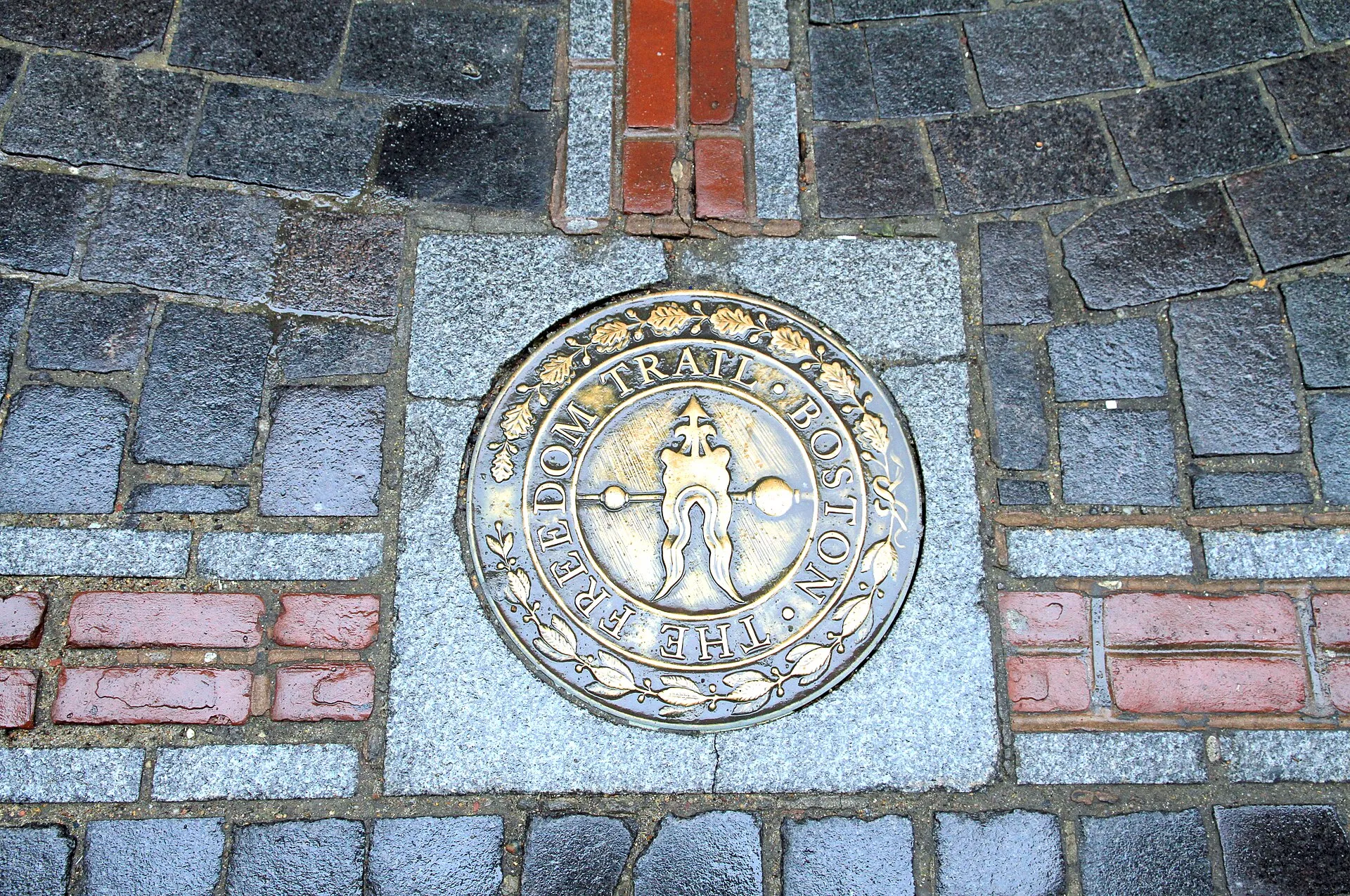
The Old North Church steeple, framed through narrow North End streets, creates dramatic perspectives. The USS Constitution, with its rigging and harbour backdrop, is most photogenic during morning golden hour. From the top of the Bunker Hill Monument (after 294 steps), the panoramic view spans all of Boston and the harbour. The red-brick trail line itself, stretching through busy intersections and along historic building facades, provides a distinctive compositional element in street photography.
When to Visit
The red-brick line is embedded in public sidewalks and can be walked at any hour, any day, free of charge. The Visitor Center on Tremont Street at Boston Common is open daily 9 AM to 5 PM, providing free maps. Official guided walks by costumed Freedom Trail Players depart from the Visitor Center throughout the day, typically 10 AM to 3 PM.
Individual site hours generally run 9:30 AM to 5 PM; the Paul Revere House closes at 4:15 PM from November through mid-April. The best time to walk is weekday mornings from April through June or September through October, when weather is comfortable and summer tour groups have not peaked.
Admission and Costs
Walking the trail itself: Completely free — the red-brick line is embedded in public sidewalks and can be walked at any hour. Official Freedom Trail Players costumed tour: $14-18 adults, $8-12 children for a 90-minute guided walk with period-costumed performers. Individual site admissions: Paul Revere House $6, Old South Meeting House $8, USS Constitution Museum free (donations welcome). Bunker Hill Monument: Free to climb the 294 steps. Private walking guide: $150-300 for a customised full-trail tour of up to 6 people. Group tour (7+): $12-15 per person for scheduled group departures.
The Case for a Guide
Walking the red brick line on your own is satisfying; walking it with a guide who connects each of the sixteen sites into a single escalating narrative transforms a pleasant stroll into a genuinely gripping story of revolution.
- Revolutionary narrative sequence: A guide shows how each site — from Boston Common through the North End to Charlestown — forms a chronological arc from colonial grievance to armed rebellion, a sequence invisible when reading individual plaques in isolation.
- Paul Revere's house in context: The 1680 house is the oldest downtown building in Boston, but a guide explains the economic gap between Revere's modest craftsman household and the wealthy merchant families who bankrolled the revolution — a class distinction the interior furnishings make vivid.
- Granary Burying Ground notable graves: Most tourists pass through quickly; a guide locates Samuel Adams, Paul Revere, John Hancock, and the five Boston Massacre victims, then explains why Mother Goose is also buried here and what that reveals about colonial Boston's literary culture.
- Old South Meeting House debate context: The building's role in the December 1773 Tea Party debate is documented, but a guide recreates the specific moment Samuel Adams gave the signal — "This meeting can do nothing more to save the country" — and explains why the crowd understood it as a cue to act.
- USS Constitution's active commission status: The frigate is still a commissioned US Navy vessel with active-duty sailors; a guide explains why the Navy maintains this status, how the ship turns itself around in Boston Harbor once a year under its own power, and what "Old Ironsides" actually refers to.
Tips for Visitors
Start at Boston Common: The Visitor Center on Tremont Street provides free maps and is adjacent to Park Street Station (Red and Green Lines). Wear comfortable shoes: The 2.5-mile trail crosses uneven cobblestones, brick sidewalks, and Charlestown's hilly terrain; sturdy walking shoes prevent blisters. Allow 3-4 hours: Walking the full trail without entering buildings takes about 90 minutes; with interior visits and a North End lunch stop, budget half a day. Walk one way: The trail ends in Charlestown; take the Navy Yard water shuttle back to downtown or ride the Orange Line from Community College Station. Combine with Faneuil Hall: The Cradle of Liberty sits directly on the trail, surrounded by Quincy Market dining, making an ideal midpoint break. Rainy days: Interior sites like the Old South Meeting House, Paul Revere House, and Old North Church provide shelter; a rain jacket and waterproof shoes make a drizzly walk atmospheric rather than miserable
Frequently Asked Questions
When is the Freedom Trail open to visitors?
The trail itself: The red-brick line is embedded in public sidewalks and can be walked at any hour, any day of the year, free of charge. Visitor Center: Open daily 9 AM to 5 PM on Tremont Street at Boston Common, providing free maps.
Is Freedom Trail free to visit?
Walking the trail: Completely free. Official Freedom Trail Players tour: $14-18 adults, $8-12 children for a 90-minute costumed walk. Individual site admissions: Paul Revere House $6, Old South Meeting House $8.
What is the best way to begin the Freedom Trail?
Start at Boston Common: The Visitor Center on Tremont Street provides free maps and is adjacent to Park Street Station (Red and Green Lines).