
Collection Highlights
L'Hemisfèric
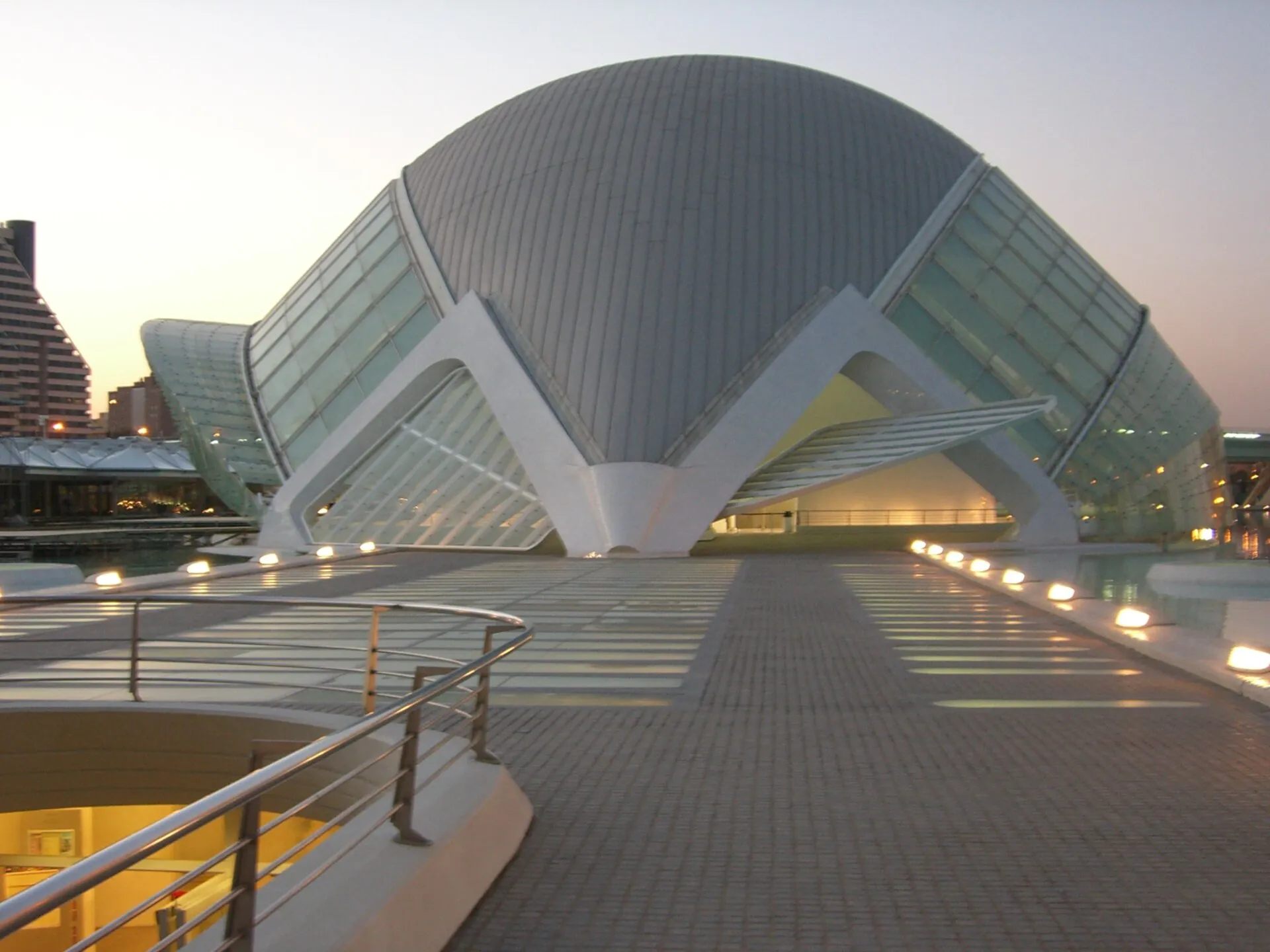
The eye-shaped building that opened in 1998, the first of the complex and the one in nearly every photograph. Beneath a curved "eyelid" roof that mirrors in the pool below, its 900-square-metre concave dome runs IMAX films and planetarium shows that fill your whole field of vision.
Oceanogràfic
Europe's largest aquarium, designed by Félix Candela and opened in 2003, holding around 45,000 animals across recreated marine worlds — an Arctic tank with beluga whales, a walk-through shark-and-ray tunnel, jellyfish galleries, a wetlands aviary and one of the continent's biggest dolphinariums.
Museu de les Ciències
The whale-ribcage science museum, three floors of hands-on exhibits under the motto "forbidden not to touch". Highlights include a suspended Foucault pendulum tracing the Earth's rotation and a walk-through display of the human genome.
L'Umbracle
The free open-air promenade and sculpture garden that roofs the main car park, lined with palms and native Mediterranean plants. It doubles as the best vantage point for looking out over the whole complex, and costs nothing to enter.
Palau de les Arts Reina Sofía
Calatrava's plume-shaped opera house and performing-arts centre, opened in 2005, clad in white trencadís tile. Its soaring 70-metre profile anchors the landward end of the complex and hosts opera, dance and concert seasons.
Assut de l'Or bridge
The single white pylon of this cable-stayed bridge, opened in 2008, rises 125 metres to become the tallest point of the complex, its harp of cables carrying the road over the old river bed between the venues.
Collections Highlights
Across the ticketed venues a handful of exhibits reward a deliberate visit. Inside the Museu de les Ciències, seek out the suspended Foucault pendulum, whose slow swing traces the Earth's rotation, and the walk-through Chromosome Forest display of the human genome; the museum's galleries honour Spanish Nobel laureates including Santiago Ramón y Cajal (Wikipedia) and Severo Ochoa. The Oceanogràfic is the real draw: its beluga whales in the Arctic tank, the sharks and rays seen through a submerged acrylic tunnel, the backlit jellyfish galleries, the mangrove and wetlands aviary, and one of the largest dolphinariums in Europe. At the Hemisfèric, the exhibit is the building itself — a 900-square-metre concave IMAX dome wrapping films and planetarium shows across your whole field of vision. Finish beneath L'Umbracle, the free open-air promenade displaying contemporary sculpture among palms and native Mediterranean plants. For a historic contrast, pair the day with the Gothic Silk Exchange in the old town.
Guided Tours
Because the campus is vast and split across separate venues, guided options genuinely change what you take away. Architectural walking tours trace how Santiago Calatrava modelled each structure on skeletal and plant forms, decoding details — the opening "eyelid" of the Hemisfèric, the ribbed vault of the Museu, the trencadís tile cladding — that are invisible to the untrained visitor. At the Oceanogràfic, behind-the-scenes tours take you above the tanks into the animal-care areas, and the "Sleeping with Sharks" experience lets families spend a night beside the shark tunnel. Science museum guides steer you through three floors of interactive exhibits and flag the installations worth your limited time. Combined skip-the-line guided packages, typically €45–80 (about $48–86) per person, bundle priority entry across venues with expert commentary and efficient routing so you never double back. Many local guides also tell the complex's contentious history — its cost overruns, structural disputes and political drama — context you won't find on the official signage. Book architectural and Oceanogràfic tours ahead in summer, when slots fill quickly.
City of Arts and Sciences timeline
-
Turia river bed earmarked for culture
After the 1957 flood diverted the Turia south of the city, Valencia's regional government plans a science-and-culture park on the drained old river bed where the complex now stands.
-
Construction begins
Work starts on Santiago Calatrava's masterplan at the seaward end of the former river, the future Jardí del Túria green corridor.
-
Hemisfèric opens
The eye-shaped IMAX dome and planetarium is the first building to open, instantly becoming the complex's defining image.
-
Museu de les Ciències opens
The whale-ribcage science museum opens with three floors of interactive exhibits under the motto "forbidden not to touch".
-
L'Umbracle promenade opens
The open-air landscaped walk and sculpture garden, covering the main car park, opens with free public access to native Mediterranean plantings.
-
Oceanogràfic opens
Félix Candela's aquarium — the largest in Europe — opens with recreated marine environments from the Arctic to the tropics.
-
Palau de les Arts Reina Sofía opens
Calatrava's plume-shaped opera house and performing-arts centre completes the cultural programme of the complex.
- 2008–2009
Assut de l'Or bridge and Àgora
The white cable-stayed Assut de l'Or bridge and the Àgora events hall round out the skyline, by which point cost overruns had become a public controversy.
When to Visit
Hours differ by building and shift with the season, so confirm the day on the official cac.es calendar. In general the Museu de les Ciències and Hemisfèric open daily from about 10:00 AM, closing around 6:00–7:00 PM and extending toward 9:00 PM on summer weekends and through July and August. The Oceanogràfic opens at 10:00 AM and closes later — frequently 8:00 PM or beyond in high season — with last entry set an hour or two before closing. The open grounds, reflecting pools and L'Umbracle walk keep no fixed hours. Best time to visit: weekday mornings just after opening, before school groups arrive and while the white surfaces are still cool, or late afternoon toward golden hour, when the buildings mirror perfectly in the pools. Allow a full day for all three venues, or a half day for the Oceanogràfic alone.
Admission and Costs
The grounds, pools and the L'Umbracle promenade are free to walk at any time — no ticket is required to see and photograph the architecture. Paid admission is charged per venue and reset seasonally, so check cac.es for the current rate; as a guide, the Oceanogràfic costs roughly €39 (about $42) for adults, the Museu de les Ciències around €9 (about $10), and the Hemisfèric around €9 (about $10). Children aged 4–12 and seniors pay reduced rates. The best value for a full day is the combined all-three pass at about €42 (about $45), which bundles aquarium, museum and IMAX. Parking in the underground garage beneath L'Umbracle runs roughly €3 (about $3.20) per hour, with entrances marked on Av. Autopista del Saler. Small-group guided architectural tours with skip-the-line entry typically cost €45–80 (about $48–86) per person.
The Case for a Guide
The grounds are easy to enjoy unguided, but a knowledgeable Valencia guide unlocks the layers of meaning behind the white curves — and keeps a sprawling, disorienting site from eating your day.
- Reading the architecture: A guide explains how Calatrava translated an eye, a whale's skeleton and a cresting plume into concrete, steel and trencadís tile — and why Félix Candela's shell vaulting makes the Oceanogràfic different from the rest
- Efficient routing: The venues sit several hundred metres apart; a guide maps the order that avoids backtracking and times the Hemisfèric film and Oceanogràfic shows so you are never waiting
- The contested story: Local guides tell the frank history of budget overruns, structural failures and political controversy that the official panels leave out
- Science-museum triage: Three floors of hands-on exhibits can overwhelm; a guide points you to the installations genuinely worth your time
- Photographer's angles: Guides position you where the buildings reflect in perfect symmetry in the pools, especially at golden hour
Tips for Visitors
Wear comfortable shoes and expect to walk — the complex stretches over two kilometres end to end on hard, open surfaces with little shade, so bring sunscreen, a hat and water in summer, when the white concrete amplifies the sun. Most visitors enter from the Hemisfèric end; start instead at the far Oceanogràfic and work backward to move against the crowd flow. Book timed online tickets for the Oceanofràfic in July, August and around Easter, when the ticket booths back up. Photographers should return at sunset, when the reflecting pools turn the buildings into perfect mirror images. The site connects directly to the Jardí del Túria, the 9 km park laid out in the old river bed — walk it northwest on foot or by hire bike for a car-free route back toward Valencia's centre, passing the giant Gulliver playground on the way.
Frequently Asked Questions
What are the five buildings of the City of Arts and Sciences, and what is inside each?
The complex is a sequence of distinct structures strung along the old Turia river bed. The Hemisfèric (opened 1998) is the eye-shaped IMAX dome and planetarium — the first building finished and the one in most photographs. The Museu de les Ciències is the whale-ribcage science museum, three floors of hands-on exhibits. L'Umbracle is the free, open-air landscaped promenade and sculpture walk that also covers the main car park. The Oceanogràfic — designed not by Calatrava but by Félix Candela — is the largest aquarium in Europe, holding some 45,000 animals across themed marine environments. The Palau de les Arts Reina Sofía is the plume-shaped opera house and performing-arts centre. The later Àgora events hall and Calatrava's white Assut de l'Or bridge complete the skyline.
What are the opening hours for the City of Arts and Sciences?
Hours differ by venue and by season, so confirm the day on the official cac.es calendar before you go. As a general guide the Museu de les Ciències and Hemisfèric open daily from about 10:00 AM, closing around 6:00–7:00 PM and extending to roughly 9:00 PM on summer weekends and in July–August. The Oceanogràfic opens at 10:00 AM with later closing — often 8:00 PM or later in high season — and its last entry is set an hour or two before closing. The open-air grounds, pools and L'Umbracle walk have no fixed hours and no ticket. Buy timed online tickets in summer and around Easter, when queues at the physical booths build fast.
How much does it cost to visit the City of Arts and Sciences, and is the complex free?
Walking the grounds, reflecting pools and the L'Umbracle promenade is completely free — many visitors come just to photograph the architecture without buying a single ticket. The paid venues are priced separately and reset seasonally, so check cac.es for the current rate, but as a guide the Oceanogràfic is the most expensive at roughly €39 (about $42) for adults, the Museu de les Ciències around €9 (about $10), and the Hemisfèric around €9 (about $10). A combined all-three pass runs about €42 (about $45) and is the clear value if you want a full day. Children (4–12) and seniors pay reduced rates, and the underground car park beneath L'Umbracle charges roughly €3 (about $3.20) per hour.
Is the Oceanogràfic worth it, and how long should I allow?
For most visitors — and especially families — the Oceanogràfic is the single most rewarding part of the complex and deserves two to three hours on its own. It is the largest aquarium in Europe, laid out as a series of buildings each recreating a marine world: a walk-through acrylic tunnel for sharks and rays, an Arctic enclosure with beluga whales, backlit jellyfish galleries, a mangrove and wetlands aviary, and one of Europe's biggest dolphinariums. If you only have time for one ticketed venue, choose this one. Allow a further 1.5–2 hours for the Museu de les Ciències and 45 minutes for a Hemisfèric film, and budget extra walking time — the venues sit several hundred metres apart.
Who designed the City of Arts and Sciences, and why does it look the way it does?
The complex is the work of the Valencia-born architect-engineer Santiago Calatrava (Wikipedia), with the Oceanogràfic designed by the Spanish-Mexican structural pioneer Félix Candela (Wikipedia). Calatrava's signature is the translation of skeletal and organic forms into white concrete, steel and trencadís tile: the Hemisfèric reads as a human eye complete with a lid that opens, the science museum as the ribcage of a whale, and the Palau de les Arts as a cresting plume or helmet. The gleaming white surfaces are set against long, shallow reflecting pools so that each structure is doubled in the water — an effect best seen at golden hour. The buildings also carry a frank public story of cost overruns and structural problems that a good guide will tell you.
Is a guided tour of the City of Arts and Sciences worth booking?
It depends on what you want. If your focus is the Oceanogràfic with children, you rarely need a guide — the aquarium is self-explanatory and well signed. But for the architecture, a guide genuinely changes the visit: they decode how Calatrava modelled each building on bone and plant forms, point out the trencadís tilework and the opening "eyelid" of the Hemisfèric, and tell the contested story of the project's budget. Expect roughly €45–80 (about $48–86) per person for a combined skip-the-line architectural tour with priority entry across several venues, or a free self-guided walk of the exterior if you simply want the views. Pair the stop with the wider Valencia old town and its Silk Exchange for a full day.