
Historical Significance
La Lonja de la Seda was built between 1482 and 1548 as the official silk exchange of the Regne de València, a city grown enormously wealthy from Mediterranean trade. At its commercial peak in the 15th and 16th centuries, Valencia was the primary silk-producing region of the Iberian Peninsula, and the exchange became the legal venue where merchant contracts were registered, arbitrated, and enforced by the Consolat del Mar — a maritime-trade tribunal whose Valencian charter dates to 1283, among the earliest commercial courts in Europe. Money itself changed hands here: the hall doubled as a table-banking floor, and merchants who defaulted could be confined in the building's own tower, effectively a debtors' prison a few steps from where they had signed their bonds.
Running in gilded Gothic letters around the top of the Contract Hall is a Latin inscription that is not decoration but a secular code of commercial ethics — an early attempt to bind trade with moral as well as legal authority. It addresses the merchant directly:
Famous house am I, built in fifteen years. Fellow citizens, taste and see how good commerce is when it holds no fraud in its words, keeps faith with its neighbour, and does not deceive him. The merchant who lives this way will overflow with riches and, at last, enjoy eternal life.
The building did not stay a temple of commerce. As Valencia's silk economy faded, La Lonja served in turn as a military barracks, a grain store, and even an emergency hospital during epidemics — hard usage that scarred the stone before 20th-century restoration returned it to its Gothic clarity. In 1996, UNESCO inscribed La Lonja as a World Heritage Site, recognising it as one of the finest surviving examples of secular Gothic architecture in Europe — built not for a saint or a king but for merchants, at the very moment traders were beginning to rival princes in wealth and civic influence. Its story sits at the heart of Valencia's golden age and of medieval Spain's Mediterranean trade.
Architecture
Master builder Pere Compte shaped La Lonja as a walled compound of four connected parts, and reading the plan is half the pleasure of a visit. The complex divides into the great Contract Hall (Sala de Contractació), a central tower, a tranquil orange-tree courtyard (Pati dels Tarongers), and the two-storey Consolat del Mar wing:
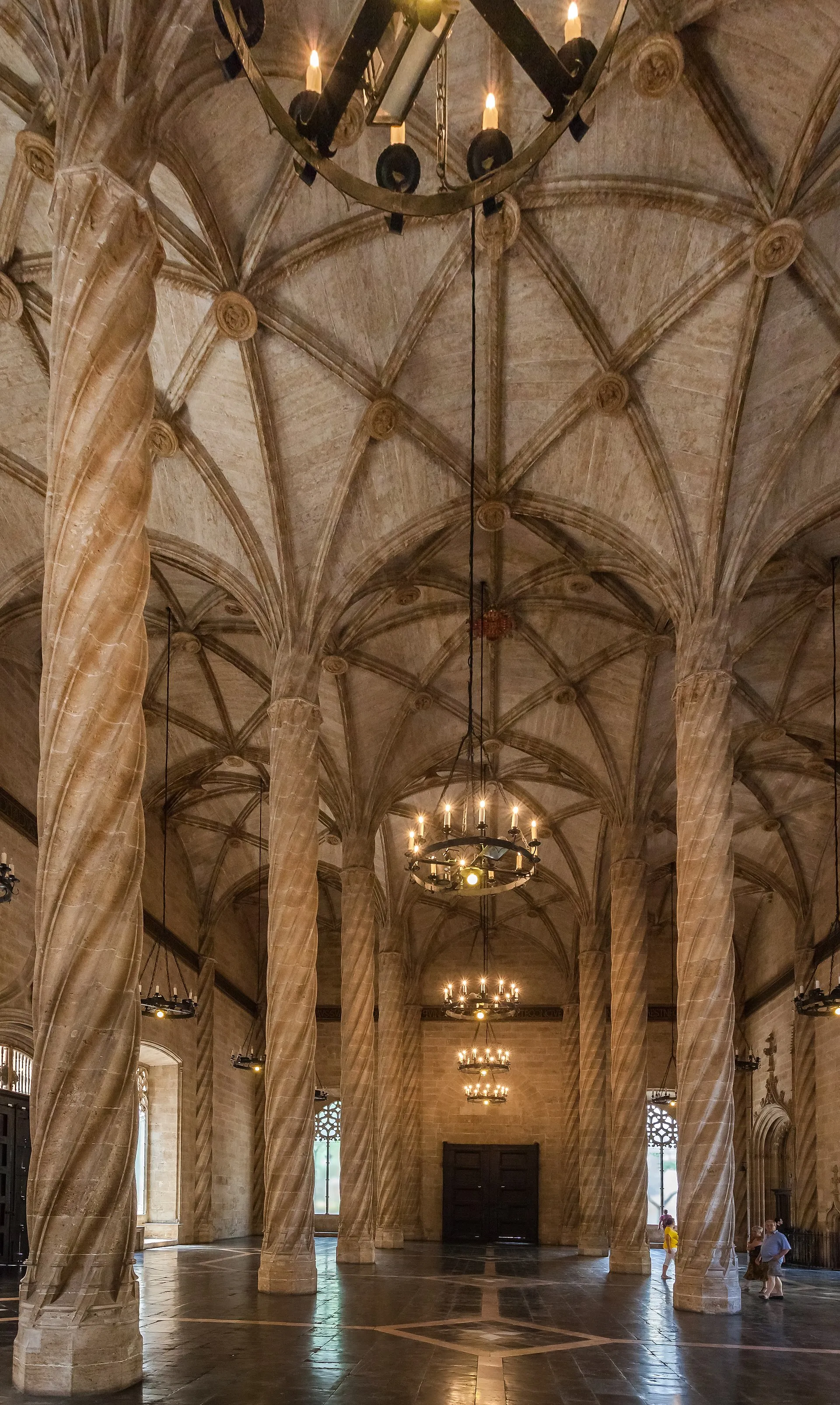
- Contract Hall — The showpiece. Eight slender helicoidal (spiral) columns and matching wall half-columns rise roughly 17 metres and fan out into ribbed star vaults that branch overhead like a petrified palm grove. The twist in each shaft is structural theatre: it draws the eye upward and dissolves the sense of load, so a hall built for hard-nosed money-changing feels like a sacred space.
- The tower — Set between hall and courtyard, it held a chapel above and served below as the lock-up for insolvent merchants. Its spiral stair, when open, delivers a rare elevated view over Plaça del Mercat and the tiled rooftops of the old town.
- Orange-tree courtyard — A quiet patio of citrus and a central fountain where traders once negotiated in the open air; the trees still fruit today and make the calmest photograph on the site.
- Consolat del Mar — The maritime tribunal wing, finished in the 1540s, whose first-floor Golden Chamber (Cambra Daurada) is crowned by a magnificent polychrome coffered ceiling, carved, gilded, and relocated here from Valencia's old town hall.
Two features reward a slow circuit. Outside, dozens of gargoyles and grotesques — demons, mythical beasts, and frankly satirical, sometimes bawdy figures — crawl across the parapets, each a carved warning against a merchant's vice. Inside, the gilded moral inscription encircling the Contract Hall (see the history above) turns the walls themselves into a manifesto.
Best photo opportunities, in order: the twisted columns shot from floor level looking straight up into the vaults; the full sweep of the nave lit by morning east light; the orange-tree courtyard framed through an arch; the coffered ceiling of the Golden Chamber; and the exterior gargoyle line along Carrer de la Llotja.
When to Visit
Monday to Saturday: 10:00 AM–7:00 PM (last entry 6:30 PM). Sundays and public holidays: 10:00 AM–2:00 PM (free entry). Closed on January 1, January 6, May 1, and December 25. Early weekday mornings offer the ideal combination of soft eastern light through the Contract Hall windows — the rising sun rakes across the twisted helicoidal columns and throws long shadows down the nave — and minimal crowds before school groups arrive. Sunday mornings draw large numbers precisely because entry is free, so paying the €2 (~$2.20) weekday rate often buys a noticeably quieter experience. Plan around 30–45 minutes for a self-guided loop of the three main spaces; a guided tour of the Contract Hall, the orange-tree courtyard, and the Consolat del Mar fills a comfortable hour. Because the whole monument is indoor and stone-cooled, it also makes an excellent midday refuge in July and August when the streets outside turn fierce.
Admission and Costs
General admission is €2 (~$2.20) per adult — exceptional value for a UNESCO World Heritage building — and free on Sundays, public holidays, and for children under 12. Beyond the ticket, guiding is where most of the budget goes:
- Self-guided visit — Just the €2 (~$2.20) entry; allow 30–45 minutes.
- Guided group tour — €10–€15 (~$11–$16) per person for a 45–60 minute session covering the Contract Hall, Consolat del Mar, and courtyard, arranged through the municipal tourist office or private operators.
- Private guide — €15–€20 (~$16–$22) per person for a small group with flexible pacing.
- Combined old-town walking tour — €25–€40 (~$27–$44) per person, typically 2–3 hours, bundling La Lonja with the Central Market and Valencia Cathedral.
Look for the official Guía Oficial de Turismo de la Comunitat Valenciana accreditation: licensed guides are the only ones permitted to lead formal tours inside the monument. A €2–€3 (~$2–$3) tip per person is standard for a group walking tour, a little more for a private guide, though never expected.
The Case for a Guide
La Lonja is small enough to walk in fifteen minutes and rich enough to reward an hour — the gap between the two is exactly what a guide fills. Because there is little on-site interpretation, an accredited Guía Oficial is the difference between admiring a pretty hall and reading a functioning medieval institution:
- Decoding the symbolism — Every exterior gargoyle caricatures a specific vice, and the gilded Latin frieze inside is a working code of trading ethics; a guide identifies them one by one rather than leaving them as scenery.
- Explaining the engineering — Why the columns twist, how the star vaults distribute their load, and why a commercial hall was built to feel like a cathedral.
- Surfacing the hidden rooms — The tower's use as a debtors' prison and the Consolat del Mar's Golden Chamber are easy to walk past without knowing what you are seeing.
- Placing it in context — Guides connect the exchange to Valencia's silk economy, the 1283 maritime tribunal, and the building's later life as barracks and grain store, so the visit reads as history rather than a photo stop.
- Sequencing the day — A local guide pairs La Lonja with the Central Market opposite and the Cathedral nearby, timing each stop against the crowds.
Tips for Visitors
A handful of practical moves make the visit far richer:
- Pair it with the Central Market. The Central Market sits directly across Plaça del Mercat — visit La Lonja first when it opens at 10 AM, then cross the square for fresh produce, horchata, and tapas.
- Chase the morning light. The east windows send dramatic shafts across the twisted columns soon after opening; a wide-angle lens (or your phone's widest setting) captures the branching vaults best from the floor, looking straight up.
- Hunt the gargoyles outside first. Circle the Plaça del Mercat and Carrer de la Llotja façades before entering — the grotesques are easy to miss once you are dazzled by the interior.
- Keep your ticket. It sometimes grants small discounts at nearby municipal museums on the same day.
- Mind the access. The ground floor — Contract Hall, courtyard, and Consolat del Mar — is step-free and wheelchair accessible; the spiral tower stair is not.
- Read the darker history. A wall placard explains the building's later use as a military barracks and grain store; the contrast with its original mercantile splendour is striking.
- Arrive on foot. The Silk Exchange is a short walk from the Àngel Guimerà metro interchange and deep inside the pedestrianised old town, so leave the car behind and fold it into a walking loop with the Cathedral and Mercat.
Frequently Asked Questions
Which season is best for visiting La Lonja de la Seda?
As a fully indoor Gothic hall, La Lonja can be appreciated in any season, though April through October lets you combine the visit with Valencia's pleasant outdoor atmosphere and the neighbouring Central Market in full swing. Sunday mornings year-round offer free entry and a quieter experience than weekday afternoons when school groups frequently visit.
When can visitors tour La Lonja de la Seda?
Monday to Saturday: 10:00 AM - 7:00 PM (last entry 6:30 PM). Sundays and holidays: 10:00 AM - 2:00 PM (free entry). Closed: January 1, January 6, May 1, December 25.
How does a guide enhance a visit to La Lonja de la Seda?
A guide turns a beautiful but silent hall into a readable document. They decode the medieval symbolism most visitors walk past — the exterior gargoyles each caricature a specific vice merchants were warned against, and the gilded Latin frieze circling the Contract Hall is a working code of trading ethics rather than decoration. A good guide also explains why the twisted columns are shaped the way they are, points out the tower once used as a debtors' prison, and connects the building to Valencia's wider silk-trade golden age.
What practical tips help when visiting La Lonja de la Seda?
Pair it with the Central Market directly across Plaça del Mercat: visit La Lonja first when it opens at 10 AM, then browse fresh produce and tapas afterwards. Come on an early weekday morning for soft eastern light on the columns and the smallest crowds, budget 30–45 minutes for a self-guided loop or an hour with a guide, and keep your ticket — it occasionally earns small discounts at nearby municipal museums the same day.