
Formation
Lake Titicaca fills a structural basin on the altiplano, the high plateau that formed as the Andes rose and buckled, trapping drainage between the Cordillera Occidental and Cordillera Oriental. Today's lake is the shrunken survivor of a chain of far larger Ice-Age lakes — geologists name them Mataro, Cabana, Ballivián, Minchín, and Tauca — that repeatedly filled and drained the basin over the past three million years as the climate swung between wet and arid.
Two bodies of water make up the lake. The larger northern basin, Lago Grande (or Chucuito), holds the deep water that plunges to 281 meters near Isla Soto; the shallow southern basin, Lago Pequeño or Wiñaymarka, averages barely ten metres deep. A narrow channel, the Strait of Tiquina, links the two — the crossing where the road to La Paz is ferried across on flat barges.
Hydrologically the lake is nearly closed. Five major river systems and countless altiplano streams feed it, but a single outflow — the Río Desaguadero — carries only a small fraction of the water south toward Bolivia's Lake Poopó. More than 90 percent of the inflow is lost to evaporation under the relentless high-altitude sun and wind, which is why the water is faintly brackish rather than fresh.
That huge, cold reservoir is also the region's thermostat. Surface temperatures hover around 10–14°C year-round, and the lake stores the day's warmth and releases it slowly at night, buffering the shoreline against the hard frosts that scour the open altiplano near Sillustani. The result is a narrow lakeside microclimate warm enough for terraced potato and quinoa farming at an altitude where little else grows.
Scientific exploration came late. In 1968 Jacques Cousteau brought a team and mini-submarines to hunt for sunken Inca gold and the lake's legendary giant frog; he found no treasure but confirmed vast populations of the endemic amphibian. In 2000 an underwater survey near the Bolivian shore revealed a submerged pre-Columbian temple and terraces of the Tiwanaku era, evidence that the lake level has risen over ground where ancient people once lived.
Trails
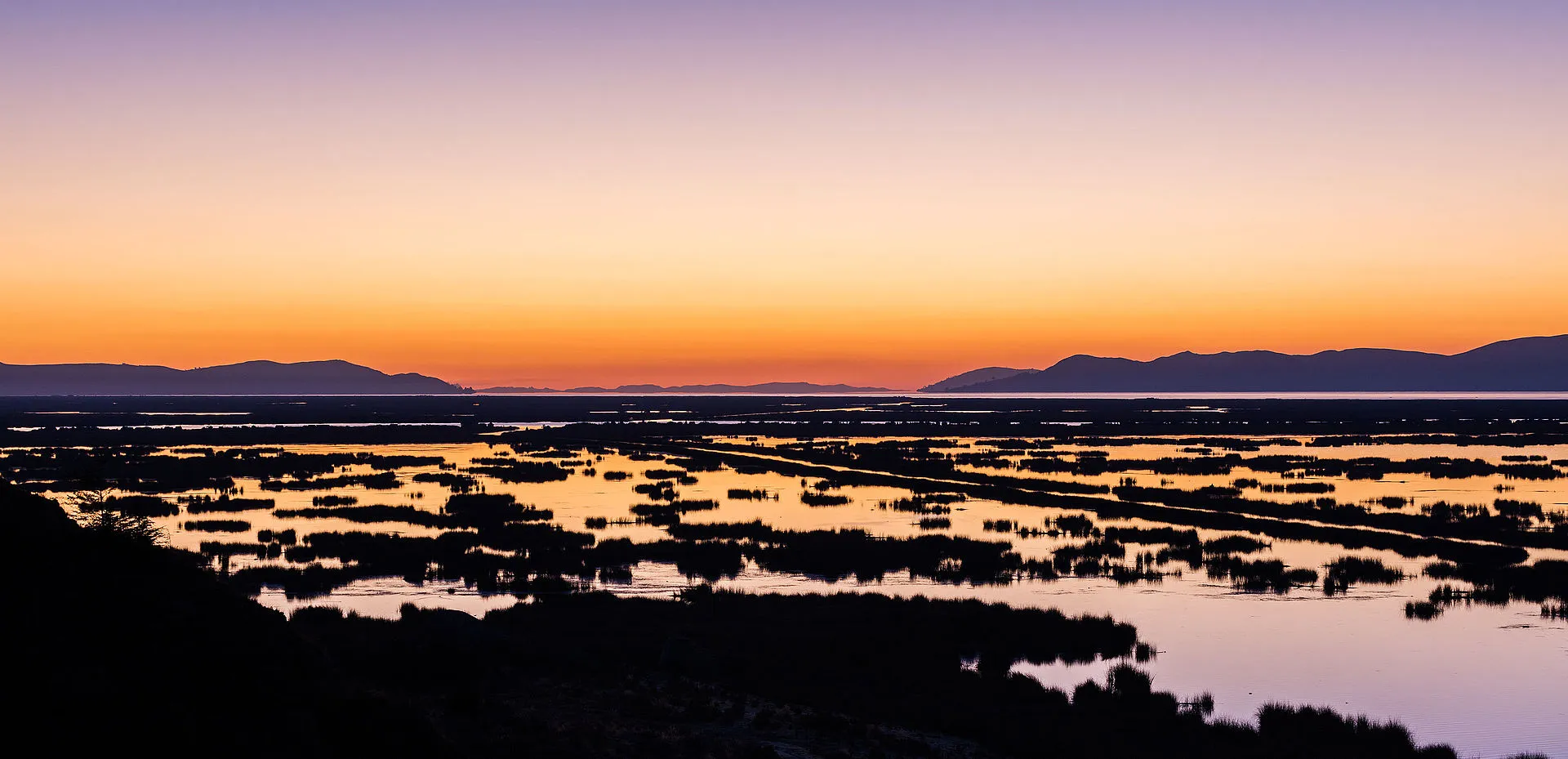
At nearly 4,000 metres the air holds so little moisture and dust that the light turns crystalline: dawn and dusk over the lake move from black through cobalt to gold in a matter of minutes, and the water can mirror the sky so perfectly that the horizon seems to vanish. It is one of the most photogenic natural settings in the Andes.
The two island communities are the set pieces. The Uros floating islands are reed platforms that compress and sway underfoot, forever rebuilt by their inhabitants; Taquile Island, with its UNESCO-listed knitting and 360-degree lake views, rises car-free above water that reaches to the Bolivian cordillera on a clear day.
After dark the reward is the sky. With zero light pollution on the islands, the Milky Way arcs overhead with an intensity few travellers ever see — reason enough on its own to stay overnight. By day, keep watch for the lake's endemic wildlife and let a guide bring alive the Inca and Aymara creation myths that were born, quite literally, on this water.
Wildlife
Lake Titicaca's high-altitude freshwater ecosystem supports species found nowhere else on Earth. The Titicaca water frog (Telmatobius culeus) — critically endangered and sometimes called the "scrotum frog" for its deeply folded skin — is the lake's most remarkable endemic species, breathing entirely through its skin in the cold, oxygen-poor water. Andean flamingos (Phoenicoparrus andinus) wade in the shallows near Puno and along the lake's marshy edges, their pink plumage startling against the deep blue water and brown altiplano.
Titicaca grebes, another endemic species, dive for fish in the open water — their numbers have declined but they remain visible on boat crossings. The totora reed beds that fringe the lake provide habitat for coots, moorhens, and Andean lapwings, while Andean gulls follow the tour boats across the open water.
On Taquile Island, the terraced hillsides support populations of Andean sparrows and rufous-collared sparrows, and the occasional Andean condor soars overhead. The drive from Puno to Sillustani passes through altiplano grasslands where herds of alpacas graze alongside wild vicuñas.
When to Visit
Island boats leave Puno's lakefront port early — most tours depart between 7 and 8 AM and return by 4–5 PM, because the lake is glassy at dawn and grows choppy as the altiplano wind rises through the afternoon. A standard full-day circuit visits the Uros floating islands first, roughly 30–40 minutes out, then continues to Taquile Island, docking back in Puno by late afternoon.
The dry season (May–October) brings the clearest skies, calmest water, and sharpest light — the best stretch for photography and island visits, with June to September the most reliable. The rainy season (November–March) turns the altiplano green and the skies dramatic, but afternoon storms can roughen the crossing or cancel late sailings.
Build in time to acclimatize before any long day on the water, and if you can, trade the rushed day trip for an overnight homestay on Taquile or Amantaní — the single best way to see the islands once the day boats have gone.
Admission and Costs
Prices on the lake are among the best value in Peru. A group half-day tour to the Uros floating islands runs S/30–60 (~$8–16) per person including the boat, while the full-day combination of Uros and Taquile costs S/60–120 (~$16–32). Hiring a private boat for the day, which buys flexibility and quieter outer islands, runs S/300–500 (~$80–135).
Overnight homestays on Taquile or Amantaní are S/30–60 (~$8–16) per person including dinner and breakfast. On top of the tour price, each community charges a small entry contribution paid directly on arrival — roughly S/10 (~$2.70) on the Uros islands and S/8 (~$2.15) on Taquile. Carry small soles in cash: there are no ATMs or card machines on any of the islands.
The Case for a Guide
Lake Titicaca rewards a guide more than most natural wonders, because almost nothing here explains itself: the reed islands, the knitted codes, and the lake's own geology all carry meaning that stays invisible without someone to translate it. A boatman alone delivers a view; a knowledgeable guide delivers the altiplano.
- Reading the living cultures: a guide bridges the Quechua and Aymara spoken on the islands, turning a rushed photo stop on the Uros islands or Taquile into a real exchange with the families who live there
- Decoding the textiles: on Taquile, the colours and patterns of a man's chullo cap announce whether he is married, single, or holds community office — a guide reads them aloud
- Explaining the engineering: why fresh totora must be laid every few weeks, and how the islands stay anchored, only makes sense when someone walks you through it
- Pacing the altitude: at 3,812 metres a good guide keeps the long boat day slow enough that the thin air never spoils it
- Linking lake and land: the best guides frame the islands against the pre-Inca tombs of Sillustani, so the Andean past and present read as one story
Tips for Visitors
Acclimatize before you sail. At 3,812 metres the altitude is no joke — spend at least a full day in Puno (and ideally arrive via Cusco or Arequipa) before committing to a long boat trip, and drink coca tea freely for the headaches. Dress in deliberate layers: the sun on the water can feel hot while the wind and shade turn bitterly cold, so pack a windproof shell, a warm hat, sunglasses, and high-factor sunscreen against the fierce high-altitude UV.
Sit near the centre of the boat if you are prone to seasickness — the lake chops up in the afternoon — and bring your own snacks and water, as food on the longer crossings is limited. Always ask before photographing Uros or Taquile residents; most are happy to pose but appreciate the courtesy.
Above all, consider staying the night. A homestay on Taquile or Amantaní trades a rushed day trip for shared meals, a working island rhythm, and a night sky of staggering clarity — the lake's quietest and most rewarding hours.
Frequently Asked Questions
When do island boats leave Puno, and how long is a day on the lake?
Most island tours depart Puno's lakefront port between 7 and 8 AM and return by 4–5 PM, timed to cross while the water is calm before the afternoon wind. A half-day trip reaches only the nearest Uros floating islands; the classic full day pairs Uros with Taquile Island and runs a long seven-to-nine hours door to door.
How much does a Lake Titicaca tour cost?
A group half-day to the Uros islands costs S/30–60 (~$8–16) per person including the boat; the full-day Uros-plus-Taquile combination runs S/60–120 (~$16–32). A private boat for the day is S/300–500 (~$80–135), and an island homestay about S/30–60 (~$8–16) with meals. Each community also collects a small cash entry contribution on arrival.
When is the best time of year to visit Lake Titicaca?
The dry season from May to October offers the clearest skies, calmest water, and most vivid high-altitude light, with June to September the most dependable stretch for photography and island crossings. The rainy season (November–March) makes the altiplano green and the skies dramatic but brings afternoon storms that can roughen the lake or cancel late sailings. Nights are cold year-round, so pack warm layers whatever the month.
How should visitors handle the altitude at Lake Titicaca?
At 3,812 metres the altitude is severe, so spend at least a full day resting in Puno — ideally after acclimatizing in Cusco or Arequipa — before a long boat day. Drink plenty of water and coca tea, go easy on alcohol, and move slowly on the spongy reed islands. If you are prone to seasickness, sit near the centre of the boat, as the lake grows choppy in the afternoon.
Can you visit the Bolivian side of Lake Titicaca from Puno?
Yes. Puno is the standard springboard for the Bolivian shore: tourist buses run the roughly three-hour route to Copacabana, crossing at the Kasani–Yunguyo border, and most continue to La Paz via the Tiquina ferry. From Copacabana, boats reach the Island of the Sun, the mythological birthplace of the first Inca. Carry your passport and a little cash in both soles and bolivianos, and check your nationality's visa rules before travelling.