
Spiritual Significance
Siena Cathedral is dedicated to the Assumption of the Virgin Mary, and the Sienese developed an unusually intimate bond with the Virgin as their city's protector. Before the 1260 Battle of Montaperti against Florence — a battle Siena had little rational hope of winning — the city's leaders formally surrendered Siena to the Virgin in the cathedral, offering her the keys to the city gates; the victory that followed was read as miraculous intercession and made Mary the Patrona of Siena in a way that went far beyond civic symbolism. Because the banded marble reproduces Siena's own heraldic colours, the building is a visual fusion of civic pride and religious devotion in which the two are indistinguishable. The 56 floor panels work as both a devotional carpet and a theological argument, moving from the pagan sibyls who were believed to have foretold Christ, through Old Testament history, toward Christian salvation — so that walking the uncovered nave is a walk through the whole arc of sacred history. The unfinished Facciatone, the stump of the abandoned 1339 plan to build the largest cathedral in Christendom and halted by the Black Death of 1348, stands as a lasting reminder of human ambition meeting its limits — a lesson the Sienese chose to preserve by leaving the fragment standing.
Visitor Etiquette
This is a working cathedral as well as a museum, so dress and behave accordingly. Shoulders and knees must be covered — the rule is enforced strictly at the entrance, and a scarf or light layer is the easiest insurance in summer. Arrive early or pre-book a timed slot, as crowds build quickly, especially during the floor-uncovering weeks (roughly August–October). Photography without flash is generally permitted, but never during services, and tripods and selfie sticks are discouraged in the crowded nave. Keep your voice low and silence your phone, particularly near the Chigi Chapel, where the faithful still pray before the Madonna del Voto. When the marble floor is uncovered, follow the marked walkways and never step on the panels. Any multi-site OPA SI Pass offers real savings if you plan to see the Baptistery, Crypt and museum as well.
Siena Cathedral (Duomo di Siena) timeline
-
Opera di Santa Maria formed
The cathedral works office — still running the Duomo today as the Opera della Metropolitana — is organised to oversee construction of the present church on the city's highest point.
- 1215–1263
Romanesque-Gothic cathedral built
The main body rises in banded marble and the high altar is consecrated; the hexagonal dome and much of the nave date from this campaign.
- 1265–1268
Pisano pulpit carved
Nicola Pisano, with Giovanni Pisano and Arnolfo di Cambio, completes the octagonal marble pulpit, a landmark of Italian Gothic sculpture.
- 1284–1297
Giovanni Pisano's lower façade
Giovanni Pisano designs the sculpture-rich lower façade, populating it with prophets, philosophers and sibyls (the originals are now in the Museo dell'Opera).
-
Duomo Nuovo begun
Siena starts the vast "New Cathedral" meant to make the existing Duomo a mere transept of the largest church in Christendom.
-
Black Death halts expansion
Plague and structural failures end the Duomo Nuovo for good, leaving the Facciatone standing unfinished as a permanent civic memento.
- 1502–1507
Piccolomini Library frescoed
Pinturicchio paints ten luminous scenes from the life of the humanist pope Pius II for Cardinal Francesco Piccolomini, later Pius III.
- 1659–1662
Bernini's Chigi Chapel
For the Sienese pope Alexander VII, Gian Lorenzo Bernini designs the Baroque Cappella del Voto with his statues of St Jerome and Mary Magdalene.
When to Visit
Hours are timed, ticketed and seasonal, so confirm the day on operaduomo.siena.it before you go. The usual pattern is Monday–Saturday from about 10:30 AM to 7 PM in high season (closing earlier, nearer 5:30–6 PM, in winter) and Sundays and holy days only from around 1:30 PM, since the mornings are reserved for Mass. The Piccolomini Library keeps the same hours as the cathedral, and sightseeing is suspended during services. The floor is uncovered only during the annual "pavimento scoperto" weeks — in recent years spread across late June–July and mid-August–October — when a combined ticket and a timed slot are strongly advised because queues build fast on the piazza.
Admission and Costs
Prices are set annually by the Opera della Metropolitana; check operaduomo.siena.it for the current rates, but as a guide the cathedral-and-library Acropoli / OPA SI Pass runs around €16 (about $17), and the all-inclusive pass adding the Baptistery, Crypt, Museo dell'Opera and Facciatone runs around €21 (about $23). During the floor-uncovering weeks a surcharge applies and the combined ticket rises to roughly €25 (about $27). The separate guided Porta del Cielo rooftop walk costs about €20 (about $22) on top. A small-group guided tour is typically €40–60 (about $43–65) per person for 1.5–2 hours; a private guide for up to six runs €150–250 (about $162–270). Buying any multi-site pass online saves both money and queueing time.
The Case for a Guide
The Duomo can be admired on your own, but far more of it becomes legible with a knowledgeable Siena guide, because its greatest treasures carry meaning that is invisible without context.
- Reading the floor as a programme: A guide walks you through the 56 panels in sequence, explaining how the sibyls, the Slaughter of the Innocents and Beccafumi's shaded presbytery scenes build a single argument from pagan prophecy to Christian revelation
- Spotting the masterpieces: Which four saints on the Piccolomini Altar are the young Michelangelo's, where Donatello's bronze hides, and how to tell Nicola Pisano's Gothic pulpit from Bernini's Baroque chapel
- Decoding the Piccolomini Library: Pinturicchio's ten frescoes narrate the life of a Renaissance pope that means little without the story of Enea Silvio Piccolomini
- Understanding the Facciatone: Standing before the unfinished wall, a guide explains the audacious 1339 plan and why the 1348 plague stopped it forever
- Civic and sacred together: A guide connects the balzana stripes, the Montaperti vow to the Virgin, and the cathedral's role in Sienese identity
Tips for Visitors
The 56 marble floor panels are the cathedral's single greatest treasure, so if your dates are flexible, plan your visit for the annual uncovering (recently late summer into October) and confirm the window on operaduomo.siena.it. Allow 1.5–2 hours for the full complex, more if you add the Porta del Cielo rooftop walk. Buy a multi-site OPA SI Pass online to skip the piazza queue, and climb the Facciatone for a view that rivals any tower in Tuscany — looking straight across to the Duomo's striped dome. Morning light flatters the façade sculpture; the interior is calmest just after opening. When you are done, walk downhill to Piazza del Campo and the Palazzo Pubblico for a full Siena day.
Frequently Asked Questions
When is Siena Cathedral's marble floor uncovered, and is it worth timing a visit around?
The cathedral's single most extraordinary feature — the 56 inlaid marble floor panels that carpet the nave, transepts and presbytery — spends most of the year hidden beneath protective hardboard, because the soft marble wears under foot traffic. The Opera della Metropolitana (the eight-century-old works office that still runs the Duomo) lifts those covers only for a limited "pavimento scoperto" window, which in recent years has fallen across late summer and autumn — roughly late June through late July and again from mid-August into October — though the exact dates are set annually and published on the official operaduomo.siena.it calendar, so confirm before you book. When the floor is bare the visit changes character completely: you walk across six centuries of Sienese draughtsmanship, from the she-wolf emblem at the entrance to Domenico Beccafumi's shaded presbytery scenes, and a ticket surcharge applies. If your trip is flexible, timing it to the uncovering is the single best decision you can make; if it is not, the Pisano pulpit, Piccolomini Library and the art of the side chapels still make the Duomo one of Tuscany's finest interiors year-round.
What are Siena Cathedral's opening hours?
Visiting hours are shaped by the liturgical calendar and shift with the season, so always check operaduomo.siena.it for the current day, but the usual pattern is Monday to Saturday from about 10:30 AM to 7 PM in high season (shorter, closing nearer 5:30–6 PM, in winter) and Sundays and holy days only from around 1:30 PM, because the mornings are reserved for Mass. The Piccolomini Library keeps the same hours as the cathedral. Sightseeing is suspended during services. Because entry is timed and ticketed rather than free walk-in — unusual for an Italian church — you should book a slot online in high season and during the floor-uncovering weeks, when queues on the piazza build quickly.
Which famous artists worked on Siena Cathedral?
Few churches anywhere pack in so many first-rank names across so many centuries. Nicola Pisano, helped by his son Giovanni Pisano and the young Arnolfo di Cambio, carved the octagonal marble pulpit (1265–1268), a dense relief sermon that is one of the masterpieces of Italian Gothic sculpture. Duccio di Buoninsegna designed the great round stained-glass oculus (1287–1288), among the oldest surviving Italian stained glass (the original now hangs in the adjacent Museo dell'Opera). Donatello contributed a bronze St John the Baptist and the floor tomb-slab of Bishop Giovanni Pecci; Michelangelo carved four early statues of saints for the Piccolomini Altar (1501–1504); Pinturicchio frescoed the Piccolomini Library (1502–1507); and Gian Lorenzo Bernini designed the Baroque Chigi Chapel (the Cappella del Voto) with his statues of St Jerome and Mary Magdalene (1659–1662) for the Sienese pope Alexander VII. Dozens more artists — over forty across six centuries — designed the marble floor.
Why is Siena Cathedral striped black and white?
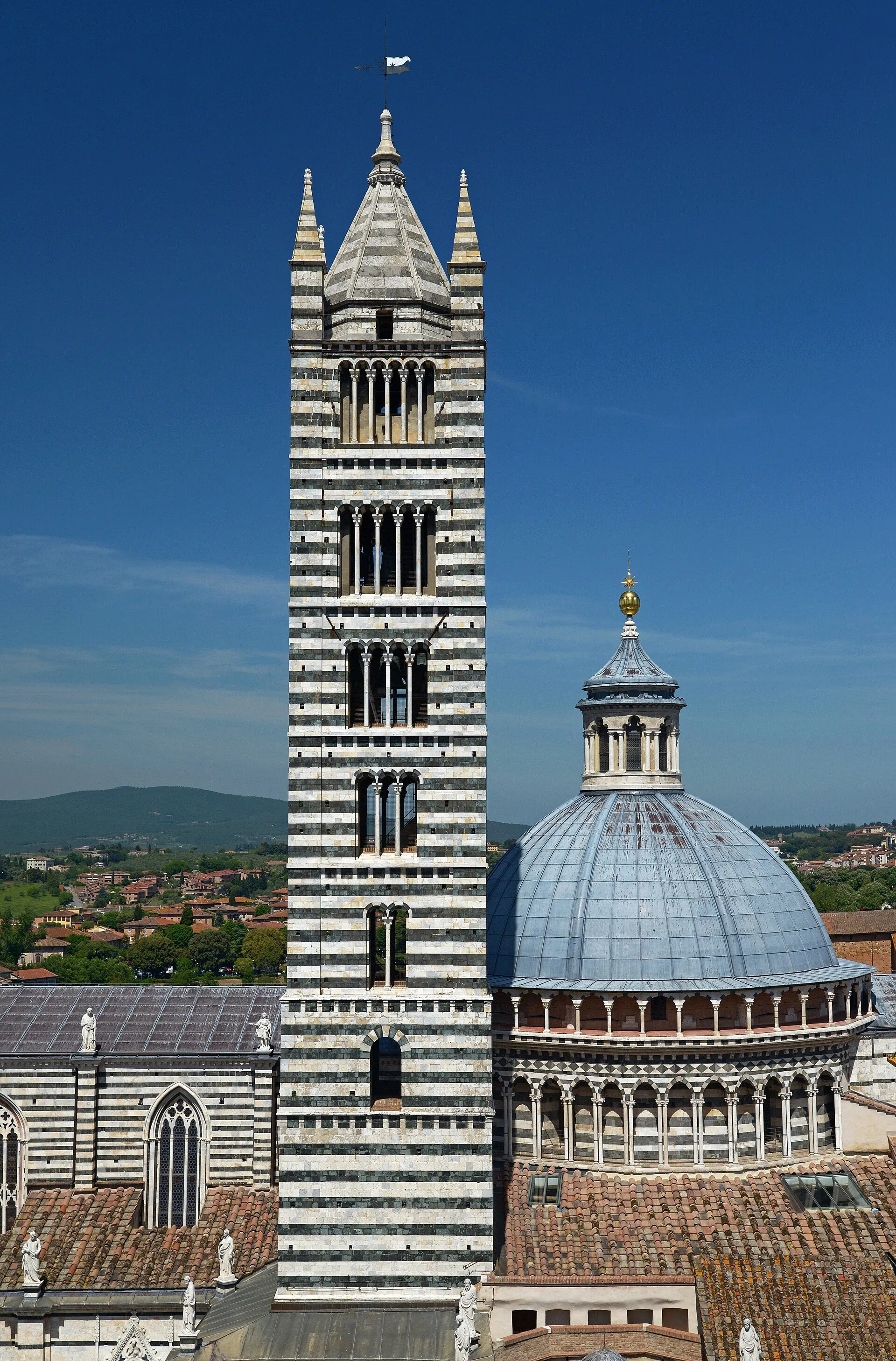
The dramatic horizontal banding of dark greenish-black and white marble is not decoration for its own sake — it reproduces the balzana, the black-and-white heraldic shield of the city of Siena itself, so the entire building reads as a civic as well as a religious monument. Sienese legend ties the colours to the black and white smoke sent up by the horses of the city's mythical founders, Senius and Aschius, sons of Remus; the practical truth is that striped marble façades were a broader Tuscan–Pisan Romanesque fashion that Siena adopted and pushed to an unusually theatrical extreme, inside and out. The stripes run around the piers of the nave and up the campanile, giving the interior its hypnotic, almost dizzying rhythm.
What is the Facciatone, and can you climb it?
The Facciatone ("big façade") is the most eloquent ruin in Siena: the surviving wall of the Duomo Nuovo, the "New Cathedral" that the city began building in 1339 with the breathtaking aim of turning the existing Duomo into merely the transept of what would have been the largest church in Christendom, outdoing even Florence. The Black Death of 1348 wiped out much of the labour force and capital, structural cracks appeared in the hastily raised masonry, and the project was abandoned — leaving the enormous unfinished façade standing as a monument to civic over-reach. Today you can climb a tight internal staircase (accessed through the Museo dell'Opera) to the narrow walkway along its top, the Panorama dal Facciatone, for one of the finest rooftop views in Tuscany, looking straight across to the Duomo's striped dome and campanile and out over the medieval rooftops.
Is a guided tour of Siena Cathedral worth booking?
For the Duomo more than for most churches, yes — because so much of what makes it extraordinary is legible only with context. The 56 floor panels form a single theological programme, moving from pagan sibyls through Old Testament history toward Christian revelation, and without a guide most visitors simply admire the craftsmanship and miss the argument. A guide also decodes Pinturicchio's ten narrative scenes in the Piccolomini Library (the life of the humanist pope Pius II), points out which saints on the Piccolomini Altar are the young Michelangelo's, and separates Nicola Pisano's Gothic pulpit from Bernini's Baroque chapel. Expect roughly €40–60 (about $43–65) per person for a small-group guided visit of 1.5–2 hours, or €150–250 (about $162–270) for a private guide for up to six, often bundled with Piazza del Campo and the Palazzo Pubblico.